After weeks of long shifts and weekend duties, I finally got a well-deserved pause—and so did my fiancé. As many of you know, I’ve been working extra weekends not only for the enhancements (which are definitely helpful) but because weekends at work tend to be calmer. Still, it’s important to make space for life outside the hospital walls.
We try our best to take a trip together once a month. Last time it was Leicester (I promise I’ll write about that soon—one day, I swear 😂), and this time we decided to explore the charming town of Shrewsbury.
Here’s a little secret: travel doesn’t always mean crossing countries or emptying your savings. Sometimes, it just means hopping over to the nearest town and letting it surprise you. And Shrewsbury? It absolutely did.

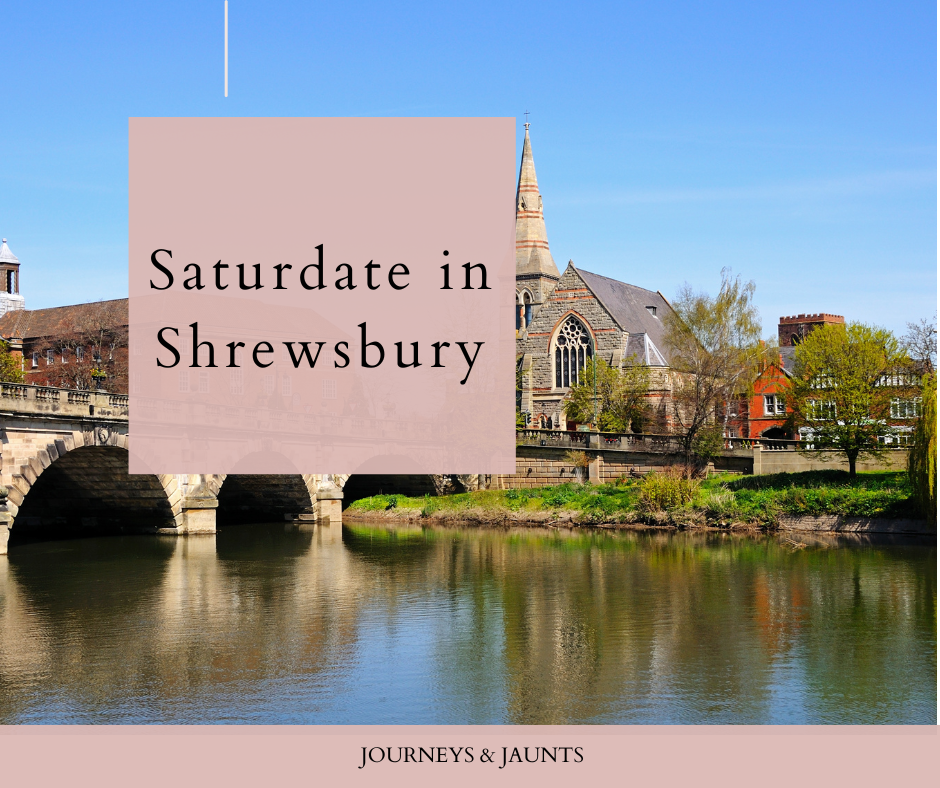
Shrewsbury turned out to be a particularly good choice. It’s a town of medieval streets, half-timbered buildings, old churches, independent shops and beautiful riverside scenery, with the River Severn curling around much of its historic centre. The architecture alone was enough to interest me. I have a weakness for buildings that look as though they’ve lived through several centuries of gossip, political disagreements and changes in fashion without feeling obliged to explain themselves.

We started with St Mary’s Church, which immediately made me feel that Shrewsbury understood my priorities. Some people begin a date by visiting a trendy café or booking a restaurant. Apparently, my ideal romantic outing can involve standing beneath a medieval church roof while admiring stained glass. Fortunately, Jan seemed willing to entertain the arrangement.
St Mary’s is one of the most beautiful churches I’ve visited in an English town. Its tall spire dominates the skyline, but I was especially interested in what waited inside. The soaring stone arches, carved details, colourful stained glass and decorative floor tiles made the building feel like a collection of different artistic traditions gathered in one space. It was the kind of architecture that encourages visitors to look upwards, then continue looking because there’s always another detail worth examining.
The church has roots reaching back to Saxon times, and its surviving medieval architecture tells a much longer story than a single historical period. One of its greatest treasures is the extraordinary medieval Jesse Window, which depicts the ancestry of Christ through richly coloured glass. The church also contains stained glass from different parts of Europe, along with remarkable woodwork and monuments.
What fascinated me was the amount of care invested in things that could easily have been designed more simply. A doorway didn’t need such beautiful stonework to function as an entrance, and windows didn’t require elaborate scenes to allow sunlight into a building. Yet people had spent enormous amounts of skill and effort creating these details, and centuries later, visitors like me were still standing there admiring them. I love that. It suggests that beauty has always been considered worth making room for, even when practicality might have offered an easier alternative.
Old churches also have a particular atmosphere that I find comforting. They carry the traces of generations of people who came through their doors with entirely different circumstances. Some arrived to celebrate, others to grieve, pray, reflect or simply find a few moments of quiet. The building remains, even as the people and their stories change. As someone who has spent years working in healthcare, where ordinary days can become unexpectedly significant, I find that continuity especially moving.


Of course, I also took photographs, because apparently silent admiration is not sufficient evidence that I’ve appreciated a beautiful church properly. I can spend a respectable amount of time examining a stained-glass window, then decide it needs to be photographed from another angle. Jan has long since become familiar with this behaviour. He probably understands that my statement, “Just one more photo,” should be treated as an expression of hope rather than a reliable prediction.
From centuries-old stonework, we moved to something rather more leisurely: a river cruise.

We boarded Sabrina at Victoria Quay for a journey along the River Severn, and almost immediately I decided this was an excellent use of our Saturday. There is something wonderfully pleasant about being on a boat when you have no particular responsibility beyond sitting down, enjoying the scenery and listening to somebody else explain where you’re going. I spend enough time making decisions during working hours. Being transported along a river while a knowledgeable guide takes care of the commentary seemed like a very reasonable alternative.
The cruise lasted approximately forty-five minutes to an hour during our visit, carrying us along the river past the town’s historic scenery. We travelled towards the English Bridge before returning towards the Welsh Bridge and our departure point. Seeing Shrewsbury from the water gave it an entirely different character. Buildings that had seemed impressive from the street became part of a broader landscape, with greenery, bridges and the riverbanks creating a lovely backdrop.


The commentary was one of the highlights. Our guide had an entertaining way of presenting local information, combining history with humour rather than making us feel as though we’d accidentally enrolled in a compulsory educational seminar. I enjoy learning about places, but I particularly appreciate somebody who can tell a good story without draining the life out of it. There is a skill in making history accessible and funny while still respecting the facts, and our guide seemed to understand that very well.

I remember laughing, enjoying the breeze and looking at the town from a perspective we’d never have discovered simply by wandering through its streets. There is also something amusing about the idea that taking a seat on a boat can qualify as sightseeing. We’d already walked around enough to justify a break, and suddenly there we were, being transported towards our next lovely view without having to do any of the work ourselves. It was efficient, scenic and suspiciously relaxing. I approve of this approach to tourism.
One of the things I liked most about the river journey was how it encouraged us to pay attention to the town as a whole. On foot, it’s easy to become absorbed in individual attractions: a beautiful doorway, a shop window or an interesting building. From the boat, those details form part of a larger picture. Shrewsbury’s bridges, buildings and riverside greenery made much more sense together. The River Severn isn’t simply a scenic feature added for visitors. It has helped shape the town and the way its streets developed.


After our boat adventure, we returned to exploring on foot and found ourselves at St Chad’s Church. If St Mary’s had impressed me through its tall spire and medieval details, St Chad’s offered something quite different. The church has an unusual circular design, making it stand out from the more traditional church buildings I was accustomed to seeing.
I was immediately fascinated. The central space felt distinctive, and the architecture invited a different kind of observation. I enjoy visiting churches partly because their designs reveal how people have interpreted sacred spaces across different centuries. Some rely on height and grandeur, others on symmetry, decoration or the arrangement of natural light. St Chad’s appeared to have decided that ordinary rectangular expectations weren’t particularly important.
The church also has a connection with Charles Darwin, who was born in Shrewsbury in 1809 and baptised there. I found that interesting because so much of Darwin’s later work would become associated with scientific explanations of the natural world. Here was a church connected to the childhood of someone whose ideas would eventually influence generations of scientific discussion. History has a wonderful habit of placing people and institutions into the same story in ways that become far more interesting when viewed retrospectively.


Near St Chad’s, we found one of my favourite places of the day: The Quarry.
The Quarry is a beautiful riverside park, with broad green spaces, walking paths, mature trees and the celebrated Dingle flower garden. I love finding green places within historic towns. Shrewsbury already had enough beautiful architecture to keep me entertained, but the park provided something different: an opportunity to spend time outdoors without needing to follow a particular attraction or examine an information board.
The Dingle was especially lovely. Its carefully arranged flowerbeds and colourful planting gave the garden an almost storybook quality, while the surrounding greenery made it feel wonderfully peaceful. I have always enjoyed gardens, although my appreciation of flowers is considerably more developed than my ability to remember every plant’s name. I can recognise beauty with great enthusiasm while remaining entirely uncertain about the correct botanical terminology. Fortunately, flowers don’t seem to require visitors to pass an identification test before admiring them.
Walking through the gardens reminded me how little a pleasant afternoon sometimes needs. There was sunlight, greenery, fresh air and Jan beside me. We weren’t rushing to finish a checklist, and nobody was expecting us to complete a particular number of activities before returning home. After several weekends occupied by nursing duties, that freedom felt particularly enjoyable.
At work, my time is often divided according to tasks, responsibilities and what needs attention next. Even when things are relatively calm, there’s always an awareness that circumstances can change quickly. In the park, however, the biggest immediate decision was which direction looked more attractive for a walk. I found that delightfully manageable.
The flowers were making a strong argument for repeated photography, and I was doing very little to resist. The Quarry is the kind of place where you can admire a garden, sit beside the river or simply watch people enjoying their own afternoon. It doesn’t demand that you do anything impressive. I suspect that’s one of the reasons public parks are so valuable. They provide somewhere to exist without needing to make a purchase or justify your presence through productivity.


Eventually, hunger became a more urgent consideration than architectural appreciation or horticultural curiosity. This happens surprisingly often during our travels. I begin the day thinking about history and scenery, and by lunchtime my priorities have been thoroughly reorganised by my stomach.
We chose Umai, a Japanese restaurant, and enjoyed sushi and sashimi. I don’t believe every travel meal requires an elaborate culinary review, but I do believe good food deserves recognition when it arrives at the right moment. We’d spent the day wandering through churches, gardens and historic streets, so sitting down to a satisfying meal felt entirely appropriate.
I particularly enjoy the way travelling can make ordinary food stops more memorable. You might visit a restaurant because you’re hungry, enjoy something delicious and move on, but years later the meal becomes attached to memories of the town. You remember the atmosphere, the conversation and the pleasant relief of sitting down after walking for hours. Suddenly, a lunch that wasn’t intended to be a significant event becomes part of the story.


Shrewsbury still had more surprises waiting for us, particularly in its independent shops. As we wandered through the historic centre, I became increasingly distracted by the town’s mixture of old buildings and interesting shopfronts. Half-timbered façades, narrow streets and architectural details seemed to appear around every corner. It felt rather like walking through a town that had collected several centuries of buildings without feeling the need to make them all match.
I love places like that. A street becomes more interesting when it contains evidence of different generations, especially when old architecture continues to accommodate ordinary modern life. A beautiful timber-framed building might contain a shop or business, while a doorway that looks as though it belongs in a historical drama turns out to lead somewhere perfectly practical. It makes the town feel lived in rather than preserved purely for tourists.
We found the Shrewsbury Antiques Centre, which was an immediate threat to my ability to maintain a reasonable itinerary. Antiques shops fascinate me because they’re filled with objects that have already belonged to other people’s lives. Old books, vintage brass pieces, furniture and miscellaneous treasures sit together, waiting for somebody new to recognise their appeal.
There is something wonderfully unpredictable about browsing antiques. Unlike an ordinary shop where products have been arranged according to their expected purpose, an antiques centre invites curiosity. You might begin examining an old decorative object and suddenly notice a book whose cover interests you. Then another shelf catches your attention, and before long you’ve completely forgotten why you entered the building in the first place.
I have always liked second-hand objects because they carry a sense of history without necessarily revealing the whole story. An old book might have belonged to someone who read it on a train, kept it beside their bed or received it as a gift. A piece of furniture may have stood in several homes before arriving in a shop. Those details usually remain unknown, but I like imagining the ordinary lives connected to them.


At The Parade, another of Shrewsbury’s charming shopping spots, I found Second Chapter Books, an independent bookshop that immediately appealed to my weakness for shelves of old stories. Bookshops have a dangerous effect on me. I can enter with the firm intention of browsing and somehow persuade myself that leaving without a purchase would represent a missed literary opportunity.


I enjoy second-hand bookshops in particular because the selection is less predictable. You might discover an older edition of a favourite novel, a book you’ve never heard of or something you wouldn’t ordinarily have considered reading. There is also the pleasure of finding a title at a reasonable price, which helps create the impression that buying another book is an act of admirable financial responsibility. This argument is especially effective when I choose not to examine how many unread books are already waiting at home.
I also found a little Japanese shop and bought myself a new pair of chopsticks. It wasn’t a grand souvenir, and I certainly hadn’t travelled to Shrewsbury with the specific intention of expanding our household’s chopstick collection. But I liked them, and they made me happy. I have learned that small purchases can become lovely reminders of ordinary days. Not every travel souvenir needs to be expensive or impressive enough to occupy a display cabinet.


The chopsticks were practical, the book was delightful, and I was beginning to think that Shrewsbury had understood me rather well.
By this stage, we’d covered a respectable amount of ground. There had been two churches, a river cruise, gardens, Japanese food, old buildings, antiques and a bookshop. We could easily have finished the day by heading home, satisfied that we’d made excellent use of our Saturday.
But my favourite memory came towards the end, when we finally stopped doing things.
We found somewhere peaceful beside the River Severn, sat down with ice cream and allowed the afternoon to settle around us. I had my second-hand book, Jan was beside me, and for once there was absolutely no reason to move towards the next attraction. We weren’t checking opening times or wondering what else we might fit into the day. We’d already seen plenty, and the remaining hours were ours to enjoy.
I remember that little scene more clearly than many of the grander details. There was something lovely about sitting together after a full day of wandering, enjoying ice cream and allowing the world to carry on around us. It wasn’t a particularly dramatic moment. Nobody was making an announcement, there wasn’t an important milestone to celebrate, and we weren’t standing beneath a famous landmark. We were simply two people enjoying a Saturday together.
Perhaps it stayed with me because I knew how easily an ordinary weekend could disappear into work and responsibilities. Nursing shifts, household tasks and the general organisation of adult life have a way of making personal time feel like something that must be carefully negotiated. Even when you’re off duty, there’s usually something useful waiting to be done. You can fill an entire day with necessary errands and reach the evening without feeling that you’ve actually had time to enjoy it.
Sitting beside the river, I wasn’t particularly interested in being useful. The book didn’t need to be finished, the ice cream didn’t need reviewing and our afternoon didn’t require another destination. Jan and I could simply sit there and enjoy the company and surroundings. It was a small pleasure, but one that felt much more significant after the busy weeks preceding it.
I think that’s one of the things travelling has taught me about relationships. It’s lovely to share major occasions, celebrations and elaborate holidays, but ordinary time together matters just as much. A casual walk, a meal, an unexpectedly interesting shop or an afternoon beside a river can become part of a relationship’s history without ever appearing on a calendar as a special event.
We didn’t need a grand romantic gesture to make that Saturday memorable. There were no elaborate surprises or expensive arrangements. We chose a nearby town, explored things that interested us and spent a day enjoying each other’s company. Some activities were historical, some were cultural, some involved food, and a surprising number required me to take photographs of buildings that had been standing perfectly well without my assistance for centuries.
I’ve learned that making time for the people and experiences that matter doesn’t always require a grand plan; sometimes it simply means refusing to let an ordinary Saturday disappear into another list of responsibilities. Shrewsbury gave us that opportunity, and I appreciated it more than I might have done during a quieter period of life.
Looking through the photographs afterwards, I realised how much variety we’d managed to find without travelling particularly far. There were the magnificent windows of St Mary’s, the round architecture of St Chad’s, the view from Sabrina, flowers in The Dingle, beautiful old streets, sushi, second-hand books and the small things we’d brought home.
Yet the photograph I would most like to preserve isn’t necessarily the most impressive one. It would be that ordinary ending: ice cream, a book and Jan beside me, with nothing urgent demanding our attention.
I’ve become more convinced that the best days don’t always announce their significance while they’re happening. Sometimes they seem perfectly ordinary until enough time has passed for us to recognise how enjoyable they were. The places we visited are worth remembering, but so are the conversations between them, the laughter during the boat tour and the pleasure of simply being somewhere different together.
Would I return to Shrewsbury? Certainly. There are still historic streets I’d like to explore, little shops that might tempt me into another unnecessary book purchase and enough riverside scenery to justify another leisurely afternoon. I’d happily revisit St Mary’s, return to The Quarry when the flowers are in bloom and perhaps enjoy another cruise aboard Sabrina.


Next time, I might even arrive with a more carefully planned itinerary. Although I’m not convinced that would improve the experience. Some of the nicest parts of our day happened because we allowed ourselves to wander rather than treating the town as a collection of attractions that needed to be completed.
Shrewsbury was charming, historic, surprisingly peaceful and excellent at distracting me with old buildings and second-hand books. It also reminded me that a few hours away from routine can make an ordinary weekend feel like a small holiday.
And after weeks of working weekends, that was precisely what I needed.
Until the next Anjventure,
Anj,
off duty and among old books.

Planning a Day Trip to Shrewsbury? My Practical Visitor Guide
Shrewsbury is a historic market town in Shropshire, known for its medieval streets, half-timbered buildings, churches, independent shops and riverside scenery. Much of the town centre can be explored on foot, making it a good choice for a day trip from the West Midlands or other nearby regions.
For a first visit, I’d recommend combining one or two historic attractions with time to explore The Quarry and enjoy the town’s independent shops. A Sabrina river cruise is an excellent seasonal option if you want to see Shrewsbury from the water. Remember that the cruise operates on a limited seasonal schedule, so check availability before travelling.
Shrewsbury at a Glance
| Travel detail | Visitor information |
|---|---|
| Destination | Shrewsbury, Shropshire, England |
| Our visit | A Saturday outing in 2022 |
| Best for | Historic architecture, riverside walks, gardens, antiques and independent shops |
| My highlights | St Mary’s Church, Sabrina Boat, St Chad’s, The Quarry and The Dingle |
| Food stop from our visit | Umai Japanese restaurant |
| Shopping memories | Shrewsbury Antiques Centre, Second Chapter Books and The Parade |
| Suggested duration | One full day |
| Main railway station | Shrewsbury |
| Getting around | Walking; local transport for destinations farther away |
| Best planning advice | Leave time for the shops and a relaxed riverside break |
Things to See and Do in Shrewsbury
| Attraction | Why visit | Visitor information |
|---|---|---|
| St Mary’s Church | Medieval architecture and exceptional stained glass | Free to enter; donations welcomed |
| Sabrina Boat | Scenic River Severn sightseeing cruise | Paid; operates March–October |
| St Chad’s Church | Distinctive circular architecture and Charles Darwin connection | Check church access arrangements |
| The Quarry | Riverside walks, green spaces and gardens | Free |
| The Dingle | Seasonal floral displays within The Quarry | Free |
| Shrewsbury historic centre | Timber-framed buildings, independent shops and old streets | Free to explore |
| Shrewsbury Museum & Art Gallery | Local history, archaeology, art and exhibitions | Free general admission |
| Shrewsbury Castle | Historic castle and Shropshire regimental heritage | Check current museum access and opening |
Shrewsbury Museum & Art Gallery and Shrewsbury Castle are additional visitor suggestions, not places I’m claiming we visited during our original Saturday outing.
Sabrina Boat: What to Know Before Booking
Sabrina operates sightseeing cruises along the River Severn from Victoria Quay, near the Welsh Bridge.
The operator’s current published season runs from 1 March to 31 October, with regular sightseeing departures generally between 11 am and 4 pm. The standard cruise takes approximately 45 minutes, with commentary about Shrewsbury and its riverside landmarks.
The boat company also offers selected themed cruises and private experiences, but these have separate arrangements. Prices, timetables and availability should be checked directly before travelling.
Official website: Sabrina Boat.
St Mary’s Church
St Mary’s Church is one of the finest historic buildings in central Shrewsbury. Its famous stained glass includes the medieval Jesse Window, and the church also contains carved woodwork, Norman and Gothic architecture, and beautiful Victorian floor tiles.
The Churches Conservation Trust lists regular visitor opening hours as Monday to Saturday, 10 am to 4 pm, subject to volunteer availability and special circumstances.
Official website: St Mary’s Church, Shrewsbury.
The Quarry and The Dingle
The Quarry is Shrewsbury’s principal riverside park, covering approximately 29 acres beside the River Severn. It is free to visit and generally accessible throughout the year.
The Dingle is a beautiful sunken garden within the park, known for its seasonal flowers and landscaped beds. It is particularly lovely during spring and summer, although the park can be enjoyed in other seasons too.
Official information: Shrewsbury Town Council — The Quarry.
A Suggested One-Day Shrewsbury Itinerary
| Time | Suggested activity | Why visit |
|---|---|---|
| 10:00 am | Arrive and visit St Mary’s Church | Historic architecture and stained glass |
| 11:00 am | Explore the medieval streets and independent shops | Old buildings, books and antiques |
| 12:00 pm | Lunch in the town centre | Enjoy a relaxed food stop |
| 1:00 pm | Take a Sabrina river cruise, when operating | See Shrewsbury from the Severn |
| 2:15 pm | Visit St Chad’s Church | Discover its circular design |
| 3:00 pm | Explore The Quarry and The Dingle | Flowers, greenery and riverside walking |
| Late afternoon | Ice cream, a book or a café stop | Finish without rushing |
This is a recommended itinerary for readers rather than the exact timeline of our day. Adjust it according to cruise availability, attraction opening hours and how much time you’d like to spend browsing.
How to Get to Shrewsbury
Shrewsbury railway station provides connections to the West Midlands, Wales and surrounding parts of England. Visitors travelling from Wolverhampton can check train routes and current schedules through National Rail or Transport for Wales.
Much of the historic town centre is within walking distance of the station, including St Mary’s Church, The Square and the shopping streets. The Quarry is farther towards the river but still accessible on foot from the centre.
If you’re driving, consult Shropshire Council’s parking guidance and consider Park and Ride when appropriate. Central streets can be narrow or busy, and parking arrangements vary.
Useful Official Shrewsbury Travel Links
| Resource | What it’s useful for |
|---|---|
| Visit Shropshire | Destination guides, attractions and events |
| Sabrina Boat | Cruise bookings, season and departure times |
| St Mary’s Church | Visitor opening hours and church history |
| The Quarry | Park information and gardens |
| Shrewsbury Museum & Art Gallery | Current exhibitions and admission |
| Shrewsbury Visitor Information Centre | Local advice and maps |
| Transport for Wales | Railway journeys and timetables |
| National Rail | Train routes and service updates |
| Met Office | Weather forecasts |
My final recommendation is to keep the itinerary flexible. Shrewsbury is best enjoyed with enough time to admire the buildings, explore the shops and pause beside the river. If you happen to find a second-hand book and a good ice cream along the way, consider your day particularly successful.



Leave a Reply