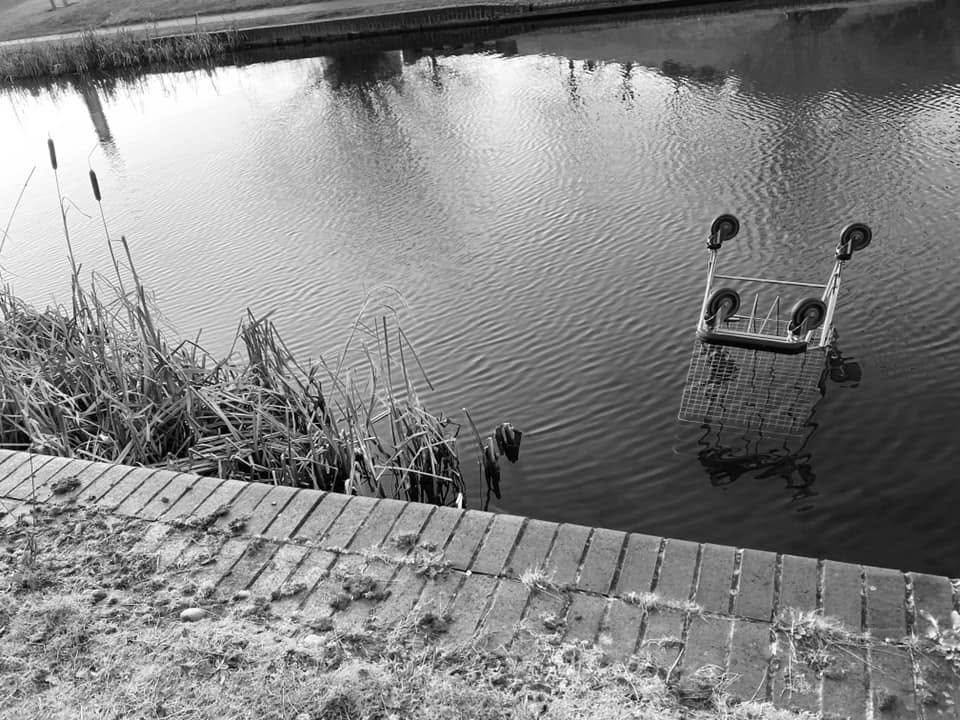
The pound coin was technically mine for about forty seconds. I was walking towards the trolley bay outside the supermarket with one already pinched between my fingers when a woman pushed her trolley towards me and said, “You can have this one.” I reached automatically for the coin still locked into the handle, but she waved it away. “Keep it for the next person,” she said, then walked off before I could properly argue or accidentally turn a supermarket trolley into a financial negotiation. For a moment, I stood there with two pound coins and far more responsibility than the situation deserved. One was mine. The other had been handed to me by a stranger who clearly had no intention of monitoring its future. She would never know whether I kept it, spent it, forgot about it in the bottom of my bag or passed the trolley on exactly as she had. It was such a small thing that I nearly forgot about it too.
Later, when I returned the trolley, somebody was approaching the bay behind me. I pushed it towards them and left the coin where it was. “Keep it for the next person,” I said, and the words came out before I had properly thought about them. I walked away and realised I had just passed on something that had never entirely belonged to me in the first place. Not the pound, exactly. The gesture. That stayed with me longer than a supermarket trolley probably deserves to occupy anyone’s philosophical life.
We spend a surprising amount of time wondering what happens to the things we give. Did the person remember our kindness? Did the encouragement matter? Did our patience make any difference? Did somebody notice that we stayed longer than necessary, spoke more gently than we could have, or chose not to embarrass them when embarrassment would have been easy? We rarely admit how much we want to know because generosity sounds more impressive when it expects absolutely nothing back. But human beings notice when what we give disappears from view. We wonder where it went. I used to think about goodness almost mathematically. If I am kind to someone, surely kindness should eventually come back. If I help somebody, perhaps they will remember when I need help. If I offer patience, generosity or understanding, some recognisable version of it should make the return journey. It seems fair enough until human beings become involved, and human beings have never been particularly committed to equations. You can be good to someone who will never be good to you. You can carry somebody through a difficult season and discover they are nowhere nearby when yours arrives. You can offer chances to people who would not have offered you one. You can protect somebody’s dignity and later learn that they did not feel particularly responsible for yours.
That used to bother me much more.
Perhaps I was watching the wrong route. I expected whatever I gave to return from the same direction, carried by the same person, preferably with some acknowledgement that the transaction had been received. Life is rarely that tidy. The person you encouraged may never encourage you. But years later, they may notice somebody struggling because they remember what it felt like when someone once noticed them. The person whose dignity you protected may eventually find themselves holding somebody else’s dignity in their hands. The person you listened to may become a better listener to someone whose name you will never know.
You may never find out.
That may be the hardest and most beautiful part.
Most of what we leave inside other people happens beyond our sight. We tend to remember grand gestures because they are easy to identify, but I suspect people are shaped just as much by smaller encounters. Someone remembers that you did not make them feel stupid when they made a mistake. Someone remembers that you stayed five minutes longer when they were frightened. Someone remembers that you spoke directly to them when everybody else seemed to be talking around them. Meanwhile, you may have gone home, made dinner and forgotten the entire conversation.
Words are particularly troublesome that way. They leave our mouths in seconds and occasionally take up residence in another person’s memory for years. There are sentences people once said to me that I still remember with absurd clarity: the room, where I was standing, sometimes even what I was wearing. The person who said them has probably forgotten the conversation completely. Encouraging words can live much longer than the moment that produced them. Unfortunately, cruel ones are equally talented tenants.
That thought makes me more careful with language, although certainly not flawless. I have spoken when silence would have been more intelligent. I have misunderstood people. I have responded while tired, irritated or already carrying something unrelated. There have been occasions when my mouth completed its shift before my better judgement had even clocked in. Growing older has not made me incapable of getting things wrong. It has mostly made me less interested in pretending I never do.
Sometimes I was wrong. Sometimes my intentions were decent but my delivery was dreadful. Sometimes I could have handled something differently. There is a strange freedom in admitting that without immediately constructing an elaborate defence of oneself. An apology cannot reverse what happened, but it can stop pride from becoming the next unnecessary injury.
Goodness does not require perfection. It does require attention, because kindness is not the only thing capable of travelling. Cruelty has excellent transport links too.
A person humiliated by somebody in authority may later discover that humiliation is an easy language to use once they have authority themselves. Anger can pass from one person to another until somebody completely unrelated to the original wound ends up receiving it. Families can pass certain hurts through generations so efficiently that eventually nobody remembers where they started. Sometimes we inherit ways of treating people before we are old enough to recognise them as harmful.
But inheritance does not have to become continuation.
The humiliation somebody handed to me does not require another recipient. The sentence that once wounded me does not need to come out of my own mouth. The fact that I once lacked encouragement does not prevent me from encouraging another person. We cannot choose everything that reaches us, but we have some say over what keeps travelling after it does. There is something powerful about a painful thing moving from person to person for years and eventually reaching someone who decides, no further.
Not everything handed to us deserves to be passed on.
That does not mean kindness requires unlimited access to me either. I used to confuse being good with being endlessly understanding. Experience corrected that fairly efficiently. I can understand why somebody behaves the way they do and still decide that the behaviour is unacceptable. I can forgive and still lock the door. I can wish somebody well from a distance substantial enough to require binoculars.
Sometimes kindness is warm. Sometimes kindness has boundaries and a locked front door.
There is a difference between giving something good and allowing yourself to be stripped bare by people who keep taking. A clear no can be kinder than a resentful yes. Walking away can be healthier than repeatedly demonstrating how much mistreatment you are capable of surviving. Goodness does not require becoming available for harm. A tree may give shade, but even a giving tree needs its roots left in the ground.
The harder part is protecting those roots without allowing bitterness to alter everything above them. It is easy to call ourselves patient when nobody is testing our patience. Forgiveness sounds lovely before someone gives us something genuinely difficult to forgive. Kindness is wonderfully uncomplicated when everybody around us is behaving well. Character becomes more interesting when somebody hands us disrespect, anger or humiliation and we have to decide whether to return it, store it or finally refuse delivery.
Working as a nurse has probably made me think about this more because healthcare places us beside people on some of the worst days of their lives. Fear can make people behave strangely. So can pain, exhaustion, grief and uncertainty. A patient may sound impatient because they are terrified. A relative may ask the same question several times because their mind has stopped absorbing the answer. A colleague may sound sharper than usual after twelve exhausting hours. Understanding the reason does not excuse every behaviour, but sometimes it changes the response I choose.
And occasionally, the person requiring grace is me.
There are days when I am tired, distracted, overthinking or simply operating with less social battery than circumstances require. I do not move through hospital corridors scattering patience and wisdom like an emotionally enlightened Disney character. I get irritated. I misread situations. I occasionally think of the ideal mature response approximately forty minutes after providing a substantially less impressive one.
Perhaps that is why I value grace so much.
There have been moments when people were more patient with me than they were required to be. Someone gave me the benefit of the doubt. Someone corrected me without humiliating me. Someone listened while I struggled to explain myself properly. Those moments rarely looked extraordinary from the outside, but I remember them precisely because I know how differently they could have gone.
That is what fascinates me about ordinary goodness. It often looks unimpressive while it is happening. Nobody applauds the colleague who explains instead of embarrasses. Nobody writes a newspaper article about someone who stayed and listened for five extra minutes. There are no medals for deciding that the tired cashier, frightened patient, struggling student, overwhelmed stranger or new colleague does not need another difficult person added to their day.
Most goodness happens without witnesses, which perhaps explains why its effect is almost impossible to measure. We are constantly stepping into and out of one another’s stories without knowing which part we played. Somewhere, someone may remember a sentence you have forgotten saying. Somebody may feel slightly more capable because you believed in them during a season when they believed very little in themselves. Someone may remember that they felt safe around you. Meanwhile, we carry pieces of people who probably have no idea they left anything behind.
That humbles me because influence happens even when we are not trying to be influential. Trust forms through repetition: showing up, listening, remembering, respecting, apologising. Distance forms through repetition too. One sharp remark becomes another. One dismissal becomes a pattern. Eventually somebody leaves, and the person left behind may look desperately for the single event that caused it when the answer was a hundred teaspoons rather than one bucket.
Relationships are often built or dismantled in teaspoons. Character probably is too.
I no longer believe the world operates like a perfect moral accounting system. Experience would make that impossible. Good people suffer. People who hurt others sometimes appear to continue perfectly comfortably. Kindness is not insurance against pain, and goodness does not guarantee that people will treat us well in return. I can leave the coin in the trolley and somebody else can simply pocket it. That possibility does not make the original gesture foolish.
It only means I never controlled what happened after it left my hands.
Perhaps that is the part I am finally learning. Goodness does not have to return to me in order to have mattered.
Years ago, I might have watched the person I helped and waited subconsciously to see whether they remembered. Now I am increasingly interested in what happens farther down the road. Perhaps a kindness I offered becomes part of how another person treats somebody else. Maybe the grace someone once gave me becomes the reason I pause before humiliating someone who has made a mistake. Maybe a nurse who once made a frightened patient feel safe influences how that patient later comforts somebody else in a completely different setting. The line may travel so far that nobody could possibly trace it back.
That is where the image of a tree begins to make sense to me. I imagine an old fruit tree beside a road, older than anybody remembers planting. Travellers stop beneath it when the heat becomes unbearable. Children climb its branches and go home with scratched knees and stolen fruit. Birds make homes there. Families sit beneath it. Fruit falls onto the road and somebody carries it away. The tree keeps no record of who received what. It never learns which family shared its fruit at dinner or which seed was thrown into unfamiliar soil and eventually became another tree beside another road.
The tree does not need the story back.
It gives according to what it has.
Human goodness is more complicated because we have choice, history, wounds and expectations. But perhaps we can still learn something from that. We can decide what leaves us. We can decide that another person’s cruelty will not automatically become our own. We can choose whether our words add unnecessary weight to somebody who may already be carrying more than we can see. We can decide whether a mistake deserves humiliation or humanity. We can choose to become the place where something painful finally stops travelling.
I cannot know what happens to every kindness after it leaves me. Maybe someone I encouraged will eventually encourage somebody I will never meet. Maybe somebody I treated gently will remember the feeling when another person needs gentleness. Maybe a conversation I have completely forgotten remains important somewhere else. Perhaps some of what I give will seem to disappear entirely.
That no longer makes it meaningless.
I think again of the tree beside the road. It never sees every table where its fruit is eaten. It does not know which seed eventually reaches soil. Years pass. Travellers arrive and leave. Children grow older. Some move away. Some return with children of their own. Somewhere beyond the village, another tree may eventually stand beside another road, and nobody resting beneath it will know exactly where the first seed began. They will simply be grateful for the shade.
Perhaps the world remembers what we give in much the same way. It remembers through people. Through patience somebody learned because they were once treated patiently. Through courage that grew because someone believed in them. Through cruelty that stopped because one person finally refused to hand it onward. Through kindness that travelled so far from its beginning that nobody could identify the first pair of hands.
And that brings me back to the supermarket trolley, which is still an absurd object to have carried this much philosophy.
I never found out where that pound went. Perhaps the next person passed the trolley on. Perhaps another person did the same. Perhaps the chain lasted until closing time. Perhaps it ended five minutes later when someone noticed the coin and thought, excellent, free pound. I hope they bought something worthwhile.
I will never know.
Most of what we give works like that. A word leaves us. A kindness leaves us. A little patience on somebody’s awful day leaves us. A moment when we decide not to humiliate another person leaves us. We receive no notification telling us where it landed. No tracking number. No satisfying update several years later confirming that our small act became something larger. Sometimes it probably does not. Sometimes it might.
But if something good reaches my hands and I have the choice to keep it for myself or let it continue travelling, I hope I remember that woman outside the supermarket. She gave me no lecture about generosity. She did not stay to see what I would do. She simply pushed the trolley towards me, left the pound where it was and trusted the rest of the story to someone she did not know.
“Keep it for the next person.”
Perhaps that is enough instruction for more of life than I first realised. Not everything good has to come back to me. Some things are meant to keep going. So when they reach my hands, I hope I have the wisdom not to pocket them.
No tracking number required,
Anj 🖤


































Leave a Reply