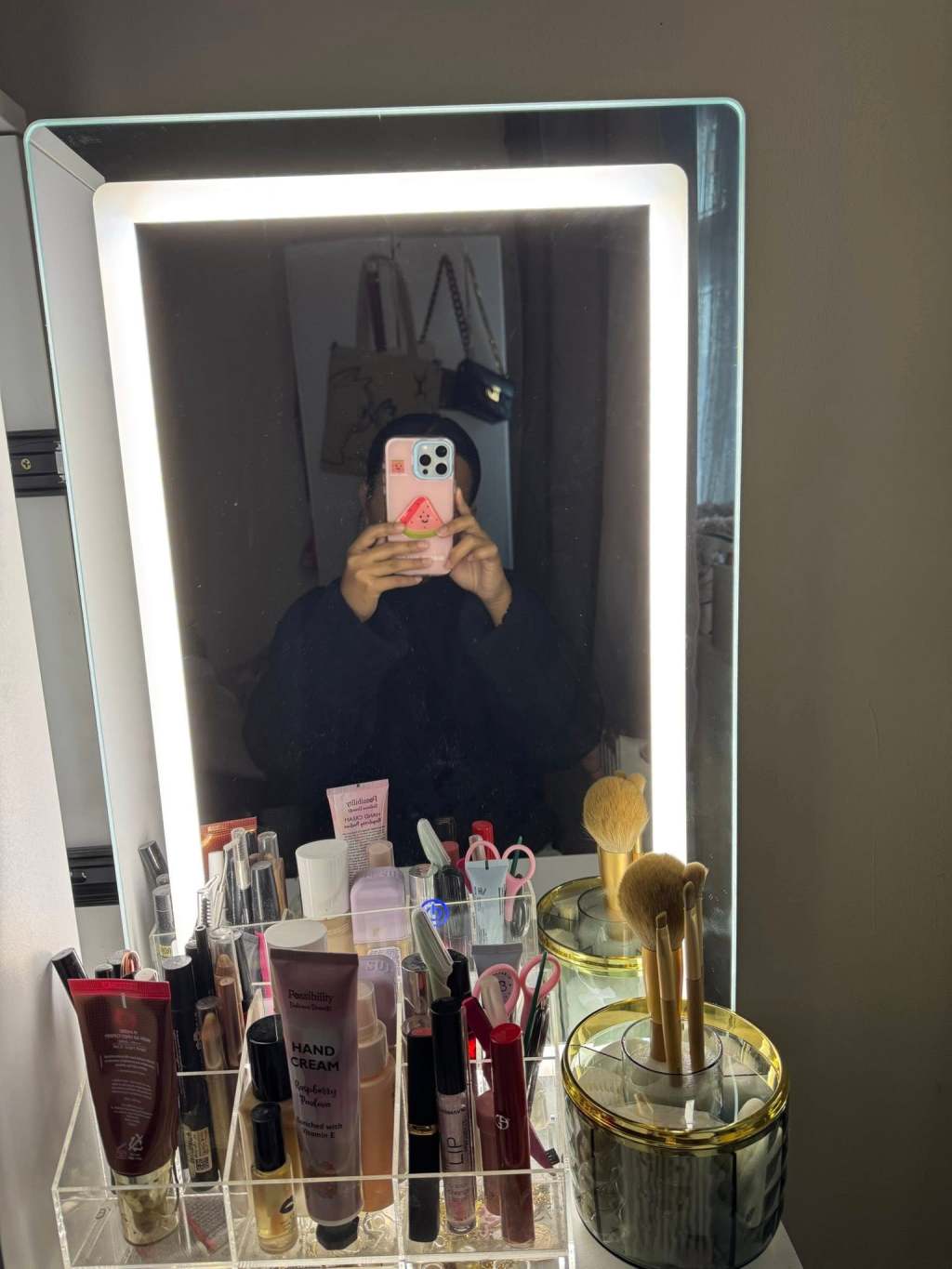
The Wayfair boxes had barely settled on the floor before I decided patience was no longer necessary. My partner had already told me he would build the dresser for me. It was a perfectly sensible arrangement. He knew what he was doing, I could leave the screws in peace, and eventually I would have the new dresser I had been ridiculously excited about—the one with the mirror and lights, which in my mind had already transformed one corner of the room into something far more glamorous than reality had any obligation to provide. All I needed to do was wait. Naturally, I did not wait.
At some point, excitement convinced me that assembling flat-pack furniture was simply a matter of opening the box and believing in myself. I spread the pieces across the floor, found the little bags of screws, unfolded the instruction booklet and looked at the cheerful diagrams with the dangerous confidence of someone who had not yet reached Step Four. Wayfair manuals make construction look wonderfully civilised. Here is Board A. Here is Screw B. Insert one into the other. Continue smiling. Nowhere in the drawings is there a woman sitting cross-legged on the floor forty minutes later, surrounded by wooden panels, holding two almost identical screws and questioning every decision that led her there.
Still, I persisted. I turned pieces around. I turned them back. I studied the pictures so closely I began to feel personally acquainted with the tiny illustrated person doing everything correctly. At one point I attached something the wrong way and had to undo several steps, which is an excellent method of discovering how quickly enthusiasm can become resentment. Then came the truly unsettling moment: I looked down and found a screw still sitting beside me when, according to my understanding of the situation, there should not have been any screws left.
Nothing tests confidence quite like finishing part of a piece of furniture and discovering one spare screw.
I stared at it. Then at the dresser. Then back at the screw. I gave the structure a cautious little shake, the universally recognised engineering test performed by people with no engineering qualifications whatsoever. It remained standing, which was encouraging but not entirely persuasive. Was the screw extra? Had I missed a step? Was the whole dresser now waiting until three in the morning to collapse dramatically and prove that Jan had, in fact, been right when he said he would do it for me?
So I went back to the instructions.
That was the reassuring thing about the booklet. However badly I had confused myself, there was still a sequence. Step one. Step two. Step three. If something looked wrong, I could go backwards and find where I had gone off course. Somewhere on those pages was a picture of what the finished thing was supposed to look like and a set of directions for getting there. The problem was not that the instructions were missing. The problem was that I had to understand them, follow them and occasionally accept that my confident interpretation of Step Five had been completely wrong.
I think that may explain more about me than the dresser ever intended to.
I grew up liking instructions. My mother taught me to follow rules properly. If something had to be done a certain way, you did not suddenly decide halfway through that your personal interpretation was more interesting. School reinforced the habit. Teachers gave directions, textbooks had chapters in order, exams had questions with answers, and even when I did not know an answer, there was something reassuring about knowing that one existed somewhere. Do this, then this. Study hard. Finish what you started. Follow the guidelines. For a long time, life seemed as though it should operate according to roughly the same arrangement.
It worked surprisingly well for a while. You studied, sat the exam and received the result. You completed one school year and moved to the next. There were subjects, schedules, deadlines and people whose job was to tell you whether you had done something correctly. Even mistakes had structure. If an answer was wrong, somebody could point to the correct one, you could learn it, remember it and hopefully avoid repeating the same mistake next time. I think some part of me assumed adulthood would simply be the advanced version of this system.
It was not.
Somewhere in my twenties, I became very attached to plans. Not necessarily good plans, but plans nevertheless. There was comfort in arranging life in what seemed like the correct order: finish school, find work, build a career, save money, travel, settle down, achieve the next thing and continue until adulthood eventually resembled the version I had been promised by absolutely nobody. I never actually said, “Lord, here is the schedule I have prepared for us,” but some of my prayers came dangerously close. I had considered the matter carefully, selected what seemed like a sensible outcome and apparently expected God to appreciate my organisational skills.
Then adulthood began removing the instructions one by one. There were decisions with no obviously correct answer, situations where doing everything properly still did not produce the expected result and prayers for which there was no answer key hiding at the back of the book. Hard work did not always guarantee the opportunity. Being good to someone did not guarantee they would be good to me. Doing what seemed sensible did not automatically make the outcome easy. Some things arrived too early, others embarrassingly late, some never happened at all, and several things I had never included in the original plan somehow became parts of my life I would now refuse to exchange. This was deeply inconvenient for someone raised to believe that following instructions usually got you where you were supposed to go.
For a long time, I kept looking for the missing instructions anyway. Perhaps they were hidden inside another qualification, another five-year plan, another carefully considered decision or another prayer. Surely adulthood could not simply expect people to make enormous choices with incomplete information and then continue behaving as though this were a perfectly reasonable system. Yet the older I became, the more I suspected that this was exactly what adulthood expected. There was no final answer sheet waiting somewhere. There was simply more life.
Plans changed. People changed. Circumstances arrived without consulting my diary. Things I had been certain would happen did not, while opportunities I had barely considered appeared and altered several things after them. There were prayers I expected God to answer quickly that seemed to disappear into some mysterious administrative department in heaven, while things I had never thought to request arrived and eventually became ordinary parts of my life. That still fascinates me because some of the best things in my life were never on the original list, while some of the things I once wanted most now make me think, with considerable relief, Thank God You ignored that particular suggestion.
This is slightly embarrassing because I did not present those old prayers as suggestions. I presented them with confidence, occasionally with supporting arguments and probably with an implied deadline. I knew what I wanted and, more importantly, I had already decided why it would be good for me. God has apparently always reserved the right to edit, which perhaps explains why my understanding of direction has changed so much.
Years ago, if somebody had asked what gave my life direction, I might have talked about goals, career, education, plans for the future and achievements still ahead. I still value all of those things. I have not become a woman who throws away her planner, abandons ambition and waits serenely for heaven to organise everything while she drinks coffee. I still make plans, I still make lists, and I still have very specific opinions about how I would prefer certain things to happen. What changed was that I stopped confusing the plan with the direction. The direction, for me, became faith, although that sounds much simpler written down than it has ever been to live.
Faith has never given me the full itinerary. If anything, it has repeatedly asked me to continue when the itinerary was precisely what I wanted. There have been periods when I prayed and remained uncertain, moments when I believed God was there but could not understand what He was doing, and situations where trusting Him meant accepting that the version I had prepared was not the version unfolding in front of me. When I was younger, I wanted God to function a little like the instructions I had trusted growing up. Tell me what to do, show me where it leads, confirm that I have understood correctly and preferably let me know how long this is all going to take. If a decision required risk, I wanted reassurance before taking it. If something was going to work, I wanted evidence before becoming emotionally invested. If a prayer was taking years, I wanted an explanation for why several convenient weeks had apparently been ruled out.
I thought answers would give me peace, but sometimes the answers never came. Life continued anyway. I still woke up, went to work, made decisions, changed my mind, made mistakes, prayed again and carried on with whatever information I had. Somewhere in that very uncinematic process, I began learning that direction and certainty were not the same thing.
Looking backwards makes this much easier to explain than it was to experience. Hindsight has excellent vocabulary. It will take a year you once described as nothing is working and later call it redirection. It can rename disappointment as preparation and rejection as protection once it knows what happened next. Hindsight is very wise because hindsight never has to spend Tuesday night wondering whether it has made a terrible mistake. The present is far less articulate. The present usually asks only, What now?
There have been seasons when I genuinely wondered whether I had misunderstood my own life. I was working, praying and doing what I believed I was supposed to do, yet certain things remained stubbornly unchanged. Meanwhile, other people seemed to be progressing with suspicious efficiency. Comparison makes uncertainty much heavier than it needs to be. Someone gets promoted and suddenly you are examining your career. Someone buys a house and your bank account develops a personality. Someone gets married, starts a family, travels somewhere, receives an opportunity or announces the exact thing you have been privately asking God about, and within seconds the mind opens a spreadsheet nobody requested. How old are they? How long did that take? What am I doing? Have I missed something? Human beings can turn someone else’s happy announcement into a personal performance review with astonishing speed.
I have done it, and I will probably do it again. Faith has not made me immune to being human. I still compare sometimes, I still become impatient, and I still occasionally wonder whether heaven has misplaced a form. The difference is that I recover from those thoughts faster than I used to, and perhaps that counts as progress. Someone else reaching a milestone before me has never proved that I am lost. Their life is not a measuring instrument for mine. They are not carrying my history, responsibilities, losses, opportunities or whatever God may be doing in the parts of my life I cannot see yet. Someone else’s twenty-eight does not dictate what my thirty-six should contain. That sounds very sensible written here, although it is slightly harder to remember at midnight while scrolling through social media.
For years, I also assumed direction should look like movement. If I was going somewhere, surely something visible ought to be changing. A qualification, a promotion, a new role, a financial milestone, a major decision. Progress should be measurable enough that I could explain it when someone asked what was new. I am less convinced of that now. Some periods of my life looked almost stationary from the outside and changed me considerably underneath. I learned patience when nothing seemed to be moving. I learned boundaries after spending too much time without them. I learned which people felt safe partly because I had known people who did not. I discovered that rest can be necessary without becoming laziness and that repeatedly forcing something does not necessarily make it meant for me.
That last lesson was particularly annoying because I am persistent by nature, and persistence is useful until it quietly becomes refusal to accept reality. There have been situations where I genuinely could not tell whether faith meant trying again or finally stopping. Should I pray more, apply again, stay, leave, push harder or let go? Christian phrases can make these decisions sound much tidier than they feel at two in the morning. Sometimes “do not give up” is exactly the advice someone needs, while sometimes refusing to give up is precisely what prevents them from moving somewhere healthier. I do not think there is one rule, although the child raised on instructions would very much appreciate one. Perhaps wisdom is partly learning to recognise what this particular moment requires instead of applying yesterday’s answer to today’s problem.
Prayer became important to me there, although prayer itself has changed. I used to expect guidance to feel more dramatic. Something unmistakable would happen. A clear sign, a sudden certainty, perhaps even an arrow if God was feeling particularly generous. Most of my actual experience has been far less cinematic. Sometimes I pray about something repeatedly until my own emotional noise becomes quieter. Sometimes I remain uncertain after praying. Sometimes a conversation stays with me for reasons I cannot immediately explain. Someone says one sentence without knowing that it touches something I have carried for weeks. An opportunity appears at a time I could not have arranged, or something I keep trying to maintain becomes heavier each time I touch it. None of these arrives stamped DIVINE GUIDANCE: PLEASE OPEN IMMEDIATELY, which would honestly be helpful. Yet looking backwards, patterns occasionally appear where individual moments once seemed unrelated.
Perhaps that is why the image of a compass feels closer to faith for me now than a map. A map gives detail. It shows roads, distances, junctions and destinations. A compass is far less accommodating. It gives you direction and then leaves you responsible for dealing with the actual terrain. It does not warn you about mud, it does not care whether the hill is inconvenient, and it certainly does not provide an estimated arrival time. It simply keeps pointing. Faith has often felt like that to me, not here is everything that will happen, but more like keep facing this way: towards God, honesty, integrity, kindness that still has boundaries, work I can respect, the people I love and values I still want to recognise in myself after the outcome has been decided.
Perhaps direction is sometimes less about knowing where I will eventually arrive and more about knowing what I do not want to abandon while getting there. That changed the question for me. For years, I asked, When will I get there? I still ask it, obviously. I have not reached some spiritually advanced level where dates no longer interest me. But another question began appearing beside it: Who am I becoming while I am trying to get there? Reaching the right destination as the wrong version of myself would not necessarily feel like success.
I could achieve something and become bitter towards everyone who achieved it first. I could become successful and lose humility. I could become independent and forget how to receive help. I could protect myself so thoroughly that nobody could reach me, including people who came with good intentions. I could build an impressive career and discover that once the uniform came off, very little of me remained. Those possibilities frighten me more now than being late, and perhaps purpose lives somewhere inside that concern too.
I once imagined purpose as something enormous: a calling, a mission, the one special thing that would explain why someone existed, preferably something impressive enough to fit into a biography. Now I suspect purpose may often be embarrassingly ordinary. It may be found in how I treat somebody when I am tired, whether I keep my word when breaking it would be easier, whether I remain kind after discovering that kindness does not guarantee kindness in return, whether I learn to say no without becoming proud of withholding myself, whether I apologise properly, do my work well when nobody is going to congratulate me and become somebody the people I love feel safe telling the truth to. These things do not photograph particularly well and rarely make impressive announcements, but that does not make them small. Perhaps a life finds direction through thousands of decisions that barely look like decisions while they are happening.
This way of thinking also changed my relationship with stillness. I have always preferred doing. Action gives me the pleasant illusion that I have control, and even worrying can pretend to be productivity because at least the mind is working very hard. Rest is more suspicious. Surely there is something I should be doing, and there always is. Laundry possesses extraordinary resilience, emails reproduce and there will always be another item on the list if I need an excuse not to stop. Yet I have made some of my worst decisions while trying to force clarity from a mind that simply needed space.
Prayer sometimes gives me that space, not necessarily an answer, but enough silence to hear what fear, pride, exhaustion or impatience has been shouting over. I do not believe every feeling of peace automatically means God has approved something because human emotions are far too complicated for that. But I have learned to pay attention when a choice repeatedly leads me towards honesty, responsibility and steadiness even after the initial excitement wears off. I have also learned to distrust decisions made entirely from fear. Fear is an excellent emergency alarm, but I am not convinced it should be allowed to run long-term navigation.
None of this means I now understand everything difficult that has happened to me. I do not. There are experiences I still wish had never occurred, losses that no lesson could adequately compensate for and questions I may carry for the rest of my life. Faith does not require me to lie about that. I can believe God brought something useful from a painful season without pretending the pain itself was therefore a gift. I can trust Him and still tell Him I do not understand. I can feel disappointed and continue praying. I can be frightened and still take the next step. Perhaps faith has enough room for contradiction because human beings do, and it has certainly needed enough room for mine.
I still make plans, set goals and want things, sometimes badly. I do not believe surrender means sitting still and describing lack of preparation as trust. If something requires study, I should study. If I need to apply, save, work, speak, apologise, leave or begin, faith does not remove my responsibility to do it. God can guide my life, but He does not need to pack my suitcase. That remains my job, unfortunately.
What has changed is how tightly I hold the itinerary. My plans once felt almost contractual. If I worked hard enough and made the correct decisions, the expected result should follow. Now I think of them more like drafts. I still write them carefully and become attached to certain sentences, but I leave wider margins. Sometimes God edits, sometimes circumstances do, and sometimes I do after realising the person who wrote the first version no longer wants the same ending.
There are still prayers where surrender sounds very noble until I actually care about the outcome. I can say, “Your will be done,” and somewhere in the footnotes quietly add, “although if Your will could look something like this, happen within this general timeframe and involve minimal inconvenience, that would be greatly appreciated.” I suspect God is familiar with the footnotes. I am still learning.
Perhaps that is one of the things adulthood has finally taught me about direction. It does not require knowing the next ten years and may not even require knowing next year. People I have not met yet may become important. Places I have never considered may become part of my story. Dreams I protect fiercely today may eventually stop fitting, while things I cannot yet imagine may become impossible to picture my life without. I cannot map that honestly, but I can choose what I keep facing.
When I think back to the child I was—the one who learned that instructions mattered, who sat in classrooms where questions had correct answers and who believed following the steps would eventually get her where she needed to go—I do not think she was wrong. Those lessons gave me discipline, responsibility and a respect for doing things properly. I am grateful my mother taught me that rules matter and actions have consequences. I think adulthood simply added another lesson: there are parts of life where no instructions are coming, no teacher will walk over and point to the line I misunderstood, and no answer sheet is hidden at the back.
Sometimes I will have to decide with incomplete information, pray without receiving immediate certainty and move without knowing where every turn eventually leads. The younger version of me would probably find that unacceptable, and the thirty-six-year-old version still finds it inconvenient. But I no longer find it quite as frightening. Perhaps I spent too many years asking God for a map when what I actually needed was something I could still use after the map stopped matching the road.
And perhaps that is why I still think about that Wayfair dresser. I wanted the finished thing badly enough that waiting for Jan to build it felt like an unnecessary administrative delay, so I opened the box, scattered the pieces across the floor and confidently began constructing something I only partially understood. In fairness, I did have instructions. I simply wanted the instructions to remove all uncertainty, all difficulty and preferably all waiting. Life has taught me that directions rarely offer that luxury.
I still make plans. I still check routes several times before travelling somewhere unfamiliar. I still ask God where all of this is going and occasionally wonder whether an estimated arrival time might be too much to request. I suspect there will always be a part of me that wants the complete diagram before I begin. But when no answer sheet appears, I no longer assume I have failed the exam. When the map stops matching the road, I try to look at what still points in the right direction and take the next step I can see.
I suppose I am still that woman sitting on the floor with the instruction booklet open, surrounded by pieces, holding one mysterious screw and wondering where on earth it belongs. The difference is that I no longer assume everything has gone wrong simply because I cannot yet see how the whole thing fits together.
And somewhere nearby, God is probably looking at the mess with the patience of someone who already told me to wait.
Still walking where grace points,
Anj ✨




































Leave a Reply