Before you read this, I want you to do something I rarely ask of anyone who visits this little corner of my writing. Find a song and let it play quietly in the background. Choose something gentle, something that seems to understand the parts of you that are difficult to explain. Maybe it is The Night We Met by Lord Huron, or perhaps it is another song that carries the particular kind of longing that belongs to memories we no longer visit often but have never completely forgotten. Let the music fill the silence around you while you read. Some stories are not meant to be rushed through; they are meant to be sat with, slowly, until something inside us recognises itself.
There was a time in my life when I believed every painful story needed a proper ending. I thought closure required two people sitting across from each other, finally saying everything that had been left unsaid. I imagined explanations arriving eventually, misunderstandings being corrected and apologies being spoken with enough sincerity to somehow repair the parts of me that had been hurt. Perhaps I had watched too many films where people eventually returned in the final act and said exactly what needed to be said, or perhaps I simply believed that people who had once mattered to each other would eventually care enough to make things right.
So I waited.
Not physically, of course. Life continued. Days passed, responsibilities accumulated and other chapters began. From the outside, nothing looked paused. But somewhere inside me, there remained a small unfinished room where I kept certain questions exactly where they had been left. I thought eventually someone would return to answer them. I imagined receiving a message one day, hearing an explanation or perhaps simply hearing the words I thought would finally make everything settle: I’m sorry. I know I hurt you.
The apology never came.
For a long time, I thought that was the hardest part. Eventually I realised the harder part was accepting that it might never come at all. There was no dramatic collapse when I understood this, no cinematic confrontation and no final conversation accompanied by the perfect soundtrack. There was simply the uncomfortable recognition that some people can hurt you and continue with their lives without ever returning to examine what they left behind. They may never understand the weight of their actions from your side of the story. They may remember the situation completely differently, justify what happened to themselves, or perhaps barely think about it anymore.
Meanwhile, you remember.
That imbalance can be incredibly difficult to accept. Someone can become a painful chapter in your life while you become little more than a paragraph in theirs. We sometimes spend years carrying the emotional consequences of moments other people barely remember creating.
I stayed inside that silence longer than I should have, although I don’t say that with judgement towards the person I was then. At the time, I genuinely did not know how to leave. I thought moving forward without answers meant pretending nothing had happened. I thought letting go meant allowing somebody to escape responsibility. I thought peace had to be negotiated between the people involved before either person could truly have it.
There is a particular exhaustion that comes from waiting for something another person has complete control over. You replay conversations, examine details and wonder whether there was something you missed. You question whether you misunderstood what happened, whether you expected too much, whether you were too sensitive or whether the pain was really as significant as it felt. Memory becomes a courtroom where you are simultaneously the witness, the lawyer and the accused, repeatedly presenting evidence for something your heart already knows happened.
But deep down, we usually know what something cost us.
We know the nights when our minds would not become quiet. We know the conversations we replayed while wondering what we could have said differently. We know the parts of ourselves that changed afterwards. We know which boundaries appeared because once there were none. We know which version of trust became harder to offer. Other people may never fully understand the impact they had on us, but their inability to recognise it does not automatically make our experience imaginary. Someone else’s refusal to acknowledge your pain does not erase the fact that you had to live through it.
What made saying goodbye difficult was not only letting go of the people involved. I eventually realised I was also grieving the hope attached to them. Somewhere inside me remained the belief that one day they would return with the right words, and those words would somehow unlock the door I had been unable to open myself. I wanted acknowledgement because acknowledgement felt like proof that what happened mattered. I wanted an apology because I thought an apology would finally give me permission to stop carrying the hurt.
There is something strangely seductive about imagining that one perfect conversation could repair everything. We create versions of it inside our heads. They finally understand. We finally explain. They apologise. We say what we should have said years ago. Everyone walks away lighter. It is emotionally satisfying because it gives the story symmetry, and human beings seem to love symmetrical endings.
Life is rarely that considerate.
- Sometimes there is no conversation.
- Sometimes the other person never returns.
- Sometimes they return but still do not understand.
- Sometimes the apology comes but sounds nothing like the one you imagined.
- Sometimes you receive the words you spent years waiting for and discover, almost disappointingly, that they cannot travel backwards through time and rescue the version of you who originally needed them.
That was perhaps the most important thing I eventually understood. I had been waiting for someone else to provide something I needed to learn how to give myself.
Closure is not always a conversation between two people. Sometimes it is a decision made quietly by one person who has finally become tired of leaving the door open.
That decision did not arrive suddenly. I wish I could say there was one profound morning when I woke up transformed, looked at everything differently and simply let go. But most meaningful changes in my life have never happened that neatly. Letting go came in fragments. It happened through tired mornings when I realised I no longer wanted yesterday to occupy so much of today. It happened through nights when the same thoughts repeated themselves until eventually they began losing their sharpness. It happened through new experiences, different people and ordinary days that slowly became more interesting than the questions I had been carrying.
Little by little, I began noticing that I was thinking about it less.
Then one day, something reminded me of what happened and I realised the memory was still there, but the urgency had disappeared. I no longer needed to solve it. I no longer needed to reconstruct every detail. I no longer needed the other person to understand my version of events before I could trust my own experience. Nothing had changed about the past. I had changed my relationship with it.
Perhaps letting go does not mean the memory disappears. Perhaps it means the memory finally loses its authority over the present.
Forgiveness changed its meaning for me during that time too. I used to imagine forgiveness as something almost ceremonial, something offered directly to another person after they apologised. They said sorry, you forgave them, everyone learned something and life moved forward. It was a wonderfully tidy concept until actual life complicated it.
I began to understand that forgiveness does not always require reconciliation, and it certainly does not require pretending something did not hurt. Forgiveness does not mean rewriting history so that someone else’s behaviour becomes acceptable. It does not require reopening a relationship that became harmful, abandoning boundaries or giving people unlimited access to you simply because you no longer want to carry anger.
Sometimes forgiveness is much quieter than that. It is deciding that what happened will no longer receive unlimited space inside your life. It is releasing yourself from the exhausting responsibility of mentally prosecuting someone forever. It is accepting that the past cannot be edited while recognising that the future does not have to become its continuation. Forgiveness does not always mean giving someone another place in your life; sometimes it means refusing to give what they did a permanent place inside you.
That distinction mattered to me because I think many people remain trapped between resentment and reconciliation as though those are the only two options available. They believe that if they let go of anger, they must welcome the person back. If they forgive, they must forget. If they move forward, perhaps what happened was not serious enough to justify the pain in the first place.
But boundaries and forgiveness can exist together.
- You can wish someone well from a distance.
- You can stop being angry without becoming available again.
- You can understand someone’s reasons without agreeing with their choices.
- You can forgive and still remember what the experience taught you.
- You can stop waiting for an apology while still believing an apology would have been deserved.
Maturity, I think, often exists inside those uncomfortable spaces where two seemingly contradictory truths are allowed to coexist. Peace does not require pretending the wound never existed; sometimes peace is simply reaching the point where you no longer need to keep touching it to prove that it was real.
Saying goodbye to that phase of my life therefore meant more than letting go of certain people. It meant letting go of the version of myself who was still waiting to be understood by them. For a long time, I wanted people who had hurt me to recognise exactly how their actions had affected me. I thought their understanding would somehow validate my experience. Eventually, I had to accept something much less satisfying but infinitely more freeing: not everyone who hurts us will ever understand what they did from our perspective.
- Some people genuinely do not realise.
- Some people realise but cannot admit it because admitting it would require confronting something uncomfortable about themselves.
- Some people will create a version of events where they were justified.
- Some will apologise only enough to relieve their own guilt.
- And some will simply continue living.
We cannot build our peace around which one they eventually become.
There was freedom in accepting that because I finally understood how much power I had unknowingly handed away. Every time I thought, I will feel better when they understand, I was making my peace dependent on someone else’s emotional growth. Every time I thought, I will move on when they apologise, I was allowing another person’s silence to determine how long I remained emotionally connected to something that had already ended.
There comes a point when waiting for someone else to give you closure becomes another way of keeping the wound open.
That does not mean we should rush ourselves. There is no moral prize for moving on quickly. Some experiences require time because our minds need time to understand what our hearts have already experienced. We should be allowed to grieve relationships, friendships, expectations and versions of people we once believed were real. We should be allowed to feel angry, disappointed or confused without immediately turning every painful experience into a lesson.
But eventually, there may come a quieter question: How long do I want this to continue living inside me?
Not how long should I remember it, because remembering is not necessarily the problem. Not how quickly should I forgive, because forgiveness cannot always be forced. The question is how much of today’s life we are willing to continue giving to something that happened yesterday.
That question changed something in me.
I began understanding that moving forward was not betrayal. Choosing peace did not mean the other person had won. Letting go did not mean what happened was acceptable. It simply meant I had reached the point where protecting my future mattered more than continuing an argument with my past.
There are experiences in life we will never fully resolve. There will be conversations we never get to have, explanations we never receive and apologies that never arrive. We may never know why somebody behaved the way they did, whether they regret it now, whether they occasionally remember us or whether they have rewritten the entire story differently inside their own mind.
Perhaps we do not need to know.
There is something strangely peaceful about reaching the point where curiosity no longer controls you. The unanswered question can remain unanswered without demanding another year of your life. Not every question needs an answer before you are allowed to stop asking it.
Looking back now, I think one of the greatest misconceptions I once had about closure was believing it meant finally understanding everything. Maybe closure is not understanding everything at all. Maybe it is accepting that some things will remain incomplete and deciding to continue anyway. It is recognising that an unfinished conversation does not require an unfinished life.
There are doors we close because somebody apologised, explained themselves and gave us the ending we deserved. Those endings are easier. But there are other doors we eventually have to close ourselves because nobody is coming back through them. Closing those doors can feel unfair because we are doing emotional work somebody else helped create, but fairness and freedom are not always the same thing. Sometimes waiting for fairness keeps us imprisoned far longer than choosing freedom would.
I think that is the goodbye I eventually learned to give. Not a dramatic farewell directed towards another person, but a quieter goodbye to my own expectation that the past would someday return and repair itself. I stopped waiting for people to become the versions of themselves I needed them to be. I stopped imagining that one perfect apology could undo years of emotional weight. Most importantly, I stopped believing that somebody else’s recognition was required before I could trust what I had experienced.
There are still things I wish had happened differently. Growing does not require pretending otherwise. There are conversations I deserved that never happened and words I probably should have heard. But there is a difference between acknowledging what we deserved and spending the rest of our lives waiting to receive it.
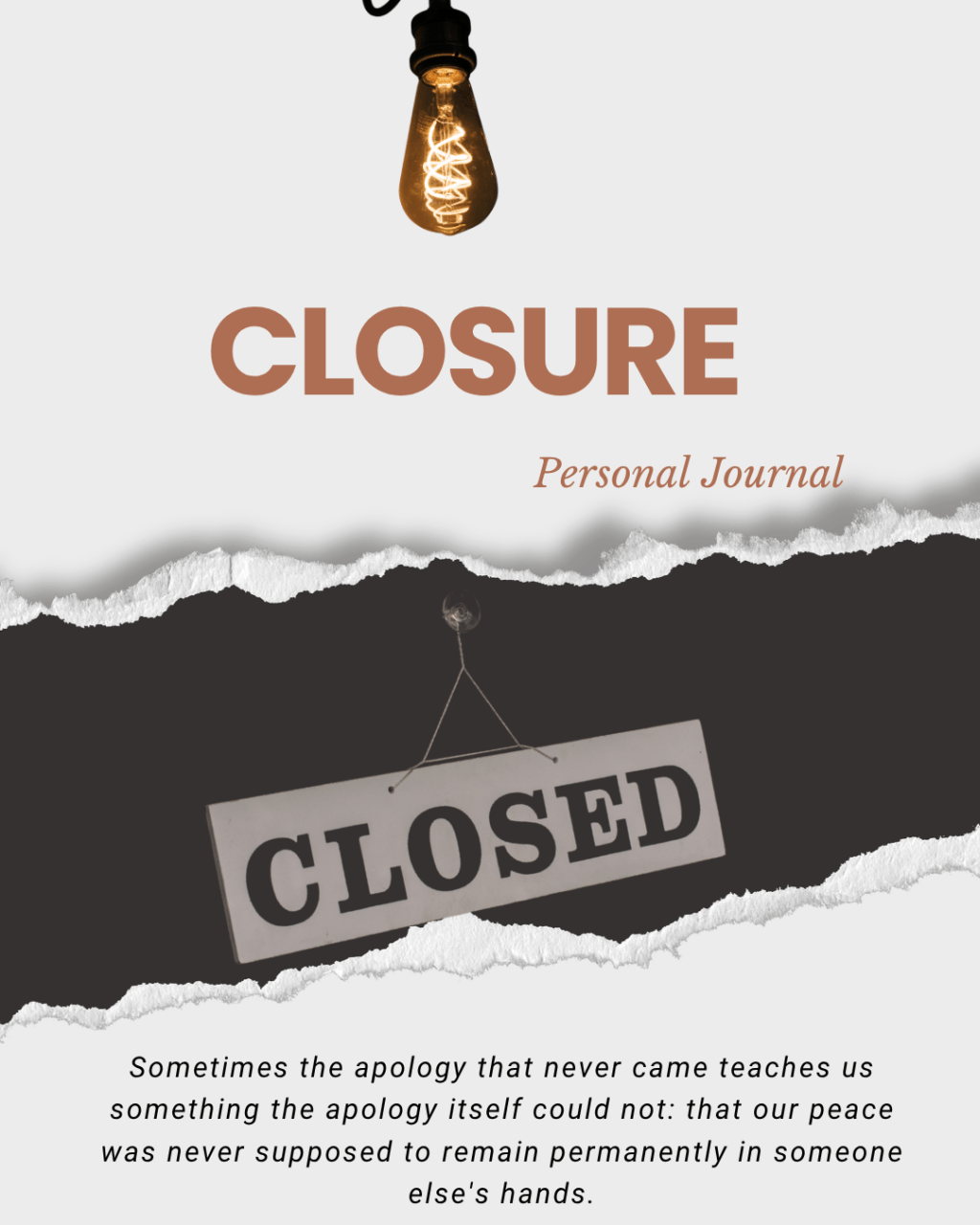
Sometimes the apology that never came teaches us something the apology itself could not: that our peace was never supposed to remain permanently in someone else’s hands.
Perhaps that is what I would tell the version of myself who waited for so long. I would not tell her to stop caring. I would not tell her she was foolish for hoping. I would simply remind her that one day she would understand that silence can also be an answer, even when it is not the answer she deserved. She would eventually learn that closure could be created without permission, that forgiveness could exist without reunion, and that moving forward did not require pretending the past had never mattered.
Some people may never say sorry, and perhaps that will always be one of life’s more painful realities. We cannot force remorse, manufacture accountability or make another person understand a story they are determined to remember differently. But we can decide how long their silence is allowed to echo through the rest of ours. We can acknowledge the wound without building our identity around it, remember what happened without continuing to live there, and carry the lesson forward without carrying the entire weight.





















 superanjventures
Leave a comment