
May 16, 2014 | The Sun Shall Soon Shine — A Visit to the Divine Mercy Shrine, an Afternoon by the Lake, and a Prayer I Was Too Tired to Explain
I have discovered that problems possess an extraordinary sense of timing. They rarely arrive when the house is clean, the bills are settled, and everybody has enjoyed eight uninterrupted hours of sleep. Instead, they appear when life is already complicated, bringing additional concerns as though somebody has accidentally subscribed the entire family to a service nobody remembers requesting. There are days when I would very much like to contact whoever is responsible for these arrangements and politely inform them that we have reached our maximum capacity for unpleasant surprises. Unfortunately, life does not appear to operate a customer service department, and even if it did, I suspect the telephone lines would be permanently occupied.
Lately, I have not been feeling particularly enthusiastic about explaining myself to anyone, including this poor, neglected diary. I have written about worries, uncertainties, and the difficulties my family has been facing, particularly since learning about my aunt’s illness. Sometimes writing helps me organise my thoughts, but there are also moments when I become exhausted by the sound of my own concerns. I sit down intending to write something meaningful, only to realise that I am preparing to revisit the same questions I asked yesterday. Even my notebook must be wondering whether I have anything new to discuss. I cannot blame it. If I were a diary, I might occasionally request a change of subject, preferably involving good food, an interesting holiday, or somebody else’s ridiculous behaviour.

Today, therefore, I have decided to give my problems a temporary holiday from appearing in every paragraph. They have been occupying enough space in my thoughts lately, and I see no reason to provide them with additional accommodation. I am not pretending they have disappeared, and I certainly do not have a miraculous announcement that everything has been resolved. But something happened last weekend that made me smile, and I would rather spend a little time remembering it than allow another entry to become an endless account of everything that has been troubling me.
Last weekend was entirely unplanned. I travelled back to my hometown in Toledo because I had a few things to attend to, and I had no elaborate itinerary waiting for me afterwards. It was one of those ordinary visits that begin with practical responsibilities rather than excitement. I needed to sort out some matters, and once they were finished, I expected the rest of the day to pass without anything particularly memorable happening. Apparently, however, my cousins had other ideas. One of them invited me to visit the Divine Mercy Shrine near our home, and since I had no pressing commitments remaining, I agreed.

It is remarkable how easily an ordinary afternoon can change direction because somebody asks a simple question. I had returned home with responsibilities on my mind, not with the intention of enjoying a little spiritual excursion. Yet there I was, suddenly looking forward to visiting the shrine, pleased to have an opportunity to spend time with my cousins and perhaps escape the constant activity inside my head. I did not expect the visit to solve anything. I simply wanted to go somewhere familiar, offer a prayer, and enjoy a little distance from the concerns that had accompanied me throughout the preceding weeks.
The Divine Mercy Shrine seemed an appropriate place to begin.
I have always found comfort in visiting religious places, especially during periods when I am finding it difficult to understand what is happening around me. There is something reassuring about entering a space associated with prayer. The surroundings encourage me to become more attentive to thoughts I might otherwise dismiss while rushing through ordinary responsibilities. I do not necessarily arrive with carefully arranged words or a particular request. Sometimes I simply need an opportunity to acknowledge what has been weighing upon me.
That afternoon, I had plenty to acknowledge.
My family’s recent difficulties had left me feeling uncertain, and I was still trying to understand how to respond to circumstances that seemed to have changed so unexpectedly. I had questions about my aunt’s illness, concerns about the people I loved, and moments when my faith felt caught between trust and the entirely human desire for an explanation. As a nurse, I am accustomed to thinking about clinical assessments, treatment, and practical responsibilities. But when illness involves somebody within your own family, professional knowledge cannot remove the worry that accompanies personal attachment.
I have been discovering that knowing what a medical diagnosis means and knowing how to live with the uncertainty surrounding it are two very different things.
At the shrine, I prayed.
I cannot claim that every thought was expressed with the elegance of a prayer written in a book. Some of my words were probably repetitive, and others may have been interrupted by questions I had already asked God on several occasions. I am beginning to suspect that my prayers lately resemble conversations with someone I trust enough to approach without preparing an impressive speech. I ask for guidance, express my fears, and occasionally admit that I am tired of not knowing what will happen next.
Perhaps that is what I appreciate about prayer. I do not need to make my circumstances sound more manageable than they are. I can believe in God’s compassion while acknowledging that I feel frightened or frustrated. I can be thankful for the good things in my life without pretending that the difficult ones are insignificant. And I can ask for help without supplying a detailed explanation of why I deserve it.

After spending time at the shrine, my cousins and I decided to visit the nearby lake. It was a simple suggestion, but I was glad we made it. I had spent enough time indoors thinking about serious matters, and the opportunity to enjoy some fresh air sounded considerably more appealing than returning immediately to another afternoon of worrying. We made our way towards the lake, and I remember how pleasant it felt to have a change of scenery.
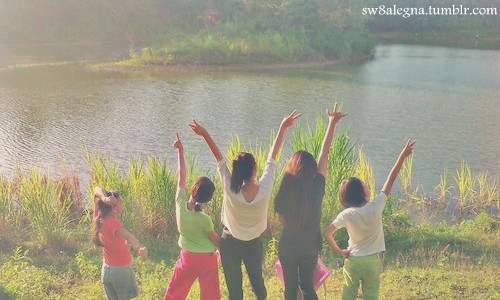
Summer in the Philippines has a personality of its own. The heat can be terribly enthusiastic, particularly during the hours when the sun seems determined to demonstrate its full capabilities. There are afternoons when stepping outside feels like entering an enormous oven, except that nobody has thought to provide a convenient temperature control. But I have always loved the way sunlight changes the appearance of familiar landscapes. Trees cast their shadows across the ground, the sky stretches above everything, and the presence of water offers a welcome contrast to the warmth surrounding it.

I remember looking at the water and the surrounding greenery, appreciating the opportunity to be somewhere that did not require me to accomplish anything. There were no hospital corridors to hurry through, no medication schedules demanding attention, and no immediate responsibilities asking to be completed. My cousins were nearby, the afternoon continued at its ordinary pace, and for a little while I could simply observe what was in front of me.
It was surprisingly difficult at first.
I have become so accustomed to thinking about the next responsibility that doing nothing feels almost suspicious. When I am at work, my attention is occupied by patients, medications, documentation, and the countless practical demands of nursing. When I am at home, there are family concerns and personal responsibilities waiting for consideration. Even during supposedly quiet moments, my thoughts have a habit of beginning conversations I never invited them to start.
Yet beside the lake, I found myself becoming less concerned with organising everything in my mind.
I watched the water, looked towards the trees, and allowed myself to enjoy the surroundings without immediately attempting to turn the experience into another lesson about life. Perhaps that was the most refreshing part. For once, I was not asking what I should do next or wondering whether I had overlooked something important. I was simply present with my cousins, grateful that we had decided to spend part of the afternoon outside.
I remember wishing that time could remain like that for a little longer.
It was a rather unreasonable request, of course. Time has never shown much interest in accommodating my preferences, and I suspect it would consider my proposed arrangements entirely impractical. Nevertheless, I liked the idea of extending those moments when the mind becomes less crowded and the world feels pleasantly uncomplicated. I wanted the afternoon to continue without another reminder that responsibilities were waiting elsewhere.
But after considering the matter, I realised that I did not actually want time to stop.
As appealing as it sounded to remain beside the lake indefinitely, life cannot be lived entirely within its most comfortable moments. There are things I still want to accomplish, people I want to spend time with, and responsibilities that will require my attention. There are also difficulties I hope our family will gradually find ways to manage. If time stopped, nothing would change, including the circumstances I have been so worried about.
I suppose I wanted something simpler than a permanent escape from ordinary life.
I wanted a little breathing space.
It is strange how difficult that can be to admit. We become so accustomed to discussing perseverance and determination that needing a break sometimes feels like an embarrassing confession. We tell ourselves to remain strong, work harder, and continue until everything has been accomplished. I have certainly repeated those instructions to myself often enough, particularly during demanding hospital shifts. But lately, I have begun to wonder whether the constant pressure to remain capable of handling everything can become exhausting in itself.
I do not think I need to prove my determination by refusing every opportunity to rest.
There are moments when taking a break is simply a sensible response to having spent too long carrying difficult concerns. We can acknowledge that circumstances remain unresolved while allowing ourselves to enjoy an afternoon with people we love. We can pray, laugh, take photographs, and appreciate the scenery without being accused of forgetting the seriousness of what is happening elsewhere in our lives.
Perhaps that was what I needed to understand.
My worries had not followed a schedule or politely disappeared when I arrived at the shrine. They were still part of my circumstances, and I knew I would have to think about them again. But for a little while, I could decide not to give them every moment of my attention. I could allow the afternoon to contain something other than fear.
And thankfully, my cousins were more than willing to contribute a little nonsense to the occasion.



At some point during our visit, they decided to experiment with an umbrella as though it were a monopod. I cannot entirely explain the engineering involved, but the result was sufficiently ridiculous to deserve photographic evidence. There we were, surrounded by a lovely natural landscape, with plenty of opportunities for quiet contemplation, and my family had somehow decided that the afternoon also required an improvised photography accessory.
Of course they did.
I should have expected nothing less.
There is a particular kind of humour that emerges when cousins spend time together. We have known one another long enough to recognise familiar personalities, and certain kinds of foolishness require very little explanation. Somebody introduces an absurd idea, another person finds it entertaining, and before long everyone is participating in something that would look completely unreasonable to an innocent observer.
I love those moments.
They remind me that family life is made up of far more than serious conversations, responsibilities, and difficult circumstances. There are also jokes, peculiar experiments, spontaneous outings, and little incidents that become funny precisely because nobody planned them. Our improvised umbrella monopod may not have been an extraordinary invention, but it gave us something to laugh about, and I appreciated that more than I could have explained at the time.
Perhaps that is one of the reasons I was so happy to spend the afternoon with my cousins. Lately, my family has been facing uncertainties that have made ordinary conversations feel more serious. We have been worried, and there are questions we cannot yet answer. But being together beside the lake reminded me that those concerns have not removed everything familiar about our relationships. We can still enjoy one another’s company, laugh at ridiculous ideas, and create new memories even while dealing with circumstances that remain difficult.
I am grateful that we still have that.
Family relationships are complicated, of course. We do not always agree, and being related does not magically eliminate misunderstandings or differences in personality. I imagine every family possesses enough material for an interesting collection of stories, including several chapters that certain relatives would strongly prefer never to see published. But there is something meaningful about recognising that, despite the difficulties we encounter, we continue finding ways to spend time together.

That afternoon, we did not need to discuss every problem.
We simply enjoyed being cousins.
I think that was enough.
As I looked across the lake, I found myself thinking about the things we ordinarily overlook while moving through our responsibilities. The water, the trees, the sunlight, and the surrounding landscape existed without requiring my approval or attention. They were simply part of the world, carrying on with their ordinary rhythms while I remained preoccupied with my own complicated thoughts.
There was something humbling about that.
I had been spending so much time thinking about everything that seemed uncertain in my life that I had almost forgotten how pleasant it could be to observe something without immediately asking what it meant for me. The lake did not offer answers to my family’s difficulties. The trees did not explain why illness had become part of our lives. The afternoon breeze could not provide a treatment plan or make the coming weeks predictable.
But the place offered something else.
It reminded me that the world still contained things worth noticing, even during a period when my attention had been occupied by worries. There were landscapes I could appreciate, people whose company made me happy, and ordinary experiences that did not need to become extraordinary to deserve a place in my memory.
As a Christian, I naturally found myself thinking about God while observing the surroundings. I have always associated the beauty of nature with His creation, and moments like that encourage me to feel grateful for the world around me. I looked at the water and greenery and wondered about the remarkable complexity of things we often regard as ordinary.
But I also found myself asking difficult questions.
If God has created so many beautiful things, why must life sometimes involve circumstances that seem terribly unfair? Why do people become seriously ill? Why do families experience difficulties they did not anticipate? Why do our prayers sometimes remain accompanied by uncertainty instead of the immediate reassurance we would prefer?
I have asked versions of those questions before.
I suspect I will ask them again.
There are times when faith seems easier to understand through gratitude than through suffering. It is natural to thank God when something good happens, when our plans succeed, or when we receive news that makes us happy. But when circumstances become frightening, the relationship between faith and experience can feel more complicated. We may believe in God’s love while struggling to understand why particular things happen.
I do not think every question requires an immediate answer.
Perhaps some are simply part of learning to live with uncertainty.
I know that faith does not mean I can predict what will happen to my aunt or guarantee that every family difficulty will be resolved in the way we hope. Medical conditions require appropriate assessment and treatment, and the future may involve decisions that are difficult to make. Prayer cannot replace those responsibilities. But I believe it can accompany us as we navigate them, offering a way to express our worries and hopes without pretending that we possess complete control.
At the shrine, I asked God for help.
Beside the lake, I found myself thanking Him for the chance to spend time with my cousins and enjoy an afternoon that had not been planned.
Perhaps those two conversations belonged together.
We often imagine prayer as something that happens only inside a church, particularly when we kneel before an altar or speak words we have memorised since childhood. Those moments are important to me, and I value the familiar structure of Catholic devotion. Yet there are occasions when my thoughts turn towards God somewhere completely ordinary, such as during a journey home or while looking at a beautiful landscape.
I suppose that afternoon allowed me to recognise another form of prayer.
Not one involving an elaborate request, but the quiet appreciation of being alive, surrounded by people I love, and able to witness something beautiful even while other aspects of life remained uncertain.
I am beginning to understand that gratitude does not require us to deny our difficulties.
I can thank God for the afternoon while continuing to worry about my aunt. I can enjoy my cousins’ company while acknowledging that our family is facing serious concerns. I can appreciate the beauty of the lake without claiming that everything in my life has suddenly become wonderful.
Perhaps the ability to recognise those different feelings at the same time is part of becoming more mature.
When I was younger, I sometimes imagined that happiness meant having no problems. I thought that if everything were arranged according to my preferences, I would finally be able to enjoy life without interruption. But the more experiences I encounter, the more I realise that ordinary life rarely provides an entirely problem-free season. There are always responsibilities, decisions, relationships, and uncertainties demanding our attention.
If I insist on waiting until every concern has disappeared before allowing myself to enjoy anything, I may spend a considerable amount of time postponing happiness.
That seems like a terribly inefficient arrangement.
I do not want to become someone who overlooks a beautiful afternoon simply because tomorrow contains unanswered questions.
Of course, this is much easier to write than to practise.
I know myself well enough to recognise that I will probably return to worrying about the same things again. I will think about my aunt’s health, my family’s circumstances, and the responsibilities waiting for me at work. I may become frustrated by the uncertainty, and there may be days when I find it difficult to concentrate on anything else.
But perhaps I will remember the lake.
Not as a place where my problems disappeared, but as somewhere I learned that I could make room for something good without first demanding that life become easier.
I find that thought comforting.
I have also been thinking about the coconut trees we saw during our afternoon. In the Philippines, coconut trees are such familiar parts of the landscape that we rarely stop to consider how extraordinary they are. Their trunks rise above the surrounding greenery, and their leaves respond to the wind in ways that make them particularly recognisable against a bright sky.
I have always associated them with tropical landscapes and the familiar scenery of home.
Yet lately, I find myself appreciating their ability to bend in the wind.
There is something worth considering in the way a tree responds to forces beyond its control. It cannot instruct the weather to behave more gently, and it cannot simply relocate whenever the conditions become unpleasant. Its survival depends upon many factors, including its structure, health, surroundings, and the strength of the weather it encounters. Not every tree survives every storm, of course, and I would not want to turn a natural image into an unrealistic promise about human suffering.
But the sight reminded me that adapting to difficult circumstances is not necessarily the same as surrendering to them.
Sometimes we must reconsider our expectations, ask for assistance, and accept that the path ahead will look different from what we originally imagined.
Perhaps our family will have to do some of that in the coming months.
I cannot know exactly what lies ahead. There may be hospital appointments, difficult conversations, and decisions that require careful thought. We will need accurate medical information, practical support, and patience with one another as we navigate the uncertainty surrounding my aunt’s illness.
I hope we will continue finding moments when we can enjoy being together.
I hope we will remember to laugh, even when some days feel serious.
And I hope we will allow ourselves to rest when we are exhausted, rather than treating every admission of tiredness as evidence that we have somehow failed.
I have been thinking about how often people tell one another to remain strong. It is a familiar expression, especially in our culture, and I understand the good intentions behind it. When someone is facing difficulties, we want to encourage them. We want them to believe that the future may still contain good experiences and that they do not have to abandon every hope simply because the present is painful.
But sometimes I wish we would be a little more careful about what we expect strength to look like.
There are days when someone may need to cry, ask questions, or admit that they cannot manage everything without help. I do not think those responses should be treated as weakness. We are human beings, not objects designed to withstand unlimited pressure without consequence.
Even the strongest person needs rest.
And even the most faithful person may sometimes ask God questions that sound more like complaints than polished prayers.
I suspect He has heard quite a few of mine lately.
There have been moments when I have looked towards heaven and asked why the difficulties seem to keep coming. I have wondered whether our family will finally receive some reassuring news, whether the concerns occupying our thoughts will become more manageable, and whether I will eventually return to the kind of ordinary days I used to take for granted.
I do not have those answers yet.
But I am learning that I do not necessarily need to resolve everything before appreciating what remains good in my life.
That afternoon with my cousins was one of those good things.
We visited the Divine Mercy Shrine, offered our prayers, and spent time beside the lake. We enjoyed the fresh air, looked at the scenery, took photographs, and laughed at an umbrella being promoted far beyond its original responsibilities. None of those activities were extraordinary, but together they made the weekend memorable.
I am glad we went.
I am also glad the outing was unplanned, because it reminded me how easily something enjoyable can emerge from an ordinary day. Had I been too preoccupied with my worries, I might have declined my cousin’s invitation and spent the afternoon continuing the same exhausting conversation inside my head. Instead, I accepted, and the decision gave me a little memory I can return to whenever the days become difficult.
Perhaps there will be more afternoons like that.
I hope so.
I want to continue enjoying the people around me, visiting places that remind me of home, and finding opportunities to appreciate the ordinary beauty of the world. My responsibilities as a nurse will continue, and my family’s concerns will still require attention. But I do not want those things to occupy every available moment.
There should be room for photographs, conversations, spontaneous journeys, and ridiculous inventions involving umbrellas.
Especially the umbrellas.
I suspect our family has only begun exploring the full possibilities of that particular technology.
As I write this on May 16, I realise that the weekend has left me with something I had not expected. I went home because I needed to attend to practical matters, visited the shrine because my cousin invited me, and ended up spending an afternoon beside a lake that offered no answers to my questions.
Yet I returned feeling grateful for the experience.
I still carry the same concerns, and I am still tired of thinking about them. I cannot pretend that the uncertainty surrounding my aunt’s health has become easier to accept simply because I enjoyed a little outing. But I can acknowledge that, for several hours, I was able to spend time with family, appreciate the scenery, and remember that life contains experiences beyond the things frightening me.
Perhaps that is enough for one weekend.
I have been asking God for so many things lately that I sometimes wonder whether I have forgotten to thank Him for what I already have. I know gratitude is not a transaction, and I do not believe that expressing it guarantees a particular answer to my prayers. But I want to remember the people, places, and opportunities that continue to give meaning to my days, even while I am worried about what lies ahead.
I am grateful for my cousins.
I am grateful for the chance to return home.
I am grateful for that peaceful afternoon beside the lake and for the familiar comfort of visiting the shrine.
And I am grateful that, despite the difficulties we are facing, our family can still find reasons to enjoy being together.
I began this entry complaining that life has become remarkably skilled at delivering problems without warning. I still believe that, and I would appreciate it if the universe considered reducing the frequency of its surprises for a while. But perhaps the unexpected afternoon with my cousins has reminded me that unplanned events are not always unpleasant.
Sometimes somebody invites you to visit a shrine.
Sometimes a simple walk leads to a lake.
Sometimes your cousins turn an umbrella into a questionable photography accessory.
And sometimes, while you are occupied with wondering how to manage the future, an ordinary afternoon offers a few hours worth remembering.
I cannot promise myself that the coming days will be easy. I cannot know what news our family will receive or how quickly the circumstances troubling us may change. But I hope I will continue making space for the people and experiences that matter to me while addressing those difficulties as carefully as I can.
I used to think that being strong meant continuing without interruption, as though stopping to rest would somehow allow my problems to defeat me. I am beginning to reconsider that idea. Perhaps there is nothing particularly admirable about exhausting ourselves unnecessarily. Perhaps we need moments when we can admit that the responsibilities have become heavy and allow someone else to accompany us for a while.
Last weekend, my cousins did exactly that, although I doubt they realised how much I appreciated their company.
They simply invited me out.
And I went.
There is something beautifully ordinary about that.
Tonight, before I finish writing, I want to offer another prayer. Lord, You know the things our family has been facing, including the worries I struggle to explain to other people. Please guide us as we make decisions, help my aunt receive the care and support she needs, and give us patience with circumstances we cannot immediately change. Thank You for the people who continue bringing laughter into our lives, for the places that remind us of home, and for the chance to enjoy a little peace amid uncertainty.
I am still tired, Lord.
I still have questions.
And there are moments when I wish You would answer them a little more quickly.
But I am grateful for the afternoon You allowed me to spend with my family, and I hope I will remember it whenever my thoughts become too crowded.
As for the sun, I realised something while looking back at our photographs. During those hours by the lake, it was already shining. It had not solved our problems, changed our circumstances, or provided the answers I had been asking for. It was simply there, illuminating the water and the familiar landscape while my cousins and I enjoyed an afternoon together.
Perhaps I have been so occupied with waiting for the sun to shine again that I almost failed to appreciate the afternoon when it did.
I do not know whether tomorrow will bring good news, another difficulty, or the ordinary mixture of both. But I hope I will remember that I do not need to understand everything about the future to appreciate something beautiful in the present.
And when I become tired again, I hope I will have the sense to rest, the courage to ask for help, and a cousin nearby with another wonderfully ridiculous suggestion.
Preferably one that does not require an umbrella to perform duties outside its job description.
May 16, 2014 — for the Divine Mercy Shrine, the lake near home, my wonderfully eccentric cousins, and a summer afternoon that reminded me how much I still have to be grateful for.
— Just Anj, RN, still asking God questions and occasionally receiving an afternoon worth remembering instead.


































Leave a Reply