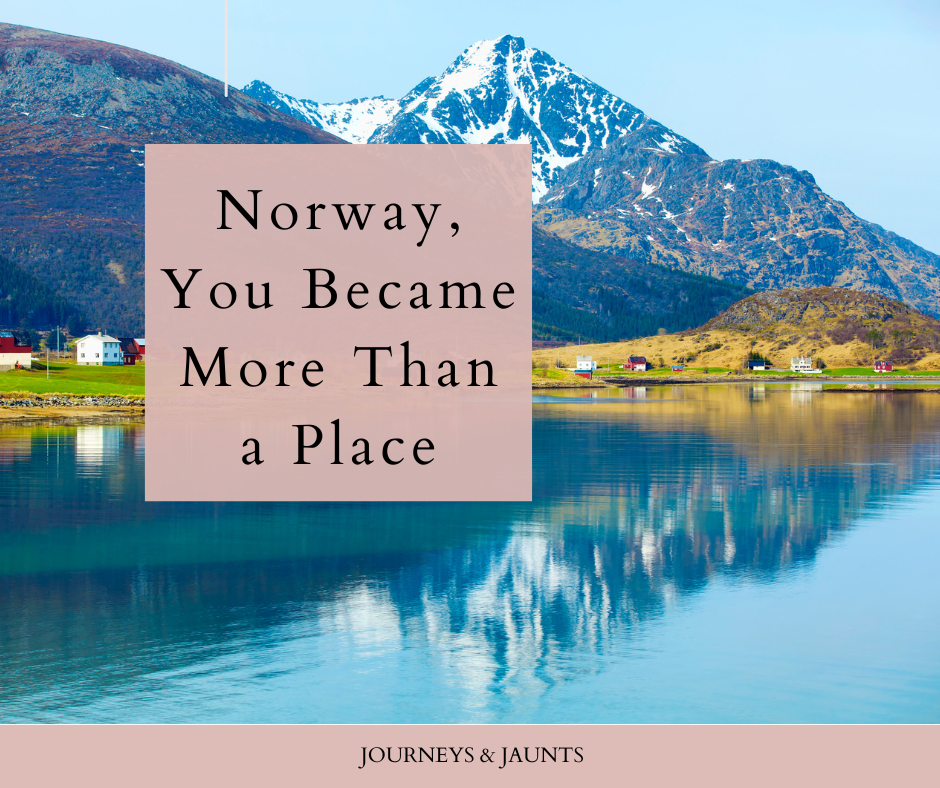
From the Arctic beauty of Lofoten and Vesterålen to Oslo’s museums and waterfront, a summer journey through Norway.
Somewhere along a road in Northern Norway, I began to suspect that the mountains were doing it deliberately. Every time I put my camera down, another one appeared around the bend, rising straight from the sea with such extraordinary confidence that I immediately reached for my phone again. There were jagged peaks, little houses resting beneath enormous slopes, narrow stretches of road, and water so still that the landscape appeared to have acquired a second copy of itself. We were travelling by bus, and I had claimed a window seat that quickly became my favourite place in Norway. Every bend in the road revealed another mountain, another stretch of shimmering water, or another little village tucked beneath the enormous peaks. I barely had time to admire one view before the next appeared, and my phone was working considerably harder than I was. At this point, I suspected the bus windows were the only things preventing me from photographing the entire Norwegian coastline.I had already taken more photographs than any reasonable person needed. Unfortunately, Norway appeared to be nowhere near finished.
We travelled from England to Norway between 30 June and 11 July 2026, combining time with Jan’s family in Sortland, a stay in Svolvær, drives through the Lofoten Islands, a fjord excursion, and several days exploring Oslo. It was my first time experiencing these particular parts of Norway, and I had deliberately looked forward to seeing the dramatic landscapes that had filled my travel searches long before the holiday began. I had seen photographs of mountains dropping towards turquoise water, fishing villages with colourful houses, and roads winding through some of Europe’s most striking coastal scenery. What I had not understood was how little those photographs could communicate the scale of the place.
Norway is an interesting country to explore because its geography changes the very nature of travelling. Distances that appear manageable on a map can involve mountain roads, bridges, tunnels, ferries, and landscapes that make you want to stop far more often than originally planned. The journey can become as memorable as the destination, particularly in Northern Norway, where the scenery refuses to remain neatly confined to official viewpoints. There were stretches when I barely knew where to look first. The road ahead was beautiful, the mountains behind us were equally impressive, and the water alongside us seemed determined to contribute another photograph before we moved on.


Our northern adventure began around Sortland, where Jan has family.
Situated in the Vesterålen archipelago, Sortland offers a different experience from the more internationally famous Lofoten Islands. It is a working Norwegian town rather than a destination built entirely around tourism, and I appreciated seeing a part of the country connected to ordinary family life. There were familiar routines, time spent with relatives, and the pleasure of experiencing Norway beyond the carefully selected attractions that dominate travel websites.
Sortland is also known as the Blue City, a wonderfully distinctive identity inspired by an artistic project that introduced blue-painted buildings and literary text into its urban landscape. I find the idea charming because it gives the town a personality beyond its natural surroundings. In a region where mountains and fjords are already competing rather successfully for attention, somebody apparently decided that the buildings deserved a little artistic recognition too. I would encourage visitors to notice these details while exploring the centre rather than treating Sortland merely as a place to pass through on the way to Lofoten.


The surrounding Vesterålen landscape deserves attention in its own right. Here, mountains meet the sea, islands are connected by roads and bridges, and the coastal atmosphere feels spacious and unmistakably northern. It is an area worth considering if you want to experience more of Northern Norway without confining your journey to the most heavily photographed parts of Lofoten. Travellers interested in outdoor experiences can explore the wider Vesterålen region, although the particular activities available will depend upon the season, weather, and how much time they have.
What struck me most was how much the landscape shaped the atmosphere of everyday life. In England, I am accustomed to travelling through towns where buildings, roads, and commercial spaces dominate the view. Around Sortland, the natural surroundings seemed to remain constantly present. Mountains formed the background to ordinary journeys, while stretches of sea appeared where I might otherwise have expected another housing estate or supermarket. It is difficult to explain how beautiful an ordinary drive can become when the surroundings look like something a landscape photographer would patiently wait hours to capture.
There was also the curious experience of Northern Norway’s summer light. Travelling at the beginning of July meant visiting during the season of the midnight sun, when the sun remains above the horizon through the night in parts of the Arctic. I had heard about the phenomenon before, but understanding it intellectually is rather different from experiencing the absence of an ordinary dark night. The familiar relationship between daylight and bedtime becomes less dependable. You look outside, see a sky that still appears remarkably bright, and wonder why your body insists that the day ought to have ended several hours ago.
For anyone visiting Northern Norway in summer, this is something worth preparing for. The extended daylight is wonderful for sightseeing and photography, particularly because it allows greater flexibility in how you organise your day. But it can also interfere with sleep if you are accustomed to darkness. Accommodation with effective blackout curtains is particularly useful, and bringing an eye mask is a sensible precaution. I would also recommend checking the local conditions for seeing the midnight sun because mountains can block direct views of the sun even when it remains above the horizon.
From Sortland, our journey took us towards Lofoten, the island region that had occupied such a prominent place in my imagination before the holiday.
If Vesterålen introduced me to Northern Norway’s coastal character, Lofoten took that character and turned the landscape into something almost theatrical. The mountains were sharper, the roads seemed to bend through increasingly dramatic scenery, and little settlements occupied narrow pieces of land between steep slopes and the sea.
I had expected Lofoten to be beautiful. I had not expected to become so fascinated by the proportions of everything. Enormous mountains appeared behind houses that seemed almost impossibly small in comparison. Fishing villages occupied sheltered bays beneath towering peaks, and the surrounding water changed colour depending upon the light. Sometimes it appeared deep blue, almost dark enough to merge with the mountains. Elsewhere, it looked remarkably clear, creating the strange impression of a tropical coastline that somebody had accidentally transported to the Arctic.
The contrast made me think of the beaches back home in the Philippines, although the resemblance becomes considerably less convincing once you consider the temperature of the water. Northern Norway can have beautiful pale beaches and striking turquoise shallows, but that does not mean the conditions resemble a warm afternoon in Cebu. The scenery may suggest a beach holiday; the Arctic air has its own interpretation of the arrangement.
One of the things I would strongly recommend in Lofoten is allowing time simply to drive and explore the landscape. The region is famous for its scenic roads, with routes connecting fishing villages, mountains, beaches, and viewpoints. Norway’s designated Scenic Route Lofoten follows parts of this extraordinary coastal landscape, including stretches between Å and Raftsundet and detours towards several well-known villages and natural attractions. If you have access to a car, it becomes easier to explore at a flexible pace, provided you are comfortable with the driving conditions.
I particularly loved the way the scenery changed from one bend to another. A narrow road might run beside the water before turning towards a mountain, crossing a bridge, or opening into a view of little houses gathered around a harbour. There were so many occasions when I wanted to stop and photograph what appeared outside the window. I learned that a sensible road trip requires making use of designated parking areas and viewpoints rather than assuming every beautiful stretch of road is an invitation to stop wherever you please. Lofoten is beautiful, but its roads still have to function for the people who live and travel there.
For photographers, I would recommend looking beyond the famous postcard compositions. Lofoten’s appeal lies not only in its recognisable villages but also in the smaller details of coastal life: fishing boats, colourful buildings, reflections, weathered timber, and mountains appearing unexpectedly between houses. A photograph of an entire fjord can be spectacular, but a quieter image of a little harbour beneath the peaks can convey something different about the region. The natural landscape is extraordinary, yet the human settlements help explain how people have made lives within it.
Svolvær became another memorable part of our journey. As Lofoten’s largest town, it offers a convenient base for exploring the surrounding region, with accommodation, restaurants, shops, galleries, and excursions departing from the harbour. I loved the relationship between the waterfront and the mountains. There is something remarkable about a town where boats, buildings, and everyday activity occupy the foreground while enormous peaks rise immediately behind them. It makes even an ordinary walk near the harbour feel unusually scenic.
We stayed at Thon Hotel Svolvær, and I was particularly grateful to Tita Marydean for the generous birthday treat that included our hotel stay and dinner. The hotel provided a lovely setting for this part of the journey, and its waterfront location suited my enthusiasm for taking photographs. Svolvær itself is worth exploring on foot, particularly around the harbour, where the boats and buildings create different views against the surrounding mountains. I enjoyed experiencing the town’s atmosphere rather than treating it simply as a place to sleep between excursions.


For visitors choosing accommodation in Lofoten, I would recommend considering the kind of holiday you want. Svolvær is convenient if you prefer having restaurants, services, and excursion operators nearby. Smaller fishing villages may offer a quieter atmosphere and more traditional accommodation, including converted fishermen’s cabins known as rorbuer. Neither option is automatically better. A town centre can be practical for first-time visitors, particularly those relying on public transport or booked tours, while smaller settlements may appeal to travellers seeking a more secluded experience.

One of the highlights of our time in Northern Norway was the fjord tour. Until then, I had admired much of the scenery from the road, looking outward towards the mountains from the car. Being on the water changed the experience completely. The landscape no longer occupied the distance beyond the windscreen. It surrounded us. Mountains rose along the sides of the fjord, rocky slopes descended towards the water, and waterfalls appeared against the cliffs like pale threads drawn down the mountainside.
The boat moved through the fjord while the scenery unfolded around us, and I found myself turning repeatedly from one side to the other. There were moments when the water looked almost impossibly calm, reflecting the surrounding rock and sky. In other places, the steep sides of the mountains made the space feel enclosed, creating a remarkable sense of scale. I had seen plenty of photographs of Norwegian fjords before travelling, but the experience of moving through one was entirely different from seeing a still image.


For anyone visiting Svolvær, I would recommend considering a guided fjord excursion, particularly towards the Trollfjord area if available during your visit. This narrow fjord is known for its steep mountains and dramatic setting, and boat excursions from Svolvær are a popular way to experience the landscape. Different operators offer different vessels, itineraries, and wildlife-focused experiences, so it is worth comparing what each trip includes before booking.
I would also recommend bringing a windproof and waterproof outer layer, even in summer. The weather on the water can feel considerably cooler than conditions on land, particularly when the boat is moving. If you intend to spend time outside photographing the surroundings, gloves or an additional warm layer may be surprisingly welcome. My general lesson from travelling in Norway is that summer does not automatically mean warm, especially when mountains, wind, and open water become involved.
The fjord tour was also one of the occasions when I eventually remembered to lower my camera. I had been photographing mountains, water, waterfalls, and Jan, apparently determined to return home with enough material to produce a complete visual record of the excursion. But there was a moment when I simply looked around without trying to frame another photograph. The scale of the landscape, the movement of the boat, and the cold air were part of the experience in ways a camera could not entirely preserve.
That was one of my favourite memories of Lofoten, and it is something I would encourage other travellers to allow themselves. Take the photographs, certainly. Norway is extraordinarily photogenic, and there is nothing wrong with wanting to preserve what you see. But occasionally, put the camera down and spend a few moments experiencing the place without considering how the image might look afterwards.
The best travel memories are not always the photographs we bring home, but the moments when we were paying enough attention to remember how being there actually felt.
I think that distinction matters particularly in destinations as visually impressive as Norway, where the temptation to document everything can become almost irresistible.


Our northern stay also coincided with my birthday on 7 July, when I turned thirty-six. Celebrating in Norway made the journey especially memorable, not simply because of the scenery but because Jan and his family made the occasion so lovely. I was grateful for the thoughtful arrangements and the birthday dinner, which gave me a personal reason to remember Svolvær beyond its extraordinary location. I would not want to turn the travelogue into a long reflection about birthdays, but I cannot separate that experience from the holiday itself. Certain destinations become meaningful because of the people with whom we experience them, and Svolvær will always carry that association for me.


After the mountains, fjords, and quiet expanses of Northern Norway, Oslo offered an entirely different side of the country. I enjoyed the contrast almost immediately. Instead of dramatic peaks dominating the landscape, there were broad streets, contemporary architecture, historical buildings, museums, and a waterfront filled with movement. Oslo felt like a capital city that had made a particular effort to retain a relationship with its natural surroundings, allowing urban life and access to the fjord to exist side by side.
Oslo Opera House
One of my favourite places was the Oslo Opera House, an extraordinary modern building beside the waterfront. Its pale exterior and sloping roof make it immediately recognisable, but what makes it particularly enjoyable is that visitors can walk across the accessible roof surfaces. Rather than being admired exclusively from street level, the building invites you to experience its architecture as part of the surrounding public space.
We walked upwards, and the city gradually opened around us. From the higher surfaces, there were views towards the Oslofjord, boats moving across the water, and the buildings surrounding the harbour. It was a wonderfully different experience from the mountains of Lofoten. In Northern Norway, I had spent much of my time looking upwards at the scenery. At the Opera House, I could look outward and downward across part of the city.


For anyone visiting Oslo, I would put the Opera House high on the itinerary, particularly if you enjoy architecture or photography. The exterior is impressive from several angles, and walking along the waterfront gives you opportunities to capture the building against the surrounding harbour. It is also worth exploring the Bjørvika area, where modern buildings, public spaces, and the nearby waterfront create a pleasant walking environment. Take care on the sloping surfaces, especially in wet or icy conditions, because attractive architecture does not exempt visitors from the usual rules of gravity.


I particularly enjoyed walking around the harbour after visiting the Opera House. There were boats, waterfront buildings, and the gentle movement of people spending time beside the water. Oslo is a city that rewards walking, especially when you allow yourself time to explore without treating every step as transportation between attractions. I liked being able to follow an interesting street or stop somewhere simply because the view appealed to me.
Akershus Fortress
Akershus Fortress was another place I particularly appreciated. Situated above Oslo’s harbour, this medieval fortress offers a fascinating contrast with the modern waterfront below. Its stone walls, historic buildings, and elevated position give visitors a sense of the city’s long history, from its defensive importance to its later roles. Walking through the grounds, I enjoyed the atmosphere created by the old architecture and the views towards the fjord.


I have always been drawn to historic places because they encourage me to imagine how people experienced the same surroundings centuries earlier. At Akershus, the fortress walls offer a reminder that Oslo existed long before the contemporary buildings, cruise ships, and busy waterfront we see today. Its grounds are especially appealing if you enjoy combining history with photography, since the architecture provides interesting details while the elevated setting allows views across the harbour.
I would recommend taking your time at Akershus rather than treating it as a quick photo stop. The outdoor grounds can be explored during their published access hours, while particular museums and interior spaces have separate arrangements. It is worth checking these before visiting if you want to see more than the exterior. Comfortable shoes are helpful because historic stone surfaces and sloping paths are not always as straightforward as modern pavements.
The National Museum
The National Museum was another essential part of our Oslo experience. After several days admiring Norway’s natural landscapes, I found it refreshing to spend time exploring its artistic heritage. The museum brings together art, architecture, design, and historical collections, offering a much broader perspective on Norwegian culture than a holiday focused entirely on scenery might provide.
I was particularly interested in seeing work by Edvard Munch. His paintings are famous for their emotional intensity, and there is something compelling about encountering artworks you have previously known through reproductions. The experience is different when you can appreciate the scale, surface, colours, and atmosphere of the original work. I enjoy museums because they provide another way of understanding a place, through the things people have created and chosen to preserve.


For visitors interested in art, I would recommend allowing at least a few hours for the National Museum rather than attempting to see everything quickly. It is a substantial institution, and the collections deserve more than an impatient walk between familiar masterpieces. If Munch is a particular interest, Oslo also has the separate MUNCH museum, which focuses extensively on his work. The two institutions offer different experiences, and visitors may want to consider both depending upon their interests and the time available.
Vigeland Park
Another memorable stop was Vigeland Park, located within Frogner Park. It is one of Oslo’s most distinctive outdoor attractions, featuring an extensive collection of sculptures by Gustav Vigeland. The figures depict people of different ages, relationships, and emotional expressions, creating a remarkable artistic exploration of human life. Some sculptures feel tender, others dramatic, and a few are so expressive that I found myself stopping simply to consider what the artist might have intended.
The park is unlike a traditional sculpture gallery because the artworks form part of an open landscape. Visitors can walk among them, observe them from different perspectives, and appreciate how the arrangements interact with the surrounding gardens and pathways. The famous Monolith, the bridge lined with sculptures, and the fountain area are among the most recognisable features.


I would recommend Vigeland Park even to visitors who do not ordinarily spend much time looking at sculpture. The setting is beautiful, the artworks are unusually accessible, and the experience encourages you to notice details that can be missed in photographs. It is also a lovely place to combine art with a leisurely outdoor walk. The sculpture park is free to explore, which makes it especially attractive for travellers who want to include worthwhile experiences without purchasing tickets for every stop.
During our time in Oslo, we also encountered the energy of football supporters, which provided a very different atmosphere from the museums and historic buildings. I enjoyed seeing how a city can shift between cultural sightseeing, ordinary routines, and the collective excitement of a sporting event. Travel is not simply about visiting official attractions. Sometimes the character of a place appears through what its residents are doing while you happen to be there.
I also remember noticing the moose artwork at Oslo Central Station, another example of how even transport hubs can contain something memorable. I have an unfortunate habit of photographing unexpected objects in stations, cafés, streets, and hotel interiors, particularly when they possess a little personality. I appreciate that a station is primarily intended to help people travel from one place to another, but if it offers interesting art along the way, I consider that a perfectly reasonable invitation to stop and look.
By the time our journey approached its end, I felt that we had experienced two wonderfully different versions of Norway. Northern Norway had been defined by dramatic scenery, long daylight hours, mountains, islands, and the sea. Oslo offered history, art, contemporary design, architecture, and a capital city that remains closely connected to its waterfront. I would not recommend choosing between the two simply because they offer different experiences. If time and budget allow, combining them creates a more varied understanding of the country.

For anyone planning a similar summer itinerary, I would suggest allowing approximately ten to twelve days if you want to explore both Northern Norway and Oslo without making every day excessively busy. Our trip lasted from 30 June to 11 July, although part of that time was devoted to visiting family rather than conventional sightseeing. A first-time visitor might allocate several days to Lofoten and Vesterålen, followed by two or three days in Oslo, adjusting according to travel connections and personal interests.
Transport deserves early consideration. Northern Norway is geographically extensive, and moving between the islands and major towns can take more time than a map initially suggests. A car provides flexibility for scenic drives, but visitors should be prepared for changing weather, narrow roads, and popular viewpoints that may be busy during the summer season. Public transport is possible, although journeys may require more planning and connections. Norway’s national travel planner, Entur, is useful for checking routes across different transport services.
Accommodation is another area where planning ahead can make a significant difference. Summer is a popular time to visit Lofoten, and the most desirable locations can become busy. If you have particular accommodation in mind, particularly a waterfront hotel or traditional fishing cabin, it is worth making arrangements well in advance. Svolvær offers convenience for excursions, restaurants, and transport, while smaller villages may suit travellers seeking a quieter atmosphere.
I would also advise preparing for Norway’s prices. It is generally a costly destination compared with many other European holiday options, particularly when accommodation, dining, excursions, and transport are combined. It helps to decide in advance which experiences matter most to you. A fjord excursion or a special hotel stay may be worth prioritising, while scenic drives, harbour walks, and many natural viewpoints can provide extraordinary experiences without requiring expensive admission tickets.
Packing for Norwegian summer deserves more thought than simply checking the calendar. Northern Norway can be cool, wet, and windy even in July, and weather conditions may change throughout the day. Layers are essential, along with a waterproof outer jacket and comfortable footwear. Oslo may feel considerably warmer, so a varied wardrobe is more useful than preparing for one consistent climate. I would also bring a portable charger, particularly if you intend to photograph as enthusiastically as I did. Norway’s mountains are beautiful, but they are remarkably indifferent to the remaining percentage of your phone battery.
One practical detail I would emphasise is the difference between travelling for scenery and travelling to complete an itinerary. In Lofoten, it can be tempting to identify every famous viewpoint and turn the entire holiday into a race between locations. I would encourage a slower approach. Choose the places you genuinely want to experience, allow time for the journeys between them, and accept that unexpected stops may become some of your favourite memories. The roads themselves are part of the attraction, and a visit feels much more enjoyable when you are not constantly worrying about reaching another location before a particular hour.
The same principle applies in Oslo, although for different reasons. It is possible to fill several days with museums, architecture, parks, and historical attractions, but I would also leave room for walking by the harbour, stopping for coffee, and exploring streets that were never included in the original plan. A city reveals more of itself when we occasionally allow our curiosity to determine the route.
What I especially appreciated about Norway was its ability to offer grandeur without demanding that every experience become complicated. In the north, some of the most memorable moments happened while looking out of a car window. In Oslo, I enjoyed standing on the roof of a building, walking through a park filled with sculptures, and observing the harbour. These were places worth visiting not simply because they photographed beautifully, but because they offered different ways of experiencing the country.
I still think about how often I interrupted our drives through Lofoten. I would take a photograph of a mountain, lower the phone, and begin a conversation, only for another view to appear that seemed to deserve immediate attention. At the time, I was convinced that I needed to capture as much as possible because the scenery was so extraordinary. Looking back, I appreciate something slightly different about those moments. The photographs are wonderful reminders of where we travelled, but the journey itself was never contained entirely within them.
There were the long roads, the changing light, the excitement of recognising a landscape I had once only seen online, and the pleasure of sharing the experience with Jan. There was the fjord tour, the birthday in Svolvær, the generosity of his family, and the contrast of eventually wandering through Oslo’s museums and waterfront. Those experiences are part of what made the trip memorable, even though no single photograph could contain all of them.
If I returned to Norway, I would happily explore more of Lofoten, spend additional time in Vesterålen, and discover the places we did not manage to include in our first itinerary. I would also return to Oslo, particularly for its museums, architecture, and the easy pleasure of walking around the harbour. Norway has enough variety to make another journey feel different from the first, especially when the seasons can transform the same landscape so dramatically.
recommendation:
For a first-time visitor, my recommendation is to experience both sides of the country if you can: the spectacular natural scenery of the north and the cultural attractions of its capital. Allow yourself to be impressed by the famous landscapes, but pay attention to the ordinary details too. Take the fjord excursion, explore the waterfront, walk through the museum galleries, and spend a little time in places where the view is beautiful without requiring you to accomplish anything.
And if you find yourself driving through Lofoten, keep your camera somewhere convenient.
I would like to claim that after this trip I have become a more disciplined photographer, capable of admiring an extraordinary landscape without feeling compelled to document it from every conceivable angle. Unfortunately, I have seen my own camera roll, and the evidence suggests otherwise. I still have far too many photographs of Norwegian mountains, some of which I cannot reliably distinguish from one another without examining the surrounding road or houses.
But perhaps that is a fair record of how I experienced the country. Norway gave me a landscape so beautiful that even after hundreds of photographs, I kept finding something new to admire.
I began the journey looking through a car window, convinced that every bend in the road had somehow produced a better view than the last. By the time we returned to England, I had discovered that Norway offered much more than the mountains I had originally travelled to see. It had given us coastal roads, fjords, a family celebration, a beautiful northern town, historic fortifications, art museums, modern architecture, and an entirely different understanding of what a summer holiday could look like.
Yet I suspect the next time I visit, the same thing will happen again. Jan will be driving, the road will turn, another mountain will rise beyond the water, and I will reach for my camera with all the enthusiasm of someone encountering the Norwegian landscape for the very first time.
Some destinations encourage you to collect souvenirs.
Norway, apparently, encourages you to collect mountains.
— Anj,
still photographing Norway one mountain too many.



Leave a Reply