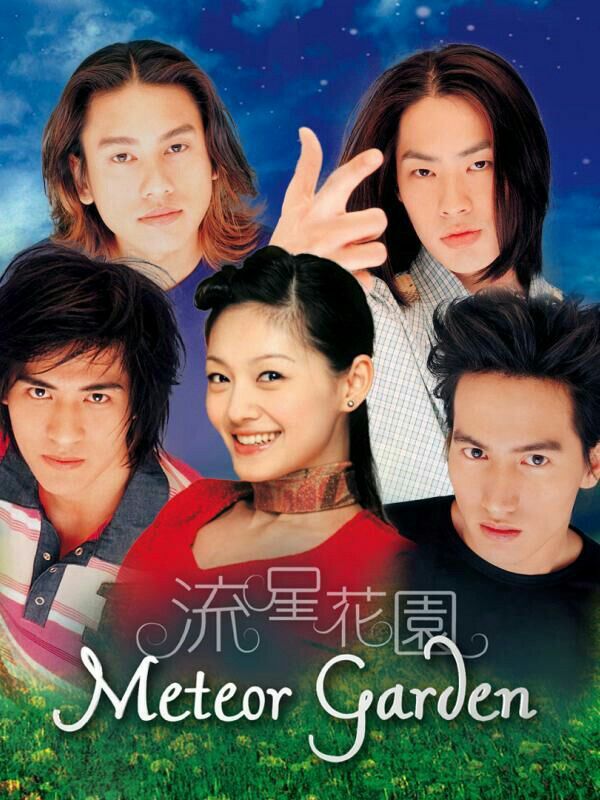
I heard the song before I properly looked at the screen, and that was probably why it got me. There are songs you hear with your ears, and then there are songs that seem to bypass the present altogether, sneak past logic and pull an old version of you out of storage without asking permission. The first few notes came through my phone and, before I had even registered the four men standing beneath the stage lights, my mind had already gone elsewhere. A school uniform. Afternoon heat. A bag dropped somewhere near the door with all the grace of a small accident. Shoes abandoned in two different directions. A television switched on with the urgency of a national emergency because Meteor Garden was about to start and, at thirteen, I apparently believed homework had flexible working hours.
Then I looked properly and there they were: Jerry Yan, Vic Zhou, Vanness Wu and Ken Chu. F4. All four of them standing together again, older now, changed in the ordinary way time changes everybody, yet familiar enough for my brain to completely disregard more than two decades of adulthood. For several seconds, 2025 felt very badly organised. I was holding a smartphone, surrounded by notifications and adult responsibilities, while some ancient department in my memory had apparently pressed an emergency button marked TAIWANESE DRAMA, CIRCA ADOLESCENCE.
I stared longer than I care to admit. The room around me had not changed. My phone was still warm in my hand, ordinary life continued nearby, and whatever I had been doing before the clip appeared remained patiently unfinished. Yet something inside me had already travelled backwards. I was no longer thinking about work, passwords, bills, appointments or the suspicious number of things adulthood insists are urgent. I was thirteen again, and apparently thirteen-year-old me had been sitting quietly somewhere inside all this time, waiting for four Taiwanese men to sing the correct song.
There was once a version of me who could get from school to the television faster than I can now get from the sofa to answer the door. Meteor Garden was starting, and this was not a situation in which delays were tolerated. My school bag landed wherever gravity accepted it. Shoes separated without agreement. Homework entered temporary suspension. If somebody needed the television at the same time, I suddenly discovered diplomatic skills that were unavailable to me in every other area of life. That programme did not merely air at a particular hour; it governed the afternoon.
Missing an episode was not a minor inconvenience. It was social sabotage. The following morning, classmates would already be discussing who had said what, who had looked at whom, whether Dao Ming Si had redeemed himself sufficiently to remain attractive, and whether Hua Ze Lei had once again destabilised everybody emotionally by doing little more than standing somewhere looking thoughtful. If you had missed the episode, you had two choices: confess your ignorance or nod along with the confidence of somebody who understood absolutely nothing. We did not merely watch Meteor Garden. We carried it into school, into notebooks, into crushes and into debates conducted with far too much seriousness for people who still needed permission to leave the classroom.
Notebooks were especially dangerous territory. Somewhere between maths exercises and science notes, hearts appeared in margins containing names that would have caused immediate embarrassment if discovered by the wrong classmate. “Dao Ming Si + Me” felt perfectly reasonable in an era when realism had not yet developed properly. We chose favourites, defended them, changed our minds and judged fictional romantic decisions as though we were qualified relationship counsellors despite having approximately zero useful experience in the field. Teenage confidence really is extraordinary.
Looking back, there was something wonderfully ceremonial about the way we watched television then. There was no endless library waiting for us whenever we felt ready. The programme came at a particular time, and therefore so did we. We anticipated things. We waited. We talked about yesterday’s episode today. If you missed something, there was no immediate replay conveniently waiting online. You relied on a classmate’s reconstruction of events, which usually contained enough exaggeration to qualify as a separate adaptation.
Even going to the toilet required strategic planning. There was no pause button. “I’ll watch it later” was reckless thinking because by tomorrow somebody would have already ruined every important moment before first period. Bladder management therefore became part of responsible fandom. Nobody warned us that Meteor Garden was also preparing us for adult life by teaching patience, commitment and the consequences of poor scheduling.
Then life continued, because life is terribly efficient at moving forward whether or not we have finished appreciating a chapter. School uniforms disappeared from the wardrobe. Notebooks were eventually thrown away. The names once written inside carefully drawn hearts became memories so faint I would probably need archaeological assistance to recover them. We finished school, chose careers, gained responsibilities, crossed places we once knew only from maps and discovered that adult love bears surprisingly little resemblance to television scenes accompanied by perfectly timed background music.
Some people moved away. Some built families. Some started again. Some carried losses they could never have imagined while sitting in front of a television after school. Somewhere along the way, F4 stopped being part of ordinary conversation and became something stored in the same internal cupboard as VCDs, handwritten song lyrics, old school notebooks and that unmistakable sound an older television made when it was switched on.
I did not think I missed any of it until four men walked onto a stage.
That was the strange thing about seeing them together again. I was obviously looking at the men they had become, because time had happened to them too. Their faces carried years. So did mine. Yet memory kept laying another image over the one on my screen, and for a moment I could see both versions at once: the young men preserved in an old television drama and the adults standing beneath stage lights decades later. Perhaps that was partly why the reunion moved me. Time had not stopped for them merely because a generation remembered them a certain way, and seeing that felt unexpectedly reassuring.
We often say we miss a programme, a song, a celebrity or a particular decade, but I think sometimes we are missing something more difficult to name. We miss the person we were when those things mattered to us. Nostalgia disguises itself as entertainment, then quietly hands you an old version of yourself.
I was not only watching F4. I was remembering the girl who raced home from school, whose world was still small enough for one television episode to become the most important event of the afternoon. She had not yet crossed oceans. She had not yet learned certain kinds of grief. She did not know how many passwords adulthood would require or why every important organisation would eventually insist she create another one. She had not accumulated the weight that comes from living long enough to love people, lose people, change plans and discover that some dreams arrive differently from the way we imagined them.
For a few minutes, she was remarkably easy to find.
That may be the peculiar kindness of old music. It keeps copies of us. A photograph can show you how you looked, but a familiar song can return the temperature of an entire period. Suddenly you remember classrooms, afternoon light, the smell of school paper, the feel of a uniform after a hot journey home, friends whose voices you have not heard in years, ridiculous arguments that once seemed important and feelings you had forgotten had ever been so enormous. Memory apparently stores much more than we authorise.
The performance itself lasted only minutes, but the memories had no respect for running time. One moment became another. I remembered waiting for episodes, talking about them in school, rewatching scenes whenever we could and believing, with the confidence available only to teenagers and fictional protagonists, that love should probably involve dramatic declarations, considerable suffering and at least one misunderstanding that could have been resolved through basic communication.
I laughed at myself while watching, and then, rather inconveniently, became emotional again. Nostalgia has that annoying habit of making you laugh immediately before it punches somewhere softer. Those old memories now come attached to people who have changed, places that look different and versions of ourselves that cannot simply be summoned whenever we want them. Nostalgia lets you visit, but it does not hand you the keys.
Maybe that was why seeing F4 together mattered to me beyond the reunion itself. It reminded me that the things belonging to our younger years are not always completely lost simply because we stopped thinking about them every day. They can disappear for years, hidden beneath work schedules, responsibilities and everything else we accumulate, then suddenly return through a phone screen and knock on a door inside us that apparently was never locked.
And I liked that they looked older. I did not need them preserved forever as the young men from Meteor Garden. Seeing the years on them somehow made the moment more meaningful. We had all gone somewhere. Their lives had travelled through decades we knew only from a distance, while ours scattered into jobs, relationships, countries, families, griefs, achievements and private histories nobody else could completely know. Yet one familiar song created a small meeting place between who we had been and who we had become.
I started watching the clip as the person I am now, but by the end I felt as though there were two versions of me sitting in front of that screen. One knew about work, responsibility, loss, resilience and all the strange negotiations adulthood requires. The other still had homework waiting inside a school bag because Dao Ming Si was on television. Somehow neither version cancelled the other out.
Perhaps that is what growing older actually looks like. We do not replace ourselves completely. We collect ourselves. The child, the teenager, the young adult and the person we are now all remain somewhere inside the same life, occasionally bumping into one another when a smell, a street, a photograph or an old song opens the right door.
I do not want to return permanently to being thirteen. Childhood was not perfect, and adulthood has given me people, places and experiences my younger self could never have imagined. But I am glad she is still here somewhere. I am glad responsibility did not completely erase wonder. I am glad maturity did not confiscate silliness. I am glad a person can carry difficult memories and still become embarrassingly happy because four men from an old television drama suddenly appeared together on a stage.
Perhaps that was why I cried. It was not only because F4 had reunited. Somewhere between the first familiar note and the last, more than twenty years briefly folded in half. The distance between a schoolgirl racing home in the afternoon and the woman holding a phone in 2025 became strangely small.
Eventually the clip ended. My screen dimmed in my hand, the room returned to itself and adulthood, persistent creature that it is, was still waiting with everything I had been doing before I pressed play. Nothing had actually travelled backwards. No clock had reversed. No old afternoon had been restored.
But for a few minutes, four familiar voices had opened a door.
And somewhere behind it, a thirteen-year-old girl was still running home from school, hoping she had not missed the beginning.
Still making it home before 4:30,
Anj ☄️


































Leave a Reply