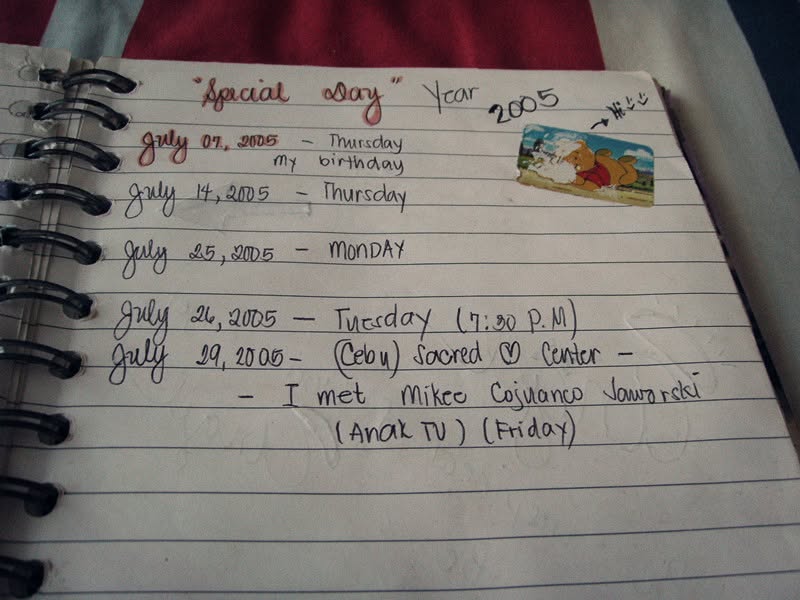
I found an old notebook and made the mistake of reading myself. A younger version of me had written down plans with the confidence of someone apparently under the impression that life accepted advance bookings. There were dates, goals, little expectations tucked between ordinary notes, and the unmistakable certainty that if I worked hard enough, loved enough, waited patiently enough, then things would unfold in roughly the order I had imagined. The notebook had structure. The future, unfortunately, had not agreed to the arrangement.
I sat there turning pages and recognising the handwriting far more easily than I recognised the person behind it. She was still me, obviously. Same tendency to overthink. Same habit of making plans as though organisation might intimidate uncertainty into behaving. Same need to understand where life was going before it had properly got there. But she knew so little about what was ahead, and I knew far too much.
She did not know which plans would collapse, which people would leave, which goodbyes would divide life into before and after, or how much courage she would eventually need for things she had not even thought to fear yet. She did not know which opportunities would arrive unexpectedly, which disappointments would later look like redirections, which versions of herself would have to be left behind, or how many times she would discover that survival is sometimes far less dramatic than people make it sound. Sometimes survival is simply getting through Tuesday and remembering to eat.
There is something strange about reading an old version of yourself when you already know what happens next. It feels almost unfair. She is writing from one side of the story while I am reading from the other, carrying information she did not have. I know which hopes lasted. I know which ones did not. I know which heartbreaks eventually stopped hurting in the same way. I know the losses she never anticipated and the people she thought would remain forever. I also know the things that worked out better than she could have planned.
And that is probably one of the first things time teaches us: hindsight can make us cruel if we are not careful.
It is very easy to look back at an old decision and think, how did I not know? How did I not see that coming? Why did I stay? Why did I trust that? Why did I think that was enough? Why did I believe that plan would work? But the person making those choices did not have access to the years that came afterwards. She was working with the information she had then, not the wisdom I have now.
I used to judge younger versions of myself more harshly than I do now. I wanted her to have known better. I wanted her to have been less trusting in some places, braver in others, more discerning, more patient, less afraid, less eager to prove herself. I wanted her to possess lessons she had not lived long enough to learn yet. Looking at those old pages, though, I realised how unreasonable that was.
You cannot demand hindsight from someone who is still standing in the before.
Time does not teach everything immediately. It has terrible customer service. Lessons rarely arrive neatly labelled. Most of them turn up disguised as confusion, disappointment, repetition, loss, embarrassment, waiting, or the occasional decision you will later describe as “character building” because admitting it was simply a disaster feels less elegant. Only afterwards do we begin to understand what happened.
When I was younger, I thought growth meant becoming a more polished version of the same person. I assumed adulthood would be mostly additive: more confidence, more knowledge, perhaps better clothes, hopefully more money, and eventually some mysterious level of competence where everyone knows exactly what they are doing. I did not understand that life changes the narrator as much as it changes the story.
Some experiences do not simply add something to you. They rearrange you.
Grief does that. Love does too. Failure. Leaving home. Starting again. Losing people. Becoming responsible for things you once thought adults handled automatically. Discovering that adults were improvising the entire time is one of life’s less reassuring revelations. There are moments when everything you believed about yourself fractures slightly, and you are forced to rebuild with fewer illusions and a much clearer idea of what matters.
Those experiences do not always make us stronger in the triumphant way people like to describe. Sometimes they make us more careful. More tender. More suspicious of easy answers. More selective about who receives our time and trust. Sometimes growth looks less like becoming fearless and more like understanding which fears deserve attention and which ones have been running the department without qualifications.
Time works differently from major life events. Big events can crash into us, but time usually operates through repetition and distance. It lets us revisit things after the emotional weather has changed. Something that once felt unbearable can eventually become understandable. Something we thought was rejection may later look like protection. A decision we regretted may turn out to have led somewhere important. A relationship we were devastated to lose may later be one we are grateful did not follow us into the future.
That does not mean everything happens for a reason, or that every painful thing needs to be turned into a beautiful lesson. Some things were simply painful. Some losses remain losses. Some choices would still be different if I had the chance to make them again. But time can change the size and shape of what happened. It can move something from the centre of your life to the edge without pretending it never mattered.
I think that is one of the kinder things time eventually offers.
It also changes urgency.
I used to think life had a timetable. Certain things should happen by certain ages. Career milestones. Relationships. Marriage. A home. Success. Stability. Some invisible checklist seemed to exist somewhere, and I was convinced everyone else had received a copy except me. If something took longer than expected, it felt like delay. If somebody else reached a milestone first, it was difficult not to treat their progress as evidence that I was behind.
Now I look back and wonder why I was in such a hurry.
The years have taught me that a life can look late from the outside and still arrive exactly where it needs to. They have taught me that speed and direction are not the same thing. Some people reach milestones early and discover they were not ready for them. Others take longer and build something sturdier because of the waiting. Some plans work beautifully. Others collapse and leave enough space for something we would never have chosen while still following the original plan.
Not everything that ended was a failure.
That took me a long time to understand.
We are often so determined to make things last that we assume duration proves value. A friendship ending does not erase the years when it was meaningful. A job we leave was not necessarily wasted because it was not permanent. A dream that changes does not mean we lacked commitment. Sometimes something belonged to one version of us and simply did not belong to the next.
The notebook reminded me of that too. Some of the things I once wanted intensely no longer interest me. Some goals I would have considered essential now seem strangely irrelevant. Other things I barely thought about then have become central to the life I value now. Peace matters more. Health matters more. The people I can be fully myself around matter more. Time with family matters more. Work still matters, ambition still matters, but they sit differently inside me now.
I am less interested in looking impressive and more interested in feeling aligned with the life I am actually living.
That is not something younger me would necessarily have understood. She was still collecting proof. Proof that she was capable. Proof that she was progressing. Proof that she had made the right decisions. Proof that other people could see she was doing well. There is an exhausting amount of performance hidden inside wanting to be recognised as successful.
Eventually, you get tired.
And perhaps that tiredness is useful.
You start asking different questions. Not “Does this look good?” but “Do I actually want this?” Not “Will people understand?” but “Can I live with this choice?” Not “Am I behind?” but “Behind whom?” Not “What should I have achieved by now?” but “Do I like the person I am becoming while trying to achieve it?”
Those questions are less glamorous, but they have been far more useful.
Time also changes what we remember.
I used to assume the biggest events would become the strongest memories. Some do. But increasingly, what returns to me are details I never thought to preserve: a familiar road, a particular laugh, the way light looked in a room, someone sitting nearby, a song playing at the wrong moment, an ordinary conversation whose importance became visible only years later.
Perhaps that is why certain songs can be dangerous.
They collapse time without permission.
A few notes can bring back a place you have not thought about in years. Suddenly you remember who you were when you first heard it, what you worried about, who you loved, what you believed would happen next. For several minutes, the distance between then and now becomes strangely thin.
That is what Castle on the Hill does for me. It carries that feeling of looking back without pretending you can return. Not because the past was perfect, but because it belonged to a version of life that existed before certain things had happened. Before particular losses. Before some lessons. Before you knew how quickly years could accumulate while you were busy thinking you had plenty of them.
Music can make nostalgia feel like geography.
One second you are here, and the next you are standing somewhere you have not physically visited in years.
But I do not think nostalgia means we are supposed to go backwards. That is another thing time has taught me. Missing who you were is not the same as wanting to become that person again. There are things I admire about younger me. She hoped easily. She believed in plans. She could imagine futures without immediately calculating everything that might go wrong. There was something beautiful in that innocence.
But she was also carrying fears I no longer have, trying to prove things I no longer care about, and giving too much importance to opinions I would barely notice now.
I do not want to erase her.
I just do not need to return to her.
Perspective changes when you realise becoming is not betrayal.
We sometimes talk about “finding ourselves” as though somewhere beneath adulthood is one fixed version waiting to be recovered. I am not sure I believe that anymore. I think we keep meeting ourselves in different forms. The person I was at twenty was real. So was the person I became after grief. So was the person who moved countries, the one who learned to begin again, the one who became more cautious, the one who became more grateful, and the one sitting now with an old notebook in her hands.
They all belong to the same story.
None of them has to remain forever.
There is relief in that.
I turned another page and found more plans. Some happened. Some did not. Some became completely different things. A few made me laugh because apparently younger me had enormous confidence in the scheduling department. She had given the future deadlines, and the future had ignored nearly all correspondence.
Strangely, I did not feel disappointed for her.
I felt fondness.
She was trying.
She was using what she knew.
She was building a life with the tools available to her at the time.
And she kept going long enough for me to sit there years later and understand things she could not.
That may be the perspective time gives us in the end. Not the ability to explain every event, and certainly not the power to make every painful thing worthwhile, but enough distance to hold our own history with more grace. We stop demanding that our younger selves should have known everything. We stop treating every ending as evidence of failure. We become less interested in racing towards milestones simply to prove that we are moving.
We begin to understand that life is not a project to complete on schedule.
It is something we keep learning how to inhabit.
When I finally closed the notebook, I did not feel tempted to rewrite any of the old pages. The mistakes were still there. So were the hopes, the plans and the confidence of someone who believed life might cooperate if she organised it properly. I could have looked at those pages as evidence of how much she did not know.
Instead, I realised they were evidence of how far she was willing to go without knowing.
I had written the plan down.
Life wrote something else.
And somehow, between the two, I became someone neither of us could have planned exactly.
I think she would be surprised by me.
I hope she would be proud.
Apparently, life never signed the itinerary,
Anj 🖤


































Leave a Reply