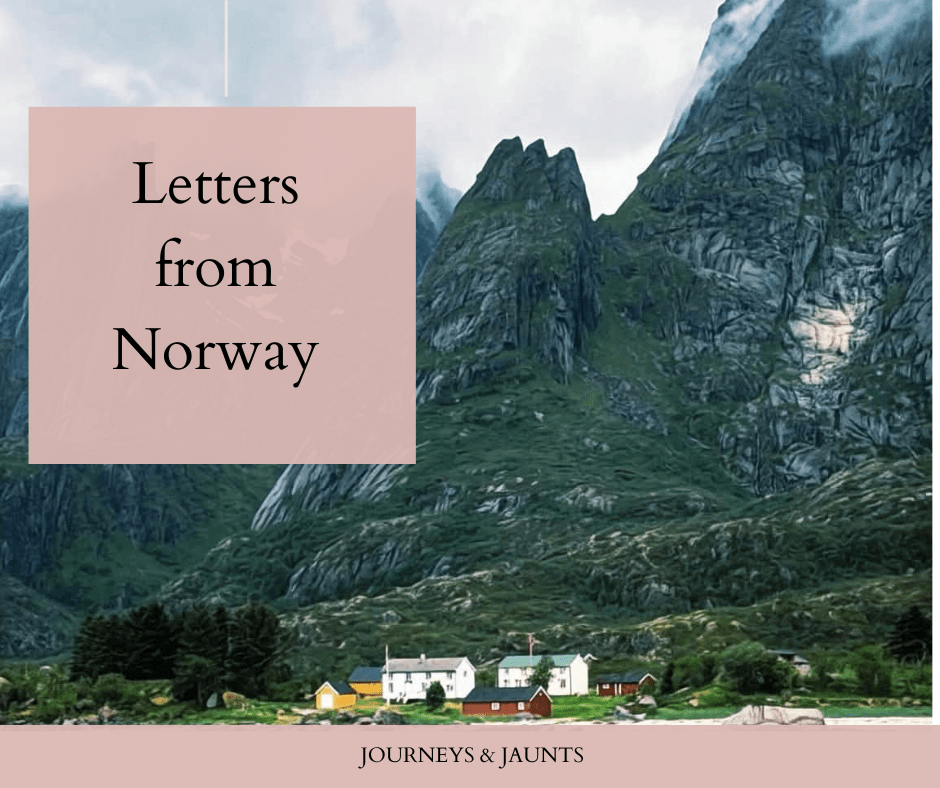
A Little Farther North
I have always thought birthdays have a strange way of making us count things. Not only candles, but years, achievements, plans, the things we managed to do, the things we thought we would have done by now, the dreams that arrived on time and the ones that apparently never received the schedule we prepared for them. Maybe that is what happens as we get older. Birthdays stop being only about cake and presents and slowly become little annual meetings with ourselves. So, how are we doing? It is not always a comfortable question. This year, however, I found myself answering it somewhere much farther north than usual.
Norway.


I went there during my birth week expecting exactly what most people probably expect from Norway: mountains, fjords, beautiful roads, cold air and enough photographs to make choosing which ones to post unnecessarily difficult. I knew it would be beautiful. It is almost impossible to look at photographs of Norway beforehand and expect anything else. What I did not expect was how quiet that beauty would make me.
Norway did not impress me loudly. It did not need to. There were moments in Lofoten when I would simply look outside the car window and stop speaking halfway through whatever I was saying. The mountains seemed almost too perfectly placed. The water looked impossibly still. Small houses sat beneath enormous landscapes as though somebody had carefully arranged them there. Roads curved between mountains and sea, disappearing somewhere ahead, and every few minutes there seemed to be another view that made the previous one feel like it had merely been preparing us. I remember looking out and thinking, Is this actually real? Photographs do that sometimes. They prepare you for what something looks like without preparing you for what it feels like to stand inside it.


And Norway felt enormous. Not crowded enormous. Quiet enormous. There is a particular feeling that comes from standing in front of a mountain. It makes your problems feel strangely embarrassed for having occupied so much space in your head. The mountain does not know about your deadlines. It does not care about the email you have not answered. It has absolutely no interest in your five-year plan. It does not ask what you do for work, whether you have achieved enough for your age, how much money you have saved, what mistakes you made ten years ago, or whether your life looks impressive to anybody else. It simply stands there. And somehow, standing beneath something that existed long before your worries and will probably remain long after them rearranges your sense of importance in the nicest possible way. Some places do not make you feel small to diminish you; they make you feel small enough to remember that not everything you carry deserves to feel enormous.
I think I needed that. Life has a way of becoming very loud without us noticing. There is always something—work, responsibilities, messages, bills, plans, things we need to remember, things we forgot to remember, people who need something, things we want to achieve and things we think we should already have achieved. Somewhere inside all of that, we become very good at continuing. I am particularly good at continuing. I can be tired and continue. Busy and continue. Worried and continue. I suspect many adults are the same. We wear exhaustion almost like evidence that we are doing life properly. We say, “I’m tired,” and then continue doing the exact things that made us tired in the first place.
Rest becomes something we schedule after everything else is finished. The problem, of course, is that everything is never finished. There will always be another shift, another responsibility, another expense, another message, another plan, another Monday. Norway reminded me of something ridiculously simple that I somehow keep forgetting: the world continues even when we stop for a while. The mountains were not rushing. The water was not trying to become more productive. The evening did not apologise for arriving slowly. Nothing seemed particularly concerned with proving that it had been busy enough that day, and yet everything was exactly where it needed to be. Maybe rest does not always have to be earned. Maybe sometimes being tired is already enough of a reason.


The fjord tour made that thought even harder to ignore. I had seen photographs beforehand, of course. I knew what fjords looked like. At least I thought I did. Then the boat began moving through the water. Mountains rose around us, waterfalls came down the cliffs, birds crossed above the sea, and the air had that cold sharpness that makes you suddenly aware of every bit of exposed skin. The water seemed to carry us through the landscape rather than simply across it. And naturally, I took photographs. Lots of them. Anyone who knows me would have expected nothing less. My phone and camera become almost additional limbs when I travel. If something is beautiful, I photograph it. If it is very beautiful, I photograph it approximately seventeen times from angles that, when I look at them later, are almost identical.
I make no apologies for this. I like photographs. I like knowing that years from now I will be able to look at an image and remember that I stood there. But there was a moment on that fjord when I lowered the camera. I cannot remember exactly why. Maybe I had already taken enough photographs, although I am not entirely convinced I understand the meaning of “enough photographs.” I just stopped and looked. No screen between the view and me. No attempt to frame it properly. No thought about whether I would post it later. Just water, mountains, cold air and the strange feeling of being completely present somewhere. It lasted only a moment, but I remember the feeling more clearly than many of the photographs.
That stayed with me because I have always believed in preserving memories. Maybe part of me is afraid of forgetting. People change. Places change. Life changes frighteningly quickly. Photographs give us something to hold when time begins taking the details away. But Norway reminded me that there are two ways of keeping a moment. One is to record it. The other is to actually be inside it. A photograph can remind us what a moment looked like; presence is what allows us to remember how it felt. I still took the photographs, obviously. Personal growth has limits. But every now and then, I put the camera down.


And the fjord felt different when I did. It did not simply look peaceful. It felt like peace. The kind of peace that does not come because everything in life has finally been solved. Nothing had been solved. My responsibilities were still waiting in England. Work had not mysteriously disappeared. Bills had certainly not received news that I was on holiday and decided to cancel themselves. Life was still life. But for those few hours, none of it required an answer from me. I could simply exist.
Perhaps that is one of the reasons travelling has become important to me. People sometimes describe travel as escaping reality, but I have never really experienced it that way. You cannot escape your life simply by boarding a plane. Your thoughts are surprisingly efficient travellers; they do not even need luggage. But distance can change the volume of things. When you stand somewhere completely unfamiliar, the worries that seemed enormous at home can suddenly become quieter. Not gone. Just placed back into proportion.
Maybe my work has something to do with the way I see travel too. Working in healthcare means seeing how quickly an ordinary day can become the day that divides someone’s life into before and after. People wake up expecting breakfast, errands, work, dinner, another ordinary evening—and sometimes life changes before lunchtime. It teaches you something about the fragility of routine. We spend so much time assuming there will be another weekend, another summer, another birthday, another chance to make the trip, another opportunity to say what we meant to say. Most of the time there is. Until one day there isn’t. Perhaps that is why travelling, for me, has never simply been about collecting destinations. It reminds me to participate in my own life while I still can. We spend years preparing for the future as though the present were merely the waiting room.


Celebrating my birthday in Norway made that thought feel even more personal. Birthdays used to make me look at what was missing. What have I achieved? What should I have by now? Am I where I thought I would be? There is something about adding another year to your age that makes the imaginary timeline in your head suddenly become very talkative. But standing there, surrounded by mountains that had existed long before any of my plans, I realised how exhausting it is to constantly measure a life instead of receiving it.


Maybe I do not need every birthday to prove that I am progressing. Maybe being alive to see another one is already worth celebrating. Maybe the better question is not, Have I achieved everything I thought I would by this age? Maybe it is, Have I noticed the life that happened while I was trying to achieve it?
And I noticed it in Norway. I noticed the people beside me. I noticed Jan. I noticed the warmth of his family. I noticed the generosity of Tita Marydean, who made my birthday even more meaningful with the lovely hotel stay and birthday dinner. I remember thinking that kindness has an interesting way of attaching itself to memories. Years from now, I may forget exactly what was served at dinner. I may forget what time we arrived or what I was wearing. But I will remember how cared for I felt. Perhaps that is what genuine generosity gives us. The gift eventually disappears, the meal ends, the hotel becomes somewhere we once stayed, but the feeling of being remembered survives much longer.
There were ordinary moments too, of course. Travel photographs are terribly dishonest about feet. Nobody posts a beautiful landscape and captions it, My legs are absolutely finished. We walked until we were tired. We carried bags. We worried about luggage allowance. We reorganised things that had somehow fitted perfectly before the trip but apparently expanded while we were not looking. We became hungry. Plans changed. There were moments of stress. There always are. But I think that is part of what makes travelling real. Perfect trips probably exist only after someone edits the inconvenient parts out of the story.


Some of the memories we laugh about later begin as moments we did not find particularly funny at the time. Wrong turns become stories. Heavy luggage becomes a running joke. Bad weather becomes part of the adventure. Sore feet become evidence that we actually explored somewhere instead of simply standing beside the landmarks long enough to take photographs. Maybe life works like that too. We are so quick to label inconvenient moments as things going wrong when sometimes they are simply the less photogenic parts of the story.
Then we reached Oslo, and Norway changed its voice. Lofoten had made me quiet with mountains and open roads; Oslo made me curious. The city felt modern and historical at the same time. I loved the way old structures and contemporary spaces seemed comfortable existing beside one another. The Oslo Opera House, the harbour, Akershus Fortress, the National Museum and Vigeland Park each seemed to reveal a different part of the city. I have always loved museums when I travel because streets show you what a place looks like now, but museums tell you what it remembers.


Seeing the work of Edvard Munch in Norway made me think about why people create anything at all. Long before social media, captions and camera rolls, human beings were already trying to leave evidence that they had felt something. Fear. Love. Loneliness. Beauty. Grief. Confusion. Hope. Maybe art has always been our way of saying, I was here, and this is what being alive felt like to me.


Perhaps that is also why I write.
I take photographs because I want to remember what something looked like. I write because I want to remember what it meant. A photograph can show me the mountain, but words remind me why standing in front of it made me rethink the size of my worries. A photograph can show me the fjord, but writing reminds me of the moment I lowered my camera. A photograph can show me my birthday dinner, but words can preserve the gratitude that sat at the table with us. I do not want my memories to become a beautiful gallery without a soul. I want to remember not only where I went, but who I was while I was there.


At Vigeland Park, I found myself studying the sculptures and the many expressions of human life represented through them. Some were tender. Some were strange. Some were humorous. Others made me pause. The park reminded me that life itself is made of different emotions, relationships, seasons, and versions of ourselves. We are not one fixed story. We are constantly changing shape through everything we experience.
Even football somehow became part of the story. Everywhere we went in Oslo, Norwegian supporters seemed to be gathering around screens, wearing their colours and carrying that unmistakable energy that appears when sport becomes about something bigger than a score. I remained loyal to England, of course, but standing among people whose pride in Norway was impossible to miss gave me strangely mixed emotions. It reminded me that belonging does not always require us to erase one place in order to appreciate another. England is home for me now, but Norway had begun making its own little space in my story. Sometimes the heart is perfectly capable of holding affection for more than one place without asking either of them to compete.
Throughout the trip, I continued taking far too many photographs. My phone, camera and Instax documented landscapes, streets, meals, buildings and all those little moments that may look ordinary now but will probably become more valuable with time. I know people often say, “Put the camera down and enjoy the moment,” and I understand what they mean. But I also think people preserve life differently. Some collect souvenirs. Some remember through stories. Some barely take photographs and somehow remember everything. I take pictures and write because forgetting has always frightened me more than having too many photographs.
Still, Norway taught me balance. Take the photograph, but look with your own eyes too. Record the video, but eventually lower the phone. Share the memory if you want, but do not let posting it become more important than living it. There is nothing wrong with wanting evidence that something beautiful happened. Just make sure you were actually there for it.
Then, as holidays always do regardless of whether we approve, the trip began moving toward its end. Bags that had been unpacked became packed again. Hotel rooms that had briefly felt familiar returned to being rooms for the next stranger. Roads we had started recognising became roads we were leaving behind. There is always something slightly sad about the final morning in a place you have loved. You look at things differently when you know you are seeing them for the last time.
Maybe endings are what teach us to pay attention.

If every holiday lasted forever, eventually the extraordinary view outside the window would become ordinary. We would stop photographing it. We might stop looking at it altogether. Perhaps part of beauty comes from knowing we cannot keep it. Some moments become precious not despite their ending, but because of it.
When I returned to England, everything I had temporarily stepped away from was still there. Work continued. Emails remained. Expenses still required attention. Messages needed replies. Laundry, unfortunately, had not developed independence during my absence. Norway had not magically reorganised my life.
But something felt different.
Maybe I was simply rested. Maybe distance had rearranged a few thoughts. Maybe mountains are better therapists than we give them credit for.
Whatever it was, I came home remembering that I am more than the things I am responsible for. I am more than my job, my deadlines, my plans and the roles I perform for other people. Being needed can give life meaning, but it cannot be the only way we measure our worth. We also deserve moments when nobody needs anything from us. Moments when we are simply allowed to stand somewhere beautiful, eat something good, laugh with people we love, take too many photographs and feel grateful that we were given another year in which to do it.
That may be the greatest thing Norway gave me.
Not an escape from my life. A return to it. There are still things I want. There are places I have not seen. Dreams I have not reached. Questions I cannot answer. Parts of my future that remain stubbornly unwilling to reveal themselves. But perhaps life was never asking me to have everything figured out.
Maybe it was asking me to pay attention.
- To take the trip when I can.
- To rest before exhaustion makes the decision for me.
- To take the photograph.
- And sometimes to put the camera down.
- To say thank you while the person can still hear it.
- To sit beside the people I love without needing the moment to become anything more than what it is.
- To look outside the window.
- To notice the sky.
- To let myself be amazed.
Because life has an inconvenient habit of happening while we are busy preparing for it.
I went to Norway hoping to see mountains, fjords, museums, roads and places I had previously known only through photographs. I saw all of those things. I filled my camera roll. I celebrated another birthday. I came home with souvenirs and memories and probably more photographs than any reasonable person requires.
But somewhere between the mountains of Lofoten, the stillness of the fjord, the streets of Oslo, the birthday dinner and that final journey home, Norway gave me something I could not put inside my luggage.
It reminded me to notice my own life.
But I hope I remember the feeling. Cold air against my face. Mountains outside the window. People I loved beside me. Another birthday quietly arriving in a country far from home. And for once, instead of asking myself how much farther I still had to go, simply feeling grateful for how far life had already taken me.
Some journeys show us a new part of the world. The rare ones return us to our own life with eyes that know how to see it differently.
Tusen takk, Norway. Until we meet again.














 superanjventures
Leave a comment