
Nursing Memoirs | Of Strict Rules, Clinical Rotations, and a Profession I Learned to Love Despite Its Many Restrictions
There was a time in my life when the greatest threat to my academic future was neither a difficult examination nor a terrifying Clinical Instructor, but a missing red ballpen. Imagine spending four years preparing to become a healthcare professional, studying the anatomy of the human body, memorising nursing procedures, and learning how to care for patients, only to discover that your morning could be ruined because you had brought two pens instead of three. Black, blue, and red. Three colours, three responsibilities, and apparently three opportunities to question your decision to enter nursing school. I used to wonder whether Florence Nightingale herself had experienced this level of stationery-related anxiety. Surely, somewhere in the history of nursing, somebody must have argued that saving lives was considerably more important than coordinating writing instruments.
But such was the peculiar world of a student nurse in the Philippines, where even the smallest details of our appearance seemed to be matters of national importance.
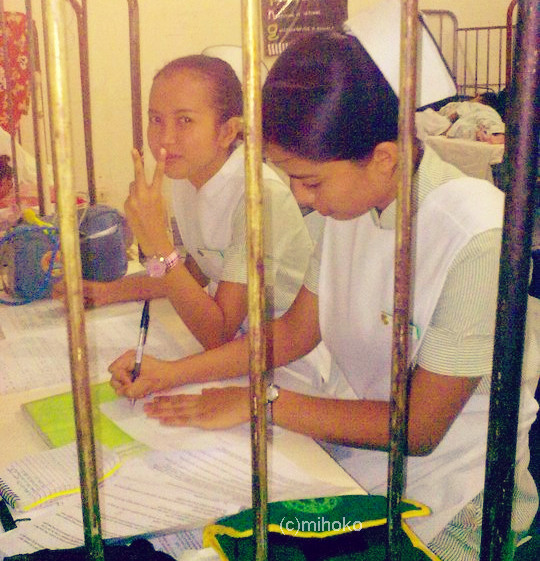

I have a confession to make. There was a time when I hated nursing school, despite the rather inconvenient fact that I genuinely wanted to become a nurse. I realise how contradictory that sounds, but anyone who has survived a Bachelor of Science in Nursing programme may understand the distinction. I loved the idea of nursing. I admired the profession, imagined myself caring for patients, and looked forward to the day when I could finally place those precious letters, RN, after my name. What I did not particularly appreciate was discovering that pursuing this ambition involved surrendering a surprising number of personal freedoms, including, apparently, the right to choose how my hair should behave.
For starters, earrings were forbidden during duty. There would be no dangling accessories, no little fashionable additions to our uniforms, and absolutely no opportunity to express our personalities through jewellery. I understood that clinical environments required proper infection prevention measures and a professional appearance, but as a young woman who still enjoyed looking presentable, I occasionally found the restrictions rather excessive. Nursing school seemed determined to ensure that our ears remained as academically disciplined as the rest of us.
Then there was the matter of our hair. It had to be neatly secured, with no loose strands casually escaping around our faces. I remember wanting to have my hair rebonded, imagining how lovely it would look falling smoothly over my shoulders. Unfortunately, such ambitions were entirely incompatible with our duty requirements. What would have been the point of paying for beautifully straightened hair if I had to tie it up every single day? I could practically hear my imaginary hairstyle protesting. Apparently, the nursing profession had already decided that my hair would enjoy considerably less freedom than its owner.
Our fingernails were another subject of serious regulation. They had to be short, clean, and free from manicure. Long nails were unacceptable, and decorative polish had no place in our clinical duties. From an infection prevention perspective, the reasoning made sense. Fingernails can harbour microorganisms, and proper hand hygiene is fundamental to patient safety. But understanding the rationale did not necessarily prevent my younger self from occasionally admiring somebody else’s beautifully manicured nails with a little envy. Other college students could experiment with colours and fashionable designs. We, meanwhile, were expected to consider neatly trimmed fingernails an exciting personal achievement.
Interestingly, although nail polish was prohibited, light make-up was expected under our school’s grooming rules. This arrangement always amused me. We were apparently required to look naturally presentable, but not so natural that we appeared to have made absolutely no effort. Too much make-up would be inappropriate, but none at all could also attract attention. I sometimes wondered whether our instructors possessed a secret measuring instrument for determining precisely how much powder and lipstick qualified as professionally acceptable. Whatever the formula, we were expected to master it alongside our clinical skills.
And then came the uniform regulations, which extended to garments that nobody outside the changing room had any reasonable business discussing. Even our underwear had to be white. White bras for the girls, white briefs or boxer shorts for the boys, and absolutely no room for fashionable rebellion beneath our equally white uniforms. I suppose the intention was to maintain a neat, consistent appearance and prevent coloured clothing from showing through the fabric. Nevertheless, I remember finding it rather extraordinary that nursing school had managed to establish authority over an area of my wardrobe that I had previously considered entirely personal.
I sometimes thought we were less like ordinary college students and more like members of a particularly strict organisation whose principal colours were white, white, and occasionally red, provided the red belonged to a ballpen.
Speaking of ballpens, our duty equipment had to be complete. Black, blue, and red pens were essential companions, along with the other instruments we needed for clinical practice. A watch was indispensable because we used it when assessing pulse and respiratory rates. Everything had to be prepared before reporting for duty. Forgetting something could mean unnecessary stress, particularly when our instructors expected us to arrive ready for the day’s responsibilities. It was astonishing how much importance a tiny object could acquire when you discovered its absence at precisely the wrong moment. A missing pen at home was a minor inconvenience. A missing pen during clinical duty felt like an impending academic disaster.
Punctuality was equally important. Being late was unacceptable, and failure to comply with our school’s requirements could result in an extension of duty hours. There were rules for attendance, appearance, equipment, conduct, and academic responsibilities. Some were reasonable, some were frustrating, and others seemed specifically designed to test whether we possessed the patience necessary to pursue a healthcare career. If we failed to meet expectations, consequences followed. Nursing school was remarkably efficient at reminding us that personal excuses did not automatically cancel professional responsibilities.
And as though these regulations were not enough, we still had to complete our nursing care plans, case studies, assignments, and other RLE requirements. There were topics to study before reporting for duty, procedures to review, and clinical questions to prepare for. Our instructors had an extraordinary talent for identifying the precise subject we had neglected to revise. We could spend an entire evening studying several topics, only to arrive the following morning and be questioned about the one chapter we had confidently assumed would not matter.
I sometimes wondered whether Clinical Instructors could detect an unprepared student through some mysterious professional instinct.
There we would be, standing in our uniforms, attempting to look knowledgeable while silently hoping that the next question would involve something we actually remembered. A confident expression was essential, although maintaining one became increasingly difficult when the instructor began asking for rationales. It was never enough to explain what we intended to do. We had to understand why we were doing it, what could happen if it was performed incorrectly, and how it related to the patient’s condition.
At the time, I found the constant questioning exhausting. There were moments when I wished our instructors would simply accept that we were trying our best and allow us to continue with our responsibilities without making our brains undergo another examination before breakfast.
But clinical practice was not a place where enthusiasm could replace knowledge.
Our instructors were responsible for teaching us to approach patient care safely and systematically. The questions, corrections, and expectations were part of preparing us for responsibilities that would eventually extend beyond the classroom. I did not always appreciate their methods while standing nervously in front of them, but I was beginning to recognise that nursing required considerably more than being compassionate and wearing a respectable uniform.
There was also the matter of patience, a virtue our instructors seemed particularly determined to cultivate. We needed patience with patients, classmates, difficult procedures, unexpected changes, and occasionally ourselves. Some days tested that patience more thoroughly than others. There were moments when everything seemed to happen at once, when requirements accumulated faster than we could complete them, and when the prospect of returning home to rest felt like an achievement worthy of national recognition.
Yet our clinical rotations were also where nursing began to become real to me.
Until then, much of what I knew about the profession had come from textbooks, lectures, and return demonstrations. Those were necessary foundations, but there was something different about entering an actual clinical environment. Hospitals had their own rhythm, their own demands, and their own ways of reminding inexperienced students that real patients were not identical to the carefully constructed scenarios used during classroom discussions.
We moved through different clinical areas, learning to adapt to unfamiliar routines and responsibilities. Every department introduced us to another aspect of nursing, sometimes one that interested me immediately and sometimes one that required considerable effort before I could appreciate its importance. We encountered patients with different needs, observed experienced professionals at work, and gradually became more aware of how much responsibility accompanied even the most ordinary nursing tasks.
I remember the nervousness of approaching unfamiliar situations, the satisfaction of completing a procedure correctly under supervision, and the relief of discovering that something I had struggled to understand in lectures finally made sense in practice. I also remember the mistakes, the corrections, and the moments when my confidence disappeared almost as quickly as it had developed.
It was not always enjoyable, but it was certainly educational.
My dutymates made those experiences far more memorable. There is a special understanding between people who have survived the same demanding clinical rotation. We knew one another’s worries, celebrated small accomplishments, and understood why completing a duty without forgetting essential equipment could feel like a personal victory. We shared conversations, laughter, and the occasional collective panic whenever an academic requirement threatened to disrupt our carefully imagined plans for the evening.
Of course, we also took photographs whenever an opportunity presented itself. Nursing school might have controlled our hair, nails, uniforms, and accessories, but it had apparently failed to regulate our enthusiasm for posing in front of a camera. There we were, wearing our carefully arranged uniforms and attempting to look like future healthcare professionals, while displaying the sort of expressions that would probably have raised questions about our suitability for formal hospital publicity materials.
Those photographs are among my favourite reminders of college life.
When I look at them now, I notice the familiar faces, the uniforms, and the younger version of myself who had not yet discovered how much her professional life would change. I remember the ordinary conversations that filled our duty days, the laughter between responsibilities, and the little complaints we repeated so often that they eventually became part of our shared experience.
I miss those people and those moments.
What surprises me most is that somewhere towards the end of nursing school, my relationship with the profession began to change. I cannot identify a particular day when it happened. There was no extraordinary revelation, no sudden announcement that I had finally developed an unconditional affection for nursing, and certainly no dramatic scene in which I embraced my white uniform while inspirational music played in the background.
Instead, I gradually realised that I had become attached to the very life I had spent so much time complaining about.
The routines that once exhausted me had become familiar. The clinical duties that initially frightened me had begun to feel like meaningful opportunities to learn. Even the rules I disliked had introduced me to the expectations and responsibilities associated with professional practice. I still thought some of our grooming requirements were unnecessarily strict, and I certainly did not develop a passionate affection for carrying three differently coloured ballpens, but I began to appreciate why discipline, preparation, punctuality, and attention to detail mattered in healthcare.
There was an important difference between following a rule simply because an instructor demanded it and understanding the purpose behind it. Some expectations were connected directly to patient safety, infection prevention, and professional accountability. Others belonged more to the traditions and institutional culture of our nursing school. As students, we were not always in a position to challenge those distinctions, but experience gradually taught me to recognise them.
And perhaps that was part of growing into the profession: learning when to follow instructions carefully, when to ask questions, and why understanding the rationale mattered more than obedience for its own sake.
As graduation approached, I became increasingly aware that the days I had once complained about were almost finished. Soon, there would be no more ordinary college mornings with my classmates, no more familiar duty groups reporting together, and no more instructors reminding us to check our equipment before entering the clinical area. We would move towards the Nursing Licensure Examination and, eventually, whatever professional opportunities awaited us.
It was a strange realisation.
For years, I had looked forward to completing nursing school. I wanted to graduate, pass the board examination, and finally become a Registered Nurse. Yet as that possibility drew closer, I began to understand that reaching one destination also meant leaving behind a life I had grown accustomed to.
I would miss the friendships, the laughter, the nervous anticipation before clinical duties, and even the occasional academic chaos. I would miss the conversations that happened while preparing our requirements and the familiar faces of people who understood exactly what it meant to be exhausted by nursing school.
I would probably even miss complaining about the rules.
Well, perhaps not the underwear regulations.
Some traditions are better remembered from a comfortable distance.
I suppose that is one of life’s more entertaining contradictions. We spend so much time wishing certain experiences would end, only to discover that their absence eventually becomes something we feel. The early mornings, the endless requirements, the strict instructors, and the ordinary routines that once seemed repetitive acquire a different meaning when they can no longer be repeated.
And photographs have a rather merciless way of reminding us.
They preserve the faces we once saw almost every day, the uniforms we were eager to outgrow, and the moments we hardly considered significant while they were happening. The young people smiling in those pictures were concerned with their next examination, their clinical requirements, and whether they had enough money left for food and transportation. They had no particular reason to imagine that these ordinary days would someday become the subject of nostalgic reflections.
We were simply living them.
That is why I sometimes want to remind students who are still completing their nursing education to enjoy the experience while taking their responsibilities seriously. Study properly, prepare for duty, respect your patients, and learn as much as possible from the people guiding you. But also appreciate your classmates, laugh when the occasion allows, take photographs, and recognise that nursing school consists of more than examinations and academic requirements.
One day, those ordinary afternoons and exhausting clinical rotations may become the memories you revisit most fondly.
I began nursing school with an ambition to become a nurse and an impressive collection of complaints about everything the institution expected from me. I resented the restrictions, questioned the rules, and occasionally wondered why pursuing my chosen profession required such extraordinary attention to my hair, fingernails, and stationery.
Yet by the time I was preparing to leave, I had developed an affection for the experience that I never anticipated.
I had entered nursing school wanting the profession.
Somewhere along the way, I had come to appreciate the journey as well.
And if I could return to one of those duty mornings, I think I would enjoy seeing my younger self preparing her uniform, securing her hair, checking her watch, and searching frantically through her belongings.
She would probably be running through a mental checklist, worried about forgetting something important and irritated by the unreasonable number of regulations governing her appearance.
I would be tempted to reassure her that the effort would eventually mean something.
But knowing her, she would probably interrupt me with a far more urgent question.
“Do you have an extra red ballpen?”
Some things, apparently, never lose their importance.
From my nursing school archives, with affection for my dutymates, gratitude to the instructors who challenged us, and a belated apology to the three ballpens that endured four years of my complaints.
— Just Anj


































Leave a Reply