By Jen Sincero
Rating: ★★★★☆ (4/5)
Category: Book Reviews | Personal Development | Life Lessons
“You are responsible for what you say and do. You are not responsible for whether or not people freak out about it.”
— Jen Sincero
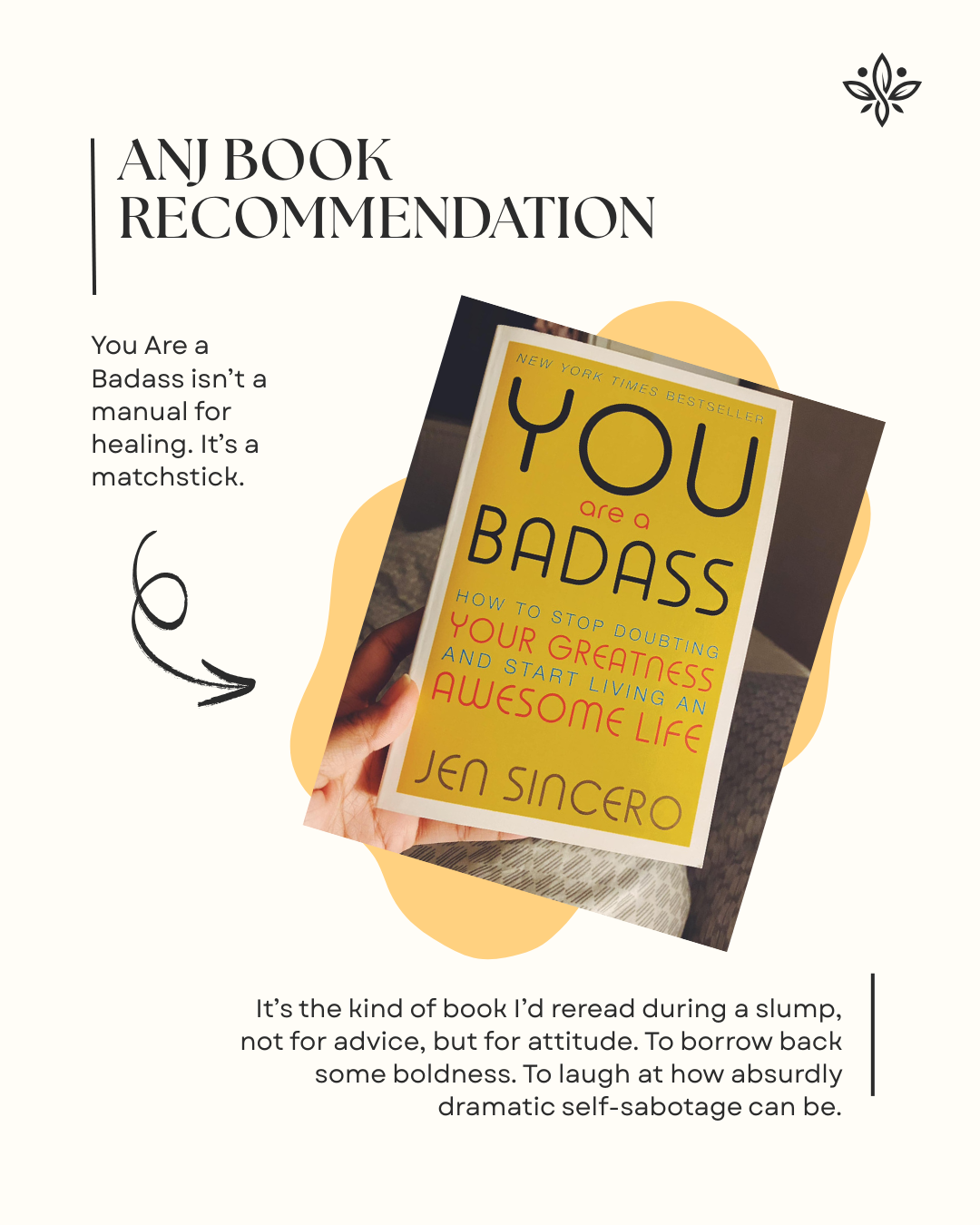
There is a particular shade of yellow that has absolutely no intention of being ignored. It is the colour of highlighter pens, caution signs, and the occasional fashion decision that makes you wonder whether somebody lost a bet. It also happens to be the colour of You Are a Badass by Jen Sincero, a book that seems determined to announce its presence before you have read a single sentence. Among my more politely dressed books, it looked as though someone had invited a motivational speaker to a library and forgotten to explain the dress code. The title was equally unapologetic. I admired its confidence, although I did wonder whether a book that certain of my potential might be expecting rather a lot from me.
I read it in bed, late at night, during one of those periods when my thoughts had become rather more ambitious than my actions. I had plans, ideas, and aspirations, along with an impressive talent for finding reasons to postpone them. There is a peculiar frustration in knowing what you would like to accomplish while remaining exceptionally skilled at negotiating with yourself about why tomorrow might be a more suitable starting date. By the time I opened Sincero’s book, I had become thoroughly acquainted with the art of overthinking. If excessive contemplation were an Olympic event, I might have been eligible for a medal, although I would probably have spent too long wondering whether I deserved to enter.
What I wanted was perspective. What I received was a woman who writes as though she has consumed three espressos, abandoned her patience with unnecessary excuses, and decided that the reader’s comfort is a secondary consideration. There is profanity, humour, personal confession, and enough enthusiasm to alarm anyone who prefers their philosophical advice delivered in measured academic language. I found it entertaining. I also found myself occasionally disagreeing with her, which, in my opinion, is a perfectly healthy way to read a book.
Because the trouble with motivational writing is that it can make almost anything sound possible for the duration of a chapter. The real question is what happens when the chapter ends.
What the Book Is About
First published in 2013, You Are a Badass: How to Stop Doubting Your Greatness and Start Living an Awesome Life is Jen Sincero’s bestselling guide to confidence, personal responsibility, self-belief, and changing the habits that prevent people from pursuing what they want. Drawing upon personal anecdotes, humour, spiritual concepts, and practical exercises, she encourages readers to question limiting beliefs, confront their fears, and take a more deliberate role in shaping their lives.
This is not a particularly restrained book. Sincero is conversational, irreverent, and occasionally so enthusiastic that I imagined her delivering certain passages while standing on a chair. Her style is closer to an animated conversation with an outspoken friend than a formal examination of psychology. She enjoys exaggeration, uses humour liberally, and frequently addresses the reader with the confidence of someone who has already decided that your excuses are becoming tedious.
What makes her writing accessible is that she does not present herself as someone who has always possessed extraordinary discipline or unwavering self-confidence. She discusses her own struggles with money, ambition, and self-limiting beliefs, using those experiences to establish a sense of familiarity with the reader. This autobiographical approach gives her advice personality, even when the underlying arguments are not particularly original.
The book’s central proposition is that our beliefs influence our behaviour and that changing the way we think about ourselves can make different choices possible. There is genuine value in examining the assumptions that shape our decisions. However, Sincero goes further by incorporating ideas about energy, manifestation, and the Universe, introducing a spiritual dimension that some readers will find inspiring and others, myself included, may approach with considerable scepticism.
I appreciate an author who is willing to be unconventional. I simply prefer that unconventional ideas be accompanied by a persuasive explanation of why they should be believed.
The Art of Getting Out of Your Own Way
One of the book’s strongest recurring themes is self-sabotage, particularly the subtle ways people undermine their own ambitions through fear, hesitation, and an excessive attachment to familiar routines.
I found this interesting because self-sabotage rarely announces itself with dramatic music and an appropriately ominous warning. Sometimes it arrives disguised as practicality. We tell ourselves that we need more preparation, better circumstances, greater confidence, or a conveniently scheduled moment when everything will finally make sense. We become remarkably inventive when explaining why something important must wait.
I recognised elements of this in my own behaviour. I enjoy planning, researching, and considering possibilities, but I also know that preparation can become a comfortable place to hide. There is a reassuring safety in imagining what we might accomplish without exposing those ambitions to the unpredictable business of actually attempting them.
Sincero’s writing challenges that tendency with considerable force. She encourages readers to examine whether their reluctance comes from genuine obstacles or from the discomfort of doing something unfamiliar. I appreciated this distinction because fear does not always deserve to make our decisions for us.
At the same time, I think the difference between unnecessary hesitation and legitimate caution deserves more attention than the book sometimes provides. There are circumstances in which careful consideration is essential. Decisions involving finances, careers, relationships, or major life changes can carry consequences that enthusiasm alone cannot resolve.
Confidence is valuable, but so is judgement. The trick is knowing when one is helping us and when the other has become an excuse for remaining comfortably stationary.
Sincero is particularly effective at challenging habitual pessimism. She reminds readers that repeatedly telling ourselves we are incapable of something can influence whether we attempt it at all. From a practical perspective, this is one of the book’s more persuasive ideas. Our expectations can shape our choices, and our choices can affect what opportunities become available to us.
But there is an important difference between believing we are capable of learning something difficult and assuming that confidence guarantees success. The former encourages meaningful action. The latter risks becoming optimism with insufficient supporting evidence.
The Confidence Question
I have always been fascinated by the way confidence is perceived. We admire people who appear certain of themselves, particularly when they speak persuasively, make decisions quickly, or seem entirely untroubled by the opinions of others. Yet outward confidence does not necessarily indicate wisdom, competence, or emotional stability. Sometimes it simply means someone has become exceptionally comfortable speaking before thinking.
Sincero treats self-belief as an essential foundation for pursuing personal goals, and I agree that persistent self-doubt can become limiting. There is little benefit in approaching every opportunity as though we must first establish beyond reasonable doubt that we deserve to be considered.
What I appreciated about her approach was the encouragement to examine where our beliefs originate. Some assumptions are inherited from family expectations, educational experiences, cultural norms, or earlier disappointments. We may carry them for years without recognising that they were formed under circumstances that no longer apply.
That observation encouraged me to consider the difference between humility and making ourselves unnecessarily small. I value modesty, but I do not believe modesty requires pretending that our abilities, ambitions, or accomplishments are insignificant. It is possible to acknowledge our strengths without becoming arrogant, just as it is possible to recognise our limitations without allowing them to define everything we attempt.
The difficulty, of course, is that confidence develops differently for everyone. Some people acquire it through encouragement. Others develop it gradually through experience, competence, and repeated attempts. I tend to trust the latter form more than the kind of instant certainty that motivational literature occasionally seems to recommend.
I would rather feel nervous and prepared than spectacularly confident and completely uninformed. The world has enough examples of the second arrangement.
Where the Book Lost Me: The Universe Apparently Has a Customer Service Department
This is where my enthusiasm became rather more complicated.
Sincero frequently draws upon the language of manifestation, universal energy, and attracting desired circumstances through belief. She presents a worldview in which our thoughts and attitudes play an expansive role in shaping our external experiences.
I understand why this philosophy appeals to readers. It offers a sense of agency in a world that can feel unpredictable. It encourages hope, challenges fatalism, and invites people to imagine possibilities beyond their present circumstances. For someone who has become discouraged, that message can be genuinely motivating.
But I struggled with the suggestion that the Universe operates according to our personal expectations, as though existence were a sophisticated ordering system and the principal reason our requests remain unfulfilled is that we have not believed enthusiastically enough.
I approach this subject through a combination of faith, reason, and personal experience. I believe in the importance of hope, prayer, perseverance, and recognising opportunities. I also believe that circumstances involve factors far more complicated than individual desire. Hard work does not guarantee a particular outcome. Good people experience disappointment. People who believe deeply in their goals can still encounter obstacles beyond their control.
There is also a substantial difference between the psychological benefits of positive thinking and the claim that positive thoughts directly attract external events. The former can be examined through human behaviour. The latter requires evidence that Sincero does not adequately establish.
My concern is not that readers might become more optimistic. I see nothing wrong with cultivating optimism. The problem arises when a philosophy of personal empowerment implies that setbacks result primarily from insufficient belief or the wrong attitude.
Life is considerably less obliging than that.
People face financial restrictions, illness, discrimination, professional setbacks, and circumstances that cannot be transformed through confidence alone. Any philosophy of personal development should acknowledge these realities without interpreting them as evidence of individual failure.
For me, genuine empowerment includes recognising what we can influence while remaining realistic about what we cannot.
I suspect the Universe has enough to manage without being held personally responsible for my career plans, bank balance, and unfinished manuscripts.
When Encouragement Becomes Repetition
Another reservation I have concerns the book’s structure and pacing.
Sincero’s energetic voice is initially one of its most appealing qualities. Her anecdotes, colourful language, and conversational delivery make the early chapters entertaining and accessible. She has an admirable ability to turn an ordinary observation about insecurity into a lively discussion that feels surprisingly personal.
However, as I progressed through the book, I began noticing familiar ideas appearing in slightly different forms. The importance of belief, the need to overcome fear, the value of positive thinking, and the encouragement to pursue one’s ambitions recur frequently. Repetition can reinforce a message, but it can also reduce the sense of intellectual progression.
At times, I wanted a more detailed exploration of the practical difficulties involved in applying her advice. It is one thing to encourage someone to transform their relationship with money, for example, and another to examine the realities of income, debt, financial literacy, and unequal access to opportunities.
The book is more persuasive when Sincero draws upon her personal experiences and offers identifiable behavioural changes. It becomes less convincing when complicated human problems are addressed through broad declarations about belief and possibility.
I also think the humour, while often effective, occasionally competes with the argument. There were passages in which I enjoyed her writing more than I agreed with what she was saying. That is not necessarily a criticism of her literary voice, but it is worth distinguishing entertainment from evidence.
A persuasive writing style can make an idea memorable. It cannot automatically make that idea correct.
What I Took Away from It
Despite these reservations, I finished You Are a Badass appreciating its encouragement to approach ambition with greater confidence.
Reading it made me think about how easily we can become attached to a particular understanding of ourselves. We develop routines, expectations, and identities that feel reassuringly familiar. We know what we are good at, what we avoid, and which ambitions seem realistic. Eventually, we may begin treating those assessments as permanent facts rather than conclusions that can change with experience.
I think there is value in questioning them.
As someone balancing nursing with a love of writing, reading, and other personal interests, I appreciate the reminder that professional responsibilities need not define the entirety of our ambitions. There are parts of ourselves that deserve attention simply because they contribute to a meaningful life. Creativity, curiosity, and the willingness to try something unfamiliar do not have to disappear beneath the obligations of adulthood.
At the same time, I do not want personal growth to become another exhausting standard against which to measure myself. There will be productive days and unproductive ones. There will be plans that succeed, ideas that require revision, and ambitions that change as circumstances evolve.
That does not necessarily indicate a failure of discipline or self-belief. Sometimes it is simply evidence that we are human beings attempting to navigate a complicated world with incomplete information.
Confidence becomes more valuable when it gives us the courage to act without demanding that every action produce the outcome we hoped for.
This is the lesson I would take from Sincero’s book, even if my interpretation differs somewhat from her more expansive claims about manifestation.
I can appreciate her insistence that we take our aspirations seriously while remaining unconvinced that positive thinking is sufficient to achieve them. I can enjoy her irreverence without adopting every philosophy she promotes. And I can recognise the encouragement her writing offers without expecting a paperback to resolve every complicated aspect of human existence.
That, to me, is part of reading critically. We are allowed to admire a book without surrendering our judgement to its author.
My Final Verdict: Is It Worth Reading?
Rating: ★★★★☆ (4/5)
You Are a Badass is entertaining, accessible, frequently amusing, and written with a personality that distinguishes it from many conventional self-help books. Sincero’s greatest strength is her ability to make familiar advice feel energetic and approachable. Her conversational writing style gives the book an immediacy that can appeal to readers who find more formal personal development literature intimidating or tedious.
I particularly enjoyed her observations about fear, self-limiting beliefs, and the tendency to postpone meaningful goals. Those discussions encouraged useful reflection and offered a practical reminder that confidence sometimes develops through action rather than appearing beforehand.
However, the book loses some of its persuasive force through repetition and an occasionally simplistic treatment of complicated circumstances. Its reliance on manifestation and universal energy will also divide readers, particularly those who prefer advice grounded in evidence and a more nuanced understanding of personal agency.
My four-star rating reflects that balance. I found the book enjoyable, motivating, and worth reading, but I would hesitate to recommend treating all its claims as reliable guidance.
Its greatest contribution, in my opinion, is not a revolutionary philosophy of success. It is the encouragement to examine the assumptions that prevent us from pursuing meaningful possibilities.
And sometimes, that is enough reason to appreciate a book.
Would I Recommend It?
Yes, with a little critical distance. I would recommend You Are a Badass to readers who enjoy humorous, conversational self-help books and want encouragement to reconsider their relationship with ambition, confidence, and fear.
It may be particularly enjoyable for someone who feels hesitant about exploring a new opportunity or has become overly attached to familiar routines. Sincero’s irreverent approach can make self-reflection feel less intimidating, especially for readers who dislike overly formal or solemn motivational writing.
I would be more cautious about recommending it as a primary source of financial, psychological, or therapeutic guidance. Its discussions of manifestation and personal responsibility should be approached as the author’s perspective rather than universally established principles.
Best read when: You are in the mood for energetic encouragement, enjoy a little profanity with your philosophy, and are perfectly comfortable disagreeing with an author while still appreciating her company.
The thought I would take away: Self-belief is most useful when it encourages us to make thoughtful decisions and take meaningful action, rather than promising that life will always reward our confidence.
The Last Word
By the time I finished the book, it was still yellow. Aggressively yellow, in fact. It had not developed a more dignified appearance simply because I had spent several evenings considering its philosophy. The cover remained every bit as audacious as it had been when I first picked it up, and I found that strangely appropriate.
I had not emerged from the reading experience as an entirely transformed person. My ambitions had not arranged themselves into a convenient timetable. My doubts had not vanished, and I had certainly not established a direct communications department with the Universe. There were still decisions to make, responsibilities to manage, and ordinary uncertainties waiting patiently for my attention.
But I had been entertained, occasionally challenged, and encouraged to examine a few assumptions I might otherwise have left undisturbed.
I think that counts for something.
Not every book needs to become a personal philosophy. Some are valuable because they introduce us to a different way of looking at familiar problems, even when we ultimately decide that parts of the author’s argument deserve a polite but firm disagreement.
Sincero has given me a few useful ideas, several entertaining observations, and a renewed appreciation for the importance of pursuing ambitions without apologising for having them.
As for the rest of her advice, I shall continue relying upon preparation, good judgement, persistence, and the occasional prayer.
The Universe is, of course, welcome to assist.
But I would appreciate something in writing.
Yours in books, bold ambitions, and reasonable scepticism,
Anj



Leave a Reply