Of old prayers, borrowed explanations, and the things we are taught to fear.
There is something about a spoon falling in a Filipino kitchen after midnight that makes it sound considerably more suspicious than the same spoon falling at noon.
During the day, you would probably assume somebody had been careless. At night, when the house has settled and the neighbourhood dogs have finally stopped conducting their disagreements across several streets, the sound acquires an entirely different personality. You lie still for a moment, listening. Perhaps something fell from the counter. Perhaps a cat has been conducting an unauthorised inspection of the kitchen. Or perhaps, if you grew up listening to enough Filipino stories, your imagination has already begun investigating possibilities that would never appear in a household insurance claim. You remember an old warning, something a relative once mentioned about strange noises, and suddenly the walk to the kitchen seems less appealing than remaining comfortably beneath the blanket. Somewhere between recognising a perfectly ordinary sound and deciding not to investigate it, an entire cultural education has quietly made itself known.
I have become rather interested in that small moment of hesitation. Not because I believe every unexplained noise requires supernatural investigation, but because I find it fascinating how easily inherited stories can influence our reactions. A sound is only a sound until we give it a possible explanation. Once the explanation involves an unseen visitor, an offended spirit, or somebody’s unfortunate encounter with a maligno, the situation becomes considerably more interesting. The spoon has not changed. The story surrounding it has.
Lately, I have been listening to Filipino supernatural podcasts again, enjoying the unsettling accounts of provincial roads, strange illnesses, family warnings, and things that allegedly happened to somebody’s relative in a barangay whose name is always delivered with remarkable seriousness. I enjoy a well-told mystery. There is something almost cinematic about the way a skilled narrator can transform an ordinary house, a familiar footpath, or a quiet field into a place that suddenly deserves suspicion. Yet I notice that many of these stories eventually arrive at a familiar character. Someone becomes inexplicably unwell, a family grows worried, an unusual event is remembered, and somebody suggests consulting the person believed to understand what the rest of the community cannot.
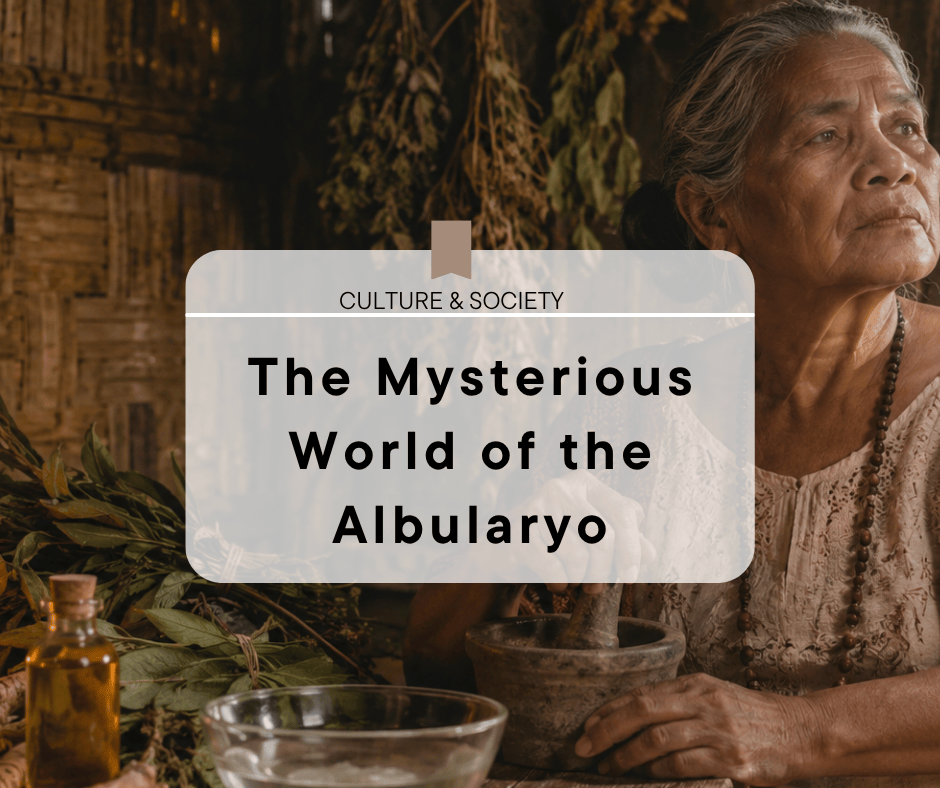
Enter the albularyo.
The character is usually introduced with considerable atmosphere. There may be whispered prayers, a small bottle of oil, a religious image hanging near the doorway, and an elderly practitioner who listens carefully before offering an explanation that sends everybody home more frightened than when they arrived. In horror stories, the albularyo often appears to possess knowledge beyond the reach of ordinary medicine, although I sometimes wonder whether the storyteller has deliberately withheld every reasonable explanation until the final five minutes. Suspense, after all, becomes rather difficult to maintain if the mysterious illness turns out to have an identifiable medical cause and responds to appropriate treatment.
But the real history of the albularyo is far more interesting than the familiar character from supernatural entertainment. Behind the dramatic portrayals lies a long tradition of community healing, inherited knowledge, religious devotion, and attempts to explain suffering in circumstances where professional medical care was not always available. The albularyo is not simply a mysterious person living in a remote village. Depending on the region and the practitioner, the role may include knowledge of herbs, traditional remedies, prayer, ritual, and community beliefs about illness. Some have been regarded as trusted local advisers, while others have been approached because ordinary explanations seemed insufficient.
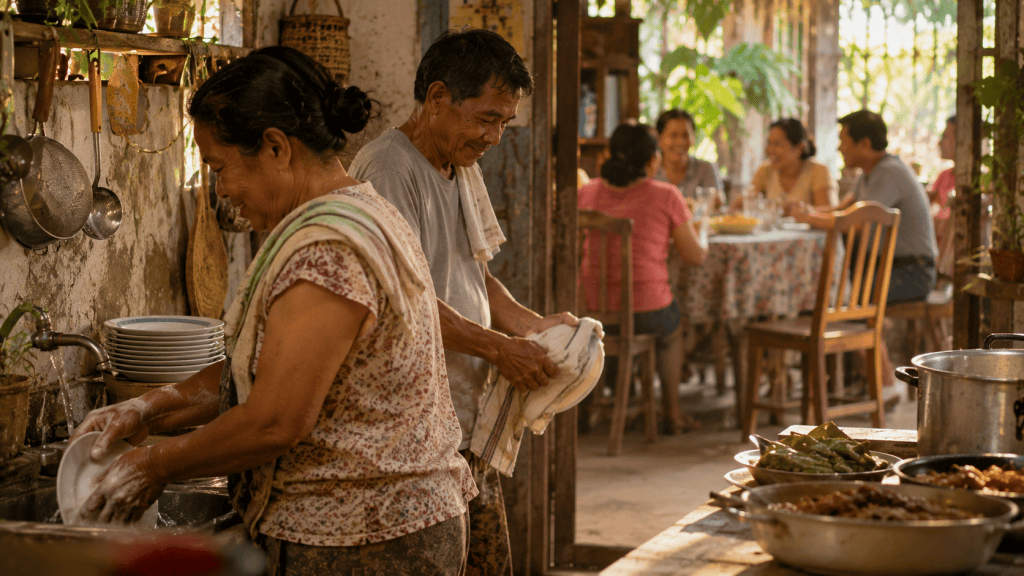
Growing up in Cebu, I was familiar with the way traditional beliefs could enter everyday conversation without anybody feeling obliged to explain why they belonged there. Someone might mention pasma after experiencing discomfort, describe a baby as having usog, or suggest that a persistent problem deserved the attention of a mananambal. The word was familiar enough to belong to ordinary vocabulary, much like hilot or tawas. These terms refer to different practices and ideas, and their meanings can vary between communities, but they reflect a cultural environment in which health, family advice, and spiritual belief have long influenced one another.
I find that especially interesting now because my professional life has taken me into a world where illness is approached through clinical assessment, scientific evidence, and increasingly sophisticated technology. As a nurse working in stroke care, I am accustomed to thinking about symptoms, observations, neurological findings, medication histories, and investigations that can influence urgent treatment decisions. The contrast between those responsibilities and the traditional explanations I heard growing up is sometimes striking. Yet I do not experience the two worlds as though one has entirely erased the other. My nursing education influences how I evaluate a claim, while my upbringing helps me understand why the claim might feel convincing to someone else.
The word albularyo is commonly linked to the Spanish herbolario, meaning herbalist, although the healing traditions associated with the role draw upon a much broader history. Before Spanish colonisation, different Philippine communities already possessed their own beliefs concerning illness, healing, plants, and spiritual relationships. The babaylan, for example, held important religious and ceremonial roles in several precolonial societies, sometimes including healing responsibilities. Their practices were diverse and should not be treated as identical to those of modern albularyo. Over centuries, Catholic devotion and local practices influenced some forms of folk healing, resulting in traditions where Christian prayers might accompany inherited rituals or preparations made from plants.
Imagine how illness must have been experienced before reliable access to modern diagnostic medicine. A person develops a fever that continues for days. Someone begins trembling without an obvious cause. A child becomes distressed, or an adult experiences persistent pain that nobody in the household can explain. Today, we would consider clinical assessment and appropriate investigations. But in communities where such resources were historically distant, expensive, or unavailable, people relied upon the knowledge and relationships around them. An experienced healer might offer a remedy, an explanation, and perhaps most importantly, the reassuring feeling that someone was taking the problem seriously.
This does not establish that the treatment was effective. Some traditional remedies may have had practical value, while others may have provided little benefit or introduced additional risks. But it helps explain why a local healer might become important to a community. Healthcare is not experienced only as a collection of interventions. It is also an encounter with uncertainty, fear, and the need to feel understood. When formal services are difficult to access, familiarity can become a powerful form of reassurance.
One of the most recognisable traditional practices is pagtatawas, in which certain materials are used to produce shapes or patterns that a practitioner interprets as clues to the supposed cause of an illness or unusual experience. Methods vary, and accounts may involve wax, alum, or other materials. To somebody unfamiliar with the tradition, the process might seem like a peculiar experiment in interpreting accidental shapes. To someone raised with the belief, however, the patterns may carry meanings connected to usog, spiritual disturbance, or other explanations accepted within the community.
Scientifically, these patterns do not establish the presence of supernatural forces or reliably identify a medical condition. Their significance comes from the interpretation rather than from a validated diagnostic process. Yet I find the ritual culturally revealing because it demonstrates our discomfort with uncertainty. A person who is suffering may be willing to accept an explanation that gives shape to their fear, particularly when the explanation comes from someone they trust. The ritual may offer an answer before anyone has established whether that answer is correct.
This is not a weakness unique to people who believe in traditional healing. Human beings generally prefer explanations to ambiguity. When something frightening happens, we search for a reason. If ordinary explanations do not satisfy us, more extraordinary possibilities can become appealing. The mind wants to connect events, even when those events may be unrelated. A strange sound followed by an illness becomes a story. A disturbing dream preceding a family misfortune begins to seem prophetic. A pattern in melted wax acquires meaning because someone has told us what it supposedly represents.
I sometimes wonder how many family stories developed through exactly this process. Someone experienced something unusual, another person offered an explanation, and the explanation became more convincing each time the story was retold. Eventually, the tale acquired the authority of an inherited warning. Nobody remembered precisely where it began, but everybody knew somebody who insisted it had happened.
Filipino folklore is particularly rich in these narratives, and I admit that I enjoy listening to them. They carry local expressions, regional beliefs, and a particular kind of suspense that familiar surroundings make even more effective. A strange encounter in a place you have never visited is interesting enough, but an alleged supernatural incident on a provincial road that resembles somewhere you grew up can make the imagination considerably more cooperative.
Still, there is a difference between enjoying a story and accepting its explanation as fact.
Consider usog, a belief familiar to many Filipino families, particularly those with young children. In some traditions, a baby who becomes unsettled after receiving attention from a visitor is thought to have experienced usog. Protective customs vary, and some traditional responses involve saliva, which can introduce infection risks. The belief is interesting because it reflects a universal concern: the vulnerability of children and the distress parents experience when something appears wrong. But from a medical perspective, persistent crying, vomiting, fever, or changes in a baby’s condition should not be explained away through superstition. Those symptoms deserve appropriate assessment.
The same distinction applies to pasma, a traditional category sometimes used to describe trembling, sweating, or discomfort associated with particular activities or changes in temperature. The symptoms may be genuine, even when the proposed explanation lacks scientific support. A person who describes their experience as pasma is not necessarily exaggerating or imagining what they feel. They are using familiar language to explain bodily sensations. Good clinical care begins by understanding those sensations and assessing their possible causes, rather than ridiculing the words the patient uses.
Medicinal plants introduce another layer of complexity. Long before modern pharmaceutical research, communities across the world experimented with plants and other natural materials in attempts to relieve illness. Some plant-derived substances have genuine pharmacological effects, while others are ineffective, toxic, or insufficiently studied. The fact that a remedy is natural does not make it harmless. As a nurse, I am particularly conscious that herbal preparations may interact with prescribed treatments, including medicines used to reduce the risk of blood clots. Respecting traditional knowledge should encourage careful research rather than automatic acceptance.
I find myself returning to a question that is perhaps more revealing than whether a particular traditional remedy works: why do some people feel more comfortable consulting an albularyo than a healthcare professional?
The easiest answer would be superstition, but it is also an incomplete one.
Imagine an older person who has known the same local healer for decades. The healer knows the family, understands the language, and may have provided reassurance through previous illnesses. The encounter takes place in familiar surroundings, without complicated appointments or unfamiliar medical terminology. Now consider the experience of entering a hospital where everything appears hurried, where investigations are ordered but not always explained in terms the patient understands, and where the person seeking help may feel intimidated or embarrassed about asking questions.
The difference matters, not because familiarity can replace clinical competence, but because trust is shaped by more than qualifications. People are influenced by whether they feel listened to, whether their concerns are acknowledged, and whether the explanations they receive make sense within their understanding of the world.
I have learned that asking patients about their beliefs does not require agreeing with every belief they hold. Someone may attribute an illness to an explanation that medical evidence does not support, but dismissing that person outright may prevent an honest conversation about what they are experiencing or what remedies they have already tried. The challenge is to remain respectful without becoming professionally uncritical. Listening to a patient and evaluating the accuracy of a medical claim are not competing responsibilities. In good healthcare, they belong together.
The Philippines has also recognised traditional and alternative medicine as an area requiring research and appropriate oversight. Republic Act No. 8423, the Traditional and Alternative Medicine Act of 1997, established the Philippine Institute of Traditional and Alternative Health Care, known as PITAHC. Its work includes research, standards, and the examination of approaches that may be safe and effective. That distinction is important: recognising a tradition as worthy of study is not the same as declaring every practice medically proven. Scientific evaluation exists precisely because inherited knowledge can contain both useful observations and mistaken explanations.
And then there are the darker stories, the ones involving kulam, barang, or the alleged influence of unseen beings.
These are the accounts that make supernatural podcasts so entertaining. Somebody falls ill after a disagreement. A strange object is discovered near the house. A relative remembers an unusual encounter, and suddenly the entire family begins examining recent events for signs that something sinister has happened. In the best-told stories, the details are arranged so carefully that the listener begins suspecting almost everybody, including neighbours who may have done nothing more mysterious than borrow a cooking pot and forget to return it.
Yet when similar accusations occur outside entertainment, the consequences can be serious. Beliefs about curses or supernatural interference can contribute to delayed medical treatment or suspicion directed towards innocent people. Unexplained symptoms are not evidence of witchcraft, and the absence of an immediate diagnosis does not establish the presence of an unseen cause. Medicine does not possess instant answers to every illness, but uncertainty is a reason for careful reassessment, not proof that supernatural forces have intervened.
I think one of the dangers of folklore is that it can become so persuasive as a story that we forget to separate what someone experienced from what they believe caused it. A person may genuinely have heard an unusual sound, experienced a frightening dream, or developed symptoms after an unsettling encounter. Those experiences deserve to be described accurately. But the explanation attached to them may remain unproven. A compelling narrative can make unrelated events seem connected, particularly when the storyteller knows how to arrange the details.
Perhaps this is why I enjoy supernatural stories most when I can appreciate them as expressions of culture without needing to accept every claim literally. They preserve local anxieties, older beliefs, and the remarkable creativity with which communities make sense of the unfamiliar. They reveal the ways people imagine the boundaries between the visible and the unseen. Even when I remain sceptical of a supernatural explanation, I can still be fascinated by the history and psychology behind it.
Living in Britain has made these Filipino traditions feel both more distant and more intriguing. Away from the familiar conversations of home, I have become more conscious of the expressions and beliefs that once seemed too ordinary to question. Words such as mananambal, hilot, and tawas carry memories of Cebuano conversations, family advice, and the particular atmosphere of stories told by people who were entirely convinced that something unusual had happened. They belong to my cultural upbringing, even when I approach the claims behind them with clinical scepticism.
I think that is one of the interesting contradictions of living between cultures. Distance can make us more curious about the things we once accepted without examination. What seemed ordinary during childhood becomes a subject of research, reflection, and occasionally considerable amusement. We begin asking why our families believed certain things, how the traditions developed, and which practices deserve to remain part of our lives.
I do not think respecting our heritage requires unquestioning agreement with everything we inherited. Traditions can be beautiful, historically significant, and emotionally meaningful while still containing ideas that deserve scrutiny. Similarly, scientific progress does not require us to dismiss the people who lived before modern knowledge became available. Earlier generations worked with the information, resources, and circumstances they had. Understanding their world requires more than congratulating ourselves for knowing things they did not.
Perhaps the most meaningful way to honour our heritage is not to protect every inherited belief from questioning, but to understand it well enough to preserve its wisdom without passing along its mistakes. I would rather approach Filipino traditional healing with that kind of curiosity than choose between romanticising every ritual and dismissing the entire subject as superstition.
This also raises a question about modern healthcare itself. We have technologies that earlier generations could scarcely have imagined, including detailed brain imaging, sophisticated monitoring, and treatments that can transform outcomes for people experiencing serious illness. Yet people still arrive at hospitals frightened, confused, and searching for reassurance. Advanced investigations can provide essential clinical answers, but patients also need someone to explain what those answers mean. The human experience of illness remains larger than the disease itself.
Perhaps the albularyo’s cultural endurance reminds us of that need. It does not establish that inherited rituals are effective treatments, but it suggests that communities have long valued healers who offered explanations, attention, and a sense of familiarity. Modern medicine should never surrender its commitment to evidence, but neither should it underestimate the importance of communication and compassion. A patient deserves both competent treatment and the dignity of being heard.
I sometimes imagine what an albularyo from a century ago might think upon entering a modern hospital. The scanner, the monitors, the medicines, and the speed at which information can be gathered would probably appear extraordinary. But I also wonder what questions that person might ask about the patient sitting in the bed. Who is caring for them at home? What do they believe caused the illness? What are they frightened of? Who will explain what happens next?
Those questions remain relevant, even if the answers should now be guided by reliable clinical evidence rather than supernatural interpretation.
The more I explore this subject, the less mysterious the albularyo becomes as a figure, and the more interesting the people surrounding the tradition appear. Behind the healer are families attempting to understand suffering, communities shaped by historical limitations, and beliefs passed between generations because they once offered a sense of order in an uncertain world. Some inherited knowledge deserves careful investigation, while other practices can cause harm. What connects them is the human desire for reassurance when life refuses to behave as expected.
And perhaps that brings me back to the ordinary sound with which I began.
Imagine the spoon falling in the kitchen again. The house is quiet, the lights are off, and the noise interrupts an otherwise uneventful night. A hundred explanations are possible, although some are considerably more plausible than others. The person who grew up listening to supernatural stories may immediately remember warnings about unseen visitors. The person trained in clinical reasoning may prefer to investigate what actually happened. In my case, both reactions might briefly compete for attention, although I would hope the second eventually wins.
I might still hesitate before entering the kitchen. Not because I believe an engkanto has developed a sudden interest in cutlery, but because imagination has always been very good at creating suspense from insufficient information. I would probably switch on the light, examine the floor, and discover that an ordinary household object had fallen for an entirely ordinary reason.
Or perhaps I would find one of my cats looking exceptionally innocent beside the evidence.
The explanation would be considerably less dramatic than the story my imagination had briefly constructed, but it would have one important advantage: it would be supported by what I could actually observe.
And perhaps that is the most interesting thing the mysterious world of the albularyo has reminded me of. The unknown is not always frightening because of what it contains. Sometimes it becomes frightening because of the story we have been taught to place around it. We inherit those stories from our families, communities, and cultures, and they can shape our reactions long before we recognise their influence.
There is nothing wrong with finding those stories fascinating. They are part of our heritage, and many deserve to be preserved as cultural history. But when the question concerns somebody’s health, safety, or wellbeing, curiosity must eventually make room for evidence.
After all, a spoon on the kitchen floor is one thing.
A patient whose symptoms have been explained away without proper assessment is quite another.
And if I ever find myself standing in a dark kitchen at midnight, wondering whether the noise came from something supernatural, I shall try to remember that distinction before allowing my imagination to complete the investigation.
Although if the spoon has fallen beside a suspicious-looking cat, I think we can safely close the case without consulting the albularyo.
— Anj,
Cebuana by upbringing, nurse by profession, and an enthusiastic collector of Filipino supernatural stories, still willing to enjoy a mystery but considerably more interested in evidence before accusing the engkanto next door.



















Leave a Reply