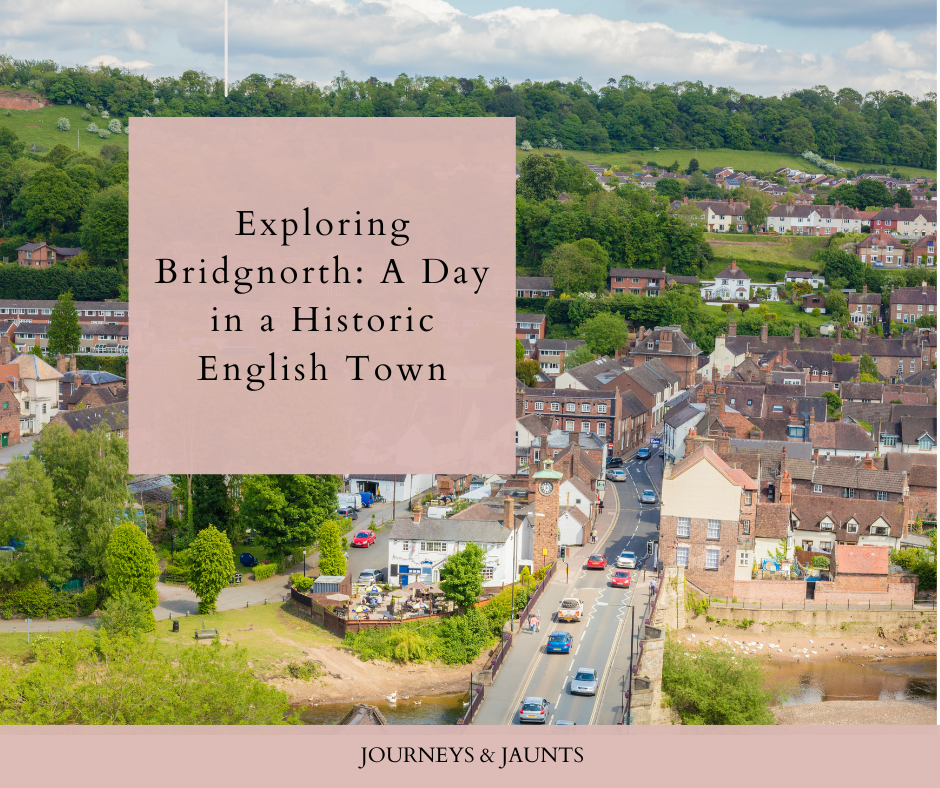
On sandstone cliffs, crooked castle walls, a little railway with enormous character, and the unexpected pleasure of discovering a Shropshire town that seems perfectly comfortable with its own history.
Bridgnorth has apparently decided that one town centre is not enough.
Instead, it has arranged itself across two different levels, separated by a dramatic sandstone cliff, with the River Severn flowing below and a little railway taking responsibility for transporting people between them. It is an unusual arrangement, particularly for visitors who are accustomed to towns having the decency to keep their principal streets on approximately the same level. But I rather liked the idea. Here was a place where going from one part of town to another could involve an actual railway journey, where the ruins of an ancient castle leaned at an angle that would cause considerable concern in a modern building inspection, and where some of the streets looked as though they had wandered out of a historical novel. I had come to Bridgnorth expecting a pleasant afternoon exploring another English market town. What I found was somewhere with enough architectural character, history, and geographical peculiarities to make an ordinary walk feel considerably more interesting than anticipated.
Located in southeastern Shropshire, not far from Wolverhampton, Bridgnorth is a historic market town whose identity is shaped by its remarkable position above the River Severn. High Town occupies the elevated ground overlooking the valley, while Low Town sits beside the river, with the two connected by steep streets, steps, and the famous Bridgnorth Cliff Railway. The arrangement gives the town a rather theatrical quality. One moment, you can be wandering among shops and historic buildings high above the surrounding countryside; the next, you can be looking towards the water and the older streets that developed along its banks. It feels almost like discovering two related but distinct places sharing the same name. I have always enjoyed towns with a little architectural unpredictability, particularly those whose streets encourage you to explore rather than simply follow a straightforward shopping route. Bridgnorth appeared to have taken that preference personally and constructed an entire town around it.
The first thing that struck me was the landscape. Bridgnorth does not reveal itself as an entirely flat collection of buildings arranged neatly around a town centre. Its sandstone cliffs rise dramatically above the Severn Valley, giving visitors magnificent views of rooftops, trees, streets, and the winding river below. From High Town, the scenery opens in layers, with the buildings nearest the cliff appearing almost miniature against the broader landscape. I found myself looking down towards Low Town and then back towards the historic streets, fascinated by the way the settlement followed the natural shape of the land. It was beautiful, certainly, but also rather amusing to imagine the practical conversations that must accompany everyday life in a place where deciding to visit another part of town may involve a significant change in elevation.


Fortunately, Bridgnorth possesses one of its most distinctive attractions precisely because of this geographical inconvenience. The Bridgnorth Cliff Railway, which opened in 1892, connects High Town and Low Town by travelling along the steep sandstone escarpment. It is recognised as England’s oldest and steepest inland electric funicular railway, although the original system used water balance before later conversion to electric operation. I have a particular affection for historical engineering that continues serving a practical purpose. There is something satisfying about a piece of technology that has survived generations of changing expectations while remaining useful to the people who live nearby. Modern transport systems are often designed around efficiency and speed, but this little railway possesses a character that makes the journey itself part of the attraction.
Riding the cliff railway gave me a different perspective on Bridgnorth. The short journey between the two levels might not require an elaborate travel itinerary, but the view makes it memorable. As the carriage moves along its steep track, the relative positions of the buildings, cliffs, and river begin to change, creating the curious sensation of travelling through a town that is rearranging itself around you. I enjoyed watching the scenery unfold, particularly the contrast between the enclosed structure of the railway and the open landscape beyond it. It is not a grand alpine cable car or an extravagant mountain railway, and that is precisely part of its appeal. It is a small, wonderfully practical piece of local history that has become an attraction in its own right. I suspect the people who built it would have appreciated the fact that visitors still find the experience entertaining, although they might be slightly surprised by the number of photographs taken during such a short journey.
My exploration of High Town introduced another side of Bridgnorth’s personality. The historic streets were filled with the sort of details that tend to interfere with my ability to walk anywhere efficiently. Timber-framed buildings stood beside brick and stone façades, shopfronts occupied properties whose architectural features suggested centuries of changing use, and narrow streets invited closer inspection. I have always liked old English market towns, particularly when their buildings do not appear to have been forced into a perfectly uniform arrangement. There is character in the irregularity of rooflines, the contrast between dark wooden beams and pale plaster, and the way old structures seem to lean towards one another as though maintaining an exceptionally long conversation. Bridgnorth offered plenty of that character, along with enough independent shops and cafés to make wandering a perfectly respectable activity in itself.
There is something fascinating about places where everyday commerce continues inside buildings much older than the people using them. A shop may sell entirely modern products beneath beams that have witnessed generations of changing fashion, trade, and local life. Someone might be purchasing a coffee in a building whose original occupants could never have imagined the technology now sitting in customers’ pockets. I often find myself wondering what these streets looked like before the arrival of motor vehicles, electric lighting, and the conveniences that we now treat as ordinary necessities. Were the same corners busy with people discussing prices, neighbours, work, and the latest local news? Were certain buildings already regarded as old-fashioned while others were considered impressive examples of modern design? History becomes much more interesting when I remember that the people who lived through it did not think of themselves as historical figures. They were simply going about their lives.
Eventually, my wandering brought me to the remains of Bridgnorth Castle, one of the town’s most intriguing landmarks. The ruined tower stands at an extraordinary angle, appearing almost as though the building has become tired of maintaining the upright posture expected of respectable medieval architecture. The castle’s origins lie in the early twelfth century, when Bridgnorth occupied an important strategic position overlooking the River Severn. During the English Civil War, the town and castle became associated with conflict, and the surviving masonry now offers a striking reminder of the destruction that shaped its later history. What remains is considerably smaller than the original fortress, but the unusual lean gives it a character that is difficult to forget.
I stood looking at the castle ruins, trying to imagine the structure as it must once have appeared. It is easy to admire the surviving walls as picturesque remnants of medieval England, particularly when they stand among attractive gardens and offer impressive views across the surrounding valley. But the castle was never originally intended to become a decorative feature in somebody’s afternoon walk. It was built for defence and control, part of a world in which political power, territorial disputes, and armed conflict shaped the lives of the people living nearby. What we now find beautiful may once have represented authority, insecurity, or the threat of violence. I think that contrast is one of the most compelling aspects of visiting historic places. Their present appearance can be peaceful, even charming, while their stories reveal circumstances that were anything but.
The leaning tower also made me think about the peculiar ways structures survive. We tend to associate endurance with remaining unchanged, yet many old buildings have become famous precisely because they carry visible evidence of damage, alteration, or the passage of time. Their walls are weathered, their original purposes have disappeared, and their surviving sections sometimes look completely different from what their builders intended. Still, they remain. The ruined castle does not provide a complete picture of medieval Bridgnorth, but it offers enough to make the past feel tangible. Standing nearby, I found myself appreciating the fact that history does not always survive in perfect condition. Sometimes it remains in fragments, leaving later generations to reconstruct its meaning from what has been preserved.
The castle grounds also offered some of my favourite views of the day. Looking across the Severn Valley, I could see how beautifully the town was arranged against the surrounding landscape. Roofs gathered below the elevated streets, the river traced its course through the valley, and the greenery softened the edges of buildings and roads. It was one of those viewpoints where I felt compelled to stop rather than continue walking, partly because the scenery deserved attention and partly because I enjoy any opportunity to admire a place without immediately having to reach the next attraction. The view had the layered quality of an old landscape painting, with natural features and human structures sharing the composition almost effortlessly. I could understand why Bridgnorth’s elevated position has attracted admiration for centuries.
There is a longstanding tradition that King Charles I praised the view from Bridgnorth as among the finest in his kingdom. Whether the precise wording of the quotation has survived accurately is another question, but I understood the sentiment. The view is beautiful in a way that feels expansive without becoming overwhelming. It offers enough detail to remain interesting while allowing the eye to travel beyond the immediate town towards the surrounding countryside. I have visited grander viewpoints and more dramatic landscapes, but there was something especially pleasant about standing above a historic market town and appreciating how naturally it fitted into the valley. The scenery did not need to compete with towering mountains or enormous architectural monuments. Bridgnorth seemed perfectly content to be itself.
I took some time to sit and enjoy the surroundings, which is becoming one of my favourite activities whenever I visit somewhere historic. There was a period when I approached travel with the conviction that every interesting attraction needed to be properly documented and every available hour should contribute towards completing an itinerary. I still enjoy exploring, and I have certainly not become indifferent to an impressive list of places worth visiting. But I am increasingly aware of how easily we can spend a beautiful afternoon moving from one destination to another without actually giving ourselves time to appreciate where we are. Sitting near the castle grounds, I could admire the view, consider the history beneath my feet, and enjoy the fact that nobody required anything particularly productive from me. For once, standing still was not a delay in completing something else. It was the activity itself.

Later, I made my way towards Low Town, where Bridgnorth seemed to adopt a quieter personality. The shift from elevated historic streets to the riverside changed the atmosphere of the visit. Instead of looking down towards the Severn from the cliff, I was now beside the water itself, watching the river pass through a landscape of trees, buildings, and boats. There is something particularly appealing about riverside towns. Water gives them a rhythm that exists independently of the shops, traffic, and ordinary activities taking place nearby. People may hurry across bridges or move along the pavements with particular destinations in mind, but the river continues at its own pace, apparently unconcerned with the schedules of those watching it.
The River Severn is Britain’s longest river, flowing through Wales and western England before reaching the Severn Estuary. In Bridgnorth, it has played an important part in the town’s development, particularly when river transport and trade contributed to the local economy. Today, the riverside offers opportunities for walking, enjoying the scenery, and observing a part of the town whose character differs from the streets above. I liked that contrast. High Town had drawn my attention towards buildings, history, and panoramic views, while Low Town encouraged me to look more closely at the water, the boats, and the quieter details of an ordinary afternoon. Both were interesting, but in completely different ways.
As I walked beside the Severn, I noticed ducks moving across the water with the sort of effortless composure that makes human beings look unnecessarily complicated. They glided along, occasionally adjusting their direction, apparently unconcerned with whether anyone was appreciating their performance. Boats moved gently nearby, trees framed sections of the path, and the river carried the reflections of the surrounding buildings. I have always enjoyed observing animals during my travels, particularly those whose ordinary behaviour becomes unexpectedly entertaining when given enough attention. Ducks, however, seem especially committed to appearing as though life is perfectly manageable. I admire the impression they create, although I suspect their existence involves considerably more practical concerns than my romantic interpretation of it would suggest.
Walking along the river felt like a pleasant contrast to the elevated viewpoints I had enjoyed earlier. From the castle grounds, Bridgnorth had appeared as a broad landscape, its buildings and streets arranged into a picture that could be appreciated almost at once. At the riverside, the experience became more intimate. I noticed the movement of the water, the texture of the paths, the shadows beneath the trees, and the changing appearance of buildings as I walked past them. There was no particular reason to hurry. The scenery revealed itself gradually, and I found that I enjoyed discovering the smaller details just as much as the grander views above the town. I have come to think that a place becomes more interesting when we allow ourselves to experience it at different scales, rather than relying entirely upon its most famous viewpoint.
At some point, I stopped for lunch at a riverside café. I remember the pleasure of settling somewhere comfortable after wandering around the town, with the surrounding scenery providing a lovely background to the meal. There is something particularly satisfying about traditional British comfort food after a few hours exploring historic streets. I do not remember every detail of what I ate well enough to reconstruct the plate with the confidence of a restaurant critic, and I would rather leave that uncertainty intact than give an imaginary lunch more attention than it deserves. What I remember is the combination of a warm atmosphere, something satisfying to eat, and the simple pleasure of sitting near the River Severn while the afternoon continued around me.
Food has an extraordinary talent for turning an ordinary pause into a memorable part of a journey. We often organise travel around famous landmarks, historical attractions, or places recommended in guidebooks, yet the moments we remember most fondly can be surprisingly modest. A cup of coffee in a little café, a meal enjoyed after walking, or a conversation overheard in an unfamiliar town can become part of the memory long after the exact itinerary has faded. I like places that allow this kind of experience without requiring every stop to be particularly remarkable. Bridgnorth’s riverside atmosphere made it easy to enjoy simply being there, and I appreciated the opportunity to rest without feeling that I ought to be doing something more impressive.
After lunch, I continued exploring the quieter corners of the town. One of the places I remember was an old mill, another reminder of the ways rivers and local industry have shaped settlements throughout England. Historic mills fascinate me because they represent an earlier relationship between natural resources, labour, and everyday life. Long before modern machinery transformed industrial production, water and mechanical systems played important roles in many communities. Buildings associated with these activities can reveal how closely work, geography, and local economies were connected. I cannot claim that I investigated every aspect of the mill’s history during my visit, but its presence added another layer to the impression of Bridgnorth as a town whose past remains visible within its present surroundings.
I also stepped inside one of the local churches, where the atmosphere became quieter almost immediately. I have always been drawn to historic churches, regardless of whether I am visiting primarily for architectural interest, reflection, or prayer. There is something about stepping from an ordinary street into a place of worship that encourages a different kind of attention. The sounds of the outside world become less prominent, the light changes, and the interior seems to invite visitors to move more slowly. In this church, I remember the stained glass catching the late-afternoon light, introducing colour into the otherwise subdued surroundings. The effect was beautiful in a gentle, understated way.
I stood there for a while, appreciating the stillness. Old churches carry a particular emotional weight because they have been part of people’s lives for generations. They have witnessed celebrations, funerals, prayers, worries, and countless ordinary moments that rarely appear in historical records. The buildings may be admired for their architecture, but their significance extends beyond stonework and stained glass. People have entered them seeking comfort, guidance, gratitude, forgiveness, or simply a quiet place to gather their thoughts. I find something reassuring about that continuity. My own concerns may be specific to the circumstances of my life, but the fundamental human desire for meaning and reassurance is hardly new. Standing inside an old church makes that connection feel particularly immediate.
As someone who enjoys both history and personal reflection, I often find myself considering how much of an ordinary life disappears from the records we preserve. We remember monarchs, battles, famous buildings, and major events because they have been documented and discussed across generations. Yet the lives of most people who walked through these streets are known only through fragments, if they are remembered at all. A merchant selling goods in Bridgnorth centuries ago, a worker returning home along the river, or somebody attending a service in the church would have possessed an entire world of responsibilities, hopes, relationships, and private concerns. Those lives mattered to the people living them, even if history has retained very little of their individual stories. I think that is one of the reasons I enjoy exploring old towns. They encourage me to imagine the ordinary human experiences behind the buildings we now admire.
Bridgnorth also reminded me how easily we associate travel with distance. There is a particular excitement in visiting another country, exploring unfamiliar cultures, and standing before landmarks we have only seen in books or photographs. I love those experiences, but I sometimes forget how much interesting history exists within relatively easy reach of home. Shropshire is full of historic settlements, countryside landscapes, and places whose stories deserve attention, yet it can be tempting to overlook nearby destinations simply because they do not require an airport or a particularly ambitious itinerary. Bridgnorth was a useful reminder that an enjoyable journey does not have to take us very far. Sometimes curiosity is more important than distance.
For anyone considering a visit, Bridgnorth offers an appealing combination of historic streets, scenic viewpoints, independent shops, and riverside walks. High Town is a good starting point for exploring the market-town atmosphere, the castle ruins, and the views from Castle Walk. Low Town offers a different perspective beside the River Severn, while the Cliff Railway provides a distinctive connection between the two. Visitors particularly interested in transport history may also enjoy the Severn Valley Railway, whose heritage services operate from Bridgnorth towards other destinations in the Severn Valley. These attractions provide plenty of possibilities for a fuller itinerary, although I would not suggest that I personally experienced everything available during my original afternoon. Part of Bridgnorth’s appeal is that it can be enjoyed without trying to complete every attraction in a single visit.
The town’s split-level layout is worth considering when planning a day out. Although the cliff railway offers a convenient alternative to some of the steep routes between High Town and Low Town, visitors should still expect changes in elevation, uneven surfaces, and historic streets that may not always be as accessible as modern town centres. The railway’s operating arrangements, ticket prices, and opening hours can change, so I would recommend checking its official website before travelling. Similarly, the Severn Valley Railway runs heritage services according to published timetables rather than functioning as an ordinary national rail connection. Anyone hoping to include a steam-train journey should check the operator’s schedule and booking information in advance. Bridgnorth is accessible by road and bus, but it does not have a conventional National Rail station in the town centre, which is worth remembering if planning a visit without a car.
I would also encourage visitors to allow time for wandering rather than treating Bridgnorth as a collection of attractions that must be completed as efficiently as possible. Its character lies partly in the narrow streets, historic façades, changing views, and small details that reveal themselves between the better-known landmarks. A walk through High Town may lead to an interesting shop or architectural feature, while the quieter riverside offers opportunities to stop and enjoy the scenery. It is the kind of destination where spending an extra fifteen minutes looking around can be considerably more rewarding than rushing towards the next planned stop. I think that is especially true of historic market towns, whose appeal often emerges through the combination of ordinary contemporary life and the visible traces of the past.
By the time my visit was coming to an end, I had developed a genuine affection for Bridgnorth. It had given me interesting streets, an unusual little railway, a remarkably crooked castle tower, beautiful views across the Severn Valley, and a peaceful walk beside the river. There had also been the comfort of lunch, the curiosity of discovering old buildings, and the quiet atmosphere of a church where stained glass caught the afternoon light. None of these experiences was particularly extravagant. I had not travelled across the world, encountered a famous celebrity, or accomplished anything that would require a certificate. I had simply spent a day getting to know a lovely English town, and that seemed more than enough.
Looking back, I think the contrast between High Town and Low Town is what makes Bridgnorth especially memorable. The elevated streets and castle grounds invite you to look outwards, towards the town and the wider landscape, while the riverside encourages a closer appreciation of the smaller details around you. One perspective makes the place seem expansive, the other intimate. Together, they give the impression of a town whose history and geography are inseparable. I liked being able to experience both sides without feeling that one was necessarily more important than the other. The grand views were wonderful, but so were the quieter paths and ordinary places where I could stop for a while.
Perhaps one of the pleasures of travelling is discovering that a place does not need to be famous, extravagant, or far away to remind us how much beauty and history exist beyond our daily routines. Bridgnorth offered that reminder without making a particularly dramatic effort. Its historic buildings, unusual geography, and riverside surroundings provided enough to keep me interested, while its slower atmosphere made it easy to appreciate the experience without rushing. I returned with photographs, pleasant memories, and the feeling that I had discovered somewhere worth revisiting.
I sometimes wonder what the people who built Bridgnorth’s castle, streets, churches, and railway would think of the town today. Some might be impressed that their work has survived, while others might be baffled by visitors spending so much time photographing buildings that were once simply part of everyday life. I suspect the engineers responsible for the cliff railway would find it particularly amusing that a practical solution to a steep hill has become a tourist attraction in its own right. Yet there is something wonderful about that transformation. Ordinary structures can acquire extraordinary significance when enough years have passed, and places originally shaped by practical needs can eventually become destinations people visit for pleasure.
As for me, I shall remember Bridgnorth as a town that managed to be both elevated and remarkably down-to-earth. It has its grand views and dramatic cliffs, but it also has quiet riverside paths, cosy cafés, old buildings, and small corners where history seems to linger without demanding constant attention. I would happily return for another wander, perhaps taking more time to explore the independent shops, revisit the castle grounds, or enjoy another leisurely walk beside the Severn. I might even ride the cliff railway again, partly for the view and partly because I remain thoroughly impressed by any town that has arranged for a railway to solve the inconvenience of walking uphill.
And if my future visit involves spending an unreasonable amount of time photographing old buildings and admiring the river, I shall consider that entirely consistent with the purpose of the trip. After all, Bridgnorth has been accumulating its history for centuries. It seems only polite to give it more than a passing glance.
Until the next little wander,
Anj —
easily distracted by old buildings, fond of riverside cafés, and always grateful when someone has invented a railway to deal with a steep hill.


If you ever find yourself in Shropshire, don’t just pass by.
Let Bridgnorth pull you in. Let it slow you down.
Because sometimes, the best stories are found in places that feel like home—even if it’s your first time there.



Leave a Reply