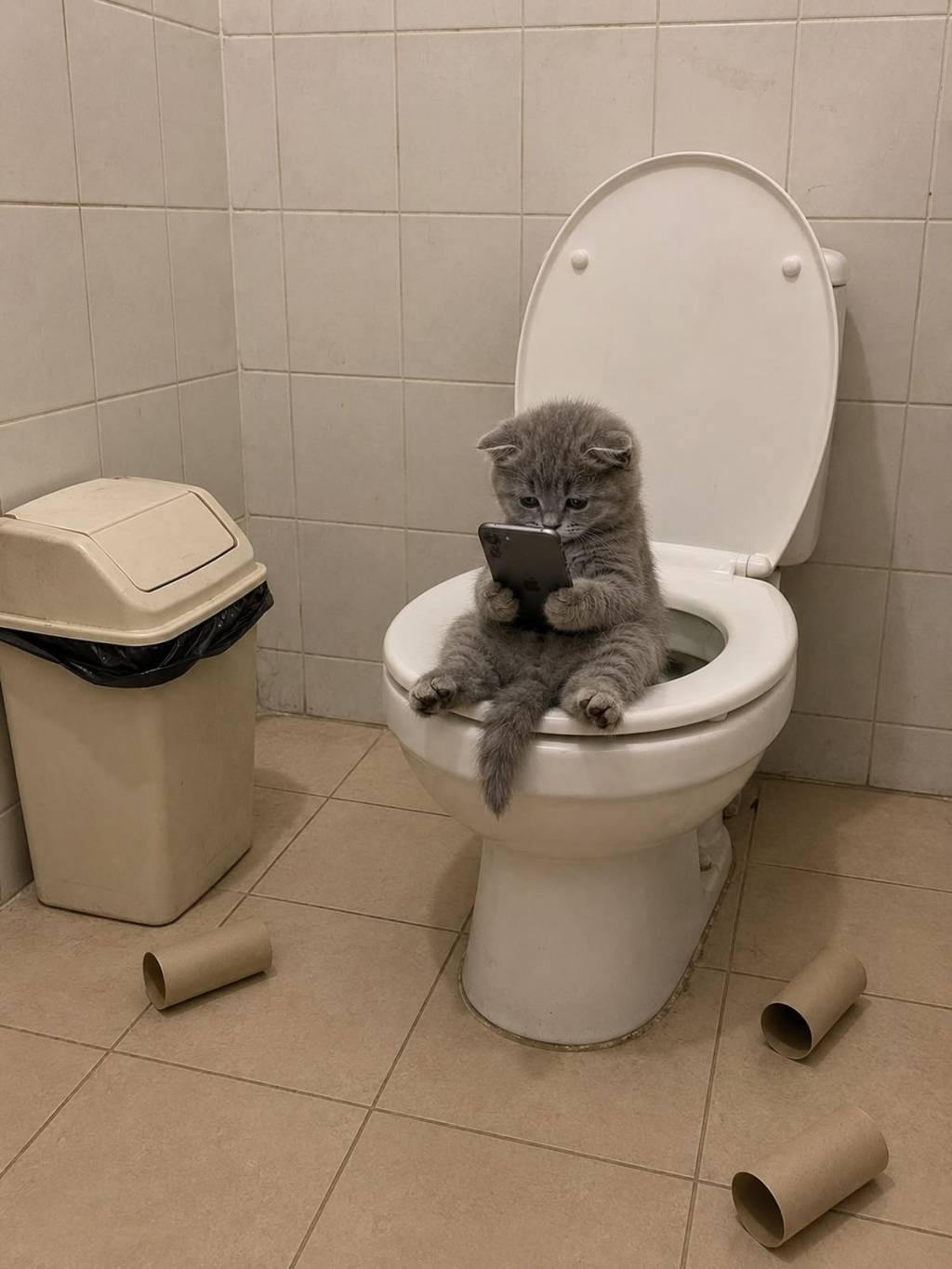
The journey to the Philippines began, rather unexpectedly, with someone else’s toilet. More specifically, with the evidence they had left behind in a Nando’s cubicle somewhere between Wolverhampton and London. The fluorescent light above me hummed with the enthusiasm of an office printer. The hand dryer outside coughed every few seconds. Somewhere beyond the door, cutlery clinked, somebody laughed over lunch, and the smell of peri-peri chicken drifted faintly into a place where no food-related thought should have been encouraged. I stood there with one hand still on the lock, staring at the bowl and thinking, with increasing disbelief, that the flush was working perfectly well. There was water. There was tissue. There was no technical failure, no plumbing emergency, no sign that civilisation had temporarily collapsed. Someone had simply decided their part of the story ended when they walked out, and for some reason, that bothered me more than it should have.
I know this sounds absurdly small, hardly the sort of thing that should launch a travel journal. There were suitcases in the car, passports packed, London ahead, the Philippines waiting beyond that, and I was standing in a toilet cubicle contemplating humanity because somebody had not pressed a button. But maybe that was exactly why the thought stayed. Big lessons often announce themselves badly. They arrive while you are folding laundry, waiting for a bus, washing dishes, or apparently staring at someone else’s unfinished business inside Nando’s. My first reaction was irritation. My second was curiosity. What makes someone walk away from something so simple? Laziness? Habit? Entitlement? Distraction? Or perhaps nothing particularly dramatic at all. Maybe they simply did not think about the person coming next. That last possibility bothered me most.
We move through shared spaces every day without thinking much about the fact that somebody inherits them after us. Public toilets. Trains. Workplaces. Kitchens. Corridors. Waiting rooms. Homes. Even conversations. We enter, occupy a little piece of them, then leave. Sometimes we leave them exactly as we found them, sometimes better, sometimes considerably worse. Most traces are small enough to be ignored: a wrapper left on a seat, a trolley abandoned where somebody else has to move it, a cup placed beside a bin rather than inside it, a task left half-finished at work because surely somebody on the next shift can deal with it, a door allowed to close in someone’s face, a message read but deliberately left unanswered when a simple reply would have spared somebody uncertainty. None of these things looks important in isolation, but together they reveal something.
I have always been interested in the small places where character leaks out. Grand gestures are easy to admire because they are visible. People donate, volunteer, make speeches, post tributes, organise celebrations and perform kindness in ways everybody can recognise. But there is another kind of decency that receives almost no attention because nobody is watching. You clean up after yourself. You return what you borrowed. You replace what you finished. You do the task properly even though the next person would never know whether you did. You say thank you to someone whose job requires them to help you anyway. You make the space slightly easier for whoever enters after you. These are not heroic acts. That may be exactly why they matter.
I think we sometimes underestimate how much of civilisation depends on ordinary people choosing not to make life unnecessarily worse for strangers. There is no medal for putting rubbish in the bin. Nobody applauds when you leave a public toilet in usable condition. No committee gathers to celebrate the person who wipes the table after eating or places the supermarket trolley where it belongs. Still, imagine the alternative. Actually, no need. We have all encountered the alternative. Perhaps consideration is simply remembering that your convenience is not the final event in the universe.
That thought followed me out of the cubicle. I washed my hands, looked at myself in the mirror and laughed because this was not how I had imagined the beginning of the trip. If I had planned the opening scene properly, there would have been luggage arranged beautifully beside a window, perhaps a coffee cup, maybe dramatic light falling across a passport. Something visually persuasive enough to suggest adventure was beginning. Instead, I had peri-peri in the air and a moral crisis beside a hand dryer. Much more realistic, actually.
Travel tends to expose the difference between the journey we imagine and the one we actually get. We picture airports, clouds outside plane windows, beautiful destinations and photographs that eventually become profile pictures. We forget the service stations, queues, delayed trains, toilet stops, lost receipts, heavy luggage and arguments about whether someone definitely packed the charger. Those parts count too. Sometimes they count more because they are where we stop performing the idea of travel and simply become human again. As we continued towards London, the thought stayed with me. Not the toilet itself, thankfully. There are limits to nostalgia. What stayed was the question of what we leave behind in the places we pass through.
Travelling makes that question oddly visible because you are constantly entering spaces other people have just left. A hotel room somebody slept in the previous night. A train seat still warm from another passenger. A café table recently cleared. An airport trolley rolling away from one family and towards another. We depend on strangers behaving reasonably all the time. Most of them do, and that is easy to forget. For every abandoned mess, there are hundreds of invisible acts of consideration we never notice precisely because they worked. Someone cleaned the toilet. Someone replenished the tissue. Someone emptied the bin. Someone wiped the table. Someone checked the train. Someone loaded the bags. Someone prepared the room before we arrived. Ordinary life is held together by people doing things for whoever comes next.
That suddenly felt larger than flushing. It made me think about nursing too. Healthcare runs on the same principle more than we sometimes acknowledge. A clear handover. A properly documented note. Equipment returned where it belongs. Something escalated before it becomes somebody else’s emergency. Details completed not because you personally benefit from them, but because another nurse, doctor, patient or family member will inherit what you leave. There is something deeply communal about doing your part properly. You rarely see the full consequence. That is the point. Most of the people affected by our care or carelessness will never know our names.
The same is true outside work. We leave traces inside people too. A careless remark can follow someone into the rest of their day. So can an unexpected kindness. You can make somebody feel foolish for asking a question, or you can answer without making them regret asking. You can leave tension inside a room after you walk out. You can leave reassurance. The spaces we pass through are not always physical. That was where the thought became uncomfortable, because it is much easier to judge an unflushed toilet than to examine the messes I may have left in less visible places. Have I always finished conversations well? Have I made things harder for people because I was tired, impatient or too absorbed in my own problem to notice theirs? Have I assumed somebody else would deal with what I could have handled myself? Probably. Human beings are excellent at noticing other people’s lack of consideration because their inconvenience arrives directly in front of us. Our own can be much harder to see.
Maybe that was the actual lesson waiting inside that ridiculous cubicle. Not look what someone else failed to do, but remember that you are also the person before somebody else. That changes the question. Instead of asking whether anyone is watching, perhaps the better question is whether somebody will have to deal with what you leave. That can apply to almost anything: work, friendship, family, public spaces, online conversations, the way you end things, the way you hand things over, the way you speak to people who cannot offer you anything, the way you behave when anonymity protects you from consequence. Decency becomes more interesting when there is no audience.
By the time the journey continued, the Nando’s stop had already become one of those strange little stories I knew I would remember despite wishing I had a more elegant opening anecdote. Tomorrow there would be the airport. After that, the flight. Eventually Cebu, family, heat, familiar roads, food I had missed and all the photographs that would look far more appropriate in a travel journal. But perhaps I did not need the beginning to be beautiful. Maybe beginnings are allowed to be ridiculous. Maybe meaning occasionally arrives smelling faintly of disinfectant and peri-peri.

By the time I left the cubicle, washed my hands and returned to the journey, the whole thing should have disappeared from my mind. We had bags to carry, trains to catch, London ahead and a flight to the Philippines waiting the next day. There were much larger things to think about than the moral implications of a stranger’s flushing habits. Unfortunately, my brain had already promoted the incident into philosophy, because someone always comes after you. Someone sits in the chair you leave. Someone uses the toilet after you. Someone receives the handover you rushed. Someone enters the room after your argument. Someone inherits the task you did properly or the mess you decided was no longer your problem. Most of the time, you will never meet them. They will never know your name. That does not make them imaginary.
I had expected the journey home to begin with luggage, airports and perhaps a dramatic photograph beside a departure board. Instead, it began in a Nando’s toilet stall with a lesson in basic decency. Not exactly cinematic, but memorable. And, for the record, I flushed.
Still flushing before I leave,
Anj🖤


































Leave a Reply