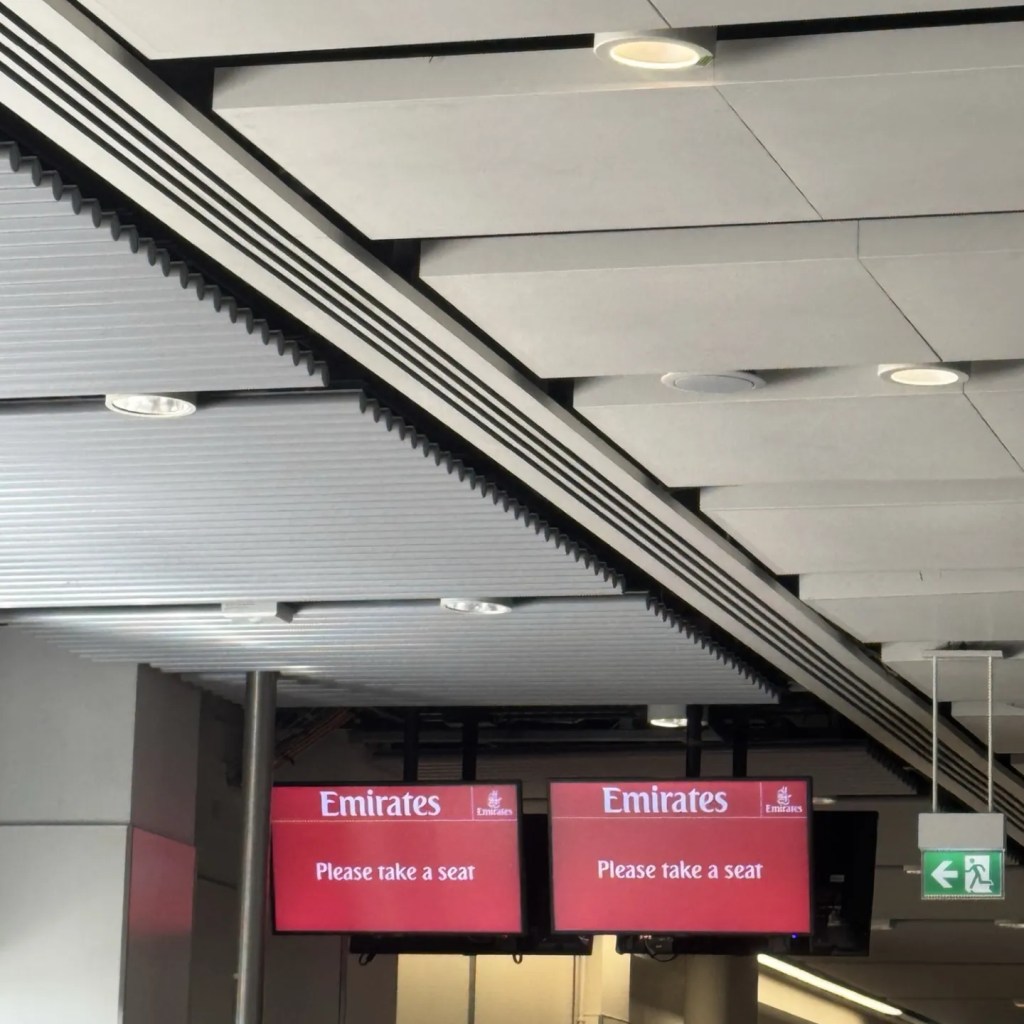
Gatwick at ten in the morning looked exactly like a place where nobody intended to stay. Suitcase wheels rasped across the floor, departure boards blinked through city names, coffee machines exhaled steam behind counters, and people moved with that peculiar airport urgency where everyone appears either ten minutes late or three hours early. Mama was studying the screen as if the airline might suddenly reconsider the Philippines if she looked away. Jan walked beside me, calm as ever. I pushed the trolley, checked the passports in my bag for no sensible reason, and decided that the first serious problem of the journey had already presented itself: Gatwick had no garlic rice.
This felt like a design flaw. There were croissants lined neatly behind glass, muffins large enough to require structural support, sandwiches cut into perfect triangles and sushi sitting beneath refrigerated lights looking far too elegant for the mood I was in. None of it was wrong. None of it was rice. More specifically, none of it was hot rice carrying enough garlic to announce itself from the other side of the terminal. Apparently I could live in Britain, work here, understand the trains, survive the winters and eventually stop mentally converting every pound into pesos, but one airport breakfast was enough to reveal that cultural assimilation had failed somewhere around the stomach.
At first, I thought I was simply hungry. The longer we walked, however, the more obvious it became that the craving had very little to do with breakfast. Food becomes strangely emotional when you have lived away from home long enough. Garlic rice is never merely garlic rice. It drags an entire kitchen behind it. Hot oil. Plates on a table. Somebody moving around in slippers. Voices carrying from another room. A rice cooker being opened. Someone asking whether you have eaten even while watching you eat. What I wanted that morning was not really food. I wanted familiarity served hot.
Eventually hunger defeated principle and we sat near the gate with whatever Gatwick had been willing to provide. My sandwich tasted exactly like something designed not to offend anybody, which is rarely the same thing as tasting good. The bottled water had achieved the classic airport distinction of being expensive enough to make you examine the receipt twice while remaining chemically indistinguishable from ordinary water. Around us, people checked phones, moved bags from one side of their chair to the other and looked towards the departure screens every few minutes, perhaps hoping persistence would make boarding happen sooner.
Then I noticed Mama’s hands.
Her rosary moved slowly through her fingers, bead after bead, the motion so familiar that she barely seemed conscious of it. Her lips moved almost imperceptibly. Nothing about the scene was dramatic. Nobody around us stopped. No music changed. The fluorescent lights remained as unforgiving as before. A suitcase rolled past. Somebody coughed. Another announcement echoed through the terminal. And there was Mama, praying in the middle of all of it.
I had seen her hold a rosary before flights, beside hospital beds, during difficult decisions, after loss, in uncertainty and on ordinary days when prayer seemed to be less an activity than a reflex. Watching her there made me think about how often faith travels quietly. We like to imagine faith in grand settings, surrounded by candles or stained glass or answers arriving at precisely the correct moment. In reality, some of the most faithful things I have witnessed happened under fluorescent lighting, between gate numbers, with hand luggage at someone’s feet.
Airports are excellent places to discover how exaggerated our sense of control really is. We prepare as though precision can protect us from unpredictability. Passports checked. Bags weighed. Documents organised. Chargers packed. Arrival time calculated with enough margin to survive several hypothetical disasters. Then a gate changes and half the terminal begins migrating in the opposite direction like startled wildlife. A delay appears. Weather interferes. A queue materialises from nowhere. You realise that preparation is useful, but control was mostly something you invented to make yourself feel better.
That morning, I had done what I could. We had arrived. The bags were there. The passports were there. Mama was praying. Jan was beside me. The Philippines remained several thousand miles away. Everything after that point required a little surrender.
Perhaps that was why the airport began to feel different once we sat down. Before, Gatwick had seemed like an obstacle between Britain and home. A long bright waiting room filled with overpriced food and people repeatedly checking screens. But the longer I watched the terminal, the more it seemed like a place where thousands of private stories had briefly been forced into the same room. Someone was travelling towards a wedding. Someone else might have been returning for a funeral. Someone was beginning a holiday. Someone was leaving for work. Someone was moving countries with their entire life divided between suitcases and whatever they had been forced to leave behind.
You cannot tell by looking.
That fascinates me about airports. Everyone becomes visually similar. Passport. Bag. Phone. Coat. Tired face. Yet the reason for leaving can be entirely different. One gate can hold reunion, grief, excitement, dread and relief at the same time, all sitting three chairs apart without introduction.
Maybe that is why airports have always felt slightly emotional to me. They are built for movement, but most of what we do inside them is wait. We sit somewhere between the place that released us and the place that has not received us yet. For a few hours, our lives shrink into boarding passes, gate numbers and the contents of hand luggage.
I know that feeling outside airports too.
Much of adulthood seems to happen in departures lounges. You have left one version of yourself but have not quite met the next one. You have made the decision but have not yet seen what it changes. You have prayed, but the answer has not arrived. You have closed one door and are standing in a corridor pretending you are not wondering whether another one will open.
I have never been naturally talented at this part.
I prefer arrival. Arrival provides evidence. There is a destination, a result, an answer, something you can point at and say, “There. That was what all of this was for.” Waiting offers none of that. Waiting simply asks you to remain where you are without knowing whether the next announcement will bring movement or another delay.
Perhaps that is why Mama’s rosary stayed in my mind. She did not rush the beads. She did not jump from the first prayer to the last because she already knew how it ended. Her fingers moved one bead at a time. There was something almost annoyingly instructive about it. I spend so much of life trying to mentally arrive before my body has even boarded.
I was already imagining the Philippines. The heat meeting us outside the airport. Familiar voices. Food. Roads. Family. The particular sensation of stepping into a place you have missed long enough that even the air seems recognisable. Yet we were still at Gatwick, and perhaps Gatwick deserved to exist too.
That has become harder to understand since I built a life abroad because leaving is no longer geographically simple. Years ago, “home” meant one place. The Philippines. Cebu. Family. The origin point. Britain was somewhere I went. Then Britain began collecting pieces of my life without asking permission. Work. Friendships. Favourite routes. Shops I knew without thinking. Ordinary evenings. Habits. The familiar relief of reaching my own front door after a difficult shift.
Eventually, another country stopped feeling entirely like somewhere else.
That complicates airports.
When I travel to the Philippines, I am going home. When I leave Britain to do it, I am also leaving home. Both statements are true. The heart apparently has no interest in geographical efficiency.
For a long time, I thought contradictory feelings meant I had failed to decide how I really felt. Now I think contradiction is sometimes simply evidence that more than one thing matters. I can be desperate to see family and still feel the small tug of leaving the life I built here. I can love Britain without loving the weather, which seems reasonable. I can miss Cebu while standing in my own home in England. I can belong somewhere without belonging there exclusively.
There is no betrayal in that.
Perhaps migration teaches the heart to become a house with more than one room.
By then, Mama had finished part of her prayer. Jan remained beside me, quietly practical in the way he usually is when travelling. I ate the sandwich because eventually hunger becomes stronger than culinary principles, though I continued to believe garlic rice would have improved both my mood and the architecture of the morning.
Nothing significant happened.
That is probably why I wanted to remember it.
I wanted to remember Mama beneath the airport lights with the rosary moving through her hands. I wanted to remember Jan sitting beside me before the long journey. I wanted to remember our ridiculous search for rice. I wanted to remember the hard chairs, the glowing screens and the ordinary terminal noise because memory rarely preserves only the grand events. Sometimes years later, what returns is the waiting before them.
Travel has taught me that the journey is full of scenes we initially dismiss as administrative. Check-in. Security. Waiting. Boarding. Yet those spaces often hold the final ordinary moments before something changes. You sit beside somebody before leaving. You eat something forgettable. You say a small prayer. You check the gate. You do not realise you are standing inside a memory because it has not become one yet.
I think life works like that too.
We keep waiting for significance to identify itself. Graduation. Wedding. Promotion. Migration. Arrival. Answered prayer. The obvious scenes. But perhaps some of the most important things happen in the minutes before them, while nobody is taking photographs because everyone assumes nothing has started yet.
Eventually the atmosphere around the gate changed. Passports appeared in hands. People stood unnecessarily early, because airport queues have a mysterious gravitational force. Someone zipped a bag. Somebody else asked whether this was the correct line despite the enormous sign above us. Jan gathered what needed gathering. Mama put away her rosary.
I checked my passport.
Then checked it again.
Apparently anxiety really does enjoy paperwork.
When we stood, I glanced back at the chairs. The airport still looked exactly as it had before: bright, functional, temporary. There was nothing cinematic about it in the conventional sense. No sunset through enormous windows. No swelling soundtrack. No dramatic farewell. Just fluorescent light spilling over people who were all going somewhere.
And perhaps that was the image.
Gate-lit longing.
Not beautiful enough to become a postcard. Not tragic enough to demand attention. Just that strange ache produced when part of you is already somewhere else while your body is still waiting for permission to follow.
We had not yet reached the Philippines, but home had already begun showing itself. It was inside Mama’s prayer. It was in Jan walking beside me. It was in the shared understanding that rice would have solved several problems. It was in the anticipation sitting underneath everything we said.
Maybe home had never been waiting exclusively at either end of the flight.
Maybe some of it was travelling with us.
We moved towards the gate with our passports, our bags and all the feelings I had finally stopped trying to arrange into one tidy emotion. I was excited. I was nostalgic. I was tired. I was grateful. I was hungry. All of them could board.
And as the queue moved forward beneath those bright Gatwick lights, I realised something I had spent years trying to make more complicated than necessary: being between two homes does not make you homeless. Sometimes it simply means your heart has learned more than one way back.
The gate opened.
Mama stepped forward.
Jan followed.
I went with them.
And somewhere behind us sat one disappointing sandwich, several empty chairs and the garlic rice Gatwick never managed to provide.
Some journeys begin with boarding.
Apparently ours began with longing.
— Anj 🖤


































Leave a Reply