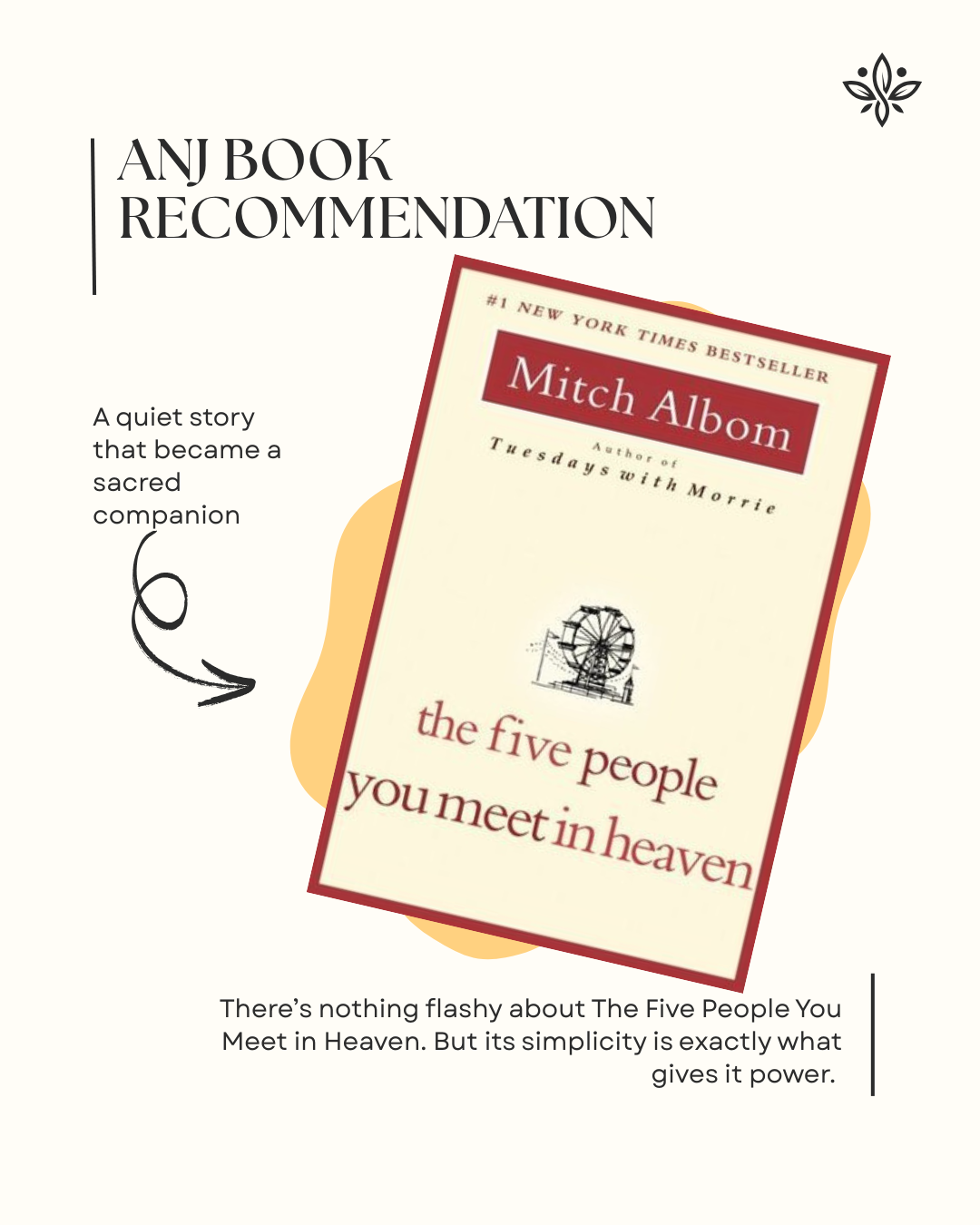
By Mitch Albom
Rating: ★★★★★ (5/5)
Category: Book Reviews | Contemporary Fiction | Spiritual Fiction | Life Lessons
“All endings are also beginnings. We just don’t know it at the time.”
— Mitch Albom, The Five People You Meet in Heaven
I have always found it curious how society measures a successful life. We are remarkably fond of impressive titles, expensive possessions, professional achievements, and the sort of accomplishments that look particularly convincing when announced on social media. We celebrate promotions, graduations, weddings, and milestones with photographs, flowers, and enthusiastic congratulations. Meanwhile, the person who quietly repairs something before anyone notices it is broken rarely receives so much as a thank-you. Apparently, keeping the world functioning is considerably less glamorous than being photographed while doing it.
Perhaps that is why I have always been interested in ordinary people and the lives that unfold beyond public attention. The hospital porter who knows exactly where everything needs to go. The cleaner who arrives before most people have finished their breakfast. The colleague who remembers that someone prefers tea without sugar. The elderly neighbour who has spent decades doing things for other people without once considering those things particularly remarkable. Their lives may never become the subject of a biography, but I have often wondered whether that tells us more about their significance or about the peculiar standards by which we measure it.
Mitch Albom’s The Five People You Meet in Heaven explores precisely this question, although he approaches it through a rather unconventional arrangement. His protagonist is an elderly amusement park maintenance worker named Eddie, a man who has spent much of his life convinced that he has accomplished very little. He has no grand professional legacy, no particularly glamorous lifestyle, and certainly none of the qualities that usually inspire motivational speeches. If his achievements were assessed according to the modern obsession with personal branding, I suspect the results would be disappointing.
And yet Albom builds an entire novel around the possibility that Eddie has misunderstood the value of his own existence.
I read this book in one sitting. Not because it was particularly long or because the plot demanded the breathless attention of a thriller, but because I wanted to know what Albom would reveal about this man whose life appeared so ordinary. I was also curious about the title. Five people in heaven seemed a rather modest number, considering the countless individuals we encounter over a lifetime. Surely there ought to be a more extensive guest list. But as I read, I began to understand why Albom had chosen to tell this particular story through five encounters rather than an entire celestial reunion.
The book made me consider something I rarely pause to examine: how much of our influence upon other people remains invisible to us.
What the Book Is About
First published in 2003, The Five People You Meet in Heaven is a philosophical novel that explores the meaning of life, human connection, forgiveness, and the consequences of actions we may never fully understand.
Its central character, Eddie, is an elderly maintenance worker at Ruby Pier, an amusement park where he has spent much of his life keeping the rides safe and operational. He is a war veteran, a widower, and a man burdened by disappointments that have gradually shaped his understanding of himself. He regards his life as a collection of missed opportunities and unfulfilled ambitions, particularly when compared with the future he once imagined.
The novel opens on Eddie’s final birthday and follows him into an imagined version of heaven, where he encounters five individuals connected to his earthly existence. Some are familiar to him, while others initially seem to have little relationship with his memories. Through these encounters, Eddie begins to discover how apparently unrelated experiences, decisions, and relationships have shaped his life and the lives of others.
What makes the premise particularly interesting is that Albom does not present heaven simply as a place of reward. Instead, he imagines it as a setting in which people come to understand the meaning of their experiences from perspectives unavailable to them while they were alive.
The novel moves between Eddie’s encounters in heaven and episodes from his past, gradually reconstructing a life that he himself has considered largely unsuccessful. Through these shifting timelines, Albom explores how regret can distort our understanding of personal achievement and how the significance of a life may extend beyond anything measurable through conventional success.
It is an ambitious concept for a relatively short novel. Albom attempts to examine mortality, grief, sacrifice, forgiveness, and spiritual meaning without constructing an elaborate theological system or a particularly complicated fictional universe.
For the most part, I think he succeeds.
Eddie: The Unremarkable Man Who Carries the Story
I found Eddie one of the most compelling aspects of the novel precisely because he is not an especially impressive man by conventional literary standards.
He is not wealthy, celebrated, or extraordinarily talented. He has made mistakes, experienced disappointment, and gradually become resentful of the circumstances that shaped his adult life. His work at Ruby Pier has given him purpose, but he does not necessarily recognise that purpose himself. Instead, he frequently sees the amusement park as evidence of the ambitions he never fulfilled.
There is something painfully recognisable about that perspective.
We have a tendency to judge our lives according to what we expected them to become. We compare our present circumstances with an imagined future that once seemed perfectly reasonable, then interpret the difference as evidence that something has gone wrong.
Perhaps we expected to work somewhere else, become financially successful earlier, achieve a particular qualification, or live in a different country. Perhaps we imagined ourselves as more adventurous, more confident, or more accomplished than we eventually became.
I think most adults carry at least one version of themselves who exists entirely in the imagination: the person they might have become had they chosen differently.
What Albom does so effectively is challenge Eddie’s assumption that an ordinary life must necessarily be an insignificant one. He allows readers to see the difference between the way Eddie interprets his experiences and the wider consequences of those experiences.
Eddie is not idealised. He can be bitter, stubborn, and emotionally guarded. His disappointments influence how he treats himself and how he understands the people around him. Yet these imperfections are essential to the novel’s emotional credibility. A character who already understands the value of his own life would have very little reason to undertake Albom’s extraordinary journey.
The five encounters gradually expose the limitations of Eddie’s perspective, revealing relationships and consequences he could not previously appreciate.
I particularly liked that Albom chose a maintenance worker as his protagonist. There is something quietly subversive about placing an overlooked member of the workforce at the centre of a story concerned with the meaning of human existence.
Eddie spends his life ensuring that other people can enjoy themselves safely. His work matters most when nothing goes wrong, which is perhaps the occupational curse of people responsible for keeping essential systems functioning. Success is frequently invisible, while failure tends to attract an audience.
As someone working in healthcare, I found that observation especially familiar.
The Art of Making an Ordinary Life Extraordinary
From a literary perspective, one of Albom’s greatest strengths is his ability to construct an emotionally engaging narrative through relatively simple prose.
His sentences are generally accessible, his imagery straightforward, and his chapters carefully arranged to sustain curiosity without overwhelming the reader. He does not rely upon particularly elaborate language or intricate philosophical arguments. Instead, the novel develops through character revelations and the gradual recontextualisation of events.
The structure is especially effective.
By moving between Eddie’s past and his encounters in heaven, Albom allows readers to interpret familiar memories differently as new information emerges. An incident that initially appears incidental may become important later, while a relationship that Eddie remembers with resentment can acquire greater complexity when examined from another perspective.
This approach gives the novel an almost cinematic quality. Scenes from Eddie’s childhood, military service, marriage, and working life unfold like fragments of a larger story, gradually acquiring meaning as the narrative progresses.
I could easily imagine the story translated into film, particularly because its emotional impact depends heavily upon visual memories, changes in setting, and the contrast between Eddie’s understanding of events and the perspectives revealed to him.
What I found especially effective was Albom’s restraint in presenting Eddie’s everyday existence. The details of his work, his routines, and his relationships establish a recognisable world before the novel invites us into its spiritual premise.
By grounding the story in an ordinary life, Albom makes its larger philosophical questions easier to approach.
There is, however, a limitation to this technique. The five encounters sometimes function more as vehicles for particular lessons than as fully independent characters with equally developed psychological lives. Their purpose within the narrative is closely connected to what Eddie needs to understand.
Readers who prefer subtle ambiguity or complex literary characterisation may find this arrangement somewhat predictable.
Yet I think the structure works within the conventions of a philosophical fable. Albom is not attempting to reproduce the untidy complexity of every human interaction. He is constructing a symbolic journey in which individual encounters illuminate different aspects of a larger argument.
The result is emotionally direct, occasionally sentimental, but undeniably effective.
The Invisible Work of Ordinary People
Of all the ideas explored in the novel, the question of unseen significance affected me most.
As a nurse, I spend much of my professional life in an environment where the meaning of a particular action may not become apparent until much later. Healthcare is often discussed through measurable outcomes, clinical decisions, treatment plans, and professional responsibilities. These are essential, of course. But there is another dimension to care that is considerably more difficult to quantify.
A conversation may remain in someone’s memory long after we have forgotten it. A moment of patience can influence how a person remembers a frightening experience. A small act of consideration may matter enormously to someone who is having an exceptionally difficult day.
I do not want to romanticise healthcare. It is demanding work, and good intentions alone are not sufficient. Patients deserve knowledge, competence, safe practice, and professional accountability. Compassion should never be treated as a substitute for these responsibilities.
But I have come to appreciate that the human experience of care cannot always be reduced to what is written in a clinical record.
This is where Eddie’s story resonated with me.
He spends much of his life judging his work according to its apparent lack of prestige. He sees what he might have accomplished elsewhere without fully recognising the value of what he has been doing all along.
I found that perspective both moving and uncomfortable.
How often do we overlook the contributions of people whose work becomes visible only when it is no longer performed? We notice when a building is untidy, when equipment fails, when services become delayed, or when something essential has been neglected. Yet the people whose daily labour prevents those problems rarely occupy the centre of our attention.
It is a strange arrangement, although perhaps an inevitable consequence of how human beings distribute recognition.
Albom invites us to reconsider that imbalance.
The significance of a life cannot always be measured by what a person achieves publicly; sometimes it is revealed through the ordinary responsibilities they fulfil and the people whose lives are better because of them.
I think that is one of the novel’s most enduring ideas. It encourages us to recognise dignity in work, kindness, and relationships that society may not consider remarkable.
It also reminds us that our understanding of somebody else’s life is necessarily incomplete.
We see occupations, routines, and outward circumstances. We rarely see the full history of decisions, disappointments, loyalties, and sacrifices that brought a person to where they are.
Eddie’s story challenges the reader to look beyond those visible details.
Five Encounters and the Complicated Business of Human Connection
The central concept of meeting five people whose lives intersected with our own is wonderfully intriguing.
I found myself wondering who those people might be if the same fictional arrangement were applied to my life. Would they be family members, friends, colleagues, or people I barely remember? Would they be individuals who influenced my decisions or strangers whose paths crossed mine for only a few moments?
The possibilities are both fascinating and rather unsettling.
We generally assume that the people who matter most to our lives are those with whom we share the closest relationships. Naturally, family, friends, and loved ones influence us profoundly. But human interaction extends far beyond our immediate circles.
We meet people through school, work, travel, neighbourhoods, and ordinary daily activities. Some remain part of our lives for decades. Others disappear after a single encounter, leaving no obvious indication that the meeting held any particular significance.
Albom explores the possibility that these connections may have consequences we never fully recognise.
I appreciate this idea because it encourages humility. We cannot assume that we understand the complete significance of our choices simply because we understand our intentions.
At the same time, I think the novel invites a degree of romantic interpretation that requires caution. Not every encounter carries a profound hidden lesson, and not every difficult experience can be neatly explained through an interconnected spiritual design.
Sometimes people behave carelessly. Sometimes circumstances are unfair. Sometimes events occur without offering us a satisfying explanation.
Nevertheless, the novel’s underlying emphasis on interconnectedness remains meaningful even without accepting every aspect of its supernatural premise.
Our choices affect other people, and other people’s choices affect us. We are neither entirely independent nor completely aware of how our lives intersect.
For a novel of modest length, that is a substantial subject to explore.
Faith, Heaven, and the Questions Literature Cannot Settle
As someone whose faith is an important part of life, I approached Albom’s depiction of heaven with both interest and curiosity.
The novel does not attempt to provide a systematic account of the afterlife according to Christian theology. Instead, Albom constructs an imaginative setting in which individuals come to understand the relationships and experiences that shaped their earthly existence.
I think this distinction matters.
Fiction can explore spiritual questions with considerable beauty, but literary imagination should not automatically be mistaken for religious doctrine. Albom’s heaven is a narrative device through which he examines forgiveness, connection, and meaning. Readers may find its ideas spiritually resonant without interpreting its details as literal descriptions of what awaits beyond earthly life.
What interested me most was the possibility of understanding experiences from perspectives unavailable to us in the present.
Human beings possess an extraordinary appetite for explanations. We want to know why certain events occurred, why people behaved as they did, and whether particular disappointments served some greater purpose. We are rarely satisfied with uncertainty, especially when the questions concern experiences that changed our lives.
Albom imagines a form of understanding in which the apparent disorder of a person’s existence begins to reveal relationships they had never recognised.
It is a comforting literary idea.
But I would hesitate to accept the implication that every painful experience must have occurred for a specific beneficial reason. Suffering does not always produce wisdom, and tragedy should not be justified simply because someone eventually discovers meaning in its aftermath.
Meaning can emerge from difficulty without requiring us to regard the difficulty itself as necessary or deserved.
For me, that distinction is important.
My faith encourages hope, compassion, and trust in God, but it does not eliminate the complexity of human experiences or provide immediate explanations for every hardship.
I appreciated Albom’s willingness to explore these questions through fiction, while also recognising that the novel offers an imaginative perspective rather than a definitive theological answer.
Where the Novel Falls Short
For all my affection for The Five People You Meet in Heaven, I recognise that its greatest strengths may also be the qualities that some readers find least appealing.
Albom’s writing is openly sentimental. He constructs scenes around emotionally significant revelations, frequently guiding readers towards a clearly identifiable lesson. There is relatively little ambiguity about the broader values the novel wishes to communicate.
At times, I wanted greater complexity in the conversations and a little more resistance to conclusions that seemed almost too neatly arranged.
Real life does not generally provide five carefully selected individuals who explain our history in an organised sequence. Relationships remain unresolved, memories can be unreliable, and people do not always acquire the understanding they need at the moment they need it.
The novel’s structure, while effective, can therefore feel more reassuring than realistic.
I also think some of the secondary characters exist primarily to advance Eddie’s development rather than to be examined with equal depth. The story remains tightly focused on his journey, which gives it emotional coherence but limits the complexity of certain relationships.
However, I do not consider these weaknesses sufficient to undermine the novel’s achievement.
Albom is working within the tradition of philosophical and spiritual fiction, where symbolic encounters and accessible language are central to the storytelling. His purpose is not to provide a comprehensive psychological study or a rigorous theological argument.
He wants readers to reconsider how they understand the value of an ordinary life.
Within that framework, the novel is remarkably successful.
There is also something to be said for emotional accessibility. Literature does not become less valuable simply because its ideas can be understood without a dictionary, an academic commentary, or a postgraduate qualification in existential philosophy.
Sometimes clarity is an artistic choice rather than an intellectual limitation.
What Stayed with Me After the Final Page
I finished this novel in one sitting, but I have returned to its central questions many times since.
What makes a life meaningful? Is significance something we achieve through extraordinary accomplishments, or can it be found in the ordinary relationships and responsibilities that occupy most of our days? How accurately do we understand our influence upon other people?
I do not think these questions have simple answers.
Working in healthcare has made me conscious of how differently people evaluate their own lives. Some speak proudly of professional accomplishments, others of family, friendships, travels, or experiences that outsiders might consider unremarkable. The things people value most are not always the things society encourages them to pursue.
I find that deeply interesting.
We spend much of our younger years imagining what we want our lives to become. We establish ambitions, set goals, and construct expectations about the future. As we grow older, however, our understanding of success can change.
Achievements that once seemed essential may lose their importance. Relationships become more significant. Ordinary routines acquire unexpected value. We begin appreciating experiences we might previously have overlooked.
I have noticed this in my own reflections about living abroad, building a career, maintaining connections with family and friends, and finding time for interests that exist beyond professional responsibilities.
There are days filled with accomplishments and others in which very little appears to happen. Yet I have learned not to assume that the quieter days are necessarily less valuable.
Sometimes a meaningful conversation, an ordinary afternoon with someone we love, or a simple act of consideration becomes a memory that survives long after more impressive events have faded.
Eddie’s story encouraged me to examine that possibility more carefully.
It also reminded me that we cannot always evaluate our lives fairly while we are still living through them. We are too close to our disappointments, too familiar with our routines, and sometimes too concerned with what remains unfinished.
Perhaps that is why literature can be so valuable. It allows us to step outside our immediate perspective and consider an ordinary existence through someone else’s eyes.
My Final Verdict: Is It Worth Reading?
Rating: ★★★★★ (5/5)
Absolutely. The Five People You Meet in Heaven is one of those novels I would happily recommend to readers who enjoy reflective fiction, emotionally engaging storytelling, and questions about what makes human life meaningful.
Its greatest strength is its accessible exploration of complex themes through an ordinary protagonist. Eddie is memorable precisely because his experiences challenge conventional ideas about accomplishment and personal significance.
I also admire Albom’s narrative structure. The movement between past and present gradually transforms the reader’s understanding of Eddie, allowing individual episodes to acquire new meaning as the story develops. His prose is simple but purposeful, and the novel’s brevity contributes to its emotional accessibility.
My reservations concern its occasional sentimentality, neatly organised revelations, and limited psychological development of some secondary characters. Readers who prefer ambiguity, literary experimentation, or philosophical complexity may find its approach overly direct.
Nevertheless, I give it five stars because of how effectively it accomplishes its central intention. It tells a compelling story, raises meaningful questions, and encourages readers to reconsider how they value ordinary lives.
I do not expect every novel to offer an entirely original philosophical argument. Sometimes what matters is the way a story allows us to understand a familiar idea through a perspective we had not previously considered.
For me, Albom achieves that beautifully.
Would I Recommend It?
Yes, particularly to readers who enjoy contemporary fiction with spiritual and philosophical themes. I would especially recommend it to those who appreciate stories about human connection, forgiveness, regret, and the meaning found in ordinary experiences.
It may resonate with healthcare workers, caregivers, teachers, and people whose contributions are often made through consistent service rather than public recognition. It is also a thoughtful choice for readers reflecting upon life changes, personal disappointments, or the difference between the futures they imagined and the lives they have actually built.
I would be cautious about recommending it to someone who dislikes openly sentimental fiction or prefers more ambiguous conclusions. Albom makes his philosophical intentions clear, and the story is designed to be emotionally accessible rather than intellectually elusive.
Best read when: You have a few uninterrupted hours, an interest in life’s larger questions, and perhaps a cup of tea that you will inevitably forget to finish because you have become too absorbed in the story.
The thought I would take away: We rarely possess a complete understanding of the ways our lives affect other people, and that uncertainty should make us more attentive to the ordinary moments we share.
The Last Word: A Life Without a Headline
I began this review thinking about how society measures success, and I find myself returning to that question with slightly more suspicion than before.
We are remarkably efficient at celebrating visible achievements. A promotion is announced, a qualification receives a certificate, and a significant milestone is accompanied by photographs that will remain on the internet long after everyone involved has forgotten what they were wearing.
But what happens to the thousands of ordinary actions that never become public events?
The colleague who stays a little longer to help someone finish a difficult task. The parent who repeatedly sacrifices personal convenience for a child’s well-being. The friend who remembers an important date. The maintenance worker who checks the same equipment every morning because someone else’s safety depends upon it.
These things rarely attract applause.
Perhaps they should not require it.
One of the reasons I loved Eddie’s story is that it asks us to consider the value of a life without demanding that it become extraordinary by society’s standards. He is not transformed into a famous hero through some astonishing accomplishment. Instead, the novel gradually reveals that his ordinary existence has been connected to other lives in ways he never fully appreciated.
Of course, I cannot claim to know whether anything resembling Albom’s imagined heaven awaits us. That belongs to questions of faith rather than literary criticism. But I appreciate the possibility his novel invites us to consider: that we may never be the most reliable judges of our own significance.
There is something humbling about that thought.
It makes me want to pay closer attention to people whose lives I encounter only briefly, to appreciate work that usually goes unnoticed, and to reconsider my own habit of measuring a successful day according to how many things I managed to accomplish.
I still enjoy achievements, ambitious plans, and the occasional satisfaction of ticking everything off a to-do list. I suspect that particular pleasure will remain with me for quite some time.
But perhaps a life deserves to be assessed by more than the number of completed tasks.
After all, Eddie spent years maintaining an amusement park without fully understanding what his work meant to the people who visited it. The irony is rather beautiful: a man responsible for keeping other people’s rides running had become convinced that his own life was going nowhere.
And that, I think, is why Mitch Albom’s novel has stayed with me.
Sometimes the person who considers their life unremarkable is the very person making somebody else’s ordinary day possible.
There may never be a headline about it. There may not even be a thank-you.
But I hope we learn to notice.
Yours in books, ordinary miracles, and questions worth keeping,
Anj



Leave a Reply