SPED Rotation | April 4, 2012
There is something rather peculiar about nursing school. You spend an extraordinary amount of time being taught how to assess people, identify abnormalities, memorise medical terminology, and distinguish one condition from another, only to discover that some of your most important lessons have absolutely nothing to do with what you have memorised. They are not found between the pages of an anatomy textbook, nor do they appear in the multiple-choice questions that seem specifically designed to make nursing students question their intelligence. Sometimes, the lesson is standing right in front of you, looking at the world in a way you have never considered before. And suddenly, all those impressive medical terms feel rather inadequate.
I had entered nursing school with a fairly straightforward understanding of what it meant to become a nurse. There would be hospitals, patients, clinical instructors, nursing care plans, and the occasional terrifying moment when somebody asked a question I was supposed to know the answer to. There would be vital signs to take, procedures to perform, and endless requirements to complete. What I had not fully appreciated was how much of nursing involved learning to recognise another person’s world before expecting them to understand mine.
Our Special Education, or SPED, rotation introduced me to precisely that.
Unlike our usual clinical placements, where the rhythm of duty was often dictated by medical charts, observations, and hospital routines, this particular rotation invited us into an environment where learning, communication, and care could take different forms. We spent time with children who had different developmental, educational, and support needs, each with their own personality, preferences, abilities, and ways of expressing themselves. No two children were exactly alike, although I suppose the same could be said of adults. We simply become more accomplished at pretending otherwise.
I remember approaching the experience with the nervous curiosity of a student who wanted to do everything correctly. Nursing school had conditioned us to believe that preparation was the answer to almost anything. Read beforehand. Review your notes. Follow instructions. Be punctual. Bring the necessary materials. And, if all else fails, maintain the facial expression of somebody who knows exactly what she is doing. Unfortunately, there is no textbook that can tell you everything about another human being, especially a child whose needs and ways of communicating may be unfamiliar to you.
That was perhaps my first important realisation: understanding someone requires more than knowing about their condition. It requires getting to know the person.
During our rotation, I began to appreciate the importance of patience in a way that felt different from how it had been discussed in our lectures. In nursing, patience is often presented as a professional virtue, something we are expected to possess alongside clinical competence and excellent time management. In practice, however, patience can mean allowing somebody the time they need to respond, observing rather than immediately intervening, or recognising that what seems like a small achievement to one person may represent considerable effort for another.
The children reminded me that communication is not confined to spoken words. There are expressions, gestures, changes in behaviour, and countless other ways people make themselves understood. It was our responsibility as students to pay attention, adapt our approach, and avoid assuming that everyone would respond to the same instructions or encouragement in the same way. A simple interaction could become an exercise in listening, even when very little was being said.
And I found that rather humbling.
We sometimes enter a caring profession believing that our purpose is to help others, which is true, of course. But there is a subtle danger in assuming that being the person offering assistance automatically makes us the person with the greater understanding. Children have a remarkable ability to challenge that assumption. They are not particularly concerned with the professional identity we are working so hard to establish. A nursing student may arrive wearing a uniform, carrying a notebook, and feeling terribly responsible, but none of those things guarantees a meaningful connection. What matters is how we approach the person in front of us.
Our rotation also made me think about the way society understands disability and difference. People can be remarkably quick to measure others against a familiar standard, as though human development were a competition with a universally agreed finishing line. We celebrate certain milestones, expect particular behaviours, and sometimes become uncomfortable when somebody’s experience does not resemble what we consider typical. Yet the children we met were individuals with their own strengths, interests, challenges, and possibilities. Their identities extended far beyond any diagnosis or educational classification.
I began to understand why genuine inclusion requires more than good intentions. It means recognising that people may need different forms of support without treating those differences as shortcomings in their humanity. It means creating space for participation rather than expecting everybody to adapt to the same environment. And perhaps most importantly, it means approaching children with dignity rather than pity.
Compassion, I discovered, is much more useful when it is accompanied by respect.
Of course, it would be terribly misleading to describe this particular chapter of nursing school as though we spent the entire rotation contemplating profound questions about humanity. We were nursing students, after all. A group of young people whose seriousness could be interrupted at astonishing speed by the appearance of a camera.
And goodness, we did love a photograph.
My dutymates — the familiar faces who made every rotation a little more memorable.
Somewhere between fulfilling our responsibilities and collecting memories, we apparently decided that no clinical rotation was officially complete without photographic evidence of our existence. There were group pictures, carefully arranged poses, and naturally, the inevitable wacky photographs. I cannot explain why nursing students feel compelled to make ridiculous faces whenever a camera appears. Perhaps it is a coping mechanism. Perhaps it is the excitement of finally having a moment when nobody is asking us to recite the steps of a procedure. Or perhaps we were simply young and easily entertained.
Whatever the reason, our commitment to looking completely unserious in photographs was admirable.
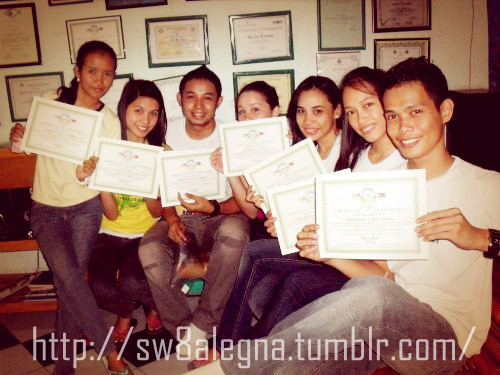
Dili gyud mawala ang wacky pose, eh? Apparently, professional development and facial discipline were two entirely separate subjects.
Looking at those photographs now, I find myself smiling at the version of us who thought these were merely ordinary duty-day memories. There is something wonderfully innocent about being a student and not yet knowing which moments will eventually become important to you. At the time, we were probably more concerned about whether everybody had managed to fit into the frame, whether somebody had blinked, or whether we could squeeze in one more photograph before leaving.
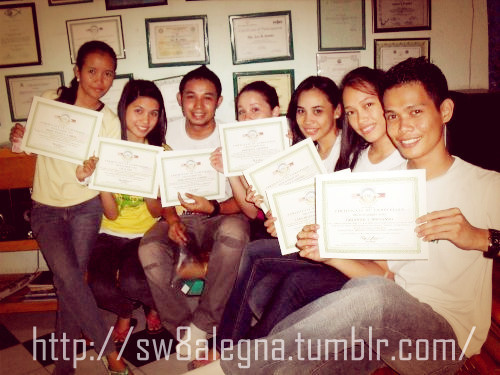
We also received certificates following our rotation, and naturally, there had to be a photograph of that occasion. A certificate might seem like a modest achievement when compared with the qualifications and responsibilities that come later in a nursing career, but back then, each one represented another experience completed, another requirement fulfilled, and another small step towards the profession we were still learning to understand.
With our certificates — another rotation completed, another memory preserved, and probably another reason to celebrate with a photograph.
One of the meaningful parts of this experience was having the opportunity to take a photograph with the founder of the Adam Jeanies Foundation. It was a reminder that the environment we had entered did not exist by accident. Behind programmes and initiatives supporting children with additional needs are people who recognise the importance of creating opportunities, building understanding, and encouraging participation.
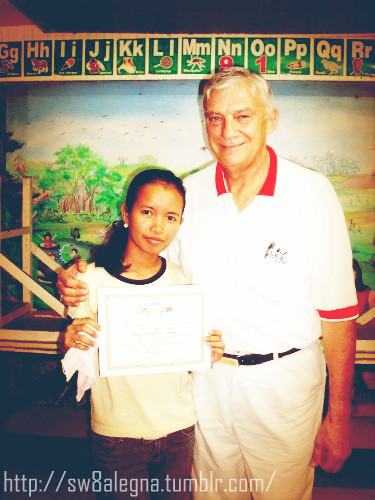
A photograph with the founder of the Adam Jeanies Foundation — a lovely reminder of the people and organisations working to support children and their development.
I sometimes wonder what my younger self would think if she could look ahead and see where nursing would eventually take her. She might be fascinated by the clinical responsibilities, slightly alarmed by the paperwork, and deeply offended to discover that adulthood does not necessarily involve getting enough sleep. But I suspect she would recognise something familiar beneath all those changes: the importance of how we treat people when they depend on us for care, reassurance, or understanding.
Our SPED rotation was only one part of our Related Learning Experience, one entry among the many placements that filled our nursing school years. It was not intended to teach us everything about disability, child development, or specialised care. Such understanding requires continued education, experience, and, above all, a willingness to listen to the individuals and families whose lives are directly affected. What the rotation gave me was an introduction to a different perspective, one that encouraged me to question my assumptions and pay closer attention to the individuality of each child.
Years from now, I may struggle to remember the exact sequence of our activities or how many hours we spent completing the requirements. I may no longer recall who suggested the first group photograph or which unfortunate dutymate became the victim of our most ridiculous pose. But I hope I will always remember what this experience encouraged me to recognise: that every child deserves to be understood as an individual, not reduced to a label, and that good care begins with noticing the person before concentrating on the task.
There is an irony in calling nursing placements rotations. The word suggests movement in circles, going from one clinical area to another, completing one set of requirements before moving on to the next. We rotate through departments, classrooms, communities, and institutions, believing that we are progressing towards a professional destination.
Yet sometimes, the places we pass through leave something behind in us.
We arrived at our SPED rotation as students carrying notebooks, expectations, and a rather excessive enthusiasm for group photographs. We left with certificates, memories, and a slightly broader understanding of what it means to care for another person.
I had thought that growing into the profession meant learning how to do more.
That day, I began to understand the value of learning how to see more. From the archives of a student nurse who was still learning that the most important lessons rarely appeared on the examination paper.
— Anj, April 2012

































Leave a Reply