
Memories of Being a Student Nurse | From the Nursing School Archives
There is a peculiar sort of confidence that comes with wearing a nursing uniform for the first time. It is an impressive transformation, really. One moment, you are an ordinary college student who occasionally struggles to remember what you had for breakfast; the next, you are dressed in white, carrying medical equipment, and looking remarkably like somebody who knows what she is doing. The uniform is beautifully deceptive. It suggests competence, composure, and a reassuring familiarity with the human body. What it does not reveal is the student underneath, silently rehearsing the steps of a procedure for the seventeenth time while praying that her Clinical Instructor will not suddenly ask a question capable of dismantling her entire confidence.
I remember those days rather fondly, although I suspect my younger self would have objected to such a generous description. Nursing school was a curious combination of ambition, exhaustion, excitement, and occasional public humiliation disguised as character development. We were expected to know our theories, apply our knowledge, demonstrate clinical skills, communicate professionally, and somehow remain presentable throughout the experience. There were days when I felt genuinely capable of becoming a nurse, and others when even the simplest question from my Clinical Instructor could make me reconsider everything I had learned since kindergarten.
And yet, I loved being a student nurse.
Perhaps not every single minute. I would be lying if I claimed that waking up early, preparing nursing care plans, and worrying about RLE grades were among life’s greatest pleasures. There were certainly mornings when my bed seemed to offer a far more convincing career proposal. But beneath the ordinary complaints and academic anxieties was something I recognised even then: I was slowly becoming the person I had wanted to be.
Our Related Learning Experience, or RLE, was where the comfortable distance between theory and practice disappeared. In the classroom, nursing procedures followed an orderly sequence. There were objectives, rationales, equipment lists, and neatly arranged instructions explaining what should happen next. Real patients, unfortunately, had not read our textbooks. They had their own worries, personalities, questions, discomforts, and entirely reasonable expectations that the person attending to them would know what she was doing.
That was where learning became considerably more interesting.
I still remember attending to a patient’s wound, concentrating on the procedure with the particular seriousness of someone who understood that this was no longer a return demonstration performed on an inanimate object. There was an actual person depending on me to be careful, attentive, and gentle. Every movement mattered. I had to think about what I was doing, why I was doing it, and how my actions might affect the patient. I was nervous, naturally. Nervousness was practically an unofficial component of our student-nurse uniform. But it was accompanied by determination, and there was something deeply satisfying about putting classroom knowledge into practice under supervision.
One of my early experiences providing wound care. Behind that concentrated expression was a student determined to remember everything she had been taught.
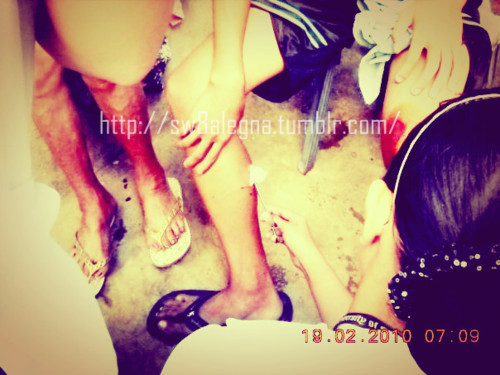
Looking back, I realise that performing a procedure correctly was only part of the responsibility. We also had to remember the person experiencing it. A wound might be described clinically according to its location, appearance, and condition, but the patient could be worried about pain, recovery, or something entirely unrelated to the procedure. The technical work demanded precision; the human interaction demanded awareness. I was beginning to understand how those two responsibilities belonged together.
Our community-related activities offered a different perspective on care. I remember participating in and leading a bathing programme, an experience that encouraged me to think about the importance of hygiene, comfort, and dignity. Tasks that appear ordinary in daily life can carry an entirely different significance when someone requires assistance to complete them. Personal care involves more than getting the practical steps right. It also requires sensitivity, respect for privacy, and an understanding that accepting help can sometimes make a person feel vulnerable.
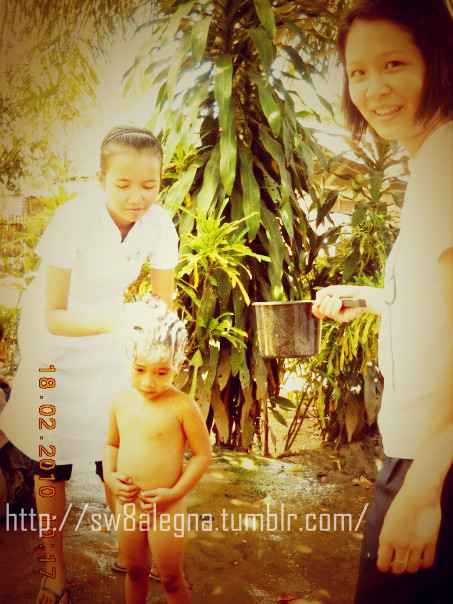
During our bathing programme — an experience that taught me to appreciate the personal side of everyday nursing care.
Of course, I must also mention the people who made those rotations bearable, entertaining, and occasionally more chaotic than necessary: my dutymates.
There is a special kind of friendship formed between people who have collectively experienced the terror of being questioned by a Clinical Instructor. Ordinary friendships may begin through shared interests or similar personalities. Nursing friendships can be established with remarkable speed through mutual academic panic. One person forgets a rationale, another misplaces a pen, somebody suddenly remembers an assignment due the following morning, and within minutes, the entire group has entered a state of coordinated concern.
But we also laughed. Goodness, we laughed.
In between our responsibilities, we found opportunities for conversations, photographs, jokes, and the sort of nonsense that probably made perfect sense to us and absolutely nobody else. We encouraged one another, compared experiences, and celebrated the little victories that made demanding days worthwhile. Sometimes those victories were clinical achievements. Sometimes they involved surviving an entire duty without being asked a question we could not answer. Both deserved recognition.

With my dutymates — my fellow students, companions in clinical adventures, and reliable accomplices whenever a camera appeared.
Another familiar activity was taking blood pressures. It is almost amusing to consider how intimidating that seemingly simple procedure could feel when we were still learning. There was the cuff, the stethoscope, the positioning, the need to listen carefully, and the extraordinary pressure of knowing that somebody might ask whether the reading was accurate. Suddenly, the faint sounds heard through a stethoscope could become the most important sounds in the universe.
I sometimes wondered whether my own blood pressure was higher than the patient’s simply because I was so anxious about taking theirs.
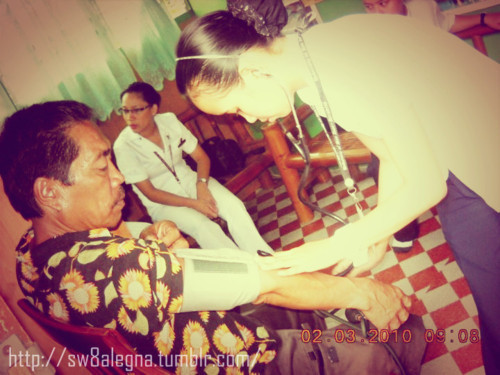
Blood pressure taking — one of those fundamental nursing skills that taught me the importance of accuracy, patience, and keeping my own nerves under control.
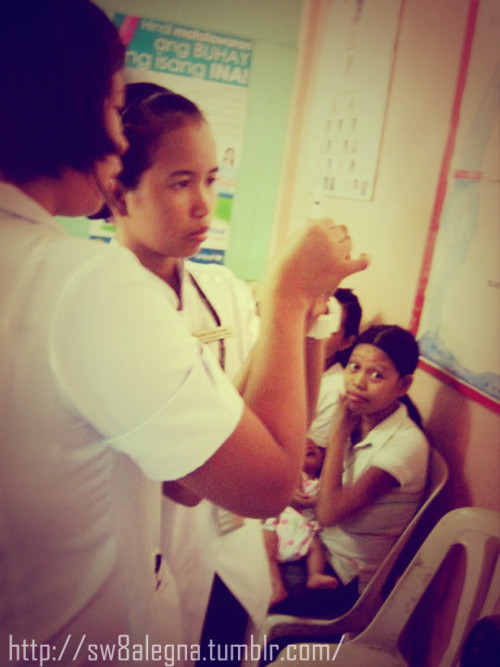
The experience felt different when I administered a vaccine to a baby for the first time. I remember how conscious I was of the responsibility. Babies are wonderfully small, and when you are an inexperienced student nurse, that smallness can make everything feel considerably more delicate. I wanted to perform the procedure correctly and safely, but I was also very aware that this was somebody’s child, not merely an opportunity for me to complete a clinical requirement.
Fortunately, my Clinical Instructor was there to guide and supervise me.
I think Clinical Instructors deserve a great deal of recognition for the patience required to teach student nurses. Imagine being responsible for a group of young adults who are eager to learn, occasionally overconfident, frequently anxious, and capable of forgetting an entire semester’s worth of information the moment somebody asks them to explain a procedure. It must require extraordinary restraint not to sigh dramatically every five minutes.
My instructor’s presence during that vaccination was reassuring. There was somebody experienced enough to recognise what needed attention and guide me through the process. It allowed me to concentrate on the child, follow instructions, and learn from the experience. I remember the sense of relief afterwards, mixed with the satisfaction of having taken another small step towards clinical competence.
My first experience administering a vaccine to a baby. A small but memorable milestone in my student-nurse journey.
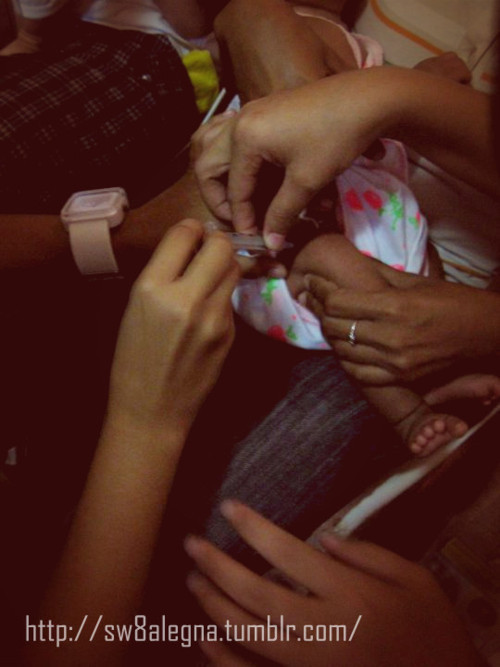
With my Clinical Instructor supervising me during the vaccination. Some of the most important lessons came from having someone experienced beside us.
Not every lesson involved hands-on procedures, however. One of our activities was providing health education about hypertension, and I remember appreciating the opportunity to share information that could help people understand their health.
It was an interesting shift in responsibility. Instead of simply being the student expected to answer questions, I had to become the person explaining something to others. That required more than repeating medical information from a textbook. We needed to communicate clearly, consider what our audience already understood, and make the information relevant to everyday life.
Hypertension was an appropriate subject because it illustrated how important prevention and health awareness could be. People may live with elevated blood pressure without experiencing obvious symptoms, which is why regular checks, appropriate medical advice, and understanding cardiovascular risk are important. As student nurses, we were learning that education was itself a meaningful part of patient care.
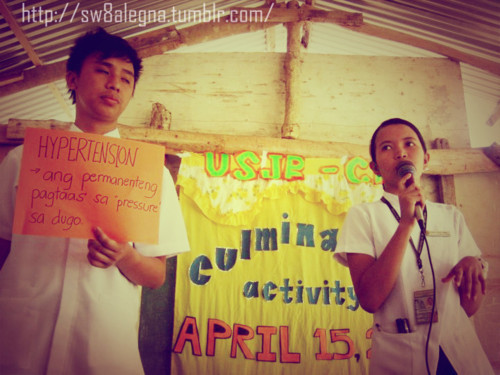
Our health teaching activity about hypertension — learning that nursing extends beyond procedures to helping people understand and manage their health.
The more duties we completed, the more I realised how much nursing demanded of us beyond academic knowledge. We had to communicate with people from different backgrounds, adjust to unfamiliar environments, accept corrections, and recognise our limitations. We learned that confidence could be developed through practice, that mistakes in learning required reflection and improvement, and that asking for guidance was far wiser than pretending to understand something we did not.
There were moments when the experience challenged my patience and others when it challenged my pride. Being corrected in front of classmates was not particularly enjoyable. Neither was discovering that something I had confidently memorised had somehow disappeared from my memory at the exact moment I needed it. But our instructors were preparing us for a profession where knowing our responsibilities, recognising uncertainty, and practising safely mattered more than protecting our egos.
And perhaps that was one of the most uncomfortable parts of growing up: accepting that wanting to be good at something did not automatically mean we already were.
Then again, we were still young, and no amount of academic seriousness could permanently suppress our enthusiasm for a ridiculous group photograph.

The obligatory wacky group photograph. Because apparently, we considered it a professional obligation to document our inability to behave seriously in front of a camera.
I sometimes find myself missing those years in the most unexpected ways. Certainly, I miss the friendships, the excitement of discovering something new, and the peculiar satisfaction of completing another clinical requirement. I miss the conversations, the shared anxieties, and the moments when we could laugh at something that had seemed terribly stressful only an hour earlier.
And yes, I even miss receiving an allowance.
There is a certain financial innocence in being a student whose greatest budgeting challenge might involve deciding whether to spend the remaining money on food, transportation, or something completely unnecessary but emotionally convincing. Adulthood, I suspect, has a rather cruel sense of humour when it comes to finances. Once you begin earning your own salary, the bills develop an extraordinary interest in your personal affairs.
But what I miss most is the unfamiliarity of everything.
Back then, so many experiences were happening for the first time. The first patient interaction that made me nervous. The first procedure I completed with guidance. The first occasion when I realised I had actually understood something I previously found difficult. Even the ordinary routines had a particular significance because we were still discovering what it meant to belong in a clinical environment.
I look at these photographs and notice how young we were, how earnestly we approached our responsibilities, and how much joy we managed to fit between them. I see students who were learning to trust their hands, sharpen their judgement, and become comfortable with the knowledge that competence would require years of practice. We were not yet the professionals we hoped to become. We were beginners, carrying our ambitions into places where those ambitions would gradually be tested against real life.
Perhaps the most curious thing about photographs is how confidently they preserve a moment while remaining completely indifferent to everything that happened before or after it. A picture of someone taking a blood pressure does not reveal the nervousness preceding the assessment. A photograph of a vaccination cannot fully express the concentration of the student administering it for the first time. A group picture cannot capture every conversation, struggle, or private worry shared by the people standing together.
And yet, each image contains just enough to remind us.
When I first wore that nursing uniform, I thought the most important thing was learning how to perform the duties expected of me. I wanted to complete procedures properly, earn good grades in RLE, and prove to my instructors that I was capable of becoming a nurse. Those ambitions were reasonable. They gave me direction during a time when almost everything still needed to be learned.
But now, as I revisit these memories, I find myself thinking about something that never appeared on our grading sheets.
Somewhere between the wound dressings, bathing programmes, blood pressure assessments, vaccinations, and health teaching activities, we were also learning what kind of people we wanted to become when somebody placed their trust in our care.
I cannot remember every grade I received. I certainly cannot recall every question my instructors asked or every answer I struggled to produce. Some of the details have disappeared into that mysterious corner of memory where forgotten passwords and misplaced belongings apparently reside.
But I remember what it felt like to be learning.
And I remember the people who were learning beside me.
There is an old photograph of us making ridiculous faces at the camera. We are smiling, completely unconcerned with appearing dignified. Our uniforms identify us as student nurses, but our expressions reveal something far more ordinary: we are young, we are together, and we are enjoying a moment in a life that has not yet shown us everything it intends to teach.
I think I like that photograph most of all.
Because years from now, nobody looking at it will know our RLE grades or how many nursing care plans we managed to finish. They will simply see a group of students laughing. And somewhere among them is a younger me, still trying to work out how to hold a stethoscope confidently, still nervous about making mistakes, still believing that becoming a nurse is something that happens when you finally receive your licence.
If only she knew how much of it had already begun.
From my nursing school memory box — for the dutymates who shared the duties, the Clinical Instructors who guided us, and the younger version of me who kept showing up, even with trembling hands.
— Just Anj

































Leave a Reply