Of delivery rooms, unexpected clinical rotations, and discovering that not every place we enter is somewhere we are meant to stay.
There is a peculiar irony in choosing a profession that requires you to become familiar with almost every aspect of the human body, only to discover that certain aspects of the human body make you considerably less enthusiastic about your career choices. Nursing school has a remarkable talent for exposing these contradictions. You spend years imagining yourself walking confidently through hospital corridors, wearing your immaculate uniform, carrying a stethoscope, and looking like somebody who has her entire professional future meticulously arranged. Then one morning, you read your clinical rotation schedule and discover that the universe has made other arrangements. Apparently, your preferences were not invited to the meeting.
For me, one of those arrangements was the Delivery Room.
I have always admired the work of nurses and midwives who spend their careers in maternity services. There is something extraordinary about the knowledge, composure, and clinical judgement required to care for mothers and newborns. The responsibility is immense, the environment can change rapidly, and the people working there must balance technical competence with sensitivity towards patients experiencing one of the most significant events of their lives. I have enormous respect for those who choose this field.
I simply never imagined myself becoming one of them.
Even as a nursing student, when my professional ambitions were still taking shape and my understanding of hospital life was largely determined by whatever clinical placement appeared on our schedule, the Delivery Room never occupied a particularly prominent place in my career fantasies. Some of my classmates were fascinated by maternal and newborn care. Others seemed genuinely excited by the prospect of witnessing deliveries and learning the intricacies of obstetric nursing.
I, meanwhile, was more inclined to admire the department from a respectful distance.
There was no dramatic incident behind my hesitation, no particular experience that made me dislike the place. It was simply an environment in which I could not picture my future self. I suppose we all have areas that naturally attract us, even before we possess enough experience to explain why. Some people discover their calling in the operating theatre. Others find themselves drawn towards paediatrics, emergency care, or intensive care. And then there are those of us who enter a department, look around, appreciate its importance, and quietly think, Well, this is interesting. I wonder where they will send me next.
But nursing education, thankfully, does not operate according to personal preference.
During my third year at the University of San Jose–Recoletos, our Related Learning Experience brought us to Eversley Child Sanitarium Hospital, where we completed a clinical rotation involving the Delivery Room. At that stage, I was still learning how to translate the carefully organised information from our textbooks into the considerably less predictable circumstances of actual hospital practice.
In lectures, everything appeared to follow a reasonable sequence. There were physiological processes to understand, clinical observations to remember, and nursing responsibilities to explain. Our instructors could discuss maternal care with impressive clarity, supported by diagrams, presentations, and enough terminology to make an ordinary conversation sound like a medical conference.
The clinical environment, however, had a personality of its own.
Suddenly, the subjects we had studied were no longer confined to pages and illustrations. They involved real patients, real professionals, and responsibilities that required more than memorising a sequence of instructions. We had to observe carefully, understand our roles, respect the people receiving care, and recognise the limits of what we were qualified to do as students.
And, of course, there was the constant awareness that our Clinical Instructor might ask us a question at any moment.
I sometimes think nursing students develop a sixth sense specifically for detecting the approach of a Clinical Instructor. A perfectly ordinary conversation can disappear within seconds. Postures improve. Expressions become attentive. Somebody suddenly remembers an important task. Another person begins examining their notes with the concentration of a scholar attempting to decipher an ancient manuscript.
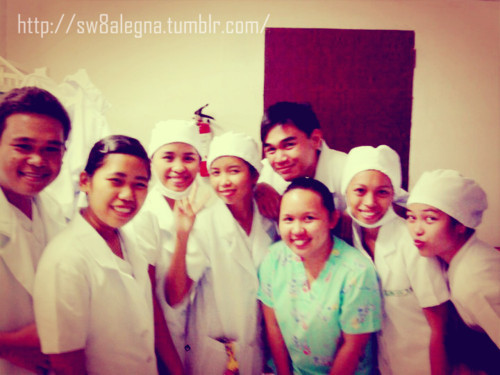
It is an extraordinary transformation, and one I suspect every generation of nursing students understands.Third-year nursing school memories — our clinical rotation at Eversley Child Sanitarium Hospital.
Looking at these photographs now, I am rather amused by how composed we appear. There is something about an old nursing school photograph that gives the impression we were entirely comfortable with the responsibilities ahead of us. The uniforms, the familiar faces, and the carefully arranged poses suggest a group of students who knew exactly where they were going.
Naturally, the photographs cannot reveal what was happening inside our heads.
I certainly had questions about my future. I was curious about the different areas of nursing, uncertain about where I would eventually belong, and beginning to understand that choosing a profession did not mean automatically enjoying every part of it. There was still so much to experience, so many departments to encounter, and so much to discover about my own strengths and limitations.
The Delivery Room became part of that discovery.
What I appreciated about the rotation was the opportunity to observe an area of healthcare that demanded a different combination of knowledge and skills from those required in other clinical settings. Maternal and newborn care involves close observation, preparation, clear communication, teamwork, and the ability to recognise when a situation requires urgent attention. It also requires sensitivity towards mothers and families whose experiences of childbirth can be physically and emotionally complex.
I began to appreciate how much responsibility rested on the professionals working in that environment.
There is a tendency to describe maternity care almost entirely through the language of beautiful beginnings, as though the clinical realities involved are secondary to the celebration of new life. But childbirth is also a significant medical event requiring skilled assessment, appropriate interventions, and careful attention to safety. Behind every reassuring word and apparently effortless action lies considerable training and experience.
That understanding increased my respect for the people who had chosen this specialty, even if it did very little to convince me that I wanted to follow them into it permanently.
And I think that distinction matters.
We are often encouraged to approach every opportunity with enthusiasm, as though a good student must find every clinical specialty equally fascinating and every placement potentially life-changing. It sounds admirable in theory. In reality, people are individuals with different interests, temperaments, and professional aspirations. Discovering that a particular department does not suit you is not necessarily evidence of a lack of dedication. Sometimes it is simply part of developing an informed understanding of where your abilities and interests might be most effectively applied.
A nurse can respect a specialty without wanting to build a career in it.
Indeed, I would argue that clinical rotations are valuable precisely because they allow students to experience areas they might never have considered independently. If nursing school had permitted me to select only the departments I already found appealing, my understanding of the profession would have been considerably narrower. I might have graduated with a collection of preferred experiences but little appreciation for the work occurring beyond them.
Instead, every placement required a degree of adaptability.
I learned to enter unfamiliar environments with a willingness to participate, ask questions, and recognise the expertise of those who worked there. I also learned that professionalism was not dependent on personal excitement. There would always be responsibilities to fulfil, people deserving of attentive care, and opportunities to improve my understanding, regardless of whether the department featured in my long-term plans.Another photograph from our third-year RLE duty. A reminder of the many departments we encountered while discovering what nursing really involved.
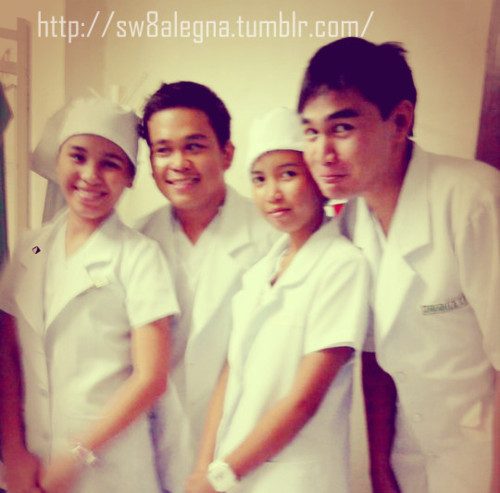
Another photograph from our third-year RLE duty. A reminder of the many departments we encountered while discovering what nursing really involved.
Of course, my dutymates made the experience more enjoyable. That was one of the great advantages of being a student nurse: even when the placement was not particularly appealing, there were usually familiar faces nearby who understood your worries without requiring a detailed explanation.
We were all trying to become competent professionals while still being ordinary college students, a combination that produced its fair share of amusing moments. There were questions we hoped our instructors would not ask, procedures we wanted to observe carefully, and the constant business of making sure we had fulfilled our academic requirements.
And whenever somebody produced a camera, we temporarily abandoned the solemnity of our future profession.
I am grateful those photographs exist. Not because they capture any extraordinary clinical achievement, but because they preserve an otherwise ordinary chapter of my student life. They remind me that becoming a nurse was never a single moment of transformation. It happened gradually, across different hospitals and clinical areas, through unfamiliar experiences and the accumulated influence of instructors, patients, and fellow students.
Some rotations made me excited about the future. Others made me question my preferences. A few probably made me appreciate the comfort of my own bed more than any reasonable person should.
But all of them gave me something to consider.
As I look back on my third-year experience at Eversley Child Sanitarium Hospital, I find myself thinking about the curious relationship between our expectations and the lives we eventually build. When we are young, we often imagine that finding our place means identifying exactly where we belong as quickly as possible. We want certainty. We want a destination. We want to know that the path we have chosen will lead towards something recognisable.
Yet understanding what suits us sometimes requires encountering what does not.
I could admire the Delivery Room, acknowledge the importance of the work performed there, and still recognise that my own ambitions seemed to be pointing elsewhere. There was nothing particularly tragic about that conclusion. It did not diminish the experience or make the rotation less worthwhile.
If anything, it made my understanding of nursing more realistic.
We cannot expect to love every responsibility, every workplace, or every environment we encounter throughout our careers. What matters is how we approach the work entrusted to us while continuing to develop the judgement necessary to make thoughtful choices about our future.
Perhaps I will feel differently about certain specialties one day. Perhaps experience will change my perspective, or circumstances will introduce me to responsibilities I once believed were entirely unsuitable. Nursing has a remarkable ability to rearrange a person’s expectations.
But at this point in my story, I am still a third-year student, standing somewhere within the hospital corridors of Eversley Child Sanitarium, wearing my uniform and trying to imagine what kind of nurse I will eventually become.
I do not have an answer yet.
There are still more rotations to complete, more clinical instructors to impress or unintentionally disappoint, and more lessons waiting in departments I have not even entered.
For now, I have completed another placement, gained another experience, and acquired a couple of photographs for my growing collection of nursing school memories.
The Delivery Room may never become my favourite part of the hospital.
But I am glad nursing school made me walk through its doors.
After all, there is a considerable difference between knowing where you want to go and understanding the places you have chosen not to stay.
And at twenty-something, still wearing the uniform of a student nurse, I am only beginning to appreciate that difference.
From my third-year nursing school archives, with appreciation for the departments that challenged my expectations and the people who made every rotation memorable.
— Just Anj


































Leave a Reply