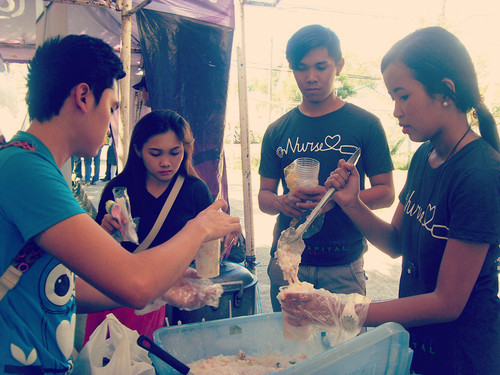
November 2013 | A Feeding Programme at Mactan Airbase, Lapu-Lapu City, Cebu — On Bayanihan, the Survivors of Super Typhoon Yolanda, and the Kindness That Begins with Showing Up
I have always believed that Filipinos possess a remarkable ability to organise an entire gathering around food. Birthdays require food, reunions require food, meetings somehow end with discussions about food, and even the simplest visit to somebody’s house can turn into a negotiation over whether you have eaten. We are a nation that can transform a packet of pancit into an occasion and consider refusing a second helping a matter deserving further investigation. But yesterday, I discovered that food can mean something far more important than celebration. Sometimes a bowl of hot arroz caldo is not merely something to satisfy a hungry stomach. Sometimes it is offered to someone who has travelled a long way from a place they once called home, carrying experiences that no ordinary meal could possibly make better. And sometimes, the most meaningful thing about preparing food is knowing that it will be received by people whose needs extend far beyond what is on the plate.
Yesterday, together with some of my closest friends, I participated in a feeding programme for people affected by Super Typhoon Yolanda. Our activity took place at Mactan Airbase in Lapu-Lapu City, Cebu, where survivors from Tacloban and other affected areas had been arriving following the devastation in the Eastern Visayas. We had originally planned to conduct the feeding programme elsewhere, but the Department of Social Welfare and Development, or DSWD, advised us to hold it at the airbase because there were many displaced people there who could benefit from the assistance. It was a change from our original arrangements, but one that made sense. If the purpose of our activity was to help those who needed food, then surely we ought to bring the food to where it would be most useful.
I remember how important that simple decision felt. We had already been thinking about what to prepare and how the activity would unfold, but the situation reminded us that volunteer work cannot always follow a plan created from a distance. The needs of the people receiving assistance must guide what we do. It is easy to become absorbed in organising an activity, particularly when several people are involved and there are practical details to consider. Yet the success of a feeding programme should not be measured by how closely everything follows our original arrangements. It should be measured, as far as reasonably possible, by whether our efforts reach the people they are intended to serve.
The devastation caused by Yolanda has been weighing heavily on my mind. Since the typhoon struck on November 8, I have been following reports of the destruction across the Visayas, particularly in Tacloban and other badly affected communities. The photographs are heartbreaking, but even those images cannot tell the complete story of what families have experienced. Homes have been destroyed, ordinary routines interrupted, and people separated from familiar surroundings. There are families grieving loved ones, people facing uncertain futures, and children whose everyday lives have been changed by circumstances they could neither anticipate nor control. Every new report has made me think about how quickly the security of an ordinary life can be disrupted.
Only recently, I joined others in repacking relief goods for the affected communities. That experience reminded me how important practical assistance becomes when disasters create needs far greater than any one person can address. Preparing supplies was meaningful, but being at Mactan Airbase brought another dimension to our volunteering. This time, we were not only organising items that would eventually be distributed. We were present with people who had been directly affected by the typhoon, offering food and having opportunities to hear some of what they were feeling.
I think that was what made the day especially memorable.
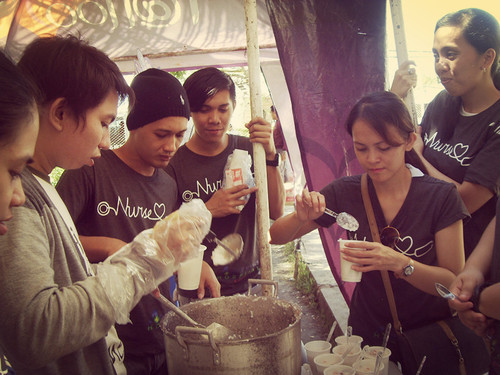
For our feeding programme, we prepared arroz caldo, pancit, and juice. It was a simple menu, but one we hoped would offer a satisfying meal to the people gathered there. Arroz caldo has always seemed to me like one of those foods that carries a little comfort in its warmth. It is familiar, filling, and particularly welcome when somebody is tired or in need of something nourishing. Pancit, meanwhile, is a dependable favourite at Filipino gatherings, appearing at practically every occasion where people need to be fed. I suspect that if somebody ever attempted to organise a Filipino celebration without pancit, at least one relative would consider it a serious oversight.
But this was not an ordinary celebration. We were preparing food for people who had experienced a devastating disaster, and the responsibility gave our simple menu a different significance. We wanted to offer something useful, something that would help address an immediate need while treating the recipients with consideration. There was no elaborate presentation to worry about, no competition over whose cooking deserved the most compliments, and certainly no expectation that the meal would somehow resolve the enormous challenges these families were facing. We simply wanted to feed people who needed food.
As the activity began, however, we became concerned about whether we had prepared enough. There were many people at the airbase, and we worried that our supplies might be insufficient for everyone we intended to serve. That uncertainty was difficult because we had come with the hope of helping as many people as possible. It is one thing to prepare a meal for a gathering where the number of guests is reasonably predictable. It is quite another to organise food assistance in a setting where needs may change and the number of people requiring support can be difficult to anticipate.
I remember hoping that the food would stretch far enough.
There is a particular kind of anxiety involved in wanting to help and wondering whether what you have brought will be sufficient. You begin examining the available portions, considering the number of people waiting, and silently questioning whether you should have prepared more. Perhaps we underestimated the need. Perhaps the arrangements could have been different. Perhaps there was something we had overlooked while planning. These thoughts can arrive remarkably quickly, especially when you understand that the people receiving the food are not simply guests at an ordinary social gathering.
But thankfully, we managed to serve everyone included in our feeding activity.
I cannot describe how relieved we felt. We had been genuinely concerned that some people might be left without a meal, and seeing that the food was enough for those we served brought an enormous sense of gratitude. As a Christian, I could not help thanking God for how the activity turned out. After all our worries about the number of portions, we were able to complete what we had hoped to accomplish. Perhaps the outcome was the result of careful preparation, practical adjustments, and the willingness of everyone involved to make the available food go as far as possible. Whatever contributed to that result, I was thankful.
It felt like a small blessing during a period when so much of the news had been filled with sorrow.
Yet the longer I think about the experience, the more I realise that the most important part of the afternoon was not simply whether we managed to distribute enough food. It was the opportunity to encounter the people for whom we had prepared it. Until then, much of what I knew about Yolanda had come through photographs, reports, and accounts of the destruction. I had been deeply concerned, but there is a difference between reading about displaced families and standing in a place where some of those families are receiving assistance.
At Mactan Airbase, the consequences of the typhoon were no longer confined to the television or the newspaper. They were part of the circumstances surrounding the people we had come to serve. These were individuals who had lived ordinary lives before the disaster, people with families, responsibilities, memories, and plans that extended far beyond the immediate situation. They were not simply victims of Yolanda, although that was how the news often described them. They were people whose identities had existed long before the typhoon and would continue to matter long after the emergency response.
I think that distinction is important.
When a disaster affects thousands of people, we naturally begin discussing numbers. We hear about casualties, damaged homes, displaced families, and quantities of relief goods delivered. These figures help us understand the scale of what has happened and the resources required to respond. But the language of statistics can sometimes make it difficult to remember that every number represents individual lives. Behind each household affected by the disaster is a family with its own experiences. Behind every displaced person is a story that did not begin on November 8.
During our feeding programme, I was reminded that compassionate assistance involves recognising those individual experiences rather than treating people as anonymous recipients of charity. We had come to offer food, but we also had the opportunity to listen. I cannot claim to understand everything the survivors were going through, and I would never pretend that a brief conversation could provide a complete picture of their experiences. But I appreciated the chance to acknowledge their feelings and offer my attention without assuming that I already knew what they needed to say.
Perhaps my nursing experience has made me especially conscious of this responsibility. During my hospital rotations, I have learned that caring for patients involves more than administering medications, performing observations, or completing assigned procedures. Those clinical responsibilities are essential, but patients also need to be treated with dignity and consideration. We should listen when they express concerns, communicate clearly, and remember that the person receiving care has a life extending beyond the circumstances that brought them into our workplace.
The same principle seemed relevant at the airbase, although we were participating as volunteers rather than providing hospital treatment.
People affected by disasters deserve practical assistance, certainly, but they also deserve to be treated as individuals whose voices matter. They should not have to perform gratitude for every item they receive or feel obliged to recount painful experiences simply because someone is curious. Assistance should be offered respectfully, with consideration for privacy and the difficult circumstances people may be facing. I wanted our activity to reflect that understanding, even in the small interactions that accompanied the distribution of food.
I found myself thinking about how easily those of us in safer circumstances can misunderstand what recovery means. We see reports of destruction and naturally wish for people to rebuild their homes, return to their communities, and resume their ordinary lives. We speak about strength, determination, and the familiar Filipino spirit of bayanihan. Those ideas are meaningful, but they can also make recovery sound simpler than it really is. A family that has lost its home may require far more than encouragement. People need shelter, food, safe drinking water, healthcare, reliable information, and sustained assistance as they work towards greater stability.
And some losses cannot be repaired by rebuilding.
That is why I do not want to describe the people we met merely as examples of resilience. They should not have to demonstrate extraordinary courage to deserve help. They have already experienced circumstances that none of us would willingly choose, and their needs deserve serious attention regardless of how strong or hopeful they appear. If they are frightened, exhausted, sad, or uncertain, those feelings are understandable. Compassion should make room for them rather than expecting everybody to express optimism for the comfort of those providing assistance.
Still, I hope the feeding programme offered a little practical relief during an enormously difficult period. A meal cannot restore a destroyed home, replace a loved one, or answer every question about what happens next. But it can help someone through part of the day. It can address an immediate need while larger relief and recovery efforts continue. And when food is offered respectfully, it can also communicate that people have not been forgotten.
I think that is worth something.
I have often heard people say that no act of kindness is too small, and I understand the intention behind the expression. But I am beginning to think that we should be careful not to romanticise small acts while overlooking the scale of people’s actual needs. Our feeding programme was meaningful, and I am grateful that we were able to help. Yet the people at the airbase would require much more than one meal. Their needs would continue after we returned home, after the food had been served, and after our photographs became another collection of memories.
Perhaps recognising that limitation makes the experience more meaningful rather than less. It reminds us that individual volunteer activities are part of a wider responsibility, not substitutes for sustained support. We can contribute within our abilities while understanding that disaster response depends upon coordination among communities, humanitarian organisations, government agencies, healthcare workers, and many others.
I am grateful that DSWD helped direct us towards a location where our activity could be useful. Had we simply continued with our original plan without considering where assistance was needed, we might not have reached the same group of people. The change reminded me that good intentions are most effective when accompanied by practical information and a willingness to adapt. In volunteering, as in nursing, it matters that we respond to actual needs rather than assumptions about what might be helpful.
There is also something special about participating in an activity like this with close friends. Friendship often develops through enjoyable occasions, ordinary conversations, and the little adventures we arrange simply because we want to spend time together. But there is another kind of companionship that emerges when people choose to contribute towards something beyond their individual concerns. We had gathered not merely to entertain ourselves but to work together in response to the suffering of fellow Filipinos. We shared the practical responsibilities, the uncertainty about whether the food would be enough, and the relief of seeing the activity completed.
I imagine that in the years ahead, this will be one of the memories I associate with my friends from 2013. We may eventually forget some of the ordinary details, perhaps even laugh about how worried we were over the food portions, but I hope we remember why we went to Mactan in the first place. We were concerned about the devastation caused by Yolanda, and rather than limiting ourselves to discussing how terrible the news had become, we decided to do something useful within our means.
That decision matters to me.
I do not believe volunteering makes anybody morally superior to someone who cannot participate. People have different circumstances, resources, responsibilities, and opportunities to help. Some can contribute financially, others can offer professional expertise, and some may be able to volunteer their time. There are also people whose own circumstances make it difficult to provide assistance, and they should not be made to feel guilty for that. Generosity is not a competition, and compassion should never become a performance intended to prove how good we are.
What I appreciate is the willingness to recognise a need and respond responsibly when an opportunity becomes available.
Yesterday, that opportunity involved preparing and serving arroz caldo, pancit, and juice.
Simple food, perhaps, but prepared with sincere intentions.
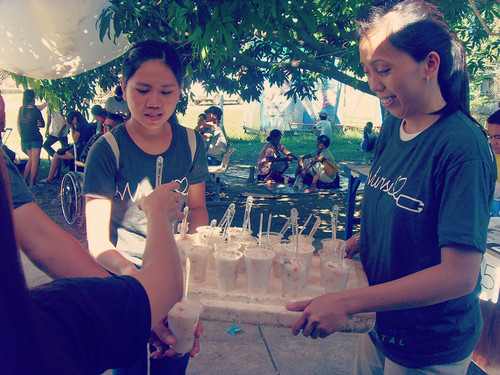
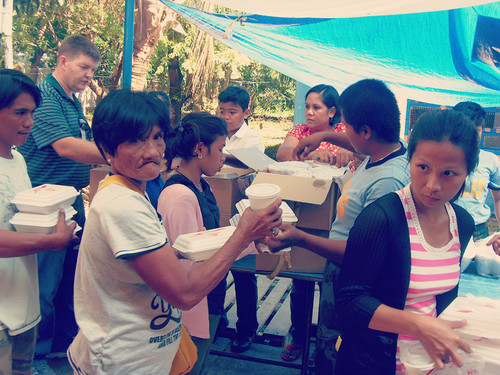
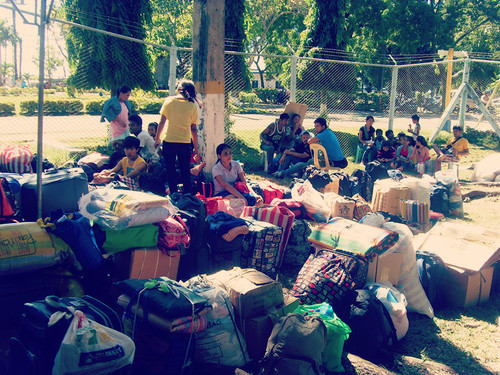
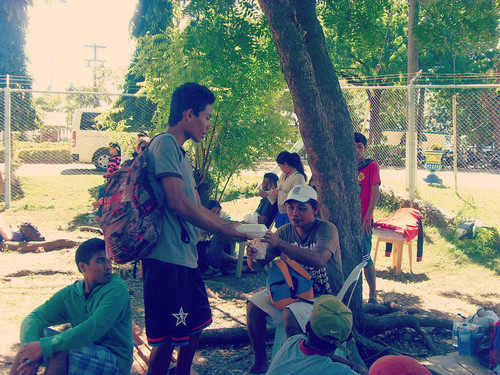
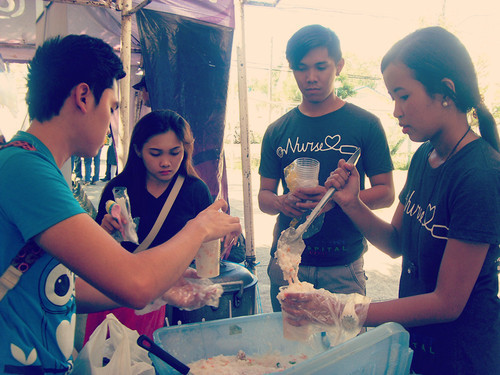
As I reflect upon the afternoon, I keep thinking about the contrast between the ordinary comfort of sharing a meal and the extraordinary circumstances that brought the survivors to the airbase. Under different conditions, a gathering over arroz caldo and pancit might have been a cheerful family occasion. People would talk, exchange jokes, and perhaps discuss whose cooking tasted better. But the meal we served existed within a very different reality. It was part of an emergency response, offered to people whose journeys to Cebu had been shaped by a disaster that disrupted their lives.
That contrast made me more appreciative of how much meaning an ordinary meal can carry.
We often take food for granted because it forms such a familiar part of our daily routines. We complain when our favourite dish is unavailable, debate where to eat, and occasionally become unnecessarily dramatic when lunch is delayed. I am certainly not innocent of that particular behaviour. After my experiences in the Operating Room, I have already established that a missed meal can inspire a remarkably elaborate personal monologue.
But yesterday reminded me that having reliable access to food is something many people are struggling with in the aftermath of Yolanda.
I do not want that realisation to make me feel guilty every time I enjoy a meal. Rather, I hope it encourages me to become more thoughtful about the circumstances of others and the importance of making assistance available when people need it. Gratitude should not end with appreciating what we possess. It can also influence how we respond to those whose ordinary security has been interrupted.
As a Christian, I believe that caring for others is one of the ways we can put faith into practice. Prayer remains important to me, particularly during times when the suffering around us feels difficult to comprehend. But I have also come to appreciate that faith can encourage action. It can remind us to share, to recognise the dignity of others, and to offer assistance without expecting anything in return.
I have been praying for the families affected by Yolanda, asking God to grant them strength and surround them with people who can provide meaningful support. I pray for those who are grieving, those who remain uncertain about their future, and those working to coordinate relief and recovery efforts. I also pray that the concern people feel today will continue beyond the immediate tragedy, because rebuilding communities requires attention long after the first emergency has passed.
I am particularly grateful that our feeding programme was successful in meeting the immediate goal we had set for ourselves. We worried that the food might run out, and the relief of having enough for everyone we served is something I will remember. I thanked God for that outcome, not because I believe we should depend upon miracles instead of careful preparation, but because gratitude feels especially appropriate when an activity intended to help others turns out well.
Perhaps the greatest lesson was recognising how much can be accomplished through cooperation and thoughtful planning, even when the resources available to us are limited.
I do not know what will happen to every person we encountered at Mactan Airbase. I do not know when their families will be able to return home, whether their homes can be repaired, or what difficulties they may face in the coming weeks. Their stories belong to them, and I would not want to invent reassuring endings simply to make this reflection more comfortable to read.
But I hope they receive the assistance they need.
I hope the relief efforts continue, that families are able to find safer and more stable living arrangements, and that those affected are treated with dignity throughout the recovery process. I hope children are given opportunities to return to ordinary routines, that people who are unwell can access appropriate healthcare, and that the communities devastated by Yolanda are not forgotten as public attention gradually moves elsewhere.
Perhaps one day I will look back on this particular experience and remember the faces of the people we served, the concern we felt about the food, and the relief of knowing that our preparations had been sufficient for the activity. I may remember the company of my friends and the satisfaction of completing something meaningful together. But I think the lesson I most want to preserve is that being of service does not always require an extraordinary undertaking.
Sometimes it begins with recognising that somebody needs a meal and being willing to help prepare it.
Of course, there is something wonderfully Filipino about the fact that our volunteer experience centred on food. We come from a culture where offering somebody something to eat is often one of the first expressions of hospitality. Kaon ta can be both an invitation and a gesture of welcome, even when there is very little ceremony surrounding it. Yesterday, those familiar words seemed to carry greater significance. We were not inviting people to an ordinary celebration; we were offering what we could to individuals whose circumstances had become deeply uncertain.
And perhaps that is why I found the experience so fulfilling.
I began the day concerned about whether we could accomplish what we had planned. We had food to prepare, a location that had been changed following DSWD’s advice, and uncertainty about the number of people we would be able to serve. By the end of the activity, we had completed our feeding programme and gained a deeper appreciation for the people affected by the disaster.
I returned home feeling grateful, although the sadness surrounding Yolanda remained.
The feeding programme did not resolve that sadness, nor should it have. There are still families grieving and communities in need of sustained assistance. But it reminded me that concern need not remain confined to helplessness. Within the limits of our circumstances, we can choose to contribute something practical and become part of the wider effort to support people facing difficult times.
I hope that is something I continue remembering, whether I am working in a hospital, spending time with friends, or encountering opportunities to help within my community.
Yesterday, a bowl of arroz caldo was simply a bowl of arroz caldo. It could not rebuild Tacloban, restore the homes destroyed by Yolanda, or erase the distress of the people who had travelled to Cebu. I would never pretend otherwise. But to someone who needed a meal at that particular moment, it could still be useful, nourishing, and welcome.
And perhaps kindness does not always need to accomplish everything in order to accomplish something worthwhile.
As I finish writing, I find myself thinking about the worry we felt before the feeding began. We looked at the food we had prepared and wondered whether it would be enough. We could not know exactly how the activity would unfold, but we did what we could, worked together, and hoped that our efforts would reach the people who needed them.
By the end, everyone we had set out to serve had received food, and our group was able to return home knowing that the day’s work had been worthwhile.
I still wish we could have offered more. I suspect that feeling will remain whenever I think about the enormous needs created by Yolanda. But perhaps the experience has taught me to recognise the value of doing what is possible while remaining aware of what still needs to be done.
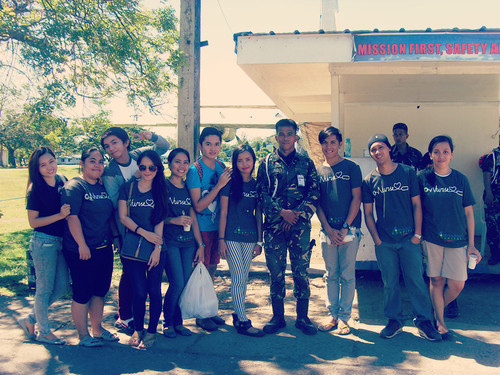
To my friends who joined the feeding programme, thank you for your time, effort, and company. To the people and organisations continuing the relief operations, may you receive the support necessary to carry out your work. And to the survivors of Super Typhoon Yolanda, I pray that you are surrounded by compassion, practical assistance, and opportunities to rebuild your lives with dignity.
Bangon, mga Bisaya. May the generosity of those around you be more than words, and may the help you deserve continue long after the headlines have changed.
From my November 2013 journal — Mactan Airbase, Lapu-Lapu City, Cebu. A day spent with friends, sharing arroz caldo, pancit, and juice with survivors of Super Typhoon Yolanda, and remembering that service begins by recognising another person’s needs.
— Just Anj, RN | With prayers for Tacloban and the Eastern Visayas


































Leave a Reply