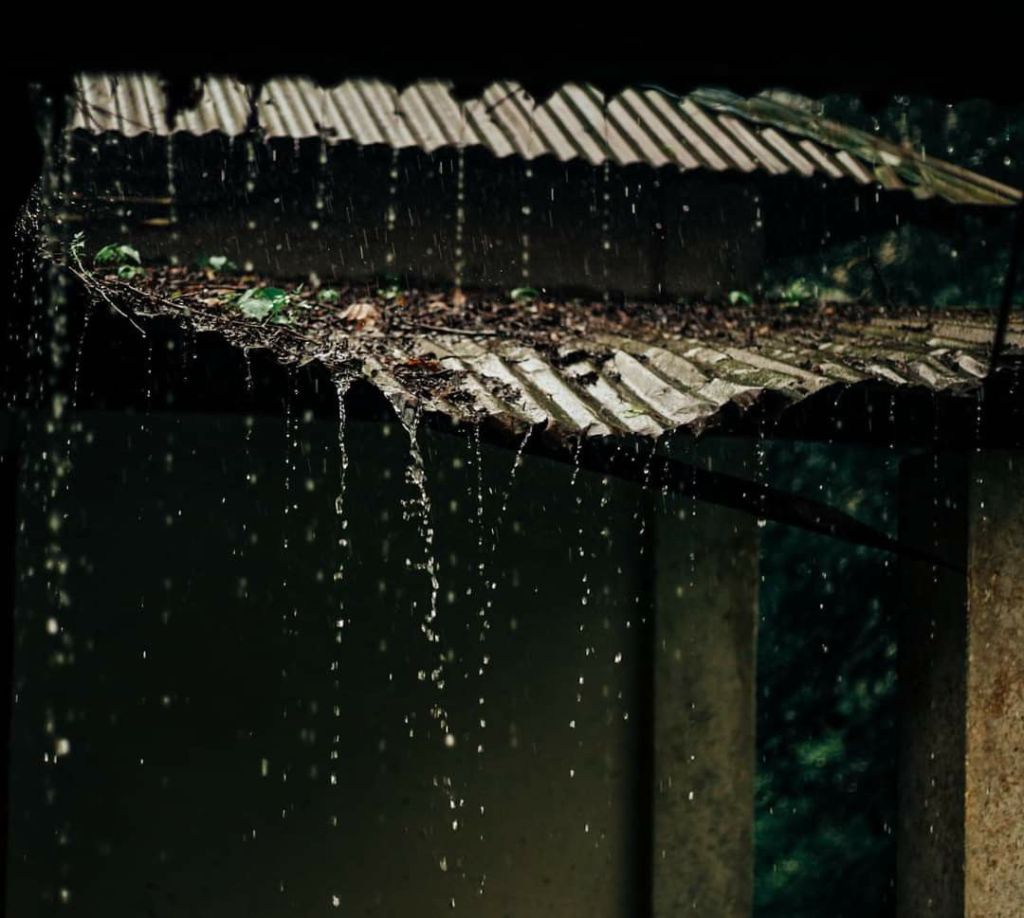
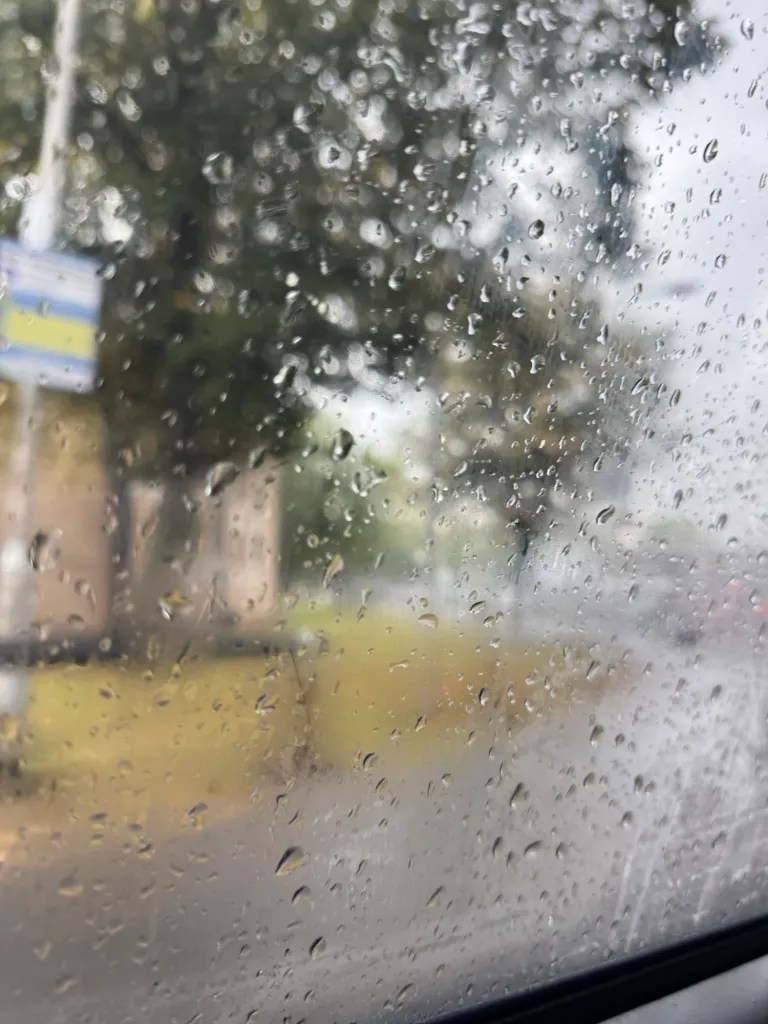
The roof began leaking just as we were about to eat. There is something about rain in the Philippines that makes it seem personally offended by the existence of ordinary household plans. It does not always begin politely. The sky darkens, the wind starts rearranging the leaves, and within minutes the rain is striking the roof with such enthusiasm that normal conversation becomes an exercise in shouting.
That afternoon, a thin stream of water appeared near one corner of the ceiling. Someone fetched a basin, then another, because experience had apparently taught us not to underestimate a roof once it had discovered an audience. The first basin went directly beneath the leak, while the second waited nearby in case the ceiling decided to expand its operations. Within minutes, the kitchen resembled a poorly funded laboratory conducting rainfall experiments.
The drops fell with remarkable precision while someone moved the rice away from the affected area. Another person examined the ceiling and offered an opinion about the roof’s condition, although the rain showed no interest whatsoever in our engineering consultation. Then came the familiar remark: “Okay ra na. Anaray na ta ana.” It’s all right. We’re used to it.
Nobody sounded particularly distressed, and in fact somebody laughed. There was something almost impressive about how quickly everyone adjusted. The roof leaked, the basins appeared, the food moved and ordinary life carried on around the inconvenience as though an indoor water feature had always been included in the architectural plan.
I remember feeling two things at once. I admired how everyone knew exactly what to do, and I was irritated because everyone knew exactly what to do. We had become so experienced at managing the problem that the problem itself had almost stopped surprising us. The basins performed beautifully, while the roof remained employed despite an increasingly questionable performance record.
That memory makes me think about a word Filipinos use with considerable pride: resilience. We hear it after typhoons, floods, financial hardship, family crises and nearly every circumstance in which ordinary people are expected to keep going through extraordinary difficulty. News reports show families smiling beside damaged homes, communities are praised for rebuilding quickly, politicians speak about the Filipino spirit, and people share stories of humour, improvisation and determination.
There is something genuinely moving about those stories because I have seen how quickly Filipinos help one another. A neighbour lends a hand, a relative brings food, somebody provides transport and families share whatever they can, sometimes before anyone has even asked. When electricity fails, people adjust. When transportation becomes difficult, they find another way. When money becomes tight, budgets stretch with a level of creativity that probably deserves its own academic discipline.
A Filipino household can turn yesterday’s leftovers into another meal, a damaged appliance into a long-term repair project and a nearly empty bottle of shampoo into several additional bathing opportunities through the strategic application of water. We improvise, adapt, laugh and continue. Those qualities deserve recognition, but lately I have wondered whether our admiration for resilience has become so automatic that we sometimes forget to ask why people are required to demonstrate it so often.
There is a difference between celebrating someone’s strength and becoming comfortable with the circumstances that keep demanding it. Resilience may help people survive difficulty, but it should not automatically make the difficulty acceptable. The distinction sounds obvious once stated, yet culturally we can become so impressed by endurance that we stop noticing what people are actually being asked to endure.
Resilience is not simply a permanent personality trait that one person possesses and another lacks. It is shaped by relationships, financial resources, access to healthcare and education, social support, stable communities and the systems surrounding a person. Yet in ordinary conversation, resilience is often reduced to attitude: be strong, stay positive, keep smiling and never give up.
Those messages can be encouraging in the right circumstances, but they become inadequate when applied to problems that require more than personal determination. A family whose home floods repeatedly may become exceptionally skilled at moving belongings to higher places, protecting documents and cleaning afterwards. Their ingenuity deserves admiration, but their ability to recover does not make repeated flooding acceptable.
The same principle applies elsewhere. A student who walks a long distance to school because transportation is unaffordable may show extraordinary commitment, but that determination does not prove better transport is unnecessary. A worker supporting several relatives on a modest salary may demonstrate remarkable discipline, but their discipline does not remove questions about wages, working conditions or economic opportunity.
Resilience can help people function within difficult circumstances, but it should never become an argument for preserving those circumstances. Survival tells us something about the people enduring the problem. It does not automatically tell us that the problem itself is reasonable.
I think this tension is especially strong in Filipino culture because endurance is woven into many of the lessons we learn early. We are taught to be patient, persevere, respect sacrifice, appreciate what our parents endured, avoid complaining unnecessarily and remain grateful even when life becomes difficult. These values can develop responsibility and perspective, but every virtue becomes complicated when turned into an absolute requirement.
Patience can become an excuse for tolerating repeated mistreatment, while gratitude can be used to silence legitimate concerns. Perseverance can become pressure to remain in situations that no longer make sense, and endurance can become so admired that asking for improvement begins to look like weakness. A virtue that helps people survive can become harmful when it teaches them that they should never expect better.
I have heard the familiar line in many forms: “Sa una, mas lisod pa gani among kinabuhi.” Life was even harder in our time. Often, the sentence comes from a sincere place. Parents and grandparents remember walking long distances, studying with limited resources, working while supporting family and managing responsibilities under conditions younger generations may never experience.
Those stories deserve respect because their sacrifices were real. But I am not convinced that the lesson should always be that the next generation must endure the same difficulties. If earlier generations struggled because opportunities were limited, perhaps progress should mean widening those opportunities rather than preserving hardship as proof of character.
If parents worked exhausting hours so their children could have a better life, then surely one measure of success is that their children do not have to repeat exactly the same exhaustion. Perhaps sacrifice should reduce hardship across generations rather than turn hardship into a family tradition. Otherwise, improvement begins to look suspiciously like ingratitude.
I also think we sometimes treat comfort with unnecessary suspicion. Someone who grows up with reliable electricity may be called spoiled, while a student whose parents can afford school materials may be assumed to be less hardworking than one who struggled to obtain them. A young person with opportunities their parents never had may be criticised for not understanding sacrifice.
Privilege can certainly distort perspective, and people who have never faced a particular difficulty may underestimate its seriousness. But hardship should not become a competition for moral superiority. Suffering does not automatically produce wisdom, and comfort does not automatically produce selfishness.
A person can go through great difficulty and become compassionate, resourceful and thoughtful, while another may become fearful, resentful or exhausted. Someone raised with stability can become generous and responsible, while another may take every advantage for granted. Character develops through many influences, and hardship is not a guaranteed teacher.
Perhaps we should stop treating suffering as though it were a compulsory educational requirement. Life will provide enough difficulty without us deliberately preserving avoidable hardship because previous generations survived it.
The familiar image of the Filipino spirit often centres on smiling through adversity. After a storm, people clean their homes, help neighbours and somehow still find reasons to laugh. That humour can reflect courage, social connection and a refusal to let hardship own every emotion, and there is real dignity in that response.
But the smile is not the whole story. A person can laugh and still be worried. They can express gratitude while recognising that something is unfair. They can appear composed while carrying responsibilities close to becoming unsustainable. A photograph captures an expression; it cannot explain the entire experience surrounding it.
I sometimes worry that we mistake cheerfulness for evidence that a situation is manageable. The family joking while repairing a damaged home may still need secure shelter. The worker laughing about an insufficient salary may still need better opportunities. Someone surviving another difficult month may still be anxious about the next one.
Humour can make hardship bearable, but it cannot repair every condition that created the hardship. A joke may help us through the afternoon. It should not become a substitute for asking why the same problem returns.
This becomes especially troubling when resilience is used as an excuse for delaying improvement. Imagine a community repeatedly affected by flooding. Residents prepare sandbags, move belongings, organise assistance and begin cleaning once the water recedes. Their cooperation deserves praise, but if the same flooding returns year after year because drainage, planning or maintenance remain inadequate, admiration eventually becomes insufficient.
At some point, the question has to change from “How inspiring that they recovered again” to “Why are they still being required to recover from the same preventable problem?” Praise is appropriate, but praise should not become a way of avoiding responsibility.
Individuals have responsibilities, and communities do too. Institutions also have obligations precisely because some problems cannot be solved effectively through personal determination alone. A family can place a basin beneath a leaking roof and protect the floor for an afternoon, but if the structure keeps deteriorating, the long-term answer is not purchasing more basins.
Eventually, somebody has to repair the roof. We understand that easily inside a household, yet we sometimes become strangely reluctant to apply the same logic to wider social problems.
The Filipino tradition of bayanihan demonstrates what community solidarity can accomplish. People contribute money, food, labour, transport or simply their presence when somebody needs help. That willingness to carry one another is one of the cultural qualities I admire most.
But bayanihan should not become a permanent substitute for functioning systems. A neighbourhood helping a family during an emergency is beautiful, while a society depending indefinitely on neighbours to compensate for inaccessible services is something entirely different. Community generosity can fill a temporary gap, but its existence does not prove the gap is acceptable.
A community’s willingness to carry a burden does not necessarily mean the burden has been distributed fairly. Sometimes the most generous people become exceptionally skilled at compensating for failures they should never have been expected to absorb.
There is also an emotional cost to being known as resilient. In families, the person who rarely complains is often admired because they keep working, solve problems quietly, help everybody else and maintain the appearance that everything is under control. They become known as strong, dependable and capable of handling anything.
The compliment sounds lovely until it becomes a job description. When people are repeatedly praised for managing without assistance, they may begin feeling uncomfortable admitting that assistance would actually help. They may worry that exhaustion will disappoint others or that uncertainty will contradict the identity everybody admires.
Strength can slowly become an obligation. The parent who always manages must keep managing, the student who always performs well must keep succeeding and the family member who always provides support must remain available. Then, when that person finally admits that something has become difficult, people respond with surprise.
“But you’re strong,” they say, as though strength should make ordinary human limits disappear. Perhaps genuine resilience should include recognising when circumstances need to change rather than proving that we can tolerate anything indefinitely.
Sometimes adapting means continuing, while sometimes it means asking for help. At other times it means questioning an expectation, changing an arrangement or admitting that what once worked is no longer sustainable. Those responses are not necessarily signs of weakness. They may be forms of practical judgement.
I find it useful to distinguish resilience from resignation because the two can look similar from the outside. Both may involve endurance and continuing through difficulty, but resilience responds constructively while remaining open to improvement. Resignation adapts because the person has stopped expecting anything better.
Real life is more complicated, of course. People sometimes have no immediate power to change their circumstances, and it would be unfair to criticise someone for enduring what cannot yet be escaped. But there is still a difference between accepting what is presently unavoidable and teaching people that preventable hardship should always be tolerated with dignity.
Understanding reality should not require promising never to challenge it. Sometimes acceptance is necessary for the present while change remains necessary for the future.
I think practical wisdom lies somewhere between those positions. There are things we cannot control and things we can influence. We cannot command a typhoon to change direction, but we can improve preparation, infrastructure and emergency systems. We cannot prevent every difficult event, but we can ask whether certain consequences are being made worse by neglect.
The storm may be beyond our control, but some of the conditions determining how much damage it causes may not be. That distinction matters because resilience should not become an excuse for surrendering responsibility where improvement is possible.
I sometimes wonder how our conversations might change if prevention received the same admiration as recovery. Imagine praising a community because improved drainage meant there was no flood to photograph. Imagine celebrating a school because its support systems prevented students from dropping out. Imagine recognising a workplace because employees could meet expectations without constantly sacrificing their wellbeing.
These successes are less dramatic, because prevention has terrible television instincts. A disaster that never happens provides no dramatic rescue scene, no rebuilding montage and no triumphant declaration that a community has risen again. It simply leaves people continuing their ordinary lives, which is visually unimpressive and probably the better outcome.
A repaired roof is far less interesting than a kitchen full of strategically placed basins. It is also considerably more useful.
The same principle applies to education and work. Students should learn perseverance because education requires effort, but the ideal system should not demand extreme hardship simply to participate. Workers should be able to manage pressure, but a functioning workplace should not depend on employees repeatedly exceeding reasonable limits to compensate for inadequate resources.
Challenges can develop skill, confidence and judgement, while avoidable hardship is something different. Perhaps the goal is not to eliminate every difficulty from life. It is to stop confusing unnecessary suffering with character development.
I also think about the way sacrifice is treated as evidence of love. Parents may work extraordinary hours, siblings may contribute financially and relatives may postpone personal goals to support somebody else. Those sacrifices can be profound acts of generosity, and I would never want to diminish their importance.
But love should not always be measured by how much pain somebody is willing to tolerate. A parent who creates stability through careful planning may love just as deeply as one whose circumstances require extraordinary sacrifice. A family distributing responsibilities fairly may be functioning more sustainably than one depending upon a single person to carry everything.
Sacrifice can be meaningful, but it becomes dangerous when suffering itself begins to look like proof that love is genuine. Care should not need to hurt before we believe it counts.
I would like future generations to inherit a broader understanding of strength. One that admires endurance without demanding unnecessary hardship, recognises courage in asking difficult questions, celebrates cooperation without allowing cooperation to excuse institutional failure and respects people who recover from adversity while valuing those who work to prevent avoidable adversity in the first place.
Maybe resilience should be something we are grateful to possess when life becomes difficult rather than a permanent condition people are expected to demonstrate. It is like an umbrella during unexpected rain: useful, sometimes essential, but nobody should have to stand beneath one forever simply because the weather has become familiar.
The Filipino ability to find humour in difficult circumstances is something I would never want us to lose. A power interruption becomes a storytelling session. An overcrowded vehicle inspires creative commentary about the limits of human flexibility. A family inconvenience becomes a story retold for years, improving slightly with every version.
Humour keeps people connected and reminds us that hardship does not own every emotion. But perhaps we can preserve our humour without allowing it to become an excuse for accepting every problem. We can laugh at an inconvenience and still believe it should be corrected. We can admire determination and still ask why so much determination was necessary.
We can appreciate resourcefulness without deciding that proper resources are therefore unnecessary. Those ideas do not cancel one another; perhaps holding them together is what a more mature understanding of resilience requires.
I do not want to belong to a generation that forgets what those before us endured. Their sacrifices deserve gratitude because many opportunities we inherit may have required years of patience, discipline and difficult decisions that we never personally witnessed. But gratitude should not become an instruction to preserve every hardship they experienced.
If our parents struggled so their children could live differently, perhaps one way to honour them is to make some of those struggles less necessary. We can remember the difficulty without turning it into a requirement. We can respect endurance without treating it as destiny.
Progress should not simply produce people who become increasingly skilled at surviving preventable problems. Perhaps it should reduce the number of preventable problems they are required to survive.
Eventually, I return to that rainy afternoon. The roof continues leaking and the basins remain on the floor. Someone checks the water level and empties one before it overflows, while another shifts a basin slightly to the left, an impressive piece of practical engineering completed entirely without blueprints. We eat, we laugh and, like families accustomed to inconvenience, we carry on with the afternoon.
There was warmth in that scene. There was cooperation, competence and a refusal to allow the weather to ruin everything. Those qualities mattered then, and they still matter now, but I understand the scene differently today.
The remarkable thing was that everyone knew exactly where to put the basins. The unfortunate thing was that we needed to know. Both truths deserve to survive in the story because celebrating one should not require pretending the other does not exist.
We should honour the hands carrying the basins, the neighbours helping, the families improvising and the communities refusing to abandon one another. But while we are praising them, perhaps somebody should also ask who is going to repair the roof.
Surviving the rain is admirable, while living beneath a sound roof should not be considered an unreasonable ambition. And if the next generation grows up without knowing where to place a basin during a storm, I hope we resist the temptation to call them weak. Perhaps they have simply inherited what the earlier generation was trying to build all along.
Still honouring strength while asking for better,
Anj


















Leave a Reply