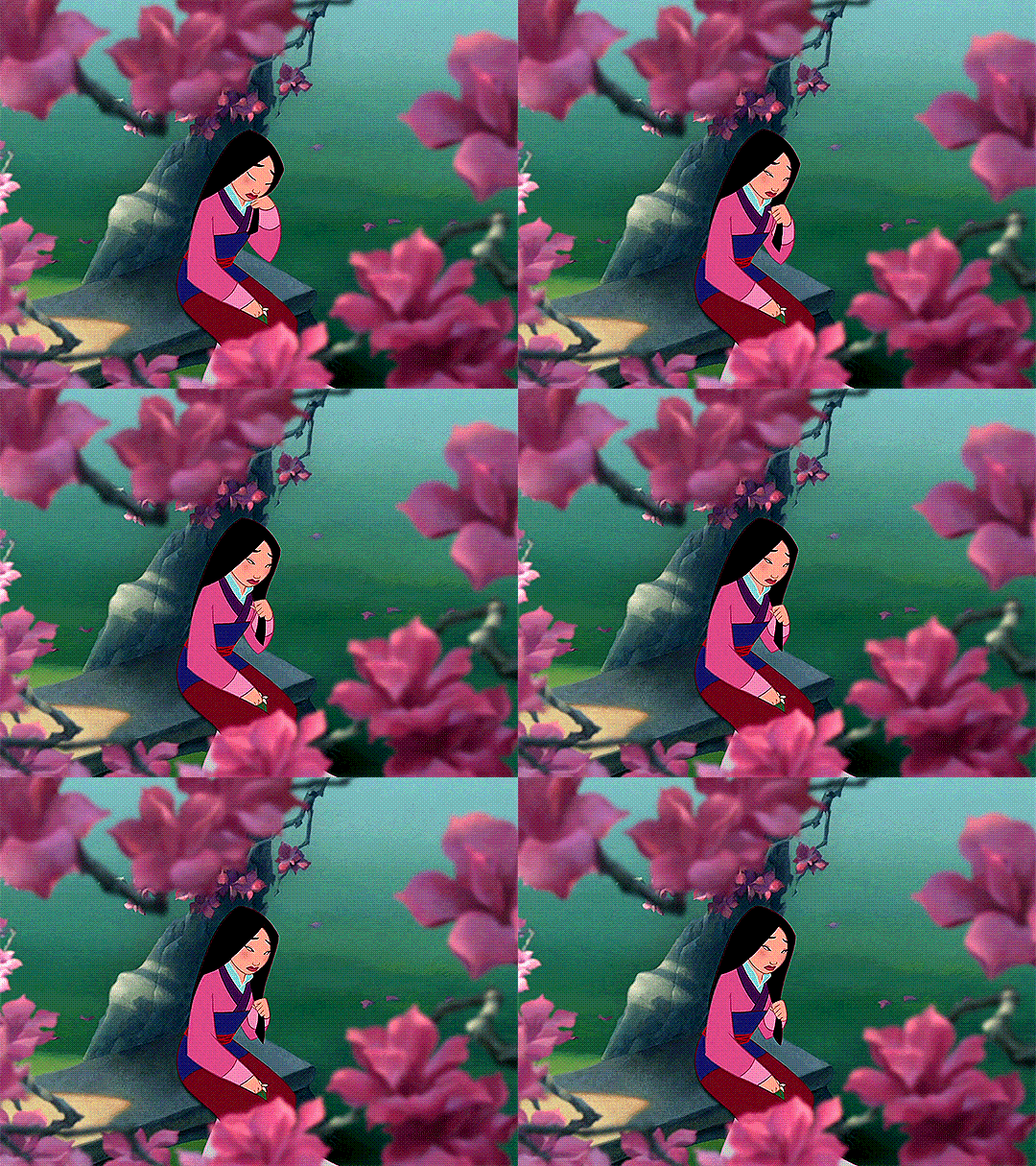
Disney Princess | On Being a Little Like Mulan, Wishing for Belle’s Grace, and Desperately Needing Timon and Pumbaa’s Philosophy of Life
I have a confession to make. If Disney ever decided to audition ordinary people for the position of princess, I would probably be disqualified before reaching the castle gates. Not because I lack enthusiasm, but because I suspect the selection committee would have concerns about my personality. I question things, occasionally disagree with people, become terribly stubborn when I believe something is worth pursuing, and possess a remarkable ability to worry about circumstances that have not even happened. I also cannot guarantee that I would behave appropriately around a talking teapot. I would probably ask how it manages to pour tea without spilling everywhere, whether being made of porcelain affects its ability to feel pain, and who is responsible for washing it afterwards. By the time I finished my questions, the entire enchanted household would have requested that I leave.
Nevertheless, I have always loved Disney.
There is something wonderfully entertaining about a world where animals offer unsolicited advice, household objects sing, and practically every serious problem seems to require a musical number. Imagine how different ordinary life would be if we could resolve an inconvenient situation by singing dramatically beside a window while birds arranged themselves into an accompanying orchestra. Unfortunately, my experience of adulthood has been considerably less cooperative. When I have a difficult day, no woodland creatures appear to tidy my room, and when I arrive home after hospital duty, my laundry remains stubbornly uninterested in washing itself. Clearly, somebody has been withholding important information about the benefits of becoming a princess.
But perhaps the reason I enjoy Disney has less to do with its magical creatures and beautiful castles than with the personalities of the characters themselves. Beneath the elaborate costumes, memorable songs, and occasionally questionable romantic decisions, many of these stories explore ideas about courage, identity, friendship, responsibility, and finding one’s place in the world. I enjoy watching characters who are uncertain about themselves gradually discover what matters to them, particularly when their journey involves challenging expectations or recognising strengths they did not initially appreciate.
And if somebody asked which Disney character resembles me most, I would not need much time to decide.
Mulan.
Yes, Mulan. The young woman who apparently looked at an entire collection of impossible expectations and decided that complying with all of them was not particularly appealing.
I have always admired her character, partly because she is brave and resourceful, but also because she does not fit comfortably into the role other people expect her to occupy. At the beginning of her story, she struggles with the pressure to behave according to established ideas about what a young woman should be. She wants to honour her family, yet her personality does not always cooperate with the standards imposed upon her. She is intelligent, impulsive, determined, and occasionally awkward in situations where everybody else seems to understand the rules.
I find that suspiciously familiar.
I have never been particularly successful at becoming exactly the person other people expect me to be. I can be respectful and considerate, certainly, but I also have opinions, ambitions, and a tendency to question things when they do not make sense to me. Sometimes I wish I were naturally graceful, endlessly patient, and capable of responding to every difficult situation with a beautiful smile. Unfortunately, my actual personality occasionally prefers asking why something must be done a particular way before agreeing to do it.
I suppose that is one reason I identify with Mulan.
She does not begin her story as someone who has already mastered every challenge. She makes mistakes, feels uncertain, and encounters situations that reveal how much she still needs to learn. Yet she continues developing her abilities through effort, observation, and determination. I appreciate that because I do not believe courage requires us to feel confident every moment of the day. Sometimes we make a decision while recognising that the outcome remains uncertain, and we learn through the responsibilities that follow.
My experience in nursing has certainly taught me that.
When I began practising in the hospital, there were many things I wanted to understand and skills I hoped to develop. I had completed my education and passed the Nursing Licensure Examination, but I also knew that professional experience would introduce situations no textbook could explain completely. There were demanding shifts, unfamiliar responsibilities, and occasions when I questioned whether I was progressing as quickly as I had hoped.
I made mistakes in my assumptions, encountered disappointments, and discovered that some professional ambitions would require more patience than I had originally anticipated.
But I continued learning.
I do not think determination means refusing to reconsider a decision or continuing something simply because we are afraid of appearing unsuccessful. Sometimes perseverance involves changing our approach, accepting guidance, or recognising that a different opportunity may be more appropriate. What matters is remaining willing to develop, particularly when the path towards something meaningful becomes more complicated than expected.
That is one of the qualities I admire about Mulan. She is not extraordinary because everything comes easily to her. Much of her development occurs because she must adapt to circumstances that challenge her assumptions about herself. She learns from her experiences, uses her intelligence, and gradually discovers that her abilities do not have to resemble everybody else’s.
I find that idea reassuring.
There have been moments in my own life when I wondered whether I was doing things correctly simply because my experiences seemed different from those of other people. I have watched classmates and friends pursue opportunities, establish careers, and make decisions that appeared more straightforward than my own. Occasionally, I have compared my progress with theirs, forgetting that I cannot fully understand the circumstances behind somebody else’s achievements.
I am learning that following a different path does not automatically make it an inferior one.
It may involve setbacks, reconsidered decisions, or opportunities that arrive later than expected, but those circumstances do not determine the value of the person experiencing them. We can be ambitious without expecting every achievement to occur according to an identical timetable.
And perhaps that is where my stubbornness becomes useful.
I admit that I can be stubborn. I have opinions about the things that matter to me, and when I believe something is worth pursuing, I do not always abandon it simply because someone questions my decision. This quality has occasionally helped me remain focused during difficult circumstances. It has also, I suspect, made certain conversations with me unnecessarily complicated.
My friends may have their own observations about that.
I would prefer they submit them in writing so I can review the evidence before responding.
What I admire about Mulan is that she does not allow other people’s doubts to become the only measure of her abilities. Throughout her story, she encounters individuals who underestimate her or assume that she cannot accomplish what lies ahead. She cannot control every opinion, but she can continue learning and demonstrating what she is capable of doing.
I think there is something valuable in that distinction.
We cannot prevent other people from expressing doubts about our decisions. Some criticism may be useful, particularly when it comes from people who understand the situation and genuinely want to help us avoid mistakes. Other remarks may be based upon assumptions, limited information, or personal preferences that do not necessarily apply to our circumstances.
The challenge is learning to recognise the difference.
I used to think ignoring pessimistic people meant refusing to listen whenever someone questioned my plans. But perhaps that is not entirely wise. Constructive criticism can help us identify problems we have overlooked, and people who disagree with us are not necessarily trying to discourage us. Sometimes they are offering a perspective we genuinely need to consider.
What I want to avoid is allowing constant negativity to determine what I believe I can accomplish.
There is a difference between somebody asking whether I have considered the risks of a decision and somebody insisting that I should not attempt something simply because they cannot imagine me succeeding.
The first deserves consideration.
The second does not need to become the author of my future.
Mulan’s story also reminds me of the importance of recognising individual strengths. She does not succeed simply by imitating everyone around her. She learns to think carefully, adapt to unfamiliar situations, and use her abilities in ways that prove valuable. I enjoy that aspect of her character because it challenges the assumption that there is only one acceptable way to demonstrate competence.
In nursing, I have met people with different personalities and approaches to their responsibilities. Some are naturally confident communicators, while others are particularly observant or skilled at organising complicated tasks. Different strengths can contribute to effective teamwork, provided everyone remains attentive to professional standards and the needs of patients.
I hope I continue recognising what I can learn from people whose abilities differ from mine.
Perhaps that is another thing Mulan would understand.
She may be determined, but she does not accomplish everything through stubbornness alone. She learns from her experiences and the people around her. I think genuine independence should leave room for accepting assistance, because refusing every opportunity to learn from others would be a terribly inefficient way to develop.
And I have enough difficulties managing my time without making life unnecessarily complicated.
The other reason I admire Mulan is her devotion to her family.
That part of her character has always meant something to me, particularly because family occupies such an important place in Filipino life. We grow up surrounded by relatives, familiar traditions, shared responsibilities, and the understanding that our decisions can affect people beyond ourselves. We may occasionally complain about family expectations, particularly when relatives become unusually enthusiastic about asking personal questions, but many of us develop a deep sense of responsibility towards the people who have cared for us.
Mulan’s decisions are strongly influenced by her concern for her father and her desire to protect her family. I find that moving because her affection is expressed through action rather than simply through beautiful words.
There is a moment in the film when her father’s response makes clear how much he values his daughter. After everything she has experienced, what matters most to him is not the impressive symbols of victory she brings home, but having her safely returned to him.
I appreciate the simplicity of that idea.
Sometimes we become so occupied with achievements that we forget what the people who love us may value most. We imagine that making our family proud requires collecting certificates, obtaining prestigious positions, or demonstrating that every sacrifice made on our behalf has resulted in something impressive. Those accomplishments can certainly be meaningful, but relationships cannot be measured entirely through professional success.
I hope that as I continue pursuing my ambitions, I remember to make time for the people whose presence gives those ambitions personal meaning.
Recently, our family has been facing difficult circumstances, particularly concerning my aunt’s health. Hearing about her illness has reminded me how quickly ordinary life can become uncertain and how much the wellbeing of our relatives matters to us. There are moments when I wish I could resolve every problem immediately, protect the people I love from difficulties, and make sure that everyone remains safe and well.
Unfortunately, life does not grant us those abilities merely because our intentions are sincere.
I cannot control every circumstance affecting my family, but I can remain thoughtful about how I support them, communicate with them, and make decisions that respect their needs.
I think that is a more realistic form of devotion than imagining I must somehow become capable of solving everything.
Mulan may be a Disney character, but her story reminds me that love for one’s family can be expressed through courage, responsibility, and the willingness to recognise what truly matters.
Of course, identifying with Mulan does not mean I possess all her admirable qualities.
I would like to think I am determined, but I am still learning patience. I appreciate her courage, but I have moments when uncertainty makes me hesitate. I admire her intelligence, yet I occasionally make decisions that seem perfectly sensible until I have enough time to reconsider them.
And while she eventually demonstrates impressive physical abilities, I suspect my own training would be interrupted by a strong desire for coffee and an opportunity to sit down.
I have already spent enough time working demanding hospital shifts to know that physical endurance is not something I should take for granted.
Perhaps I would make an unusual addition to the imperial army.
I could provide basic nursing care, offer unsolicited advice about the importance of adequate rest, and remind everyone to follow appropriate safety procedures.
Whether the soldiers would appreciate my contributions is another matter entirely.
Now, while Mulan is the Disney character I most closely identify with, she is not the only character whose personality I admire.
If I were allowed to borrow a few qualities from other Disney characters, I would probably begin with Belle from Beauty and the Beast.
Ah, Belle.
The young woman who enjoys books, appreciates the importance of looking beyond appearances, and somehow maintains an admirable degree of composure while surrounded by people whose behaviour occasionally deserves a very patient response.
I have always admired her grace and thoughtful manner.
There is something appealing about being able to express oneself confidently without becoming unnecessarily argumentative. Belle possesses a certain quiet assurance that I would love to develop further. She is curious, independent-minded, and willing to recognise qualities in people that others may overlook. She also has the advantage of being surrounded by an extraordinary library, which I consider an entirely reasonable reason to become interested in a castle.
I must admit that the library would probably distract me from most of the other enchanted activities.
If someone offered me an entire room filled with books, I suspect I would need very little encouragement to remain there for several hours.
Perhaps even days.
Provided someone remembered to deliver food occasionally.
What I particularly appreciate about Belle is her ability to remain true to her interests despite the expectations of the people around her. She enjoys reading, asks questions, and does not automatically accept the narrow possibilities others imagine for her. In that respect, I think she and Mulan share something important: neither seems entirely willing to allow society to define the limits of her personality.
But Belle’s manner of responding to difficult situations often appears more composed than mine.
I would like to develop that quality.
There are occasions when I become impatient, particularly if a situation seems unfair or unnecessarily complicated. My thoughts begin moving faster than my ability to express them diplomatically, and I sometimes realise afterwards that a calmer response might have been more effective.
Perhaps a little of Belle’s grace would help.
I could remain firm about my opinions while becoming more thoughtful about how I communicate them.
And perhaps I could learn to maintain a dignified expression when somebody says something completely ridiculous.
Although I suspect that particular challenge may require extensive practice.
But even if I possessed Mulan’s determination and Belle’s grace, I would still have one serious problem.
I worry too much.
There, I have admitted it.
I am capable of turning an ordinary uncertainty into an elaborate collection of possible outcomes, each accompanied by questions I cannot presently answer. If somebody tells me that important news will arrive next week, my imagination immediately begins investigating what the news might contain, why it is taking so long, and whether I should prepare for circumstances that have not yet occurred.
I know perfectly well that worrying cannot control the future.
Unfortunately, my mind occasionally behaves as though enough thinking might persuade events to unfold according to my preferences.
This is where I would like to borrow a little wisdom from Timon and Pumbaa.
Yes, the wonderfully relaxed pair from The Lion King.
Their approach to life is considerably different from mine, and I suspect spending even one afternoon in their company would leave me questioning why I have been making ordinary situations so complicated.
There is something appealing about their Hakuna Matata philosophy.
I understand that living without any concern for consequences would not be particularly sensible, especially for someone working in healthcare. There are responsibilities that require planning, attention, and appropriate judgement. I cannot simply announce that I have adopted a worry-free lifestyle and proceed to ignore medication schedules or professional obligations.
That would be a rather alarming interpretation of a Disney song.
But I do think I could benefit from learning how to distinguish useful concern from unnecessary anxiety.
Some situations require action.
Others require patience.
And a few simply require me to stop inventing problems before they have occurred.
I suspect Timon and Pumbaa would be delighted to explain this distinction, although I am less enthusiastic about their dietary preferences.
Perhaps I could adopt their relaxed philosophy without participating in every aspect of their lifestyle.
I have standards.
I also have a considerable fondness for familiar Filipino food, which I am unwilling to negotiate.
The combination of Mulan, Belle, Timon, and Pumbaa would probably produce a rather unusual personality. Imagine a determined young woman who refuses to abandon her ambitions, communicates with the grace of a well-read princess, and somehow remains relaxed enough to enjoy the present without constantly worrying about tomorrow.
That sounds wonderful.
Almost suspiciously wonderful.
I imagine it would take considerable effort to become such a person, which rather defeats the purpose of borrowing a philosophy intended to make life less stressful.
Perhaps I should be more realistic.
I do not actually need to become an imaginary combination of several fictional characters.
I can admire their qualities while recognising that I am still developing my own.
That, I think, is one of the interesting things about Disney stories. We begin watching them as children, entertained by beautiful animation, amusing characters, and memorable adventures. As we grow older, we sometimes return to the same films and discover themes we had not fully appreciated before.
A story about a young woman disguising herself as a soldier becomes an opportunity to think about identity and expectations.
A story about a book-loving girl in an enchanted castle encourages reflection upon appearances, character, and independence.
And a film involving a lion, a meerkat, and a warthog somehow becomes an invitation to reconsider our relationship with anxiety.
Disney certainly knows how to make philosophy considerably more entertaining.
I sometimes wonder whether we reveal something about ourselves through the characters we admire.
Perhaps choosing Mulan says that I value determination because I have encountered situations requiring it. Perhaps admiring Belle reflects my desire to become more composed and thoughtful. And perhaps my affection for Timon and Pumbaa suggests that my mind is in urgent need of an extended holiday from excessive worrying.
That last possibility seems particularly convincing.
Recently, I have experienced professional changes, uncertainty about my career, and difficult circumstances within my family. There have been moments when I felt confident about my decisions and others when I questioned whether I was making sufficient progress. I have been learning that life rarely follows a convenient schedule, even when we have prepared carefully and tried to act responsibly.
Perhaps that is why Mulan’s determination feels especially meaningful to me now.
I want to continue pursuing worthwhile goals without allowing every setback to convince me that I am incapable of succeeding.
But I also want Belle’s thoughtfulness, because determination without consideration can become stubbornness for its own sake.
And I want a little of Timon and Pumbaa’s humour, because there is very little benefit in approaching every unexpected difficulty as though the entire world has become personally offended by my existence.
I think that would make a reasonable collection of aspirations.
I have also begun to appreciate that fictional characters become interesting partly because they possess imperfections. Mulan makes mistakes and has to learn from them. Belle must navigate difficult assumptions about people and situations. Timon and Pumbaa’s relaxed lifestyle is entertaining, but their approach cannot provide a complete answer to every responsibility.
Their stories would be considerably less interesting if they were already perfect.
Perhaps the same applies to ordinary people.
We do not need to possess every admirable quality before we can appreciate the lives we are building. We can recognise our weaknesses, develop useful habits, and continue becoming more thoughtful about the choices we make.
I suppose that is what growing older involves.
Not transforming into a completely different person, but gradually understanding which parts of our personality deserve encouragement and which habits may need reconsideration.
I want to remain determined, but I also want to know when to change direction.
I want to become more graceful, but I do not want to lose the confidence to express my opinions.
I want to worry less, but I still want to remain responsible towards the people and commitments that matter to me.
Finding a balance among those qualities may be more difficult than selecting a favourite Disney princess.
At least the latter requires no complicated life decisions.
As I write this, I realise that my childhood affection for Disney has become something more interesting than simply enjoying fairy tales. The characters have given me a language for considering my own personality, including the things I like about myself and the qualities I hope to develop.
Mulan reminds me of the importance of determination and independent thinking.
Belle reminds me that intelligence and confidence can coexist with kindness and consideration.
Timon and Pumbaa remind me that not every uncertainty requires an emergency meeting inside my head.
I suspect I shall need to revisit that last lesson rather frequently.
And perhaps that is perfectly fine.
I do not expect to wake up tomorrow possessing a completely transformed personality. I will probably continue asking too many questions, becoming impatient with unnecessary complications, and thinking about the future when I should be enjoying the present.
But perhaps I can become a little more aware of those tendencies.
I can recognise when determination is helping me and when it has become stubbornness.
I can practise communicating more thoughtfully.
And I can occasionally remind myself that worrying about something beyond my control will not necessarily make it easier to manage.
There is no magical song capable of resolving every difficulty, unfortunately.
If there were, I suspect nursing school would have included it somewhere between anatomy and pharmacology.
Still, I appreciate the humour and imagination Disney brings into these reflections.
I began this entry wondering whether I would qualify as a Disney princess. The more I think about it, the less interested I become in meeting the imaginary requirements. I do not particularly need a castle, a crown, or a wardrobe full of elaborate gowns, although I would happily accept access to Belle’s library.
I would also consider employing a few helpful woodland creatures if they were genuinely capable of assisting with household responsibilities.
But I am quite content with the idea that my personality is still developing.
I have things to learn, goals to pursue, and experiences that will undoubtedly challenge some of my current assumptions.
Perhaps there will be moments when I need Mulan’s determination, others when Belle’s composure would be useful, and occasions when Timon and Pumbaa’s sense of humour might prevent me from becoming unnecessarily miserable over a minor inconvenience.
And perhaps there will be times when none of those fictional examples provides an appropriate answer.
I shall simply have to think for myself.
Which, now that I consider it, is probably one of the qualities I admire most about Mulan.
She does not spend her entire story attempting to become somebody else. She gradually discovers how to make use of the abilities and character she already possesses.
I think there is something worth remembering in that.
I may never become the sort of woman who glides gracefully into a room while birds arrange her hair and an enchanted wardrobe selects the perfect outfit. I am far more likely to arrive carrying a handbag full of unnecessary items, worrying about whether I have forgotten something important, and wondering where everybody plans to eat afterwards.
But perhaps a little determination, curiosity, loyalty to family, and willingness to laugh at myself will be sufficient.
As for Prince Charming, I hope he does not mind that I am considerably more interested in becoming a capable person than in waiting for someone to rescue me from an imaginary tower.
He would probably discover that I had already begun examining the staircase, questioning the building’s safety arrangements, and looking for a practical way downstairs.
And if there happened to be a dragon guarding the entrance, I might even ask whether it required medical attention.
So, if Disney ever asks which princess I would like to become, my answer will remain Mulan. But if they ask which qualities I would like to borrow, I shall request Belle’s grace, a little of Timon and Pumbaa’s carefree humour, and perhaps an enchanted assistant willing to complete my laundry.
After all, even a warrior deserves help with the washing.
From my Disney reflections — for Mulan, the princess who reminds me to persevere; Belle, who makes intelligence and grace look effortless; and Timon and Pumbaa, who may be the only fictional characters qualified to advise my overthinking mind.
— Just Anj, RN | A little Mulan, a little Belle, and occasionally in desperate need of Hakuna Matata.


































Leave a Reply