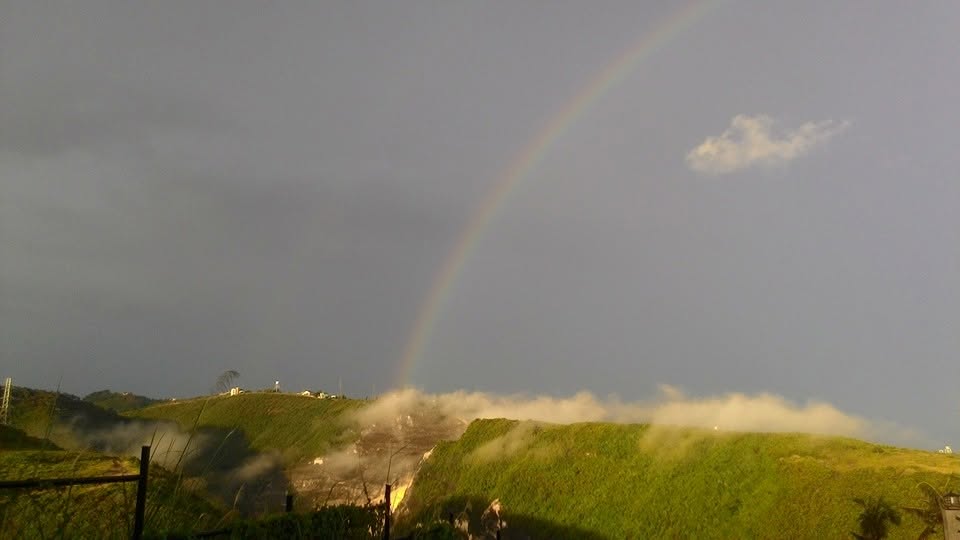
The sky was showing off. There is no other reasonable explanation for it. After spending most of the afternoon looking as though it had developed a serious disagreement with the sun, it suddenly produced a rainbow across the hills of Toledo, Cebu, with the theatrical confidence of someone who had been saving the best part of the performance for last.
The clouds were dark and uncooperative, the hills below them startlingly green, their slopes interrupted by exposed earth and a pale thread of mist moving along the ridge. Somewhere in the distance sat the familiar industrial landscape of Toledo, practical and unromantic, while a thin curve of colour rose above it all. It was beautiful, although I must admit the rainbow could have selected a more respectable background.
Postcards generally prefer waterfalls, flower-covered valleys and villages with charming little cottages. Ours appeared above uneven slopes, industrial traces and the ordinary evidence of a town that had spent generations living beside work, dust and weather. The rainbow seemed entirely unconcerned with aesthetics. It appeared anyway, and naturally, I took a photograph.
I have always been easily distracted by the sky. Clouds, strange light, sunsets and distant rain possess an unreasonable ability to interrupt whatever important thought I am trying to have. I can be deeply occupied with the future and then lose several minutes deciding whether a cloud resembles a dragon or an overweight chicken. That afternoon, however, I was carrying something even the sky could not completely distract me from.
A month had passed since I failed an examination connected to my hope of working abroad. Thirty days, give or take, was long enough for the first sting of disappointment to soften but not long enough for the questions around it to disappear. The exam was over, the result was known and no amount of revisiting individual questions could alter what had happened. My plans had not moved forward as I had hoped.
I remained in the Philippines without stable employment and without a clear sense of what the next professional step would be. The weeks had continued moving, but I could not honestly say they had delivered a satisfying explanation. I had simply reached the month after.
There is something peculiar about the month after disappointment. The day itself receives attention because there is a result, a reaction, perhaps a conversation and often a great deal of unnecessary replaying of events. The weeks afterwards are quieter. Nobody marks the twenty-third day after a failed examination, and there is no ceremony for the fourth Monday since a plan failed to cooperate.
Life simply resumes its ordinary rhythm, even when your thoughts have not caught up. That can make the weeks afterwards stranger than the original moment. The result is no longer new, yet its consequences remain in the room.
I had already thought about the examination enough to become tired of thinking about it. I knew what had happened and understood that I would eventually need to decide what came next. I also knew the overseas opportunity had mattered for reasons larger than professional advancement. It represented work, financial independence, stability and the possibility of developing my nursing career somewhere different.
Perhaps beneath all of that was another hope I was less comfortable admitting. When life feels unsettled, another place can begin to look almost suspiciously organised. Distance makes it easy to imagine a country where our abilities will finally be used properly, our plans will become sensible and the future will behave itself.
I did not believe moving abroad would solve every problem. There would have been professional requirements, financial pressures, unfamiliar systems and the ordinary difficulty of building a life somewhere new. But from where I stood in Toledo, another country still represented possibility. When the present feels uncertain, possibility can become very persuasive.
Stories of Filipinos working overseas were familiar. Someone always knew a relative who had left, a friend preparing requirements or somebody studying for another professional examination. There was always another country, another application and another route being discussed somewhere. The world seemed full of doors; the difficult part was discovering which one would actually open for me.
A month earlier, I had approached one. It had stayed closed. That did not mean every door in the world had joined an international conspiracy against my ambitions, although disappointment occasionally presented this theory with considerable confidence.
Unfortunately, I had no evidence for the conspiracy. What I had was one unsuccessful result and the ordinary uncertainty of not knowing what to do with it yet. That was enough to occupy the mind very efficiently.
Revising a future is tiring because making a plan requires imagination, while changing it requires admitting imagination was never a contract. We can prepare carefully, make responsible decisions and still encounter an outcome that forces us to reconsider the route. That is not necessarily proof that the original attempt was foolish. It is simply part of making decisions without knowing everything in advance.
Still, I questioned myself. Had I been realistic? Had I prepared enough? Should I try again? Was I even pursuing the right direction? These were useful questions initially, but useful reflection has a tendency to become an endless argument if nobody tells it when to leave.
I could examine my preparation and think about what might have been improved. What I could not do was return to the computer and select different answers. The moment had passed, yet the mind has extraordinary difficulty respecting jurisdiction. It will revisit a completed event repeatedly, convinced that one more analysis might persuade history to issue an amended decision.
History is a stubborn department. Its appeals process is dreadful.
Eventually, I began to suspect that the important task was not finding a perfect explanation for the failure. It was learning when the explanation was complete enough to stop interrogating the past and look at what remained possible. The examination had not gone in my favour, there were lessons worth considering and there were practical decisions ahead. Everything else belonged to a future I could not yet inspect.
That uncertainty irritated me because I liked questions with answers. Complicated questions did not bother me as long as there was some hope of eventually reaching a conclusion. A month after the examination, however, I had plenty of questions and almost no conclusions.
I did not know whether another attempt would become possible, when stable work might arrive or whether a different professional route would eventually make more sense. I certainly could not tell what my life would look like several years later. I found the absence of even a provisional timetable deeply inconvenient.
Then the sky produced a rainbow.
I looked at it and, because I am human, immediately began wondering whether it meant something. A rainbow one month after a disappointment has excellent symbolic timing. Perhaps it was a sign that circumstances were changing. Perhaps something better was coming. Perhaps the universe was offering reassurance with unusually impressive graphic design.
I understood the temptation because uncertainty makes patterns attractive. A meaningful song plays at the right moment, a sentence appears in a book, someone calls unexpectedly or a dream seems strangely connected to something that later happens. We notice these things because human beings are excellent pattern-seekers. It helps us learn, anticipate and make sense of the world.
The same instinct can also tempt us to assign certainty where none exists. The rainbow was beautiful, but its appearance could be explained through light and water droplets in the atmosphere. It had no obligation to comment on my employment prospects. The sky was not secretly operating a recruitment agency.
Still, I did not need to choose between appreciating the moment and understanding what caused it. I could find the rainbow personally meaningful without pretending it was evidence that a job offer or overseas opportunity was about to arrive. Beauty could influence my mood without being forced to make promises.
That distinction became unexpectedly useful. Something can matter to us without predicting anything. A photograph can become connected to a difficult season without proving that the season had a hidden purpose. An ordinary moment can offer relief without becoming a message from the future.
Perhaps I had been asking too many experiences to provide answers they were never designed to give. A difficult event needed a lesson, a coincidence needed a reason and an unexpected encounter needed to fit into some larger narrative. I wanted the pieces to connect because an organised story felt safer than admitting that some parts of life remain unresolved for longer than we would like.
Writing had become tangled in the same expectation. I barely blogged that year because my mental well-being was not at its strongest and the effort needed to turn a thought into an essay often felt larger than usual. Even when I considered writing, I kept wondering how the post should end. What had I learned? What did everything mean? How could I write about the experience if I did not yet know what happened next?
Perhaps I had been demanding too much certainty from writing too. An essay does not need to solve an entire life. I could write about disappointment without explaining why it happened, and I could describe uncertainty without pretending I had already overcome it. I could photograph a rainbow without insisting that it was announcing my future.
That idea relieved something. Honest writing may require observation more than conclusion. Sometimes experience happens first and understanding follows much later, after enough time has passed for us to see connections that were invisible while we were still living through them.
There are also experiences that never become blessings in disguise. Some disappointments remain disappointing, and some opportunities are genuinely lost. I would still have preferred to pass the examination. I would still have preferred the overseas possibility to move forward.
Recognising that does not mean the future has been permanently damaged. It simply keeps the story honest. A difficult event can remain undesirable without being allowed to dominate everything that comes after it.
I began thinking about the month itself. Thirty days is straightforward on a calendar, yet time behaves differently depending upon what we are waiting for. A month before something exciting can disappear quickly, while a month spent watching for signs of progress can feel substantially longer.
Messages, applications, opportunities and changes in routine suddenly become evidence that life is moving. When nothing dramatic appears, the temptation is to decide that the month produced nothing. I had started doing exactly that.
No job offer. No successful exam. No major announcement. Therefore, apparently, no progress.
But perhaps I had been measuring time too narrowly. Did every month need to produce something suitable for announcement? Was a month valuable only if it ended with a qualification, employment or a dramatic new direction? That expectation seemed increasingly unreasonable once I examined it.
The calendar was moving, and I had interpreted the lack of visible change as evidence that I was falling behind. But behind what? An imaginary schedule I had constructed years earlier? People whose circumstances differed from mine? A version of adulthood that had never consulted reality before publishing its timetable?
I still wanted stability, and that desire remained practical. What I did not need was to treat every week without it as proof that I was becoming less capable. A month passing does not remove qualifications, and an unsuccessful examination does not grow more authoritative simply because time has passed since the result.
I had also begun associating productivity too closely with worth. If I did not have stable employment, perhaps I should be studying more, writing more, applying more, planning more and generally demonstrating that the available hours were not being wasted. The word should had become extraordinarily industrious.
An afternoon spent resting could feel suspicious. A week without writing looked inadequate. A day without an application could make me feel as though I had failed to use time properly. My mind was working overtime and, rather inconveniently, producing neither wages nor results.
The rainbow interrupted that arrangement for several minutes. It offered no career advice, asked nothing about my next attempt and showed no interest in my five-year plan. It simply existed above the hills, and I was allowed to look at it without converting the experience into a task.
I noticed the pale colours against the dark sky, the mist drifting along the ridge and the exposed earth beneath the green slopes. The scene was not perfect. The clouds remained heavy and the industrial landscape had not magically transformed into postcard material.
Yet it was still worth photographing.
That thought stayed with me because I had been treating my life differently. I imagined the year would become worth appreciating once the difficult circumstances had resolved. Once I found stable work, passed the right exam, secured the right opportunity and finally knew what came next, then perhaps I could stop feeling as though I was waiting for life to begin.
But what was I supposed to do with the months in between?
Discard them?
Call them waiting rooms?
Treat them as temporary corridors whose only purpose was to connect one meaningful stage of life to the next?
I had started doing that with 2016. It felt like an overly long corridor with questionable lighting and no clear exit sign. Yet however inconvenient the corridor was, I was still living inside it.
The days were real. The people around me were real. The ordinary moments were still happening. Disappointment had not suspended my existence, and I did not need to earn the right to appreciate something beautiful by first producing a successful result.
This was harder to accept than it sounds because enjoying the present can sometimes feel suspicious when you are dissatisfied with your circumstances. If I enjoyed an afternoon, was I becoming complacent about unemployment? If I stopped worrying for a few hours, was I neglecting responsibility? If I laughed, did that somehow mean the failed exam had not mattered?
The questions were absurd once examined carefully. Enjoying a moment does not cancel ambition, and resting does not prove laziness. A person can remain disappointed about one part of life while enjoying another part on the same day.
Apparently, emotions are capable of sharing accommodation.
Perhaps happiness becomes fragile when we allow it only after achievement. Pass the examination, find work, become financially secure, reach the next milestone and then permit yourself to feel satisfied. The logic seems reasonable until one goal is reached and another immediately presents itself for inspection.
The promised moment of contentment keeps moving.
I still wanted to work, develop professionally, become financially secure and consider opportunities beyond the Philippines. None of that changed because I paused to photograph a rainbow. The afternoon did not need to compete with the future.
The rainbow would not become more beautiful after I found a job. The hills would not retroactively improve once my plans became clearer. What I saw was worth noticing under the circumstances that actually existed, not only under the ones I wished I had.
Perhaps patience is partly accepting that some questions cannot be solved today. It does not necessarily feel noble. Sometimes it is simply recognising that you have done what can reasonably be done and the next decision depends on information that has not arrived yet.
Waiting is not always passivity. A person can wait while reviewing options, managing finances, learning and maintaining responsibilities. There are also times when little visible progress happens because the next step genuinely depends on circumstances outside one person’s control.
That distinction became important to me because I had been measuring commitment by speed. If progress was slow, perhaps I was not trying hard enough. Yet pace does not tell us everything about effort.
This was a principle I could apply easily to other people and surprisingly poorly to myself. I could write about how unemployment did not define someone’s worth, then privately allow my own employment status to determine my confidence. I could argue that an examination measured particular performance, then behave as though my own result had measured something much larger.
Apparently, understanding a principle and practising it are two separate qualifications. I had completed the theory module. The practical assessment remained ongoing.
That may be one of the uncomfortable pleasures of reflection. It is easy to analyse somebody else’s assumptions and contradictions until the same reasoning turns around and asks what we have been doing ourselves. I realised I had been treating uncertainty as failure, comparing lives that were not truly comparable and demanding a conclusion from circumstances still unfolding.
It was an ambitious collection of unreasonable expectations. I could almost admire the administrative efficiency.
Almost.
I looked at the rainbow again. Its colours were faint against the clouds, and there is something interesting about rainbows because what we see depends partly on the relationship between light, water droplets and the observer. Change the position, and the appearance changes.
I liked that without needing to force it into a grand metaphor. The same result can occupy a different place in different lives. A month after failing an examination might look like an ordinary setback to somebody with stable employment and plenty of financial security. For me, it belonged to a wider period of uncertainty.
The exam result itself was objective. Its emotional weight existed within context.
That is why we should probably be careful when telling people how much disappointment ought to matter. We do not always know what an outcome represented to them, what other pressures surrounded it or what hopes had quietly become attached to the possibility.
I took another look at the photograph. The dark clouds remained, the exposed earth remained and the landscape was still visibly imperfect. The beauty had not required any of those things to disappear first.
I do not mean hardship is necessary to make life beautiful. I would still have chosen the passing result, stable work and better mental well-being if those options had been available. There is no need to pretend otherwise.
But perhaps disappointment in one area does not require disappointment everywhere else. A difficult month can still contain a beautiful afternoon. An uncertain future can coexist with curiosity, humour and moments that deserve our attention.
Those truths do not solve practical problems. They simply allow life to be experienced more accurately.
I sometimes wonder whether I would remember 2016 mostly through absence: the job I did not yet have, the exam I did not pass, the overseas plan that had not worked and the blog posts I barely wrote. Those absences were real. They were not the only things that happened.
There were ordinary conversations, observations, changing ideas and moments I might otherwise have forgotten. The rainbow was one of them: a photograph taken on an afternoon when the future remained unresolved.
It does not need to become evidence that success was approaching. It does not need to prove the failed examination happened for a reason. It simply records the moment I looked away from what had gone wrong long enough to notice something extraordinary above a familiar place.
Perhaps that is already enough work for one photograph.
The camera recorded light. I attached memory to it.
Someone else looking at the photograph years later might see nothing more than a rainbow above Toledo, and they would not be wrong. They would not see the failed exam, my uncertain employment or the questions I had been carrying that month because photographs do not automatically contain the emotional history of the person behind the camera.
We supply that ourselves.
For me, the picture belongs permanently to the month after. It belongs to the stretch of time when I had no satisfying answer to what came next and had grown tired of asking the same questions. The rainbow did not answer any of them.
For a few minutes, however, it allowed me to stop demanding an answer.
That was valuable because constant thinking had not solved the problem either. There are limits to what the mind can accomplish through repetition. At some point, an unresolved future remains unresolved regardless of how many times we inspect it.
The next practical decision can be made when enough information exists to make it. Until then, the afternoon still passes, the light changes and occasionally the sky does something that deserves to interrupt us.
I imagine the rainbow gradually fading, the mist lifting and the hills returning to their ordinary colours. Nothing about my professional circumstances changes during those minutes. I am still in the Philippines, still without stable employment, still disappointed by the exam and still unsure which overseas opportunity, if any, will eventually work.
But perhaps I no longer need to solve my entire future before participating in the present. I can want a different life without treating the current one as an inconvenience. I can remain ambitious without allowing ambition to become a permanent complaint against today.
The sky had other plans that afternoon. Mine were still under consideration.
I looked at the photograph and smiled at the contrast. Here I was trying desperately to organise the next chapter of my life, while the weather had produced something magnificent without completing a single application form. An irritatingly impressive achievement, really.
Perhaps I could learn something from that, although even that thought felt suspiciously like trying to turn the rainbow back into an assignment. For once, I decided simply enjoying the photograph required less paperwork.
A month after failing, I still had no grand announcement. There was no overseas opportunity secured, no stable job to celebrate and no neat explanation for why the year had become so difficult. There was only a rainbow above Toledo on an afternoon when I was still figuring things out.
I think I will keep it that way.
The hills were still there, the clouds had not cleared and the future remained uncertain. For a few brief minutes, however, the sky was beautiful anyway, and apparently it did not need my life to be sorted out before deciding to be.
Still looking up without asking the sky for answers,
Anj


















Leave a Reply