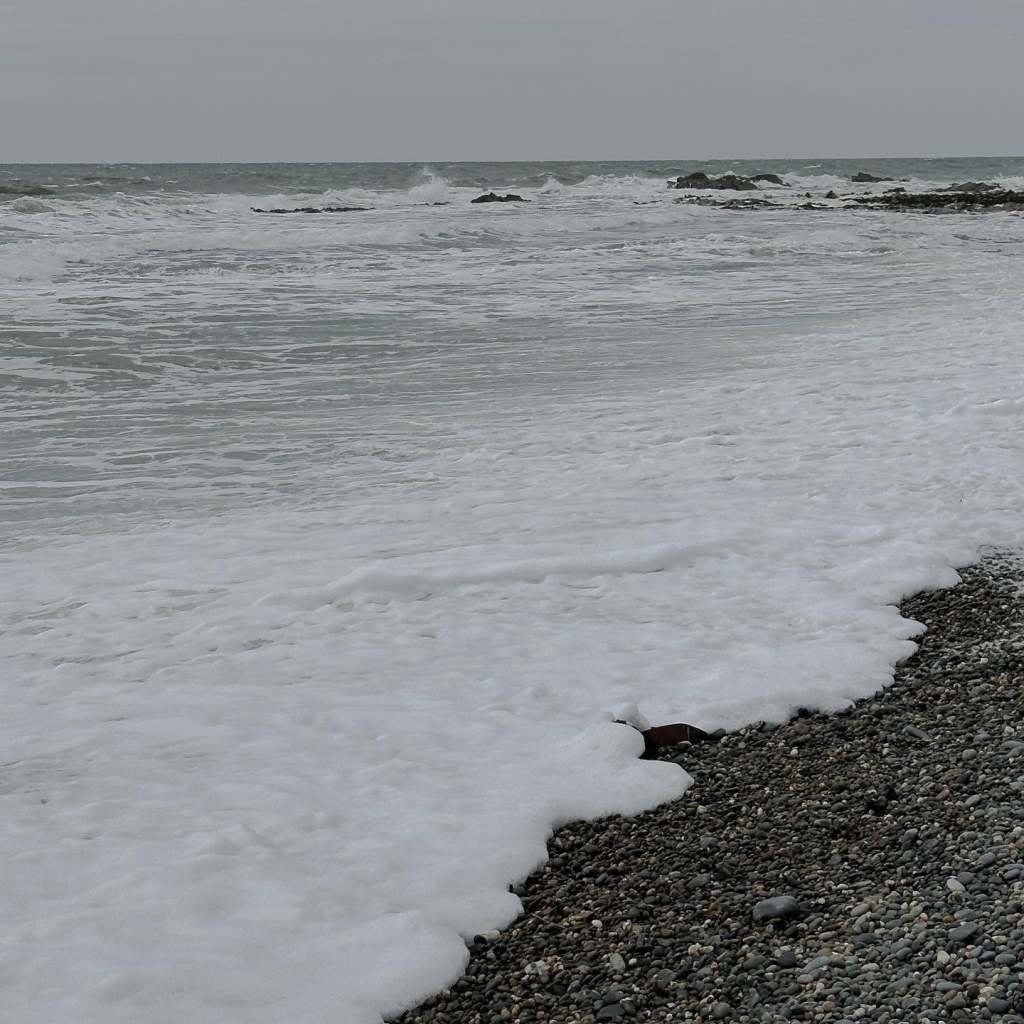
I had been watching the sea behave badly for several minutes before it occurred to me that I was probably giving it too much credit for being beautiful. From a sensible distance, the waves looked almost elegant, rolling towards shore beneath the afternoon light and breaking into white foam exactly where a photograph would want them to. Up close, they had considerably less manners. One crashed against the rocks hard enough to send cold saltwater over my feet, my legs and whatever dignity I had brought with me. I stepped backwards, naturally offended, while the sea withdrew as though nothing had happened. Then another wave came. Same rock. Same collision. Same dramatic explosion of water. The rock did not move. The sea did not apologise. Apparently neither of them had received the memo that conflict was supposed to end after one difficult conversation.
I stood there longer than necessary, partly because the view was beautiful and partly because wet slippers make retreat less graceful than inspirational quotes suggest. The air tasted faintly of salt. Wind tangled my hair across my face. Water hissed between the stones each time a wave pulled itself back towards the horizon. Somewhere between one crash and the next, I realised I had spent much of my life expecting people to behave more predictably than the ocean.

Maybe that was where some of my deepest disappointments began. Not always in what people did, but in the quiet agreements I had written for them inside my own head. If I treated someone kindly, surely they would do the same. If I stayed through their difficult seasons, surely they would stay through mine. If I explained myself carefully enough, surely they would understand. In my head, the arithmetic was embarrassingly tidy. Kindness plus loyalty should equal kindness plus loyalty. Unfortunately, people have never respected mathematics.
There were seasons when I held on to those invisible equations far too tightly. I thought effort should guarantee effort in return. I thought patience should eventually be rewarded with understanding. I thought love, if offered sincerely enough, could persuade someone to meet me in the middle. And when that did not happen, I did what many people do when reality refuses to cooperate: I blamed myself for not arranging the pieces correctly.
That is a dangerous place to live for too long.
There were moments when I wanted a particular response so badly that I started editing myself to produce it. Softer here. Quieter there. Less honest about this. More agreeable about that. I was trying to arrange myself into a shape somebody else might find easier to hold, then wondering why I no longer felt comfortable inside my own skin. There is a difference between compromise and slowly disappearing, although when you are desperate to keep a relationship intact, the two can look suspiciously similar.
I used to think changing my perspective meant convincing myself not to feel hurt. I treated acceptance almost like emotional housekeeping. Tidy the disappointment. Fold the anger. Put the sadness somewhere nobody can see it. Carry on. But emotions are poor tenants when ignored. They refuse to stay in the room you assign them.
So I began trying something different. I stopped asking why people were not behaving according to the version of them I preferred and started looking at what they were actually showing me. Patterns became louder than promises, and consistency mattered more than beautifully timed words. I learned that sometimes the answer is already present in the way someone repeatedly makes you feel, even if that answer is not the one you wanted. That lesson was uncomfortable because it required me to surrender one of my favourite illusions: the belief that I could engineer a better outcome if I simply tried hard enough. I could explain more, wait longer, be kinder, become easier, ask differently, forgive again, and perhaps then the ending would change. But life does not always reward persistence with the result we imagined. Sometimes persistence simply keeps us standing in the same place while the evidence keeps arriving.
That did not mean becoming bitter. If anything, it meant becoming more honest. People carry histories we may never fully understand. They react from wounds, fears, habits and insecurities we cannot always see. Sometimes they disappoint us deliberately, and sometimes they do it without even realising. Understanding that does not erase the impact, but it does remind me that I cannot build my peace around somebody else eventually becoming the version of themselves I hoped for. That responsibility belongs to me. I started redirecting my attention towards the people who showed up with consistency, the ones whose presence did not require me to audition for basic care. There is something almost embarrassing about how much energy we can spend analysing people who give us very little, while overlooking those who make love, friendship and respect feel uncomplicated. Perhaps chaos gets our attention because it is noisy, while consistency rarely needs to announce itself.
I used to think closure had to arrive through conversation: a final explanation, an apology, a carefully worded acknowledgement that everything I had felt was reasonable and every unanswered question was now neatly resolved. It sounds lovely, but it does not always happen. Sometimes silence becomes the ending. Sometimes distance does the work a conversation never could. Sometimes closure is simply noticing that you no longer need the answer as desperately as you once did. That took time, and so did learning that not every thought deserves permanent residence in my head. I had given certain people far too much internal floor space. Their words replayed, their actions were analysed, and their silence became evidence in imaginary court cases that never reached a verdict. Eventually I had to admit that constantly revisiting the hurt was not helping me understand it. It was simply allowing it to continue renting space without paying anything. And yes, I recognise the irony of learning emotional boundaries from a wave repeatedly assaulting a rock. Life has terrible taste in classrooms, but still, the lesson remained.
The more I understood myself, the less desperate I became for somebody else to explain me back to myself. I began to recognise the tender parts, the defensive parts, the parts that wanted approval far more than I liked admitting, and the parts that had mistaken being chosen for being valuable. Self-awareness did not make disappointment disappear, but it made it harder for another person’s opinion to become the final authority on who I was. I began asking different questions. Instead of asking, “Why didn’t they choose me?” I started asking, “Why did I need their choice to confirm my worth?” Instead of, “How do I make them understand?” I asked, “Have I already explained enough?” Instead of, “How can I make this work?” I asked, “What is this costing me to keep alive?” Those questions were less romantic, but considerably more useful.
I also started noticing how easily we become shaped by the environments we keep returning to. Spend enough time around people who belittle, dismiss or drain you and eventually you begin adjusting yourself to survive the room. You speak less, ask less, expect less, and begin calling it peace because conflict has stopped, when really you have simply become quieter. That was not the kind of peace I wanted. Peace that requires self-erasure is only silence wearing nicer clothes. So I learned to step away from certain rooms, not dramatically and not with a speech rehearsed in front of a mirror, but sometimes simply by reducing access, answering less, and refusing to repeat the same argument for the ninth time as though the tenth attempt might unlock some secret level of comprehension.
Boundaries, I discovered, are often much less cinematic than people imagine. Sometimes they look like not replying immediately. Sometimes they look like saying no without writing an essay afterwards. Sometimes they look like letting someone misunderstand you because correcting them would require returning to a version of the conversation you have already outgrown. And sometimes they look like walking away without needing the person behind you to agree that leaving was justified. That was perhaps the hardest part for me. I wanted fairness, mutual understanding, and the neatness of both people eventually saying, “Yes, this is what happened, this is where we hurt each other, and now we can leave with equal clarity.” Life rarely bothers with such elegant conclusions. People remember differently. They justify themselves differently. They may never see the situation through your eyes, just as you may never fully see it through theirs. There is freedom in accepting that, not because the truth no longer matters, but because your healing cannot depend on everybody signing the same version of it.
The sea was still hitting the rocks while I thought about all this. Wave after wave arrived, each one briefly becoming foam before dissolving back into the water. The rock remained where it was, though I knew enough about coastlines to understand that remaining did not mean untouched. The water was shaping it slowly, not visibly in one afternoon perhaps, but over years. Maybe that is what difficult seasons do to us too. They do not always destroy. Sometimes they alter. Sometimes they smooth edges we thought were permanent. Sometimes they expose cracks. Sometimes they show us exactly where we have been standing too long.
I used to resist discomfort because I assumed every painful season needed to be escaped as quickly as possible. Now I think some experiences deserve to be sat with long enough to understand what they are trying to reveal. That does not mean glorifying pain or remaining where you are being harmed. It means allowing a difficult experience to teach you without allowing it to define you. You can acknowledge what hurt without building your identity around being hurt. You can recognise disappointment without letting disappointment become your personality. You can forgive without reopening the door. You can care about someone and still understand that proximity is no longer healthy. You can wish them well from a distance large enough to protect your peace.
Perhaps that is what changing perspective really means. Not pretending the wave did not hit and not insisting the rock should have been somewhere else, but recognising that you cannot always control what arrives and that you still retain some choice over what happens after impact. By then the sun had lowered enough to turn the water bronze around the rocks. The same waves were still coming in, throwing themselves against the same stone with absolutely no evidence that either side had learned anything. But perhaps I had been watching them incorrectly. The rock was not defeating the wave, and the wave was not punishing the rock. They were simply meeting each other according to their nature. One moved. One remained. Both were changed slowly by the encounter.
Another wave reached my feet before I could step away, and this time I laughed instead of retreating. There are circumstances I still wish I could change. There are conversations I would rewrite, people I would understand differently and endings I would make less painful if life gave me editorial rights. It does not. Other people remain free to choose badly, leave unexpectedly, misunderstand me, disappoint me or become someone I can no longer walk beside. My freedom begins somewhere else: in deciding how much of myself I surrender to what I cannot control.
The sea pulled back again, dragging tiny stones with it and making that soft rattling sound they make when water rearranges the shore. My feet were wet. My hair was impossible. The rock was still there. And perhaps that was enough. I could spend my life asking the wave why it hit me, or I could learn what the rock already knew. Sometimes you cannot stop the water from coming, so when it does, kiss the wave that throws you against the rock.
Still standing where the tide left me,
Anj 🌊





















Leave a Reply