By Kiera Cass
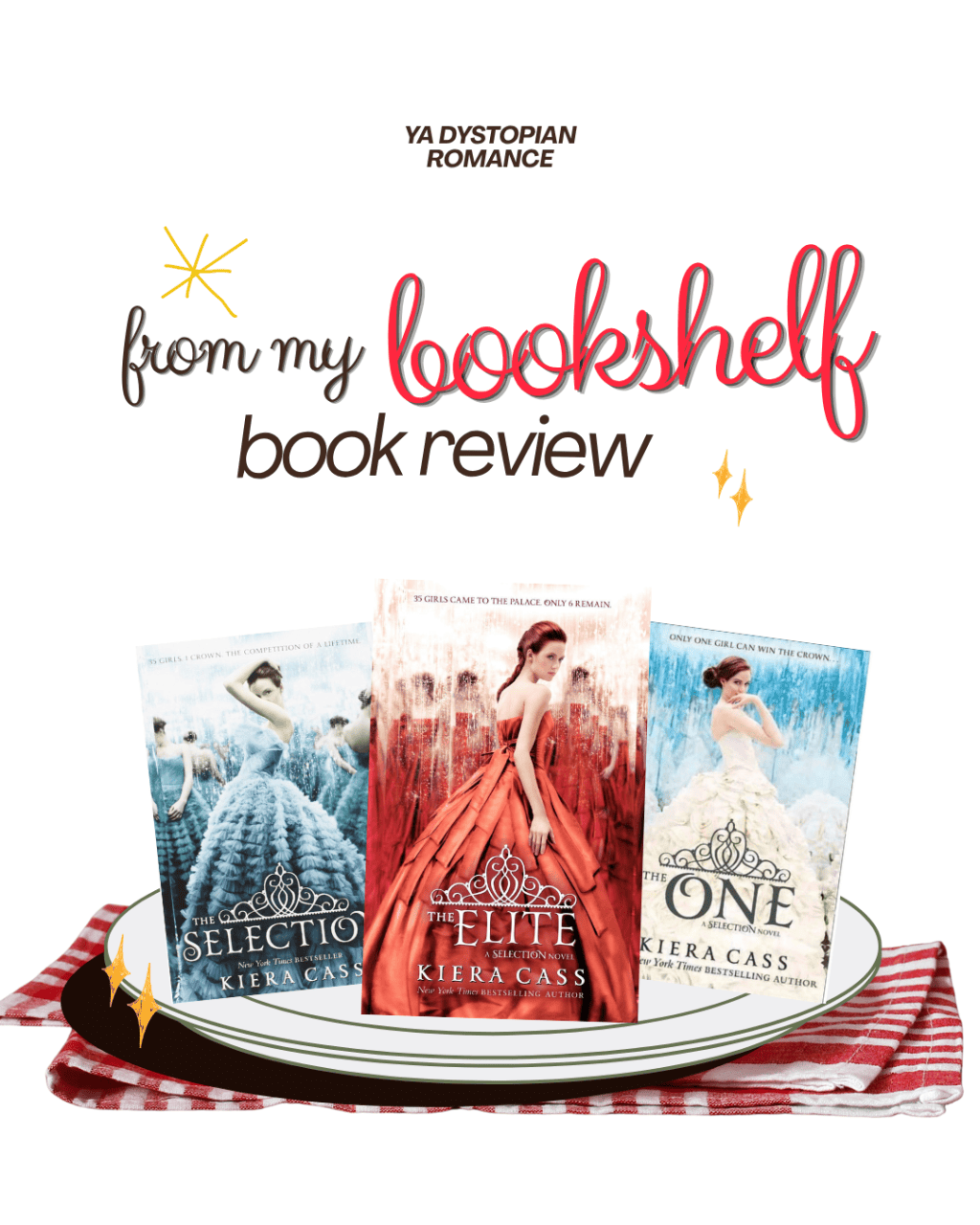
Series Review: The Selection, The Elite & The One
Category: Book Reviews | Young Adult Fiction | Dystopian Romance | Literary Reflections
“True love is usually the most inconvenient kind.”
— Kiera Cass, The Selection
I have always found the institution of royalty rather fascinating. There is something undeniably theatrical about crowns, centuries-old traditions, magnificent palaces, and people whose principal occupation appears to involve waving gracefully from balconies. Add an elaborate wardrobe, a handsome prince, and the promise of becoming queen, and you have the ingredients for a perfectly respectable fairy tale. Introduce thirty-five young women competing for that privilege, however, and the whole arrangement begins to resemble a reality television programme with a considerably larger costume budget and rather more serious consequences for losing.
This is essentially the proposition behind Kiera Cass’s The Selection series, a collection of young adult novels that combines royal romance, a rigid social hierarchy, political intrigue, and enough emotional indecision to keep several relationship counsellors gainfully employed. At its centre is America Singer, a young woman whose circumstances change when she is selected to compete for the affection of Prince Maxon Schreave. She is not particularly interested in becoming royalty, which is unfortunate considering that practically everyone around her appears determined to persuade her otherwise.
What intrigued me about the series was the contrast between its glamorous premise and the uncomfortable social arrangement beneath it. Behind the glittering dresses and beautifully decorated palace lies a society that determines people’s opportunities largely according to the circumstances of their birth. The story promises romance, but its fictional world raises a more interesting question: how much freedom does a person genuinely possess when almost every aspect of their future has already been decided for them?
Of course, there is also a love triangle. Apparently, overthrowing an unjust social hierarchy is not sufficiently complicated unless somebody’s former boyfriend is standing nearby looking emotionally significant.
What the Series Is About
Set in the fictional kingdom of Illéa, The Selection takes place in a future society organised according to a strict numerical caste system. Social class determines occupation, privilege, and economic opportunity, creating enormous differences between those at the top and those struggling near the bottom.
America Singer belongs to the Fifth caste, whose members work in artistic professions. Her family lives with financial uncertainty, and although she possesses musical talent, her opportunities are constrained by the social structure into which she was born. She is also secretly involved with Aspen Leger, a young man from a lower caste, making their relationship complicated by expectations that have little to do with affection.
Everything changes when America enters the Selection, a competition in which thirty-five young women from different backgrounds are invited to the royal palace to compete for Prince Maxon’s hand in marriage. The winner will become his wife and eventually queen.
For many contestants, the opportunity represents a spectacular improvement in social standing. For America, it initially means leaving behind someone she loves, entering a world she distrusts, and participating in a competition she has little interest in winning.
The original trilogy follows America’s experiences through The Selection, The Elite, and The One. As the competition progresses, relationships develop, loyalties become complicated, and the political tensions beyond the palace walls increasingly threaten the comfortable world inhabited by its royal residents.
Cass builds her story around a familiar romantic question: what happens when the future we thought we wanted begins to compete with one we never imagined?
It is a simple premise, but an effective one.
America Singer: Independent, Opinionated, and Occasionally Exhausting
America is an interesting protagonist because she does not begin the series with any desire to become a princess. She is outspoken, resistant to the expectations imposed upon her, and often uncomfortable with the inequalities she witnesses around her.
I appreciate that Cass gives her a personality beyond the conventional ambition of winning a prince’s affection. America has opinions, loyalties, insecurities, and a sense of identity shaped by her family’s circumstances. Her discomfort with palace life creates a useful contrast between the luxury surrounding the contestants and the social realities outside the royal residence.
However, my appreciation of her independence does not necessarily extend to every decision she makes.
America can be frustratingly indecisive, particularly when navigating her feelings for Maxon and Aspen. At certain points, her emotional uncertainty becomes so prolonged that I wanted to sit her down, offer her a cup of tea, and suggest that perhaps a little honest communication might save everyone several chapters of unnecessary confusion.
But there is an important distinction between a frustrating character and an unsuccessful one.
America’s contradictions make sense within the broader context of her situation. She is young, surrounded by competing expectations, and forced to make decisions that could alter not only her future but also her family’s circumstances. She wants independence yet fears uncertainty. She values honesty but occasionally struggles to be transparent about her own feelings.
These inconsistencies are recognisably human, even when Cass’s execution occasionally stretches the reader’s patience.
My principal criticism is that the romantic indecision sometimes becomes a substitute for deeper character development. Rather than allowing America to confront new moral and political questions, the narrative periodically returns to misunderstandings that might have been resolved through a more straightforward conversation.
Nevertheless, America remains engaging because she questions the rules of a world that others have been taught to accept.
That, to me, is where her character becomes more interesting than the competition itself.
Prince Maxon, Aspen, and the Problem with Love Triangles
The central romance is undoubtedly one of the series’ biggest attractions.
Prince Maxon initially appears to occupy the familiar role of the privileged royal love interest, but Cass gradually reveals someone whose personal desires exist in tension with his public obligations. He is expected to choose a wife while navigating political expectations, family pressures, and a world in which the monarchy’s image matters enormously.
His developing relationship with America provides some of the series’ most engaging moments. Their differences create an interesting dynamic: she challenges his assumptions about ordinary life, while he introduces her to responsibilities and pressures she has never experienced.
I found their conversations particularly effective when they move beyond romantic attraction and begin revealing the distance between their social experiences.
Aspen, meanwhile, represents America’s past and the future she once expected to have. His presence complicates her decisions because the relationship is connected not only to affection but also to familiarity, history, and the security of an identity she understands.
What makes the triangle interesting is that America is not merely choosing between two young men. She is also negotiating between two different versions of her future.
Unfortunately, the romantic tension occasionally depends too heavily upon secrecy, jealousy, and misunderstandings. While these elements create suspense, they can become repetitive when characters repeatedly avoid the very conversations that might help them understand one another.
Still, Cass understands the appeal of emotional anticipation. Her writing invites readers to become invested in the smallest exchanges, interpret subtle changes in behaviour, and develop strong opinions about decisions that, strictly speaking, are none of our business.
That is the peculiar pleasure of reading romantic fiction. We become extraordinarily confident about what fictional people should do while possessing very little authority over their lives.
Behind the Ballgowns: Class, Privilege, and a Conveniently Decorative Revolution
Perhaps the most intriguing element of the series is its dystopian setting.
Illéa’s caste system creates a society in which opportunity is distributed according to birth rather than individual ability or aspiration. Wealth, occupation, social standing, and marriage are influenced by a hierarchy that benefits certain groups while limiting others.
This provides the novels with an interesting foundation for examining inequality and social mobility.
The Selection itself becomes an almost absurd symbol of this arrangement. A young woman may escape economic hardship by winning the affection of a prince, but the system creating that hardship remains largely intact. It is difficult not to appreciate the irony of a society presenting marriage into royalty as a spectacular opportunity for social advancement while maintaining the very inequalities that make such an opportunity desirable.
Cass occasionally draws attention to these contradictions through America’s perspective, particularly as she becomes more familiar with palace life.
However, I wanted the political world to be developed more thoroughly.
The caste system, rebel movements, and history of Illéa are fascinating narrative possibilities, but they sometimes receive less attention than the romantic competition. Important political developments can feel compressed, and the wider society occasionally exists primarily to create tension for the central characters.
This is particularly noticeable as the trilogy progresses and the political stakes become increasingly significant.
I understand that the books are primarily romantic fiction with dystopian elements rather than comprehensive political novels. Judging them solely by the standards of more elaborate dystopian literature would therefore be unfair.
Nevertheless, I think the series could have become considerably richer had Cass explored the relationship between class, power, and individual freedom with greater complexity.
A beautiful palace makes an appealing setting for romance, but the world beyond its gates deserves attention too.
The Writing: Addictive, Accessible, and Occasionally Too Convenient
One of Cass’s greatest strengths is readability.
Her prose is direct, conversational, and well suited to the first-person perspective through which America narrates the story. The chapters move quickly, conversations occupy a substantial part of the narrative, and dramatic developments are arranged to encourage readers to continue.
The result is an undeniably accessible reading experience.
Cass does not attempt elaborate literary experimentation or dense descriptive passages. Her writing prioritises emotional immediacy, character relationships, and narrative momentum. This approach makes the trilogy easy to become absorbed in, especially for readers who enjoy romance-driven fiction.
There is also a distinct visual appeal to the setting. The elaborate dresses, formal gatherings, palace interiors, and ceremonial expectations create an atmosphere that feels almost cinematic. I could readily imagine the story unfolding as a lavish television drama, complete with extravagant costumes, intimidating royal etiquette, and contestants exchanging carefully concealed expressions of mutual dislike across an elegantly arranged dining table.
But accessibility comes with limitations.
Some plot developments rely upon convenient coincidences or delayed revelations. Certain supporting characters could have benefited from more substantial development, particularly those whose presence initially suggests greater complexity than the narrative ultimately provides.
The pacing can also feel uneven. Romantic misunderstandings sometimes occupy considerable space, while political developments with potentially significant consequences move more rapidly.
For readers seeking intricate world-building or psychologically demanding fiction, the series may feel comparatively light.
Yet there is literary value in understanding what a book sets out to accomplish.
Cass knows how to sustain curiosity, create emotional investment, and make a relatively straightforward narrative difficult to abandon. Those are storytelling skills in their own right, even when the result is more entertaining than intellectually challenging.
What Stayed with Me: The Difference Between Being Chosen and Having a Choice
Beneath the dresses, romance, and competition, I found myself returning to the idea of personal agency.
The women participating in the Selection are technically competing for an extraordinary opportunity, but the circumstances surrounding that opportunity raise difficult questions about freedom and expectation.
How much of their ambition belongs to them? How much has been shaped by family circumstances, economic pressures, or social conditioning? And how meaningful is a choice when certain alternatives have been made almost impossible?
These questions extend beyond fictional kingdoms.
In ordinary life, people make decisions within circumstances they have not entirely chosen. Families, cultures, economic conditions, and social expectations influence what we consider possible, desirable, or respectable.
I find this particularly interesting when thinking about the different paths people take towards adulthood. Some pursue careers they have dreamed about since childhood. Others discover their interests gradually. Some follow expectations inherited from family or community, while others spend years questioning whether those expectations reflect what they genuinely want.
There is no universal formula for making such decisions.
What matters, I think, is developing enough self-awareness to distinguish personal conviction from the desire to satisfy everybody else’s expectations.
America’s journey explores this tension, although often through romance rather than sustained philosophical reflection.
Her struggle reminds us that an opportunity can be impressive without necessarily being right for the person receiving it. A future that looks enviable from the outside may involve sacrifices that are invisible to those admiring it.
Being offered a remarkable future is not quite the same as being free to decide whether that future is the one you want.
That is the thought I found most interesting beneath the series’ fairy-tale presentation.
And perhaps it explains why America’s resistance to palace life is essential to the story. Without it, the Selection would be little more than an elaborate competition for a desirable social position. With it, Cass introduces the possibility that success should be measured according to something more personal than public admiration.
Where the Series Falls Short
Although The Selection trilogy offers engaging romance and an imaginative premise, I do not think it fully realises the potential of its fictional world.
My greatest reservation concerns the treatment of its political setting. Illéa’s caste hierarchy and tensions surrounding the monarchy offer opportunities for substantial social commentary, yet these themes often remain secondary to the romantic narrative.
I also found some character conflicts unnecessarily prolonged. The recurring pattern of insecurity, miscommunication, and emotional hesitation occasionally makes the story feel as though it is revisiting familiar ground rather than developing new complications.
The supporting cast is another area in which the novels could have offered greater depth. Several contestants have interesting backgrounds and motivations, but the narrative understandably concentrates its attention on America’s immediate relationships.
Finally, certain developments depend upon the reader accepting the heightened coincidences and dramatic conventions of romantic fantasy. This is not necessarily a problem for the genre, but it does affect how convincing some events feel.
Despite these reservations, I appreciate the books for what they do well. They create an accessible fictional world, sustain romantic tension, and explore questions about identity and personal choice through an entertaining narrative.
Not every novel needs to be an exhaustive examination of political philosophy.
Sometimes readers are perfectly entitled to enjoy an extravagant royal competition while privately questioning the kingdom’s approach to constitutional governance.
My Final Verdict: Is the Series Worth Reading?
The Selection is a charming, entertaining, and occasionally exasperating trilogy that combines royal fantasy with young adult dystopian romance.
Its greatest strengths lie in its accessible storytelling, engaging central relationships, and the contrast between an attractive fairy-tale setting and the inequalities beneath it. America Singer is an imperfect but recognisable protagonist whose resistance to social expectations gives the story an interesting emotional foundation.
The trilogy is less successful when it comes to political depth, consistent pacing, and the development of certain secondary characters. Readers looking for elaborate world-building or sophisticated social criticism may find its dystopian elements underdeveloped.
However, readers who enjoy romance, royal intrigue, competitive settings, and character-driven fiction will find much to appreciate.
I think its greatest appeal lies in the way it combines familiar fairy-tale pleasures with questions about independence and choice. The romance is the attraction, but the most worthwhile ideas often emerge when the story asks what the characters are prepared to give up for the futures they want.
Would I Recommend It?
Yes, especially to readers who enjoy young adult romance with a royal or dystopian setting. The original trilogy is well suited to readers who appreciate love triangles, palace intrigue, accessible prose, and stories involving characters navigating difficult decisions about their futures.
I would also recommend it to readers looking for an engaging series that does not demand the concentration required by denser fantasy novels. The books are relatively easy to follow, and their cliffhangers and ongoing character conflicts encourage continued reading.
I would be more cautious about recommending them to readers who dislike romantic indecision or expect detailed political world-building. The dystopian premise is intriguing, but the emotional relationships remain the primary focus.
Best read when: You are in the mood for royal drama, extravagant dresses, questionable decisions, and a fictional monarchy whose political problems could probably benefit from a serious constitutional review.
The thought I would take away: The future that looks most impressive to other people is not necessarily the one that best reflects our own values.
The Last Word: The Crown Was Never the Most Interesting Part
I began this review thinking about royalty, elaborate gowns, and the peculiar idea of gathering thirty-five young women in a palace to compete for the affection of one prince.
It is a wonderfully theatrical premise, and I suspect it accounts for much of the series’ immediate appeal. Who would not be curious about a competition in which the grand prize includes a crown, an extraordinary wardrobe, and a lifetime of being required to appear presentable at formal functions?
Although, upon further consideration, the last condition sounds exhausting.
But what I find more interesting about The Selection is the question beneath its romantic spectacle.
Throughout the trilogy, America is surrounded by people with very definite ideas about what should make her happy. Her family has expectations, the palace has rules, society has traditions, and the competition itself is designed around a particular vision of success.
Yet the central difficulty remains personal.
What does she actually want, and how much of herself is she prepared to compromise to obtain it?
I think that question is considerably more relevant to ordinary life than the prospect of marrying royalty. Most of us will never be invited to participate in a televised competition for a throne, a circumstance for which I am personally grateful. But we will encounter expectations, opportunities, and decisions that require us to distinguish between what appears desirable and what genuinely matters.
That is what I choose to remember about the series.
Not simply the dresses, the rivalries, or the romantic complications, entertaining though they may be, but the importance of retaining enough independence to question the future being presented to us.
After all, a crown may look spectacular in photographs.
It is considerably less useful if you have spent your entire life allowing other people to decide whether you should wear it.
Yours in books, ballgowns, and a healthy suspicion of royal competitions,
Anj


























Leave a Reply