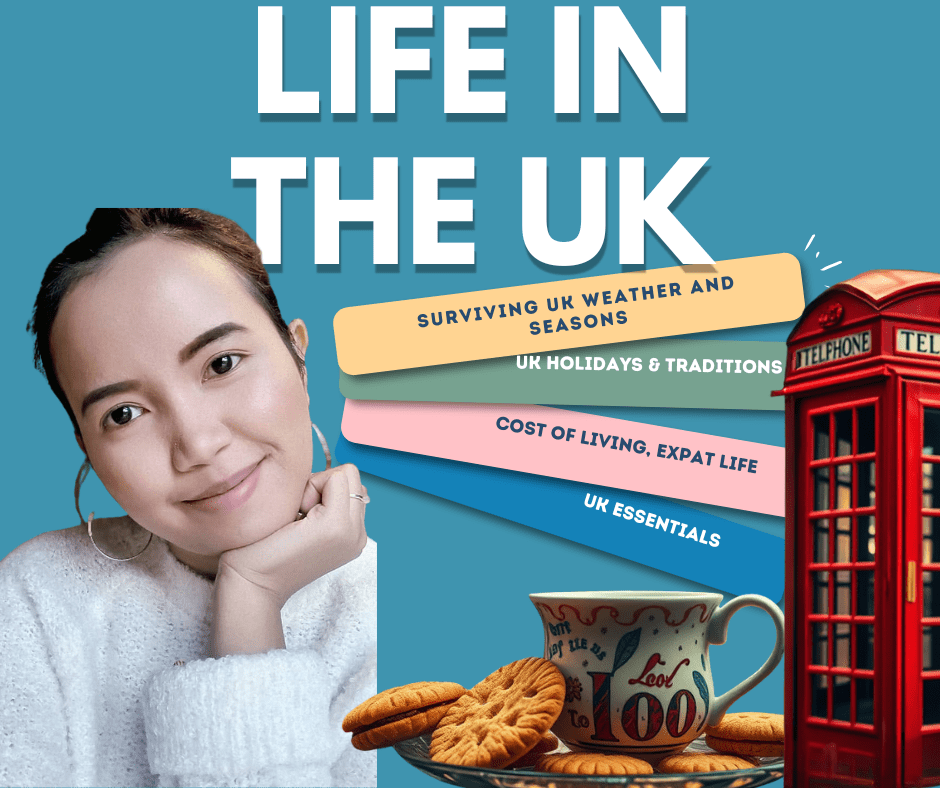
They say English is a universal language—until you move to the UK and realise you’ve only learned the subtitles, not the script.
There was a version of life abroad that looked very convincing in photographs. A coat buttoned neatly against an autumn background, coffee steaming between cold hands, Christmas lights glowing above a city street, a weekend somewhere with old brick buildings and cobbled pavements, and enough drizzle to make every photograph look thoughtfully British. From the Philippines, that version of migration could resemble a long holiday with a payslip. I understood the fascination because before I moved here, I had looked at photographs like that too. Abroad had a particular shine to it. You saw airport photos, new uniforms, shopping bags, first snow, weekend trips and smiling faces standing beside landmarks. You did not usually see the same person twelve hours later in a supermarket staring at a packet labelled mince and wondering why ground beef had apparently changed its identity at immigration. That became one of my earliest lessons about diaspora: photographs are excellent at showing where you are and remarkably poor at explaining what it takes to learn how to live there.
When I first moved to the UK, I was already confident that I spoke English. I had studied in English, worked in English, taken IELTS, attended interviews and spent years writing nursing documentation in English. I thought the language portion of migration was one thing I could safely remove from my list of worries. Britain disagreed almost immediately. In my early months at work, someone casually said, “You can nip to the loo if you need to.” I smiled with the calm professionalism of somebody who understood perfectly, while internally there was a small emergency meeting. The loo? Where was the loo? Was it a room, a place, an object? Was everybody else aware of this loo except me? Context eventually rescued me, as context frequently did during my first year in Britain, and I discovered that the mysterious loo was simply the toilet. I had studied human anatomy, pharmacology and clinical nursing, yet apparently the word that nearly defeated me that morning was loo.
It would not be the last. A little later came bog roll. Somebody mentioned that there was no bog roll in the toilet, and for a moment I genuinely wondered whether we had progressed from vocabulary difficulties into some sort of plumbing disaster. Bog roll sounds less like toilet paper and more like something that should require maintenance personnel and protective clothing. Fortunately, it was only toilet tissue. Britain had simply decided that an already functioning noun required character development.
Work became one of my best language schools, not because anyone formally taught me British expressions, but because they arrived in conversation at full speed while I was simultaneously trying to do my actual job. Someone would say, “It’s a bit of a faff,” and I would use the surrounding circumstances to calculate whether faff meant difficult, annoying, inconvenient or all three. Eventually I learned that it is a marvellous word because it sounds exactly like the experience it describes. Filling in unnecessary paperwork? Faff. Rearranging something three times because the first two systems failed? Faff. Trying to organise several nurses for dinner when everyone works different shifts? Advanced faff. Then somebody would say, “Don’t worry, it’s sorted.” Sorted became one of my favourite British words because it contains enormous emotional relief for something only six letters long. Whatever catastrophe had been developing was now handled. Sorted. Civilisation could resume.
The confusion followed me outside work too. I remember encountering jacket potato on a menu and wondering briefly whether this was a particularly sophisticated potato dish. A potato wearing a jacket sounded almost formal. I imagined something constructed, perhaps layered, perhaps chef-like. It turned out to be a baked potato. A perfectly normal baked potato. Britain had dressed the potato linguistically and sent it to dinner.
Food created an entire secondary education. Chips were what I would have called fries. Crisps were what I had grown up casually calling chips or snack chips. Pudding could apparently mean dessert in general, until black pudding entered the conversation and demonstrated that the same word could also lead somewhere completely different. Bangers and mash sounded like either a rock band or a pub fight but turned out to be sausages with mashed potatoes. Mince was ground meat. Takeaway was takeout. I once asked for something using the vocabulary I was accustomed to and immediately received that polite British expression that says, I understand approximately what you mean, but we are going to help you phrase it properly without embarrassing either of us. That expression became familiar.
Tesco provided its own lesson. I needed a shopping cart, except apparently I did not. I asked where I could get one, and the member of staff replied, “Do you mean a trolley, love?” Of course I did. A trolley. The same word that, in my Filipino brain, belonged more naturally near airports, hospitals or people moving luggage had apparently been reassigned to grocery shopping. I thanked them, collected my trolley and carried on with the dignity of a woman determined not to let supermarket vocabulary become the reason she failed at immigration.
Cars were no safer. “Put it in the boot,” someone might say. The first time you hear that as somebody raised on more American-influenced English, your brain produces an unnecessary image involving footwear. The boot is the trunk. The bonnet is the hood. Britain looked at a car and apparently decided it deserved clothing.
The most personally confusing expression, though, was probably the simplest. “You alright?” The first few times somebody said it to me, I wondered what I was doing with my face. Why? Do I not look alright? Had I appeared tired, upset, unwell? Had something happened that nobody had informed me about? Eventually I realised nobody was conducting a wellbeing assessment. They were saying hello. The correct answer did not require disclosure. “Yeah, you?” That was it. Coming from nursing, where asking whether somebody is alright may lead to observations, assessments and possibly an escalation plan, I found this casual use unnecessarily suspenseful.
Then there was tea. “Fancy a cuppa?” At first, I understood the words individually but not the cultural significance of the question. I eventually learned that tea in Britain is not merely a beverage. It is a first-line intervention for a remarkable range of circumstances. Someone is upset? Put the kettle on. Someone visits? Put the kettle on. Difficult shift? Put the kettle on. Nobody knows what to do next? Apparently the kettle has a management plan. Coffee remained my personal allegiance, but I learned to respect the institutional authority of tea.
My vocabulary expanded fastest during shifts because exhaustion has a way of making certain words immediately useful. Knackered became one of them. “Tired” sometimes felt far too polite after a long shift. Knackered sounded as though the word itself had worked twelve hours and wanted to remove its shoes. I remember using it during a video call with my mother and watching her expression change because she thought I had said something considerably ruder. “I’m just knackered,” I explained. She looked unconvinced. Apparently migration had reached the stage where I was now importing suspicious British vocabulary into family conversations.
Humour was another adjustment. Filipino humour and British humour can both be wonderfully sharp, but British understatement took practice. If a colleague said something was “not ideal,” I gradually learned that the situation might be significantly worse than those two calm words suggested. If something was “a bit dodgy,” greater caution was probably advisable. If somebody was “taking the mick,” nobody had abducted a man named Mick. They were teasing you. Then there was brilliant, which could describe anything from genuinely excellent news to somebody discovering that there were biscuits in the staff room. Context was everything. Tone was practically a second language.
The funny incidents accumulated until they became part of my education. There were moments at work when I smiled for several seconds longer than necessary because my brain was still translating. There were moments in cafés when I ordered something and discovered the name had promised a far more dramatic dish than reality delivered. There were moments in shops when I used one word and was gently handed another. There were moments when I nodded, walked away and immediately Googled what had just been said to me. Those early years taught me that speaking a language and living inside it are not quite the same thing. You can know grammar beautifully and still be ambushed by bog roll. You can pass IELTS and still meet a regional accent that sends your confidence back to Band 5. You can write clinical notes perfectly and then spend thirty seconds wondering why everybody keeps popping everywhere.
That is the part of working abroad that the glamorous photographs cannot really show. When you migrate, your brain becomes a permanent interpreter even when you already speak the language. You are translating accents, humour, workplace culture, social rules and references everyone around you seems to understand automatically. At the same time, you are learning how to function professionally inside a different healthcare system. There are policies, routines, documentation, equipment, abbreviations, expectations and unfamiliar ways of doing familiar things. The strange part is that you can feel highly competent and completely new at exactly the same time. I could look after a sick patient and make serious clinical decisions, then leave work and temporarily lose a linguistic battle with a potato. Migration is humbling like that.
For anyone planning to live in England, these are some of the words I wish somebody had slipped into my hand during my first week—not because you cannot survive without them, but because knowing them may save you several moments of smiling politely while your brain frantically searches for subtitles.
| British term | What it usually means | What my newly arrived Filipino brain heard |
|---|---|---|
| Loo | Toilet | “Where exactly is this mysterious room?” |
| Bog roll | Toilet paper | Something involving a plumbing emergency |
| Crisps | Potato chips/snack chips | “But those are chips?” |
| Chips | Fries/thick-cut fried potatoes | The international crisp identity crisis begins |
| Jacket potato | Baked potato, usually with toppings | A potato dressed for formal occasions |
| Pudding | Dessert in many contexts | Not necessarily the pudding I was imagining |
| Bangers and mash | Sausages and mashed potatoes | A band, wrestling move or questionable pub incident |
| Mince | Ground meat | One supermarket vocabulary victory at a time |
| Takeaway | Food ordered to eat elsewhere | Takeout, but British |
| Trolley | Shopping cart | Something I expected at the airport, not Tesco |
| Bin | Rubbish/trash can | Simple once your brain stops looking for “trash” |
| Wheelie bin | Large wheeled outdoor rubbish bin | A bin with its own transport system |
| Boot | Car trunk | Not footwear |
| Bonnet | Car hood | The car apparently owns a wardrobe |
| Pop out / pop in | Go somewhere briefly | Nothing explodes |
| You alright? | Usually “Hello, how are you?” | “What is wrong with my face?” |
| Cuppa | Cup of tea | A beverage with surprising national authority |
| Bit of a faff | Hassle/inconvenience | A very satisfying word for unnecessary effort |
| Sorted | Resolved, arranged or dealt with | Immediate emotional relief |
| Knackered | Extremely tired | Sounds far more scandalous to some Filipino mothers |
| Taking the mick | Teasing/making fun of someone | Mick is safe; nobody has taken him |
| Dodgy | Suspicious, unreliable or questionable | Proceed with caution |
| Gobsmacked | Astonished/shocked | A wonderfully violent-sounding form of surprise |
| Brilliant | Excellent/great; sometimes simply enthusiastic approval | Britain’s all-purpose gold star |
| Cheers | Thanks, goodbye or acknowledgement depending on context | One word doing several jobs because apparently efficiency matters |
Those terms were amusing, but behind them sat a much larger story. From the Philippines, working abroad can acquire a particular glamour. Currency conversion helps. You see somebody earning pounds and mentally convert the amount into pesos, and suddenly their life seems financially magnificent. Add photographs taken beneath Christmas lights, weekend trips around Europe, a nice coat and perhaps a coffee aesthetically positioned beside a window, and migration begins looking suspiciously like success with good lighting.
I understand why. Moving abroad genuinely gave me opportunities. I developed professionally. I became more independent. I travelled. I earned differently. I experienced things my younger self had only encountered through books, films and other people’s photographs. There are beautiful parts of migration, and I have never believed we need to diminish them simply to prove that working abroad can also be difficult. The postcard is real. It is simply incomplete.
Behind it are twelve-hour shifts, night shifts, rent, tax, bills, grocery calculations, family responsibilities, professional pressure and the peculiar mental arithmetic of earning in one currency while still thinking about another. Sometimes there is the expectation that because you are “abroad,” you must automatically be doing well. You become the relative overseas, which can sound glamorous until you realise the title occasionally comes with an invisible job description.
There were days when independence felt empowering and days when it felt suspiciously similar to having nobody nearby to fix things for you. There were birthdays celebrated through screens, family events watched through photographs and moments when I desperately wanted to be in two countries at once. Your body lives in Britain while part of your attention remains permanently tuned to the Philippines. You learn the time difference without checking. You learn when it is safe to call. You learn that bad news from home can reach you while you are at work and that sometimes you still have to finish the shift.
Diaspora carries that strange discipline. Life at home continues while your own life continues somewhere else. People marry, children grow, parents age, families gather, someone sends photographs, you press a heart reaction, and then the next patient needs you. There is no filter for that part.
Perhaps that is why humour mattered so much in my early years. It gave difficult days somewhere to release their pressure. Being able to laugh at my own confusion helped me survive the embarrassment of being new. Instead of treating every misunderstanding as proof that I did not belong, I eventually started collecting them as stories.
That changed everything. The day I stopped mentally translating loo was not a major milestone by anybody else’s standards. Neither was the first time I naturally said, “I’m just popping to the shops.” Nobody presented a certificate when faff entered my vocabulary. There was no ceremony when I caught myself saying, “It’s sorted.” But those tiny moments told me something. I had stopped merely studying Britain. I had started living here.
That did not require becoming less Filipino. I still carried my own vocabulary, humour, food, faith, family habits and ways of understanding people. Cebuano and Filipino expressions continued appearing whenever English felt emotionally underqualified. Rice remained a perfectly reasonable response to most meals. Feeding someone still felt like a form of care. A phone call home could still rearrange my entire mood. Britain did not erase those things. It added to them.
That is probably the most useful thing I learned from those early years. Migration does not have to be a contest between who you were and who you are becoming. You can learn another culture without treating your own as excess baggage. You can understand British humour without losing Filipino humour. You can become comfortable saying cuppa and still prefer coffee. You can build confidence inside the NHS while remembering that your first lessons in nursing were learned somewhere else.
Belonging, I eventually realised, is not the same as disappearing into a place. It is knowing how to stand inside it without apologising for where you came from.
When you first move abroad, adapting can feel like an examination. You worry that asking people to repeat themselves will make you look incapable. You become self-conscious about pronunciation, accents and unfamiliar expressions. Sometimes you smile and nod while hoping context will eventually rescue you. Context is helpful, but asking is better. Ask what the word means. Ask how something works. Ask why a process is done differently. Ask somebody to repeat themselves. Ask for help. Being unfamiliar with a country is not evidence that you are incompetent. It simply means you have not lived there long enough for everything to become ordinary.
That applies beyond language. The person who hesitated over loo, struggled with accents and had to learn what a trolley was was also learning how to build an entire life from scratch. She was navigating a new workplace, managing money differently, missing family, adapting to another culture and figuring out where she fitted into it. I look back at her with considerably more affection now.
If you are a Filipino newly arrived in Britain—or anyone beginning life far from home—I hope you allow yourself that same patience. Progress abroad will not always appear as a promotion, a new qualification, a house or a photograph beside some famous landmark. Sometimes progress is recognising an accent that confused you six months earlier. Sometimes it is finding your way somewhere without checking your phone. Sometimes it is making a joke your colleagues understand. Sometimes it is hearing “You alright?” and finally resisting the urge to conduct a rapid self-assessment. Tiny victories count because a life is mostly made from them.
Take the glamorous photographs too. I mean that. Wear the good coat. Stand beneath the Christmas lights. Visit the city you once saw only in films. Drink the overpriced coffee. Photograph the first snowfall. Enjoy what you worked for. The beautiful parts do not become dishonest simply because hard parts exist behind them.
Just remember that every postcard has another side. On the front might be a Filipina standing beneath fairy lights in England, smiling as though she has mastered the entire country. Turn it over and you might find the real story written in smaller letters: night shifts, homesickness, laughter, bills, mistakes, courage, phone calls home, new words, old traditions and the ordinary stubbornness required to begin again somewhere unfamiliar. Somewhere in those early lines, probably underlined for emphasis, would be the word loo.
Years ago, it made me wonder whether I truly understood English. Now I can ask where the loo is, complain that something is a faff, tell you I am knackered, pop to the shops, put something in the boot and confidently declare a problem sorted, all while remaining thoroughly capable of returning home, eating rice and switching languages halfway through a sentence when English fails to provide sufficient emotional range. Perhaps that is what the photograph never managed to capture. I did not simply learn British words. I learned the life around them.
And somewhere between the glossy postcard on the front and the scribbled story on the back, England stopped feeling like somewhere I had moved to and became somewhere I knew how to live.
With love,
Anj 🖤






















Leave a Reply