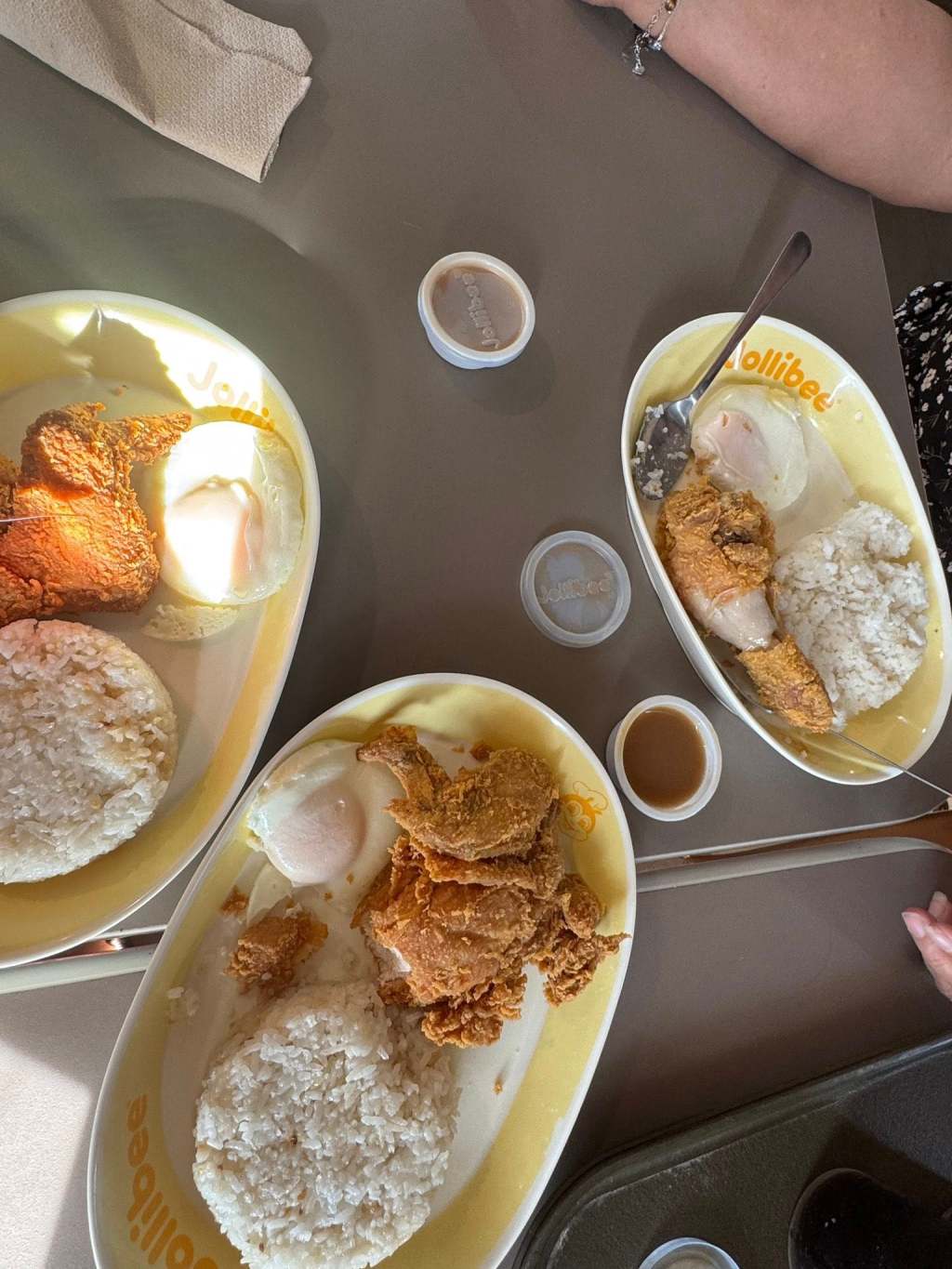
The gravy had already begun disappearing into the rice by the time I remembered I was supposed to be taking photos. Across the table, Mama was cutting into her egg, completely unconcerned with documenting the occasion. The edges were browned, the yolk still soft, exactly the way she has liked it for as long as I can remember. Jan sat beside me, occupied with his own breakfast, while somewhere behind us chairs scraped against the floor, another order was called from the counter, and every few seconds the door opened just long enough for Toledo’s morning heat to slip inside and pick a fight with the air-conditioning. In front of me sat Chickenjoy, rice and gravy. Nothing remarkable, really, except I had travelled thousands of miles for this ordinary morning.
I pulled a piece of crispy skin from the chicken and ate it before remembering that perhaps adults are supposed to possess more restraint around fried food. It cracked between my teeth, salty and oily, followed by hot rice drowned in gravy, and for a few seconds I stopped thinking altogether. There are flavours you enjoy, and then there are flavours your body seems to recognise. This was the second kind. I have eaten Jollibee outside the Philippines. Filipinos have carried it around the world with us almost as successfully as karaoke and the inability to let visitors leave the house without food. But eating it in Toledo was different. Maybe food changes according to geography. Maybe homesickness alters the taste buds. Or perhaps gravy is simply more powerful than science has so far been willing to admit. Whatever the explanation, somewhere between the chicken and my embarrassingly generous amount of gravy, Britain suddenly felt very far away.
Not dramatically far. I did not forget my life there or become overwhelmed by some grand revelation about identity. I was simply sitting in Jollibee, chewing fried chicken, when the smell of rice and gravy opened a door in my head that I had not realised was still there. Through it came a kitchen, Mama moving around somewhere behind me, garlic hitting hot oil, plates being placed on a table, the scrape of a spoon against a rice cooker, morning light entering a house where nobody was thinking yet about visas, airports, annual leave or how many kilograms an airline would permit inside a suitcase. I was younger there. Much younger. Young enough to believe mornings lasted forever and adults somehow knew what they were doing. I know better about both things now. Then somebody at the next table laughed and I was back. Mama was still eating her egg. That detail got me more than I expected. Years had passed. I had moved countries, worked endless shifts, learned unfamiliar roads, built routines somewhere else and become the sort of person who checks the weather before leaving the house because Britain has trained me through repeated betrayal. Yet Mama still liked her egg exactly the same way. There is something strangely comforting about discovering that while you were away becoming somebody else, a few small things had the decency not to change.
For years, I think I expected happiness to identify itself properly. Surely it should come with excitement, photographs, achievements, something worth announcing afterwards. But some of the happiest moments of my life would look completely unimpressive to anyone passing by. They would have seen three people eating breakfast. I saw my mother sitting in front of me instead of appearing inside a phone screen. I saw Jan beside me after thousands of miles of travelling. I tasted something I had missed without quite realising how much I had missed it. Perhaps living away from home rearranges the value of ordinary things. Maybe belonging is not always the dramatic feeling of returning somewhere. Sometimes it is simply the temporary absence of longing because, for once, what you have been missing is sitting directly in front of you.
Near our table was a bright sign that read, Toledo – The Joyful City. I had probably seen versions of slogans like it hundreds of times. Every city in the Philippines seems to have one, as though municipalities were all given a group assignment and told nobody could go home until they had produced an adjective. Joyful. Beautiful. Progressive. Something involving nature. Something involving smiles. Preferably something short enough to fit underneath a logo. But that morning, The Joyful City did not seem entirely unreasonable. Not because Toledo had somehow become perfect while I was away. Absolutely not. Toledo would shortly provide physical evidence to the contrary.
After breakfast, we wandered through streets I had known for years. The sun was already doing what Philippine sunshine does best: behaving as though it had a personal disagreement with human skin. Heat gathered quickly along my neck and arms. Motorcycles passed. Conversations drifted from shops and pavements. Somewhere, something was being repaired. Somewhere else, something probably needed repairing and had simply accepted its fate. Yet I understood all of it. The rhythm of people talking, the humour, the noise, the heat, even the inconveniences required no translation. I did not need to study the place before knowing how to exist inside it. What surprised me was how small some things looked. Roads I remembered as long were suddenly short. Buildings that had towered over my childhood had somehow become ordinary-sized. Corners that once felt far from home were only a few minutes away. For a moment I wondered whether Toledo had shrunk while I was gone. Then I realised the less interesting truth: I had grown. Childhood has terrible spatial awareness. Everything feels enormous when your legs are shorter and your world is smaller. A street can feel like an expedition. A school can become a kingdom. The distance between your house and somewhere you desperately want to go can feel roughly equivalent to crossing a continent. Years later, you return and discover that the enormous road of your memory is just… a road.
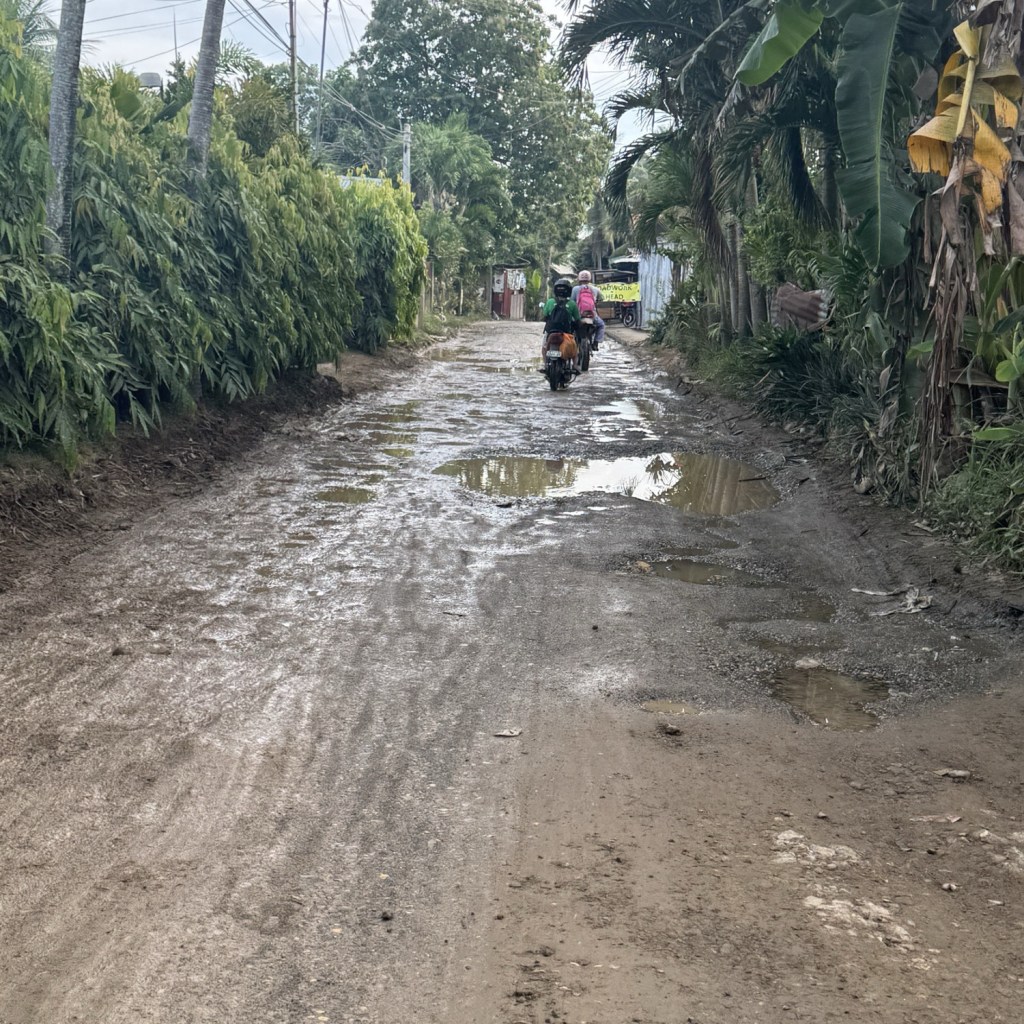
The potholes, however, had refused to participate in this shrinking phenomenon. Some appeared to have pursued professional development. They were wider, deeper and considerably more established than I remembered, as though they had spent my years abroad quietly building their portfolios. I had crossed countries, changed jobs, grown older, built a life in Britain and learned to complain about weather with reasonable fluency, while certain holes in Toledo’s roads seemed determined to remain exactly where the universe had assigned them. Some things change. Some things acquire depth.
By the time we climbed into a tricycle heading towards Awihao, the day had begun to feel different. Breakfast had been about arriving. Walking around Toledo had been about recognising. But the tricycle—that was when memory stopped behaving politely. We squeezed ourselves into the sidecar, knees immediately entering negotiations with cold metal, bags and each other. There is no elegant way to sit inside a tricycle. You simply fold whichever parts of your body are still willing to fold and trust Filipino engineering. Then the engine coughed into life. That sound. I had forgotten that sound. Not completely, perhaps. Some sounds do not disappear from memory; they simply go somewhere deeper and wait. The engine rattled beneath us, its vibration travelling through the metal frame and into my legs, and before we had gone very far I recognised the rhythm of it. The little jolts. The wind slipping through the open side. The road passing close enough that it did not feel like scenery but something travelling alongside us. Warm air rushed against my face and lifted strands of hair across my eyes. I could smell exhaust whenever another motorcycle passed, then damp earth again once it disappeared. Concrete gradually gave way to rougher roads. Houses became more scattered. Green began taking up the spaces between them. Coconut trees rose above the roofs, their leaves moving against a sky so bright I had to narrow my eyes.
Then the tricycle lurched into a pothole and my shoulder met the sidecar with enough force to remind me that nostalgia has terrible suspension. I laughed anyway. The road towards Awihao stretched ahead in patches of concrete, dirt and mud, still dark in places where rain had collected. Then came a bend, and something peculiar happened. I knew it before we reached it. There are things the mind apparently keeps without asking permission. I could not have drawn this road from memory. If somebody had handed me a blank piece of paper in Wolverhampton and asked me to sketch the way back to Awihao, I probably would have produced something resembling a confused treasure map. Yet sitting inside that rattling sidecar, my body kept recognising things half a second before my thoughts did. This turn. That tree. A house set farther from the road. A patch of green I could not explain why I remembered. Here. I know here.
The farther we travelled, the more the city loosened its grip. Houses became fewer. The spaces between them widened. Coconut trees stood above the road, and wet earth darkened its edges. Dogs barked from somewhere beyond fences, apparently reporting our movements to the entire barangay. Birds called from trees I could not see. Leaves rubbed against one another overhead. The province is never truly silent; I had simply forgotten how many things can exist inside its silence. It was nothing like the sealed quiet behind closed windows. Life leaked into everything here. I rested my arm against the metal edge of the sidecar and watched the muddy road disappear beneath us. When I was younger, I wanted roads like this to take me somewhere bigger. That thought came so suddenly I almost laughed at myself. Back then, leaving seemed like movement and staying seemed suspiciously like standing still. I wanted cities I had not seen, work I had not done, a life that existed somewhere beyond the places where people already knew my name. Eventually, I got exactly that. Airports. Britain. Hospitals. Night shifts. Independence. A life partly measured in rotas, annual leave and phone calls home arranged around an eight-hour difference.
Britain knows the adult version of me. It knows the nurse, the woman who checks rotas, pays bills, catches trains, watches the clock and carries an umbrella because experience has taught her never to negotiate with British clouds. It knows the person I became after leaving. But these roads knew me before any of that. Before uniforms and night shifts. Before airports. Before I understood that leaving home and missing home could exist inside the same person without cancelling each other out. Before “going home” became something that required annual leave, luggage allowances and months of planning. And the road did not seem particularly impressed by any of this. It simply carried on. Another pothole arrived before I could become too philosophical, which felt very Cebuano of the universe. The tricycle bounced, my bag slid against my leg, Jan adjusted himself beside me, and whatever profound thought I was preparing temporarily left my body along with my spinal alignment. I laughed again. Perhaps that is another thing I had missed—the way home can interrupt your sentimentality before you become unbearable.
Still, somewhere between the rattling engine and the coconut trees, something settled inside me. I had always imagined returning home as recognition: I would recognise the roads, the houses, the people, the flavours. I had not expected the place to recognise parts of me in return. A bend in the road seemed to know a younger version of me. A familiar smell returned a morning I had forgotten. My mother’s egg carried years inside it. Even the vibration of a tricycle engine seemed capable of reaching somewhere memory had stored without labels. Perhaps that is how home survives inside us—not as one perfect picture, but as a collection of senses stubborn enough to outlive distance. A taste. A smell. A particular quality of heat against the skin. The metallic vibration beneath your arm. The sound of leaves moving above a road you once travelled without thinking it would someday become precious.
That morning, home had tasted like Chickenjoy, hot rice and too much gravy. By afternoon, it smelled of wet earth. It sounded like a tricycle engine complaining its way over an uneven road. It felt like warm wind against my face, cold metal beneath my arm and the occasional pothole rearranging my internal organs. As the houses became farther apart and the road muddier, even the spaces between those sounds began to feel familiar. I looked ahead and realised that the road itself had changed very little compared with the person travelling on it. Once, I had wanted it to take me away. Now I was grateful that it still knew how to take me back.
Maybe that bright sign at breakfast had been right after all. Toledo was still the Joyful City. I had simply been away long enough to understand where its joy was hiding. It was never only on a sign. It was in Mama’s familiar egg, in fried chicken eaten before I remembered to photograph it, in streets that had somehow grown smaller and potholes that definitely had not, in the ridiculous folding of knees inside a tricycle, in coconut leaves moving above muddy ground. And perhaps that is why I forgot to take the photograph in the first place. Some mornings are better remembered by the tongue. Some roads, by the body. And some places do not need you to capture them at all.
By the time we reached Awihao, there was mud on our shoes, heat clinging to our clothes and enough evidence in my shoulder and lower back to confirm that the road had welcomed us personally. Nothing about the arrival was polished. There was no perfect homecoming scene waiting at the end, just familiar trees, familiar voices and a road that had apparently spent my years abroad preparing fresh potholes for my return. Strangely, I would not have wanted it any other way. Home was never supposed to be flawless. It was supposed to be recognisable. The warm rice, Mama across the table, the Chickenjoy, the tricycle, the coconut trees, the mud, the road that had once carried a younger version of me towards dreams she could not yet name—all of it belonged to the same place that knew me before the rest of the world did.
So perhaps the potholes were part of the welcome after all. A slightly aggressive welcome, admittedly, but a welcome nonetheless. I had travelled thousands of miles back to Awihao expecting to recognise home, only to discover that home had been recognising me all day: through gravy, through Mama’s familiar egg, through an engine rattle buried somewhere in memory, through a bend in the road my body remembered before my mind did, and finally through a pothole determined to make absolutely certain I was paying attention.
Welcome home.
Mind the potholes.
— Anj 🖤




































Leave a Reply