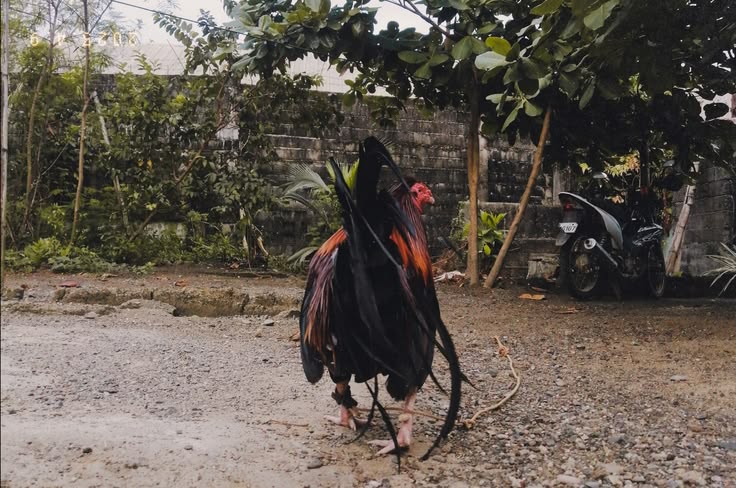
The rooster was an enthusiastic employee. It began working before sunrise, performed its duties with absolutely no regard for the sleeping population and showed extraordinary commitment to ensuring the entire neighbourhood knew it was awake. By five in the morning, it had already announced the beginning of another working day several times, which seemed rather impressive until I considered that its main contribution consisted of making noise and then wandering around as though national productivity had personally benefited from the effort.
I have never understood why roosters receive so much admiration for waking early. If a human being behaved similarly, somebody would eventually ask them to lower their voice. Still, there it was conducting its morning concert while a motorcycle started somewhere down the road, a vendor arranged vegetables beneath a makeshift shelter, a woman swept outside her house and the smell of rice drifted from a nearby kitchen.
Farther along the street, a man prepared his tricycle for another day of carrying passengers. By the time the sun had properly risen, many people were already working, some heading towards markets, farms, construction sites, shops or small businesses. Others would work until dark and then return home to another collection of unpaid responsibilities waiting inside the house.
Watching the ordinary industry of a Filipino morning made me think about a sentence I had heard in different forms over the years: “Poor people are poor because they’re lazy.” It is an astonishing conclusion, particularly when delivered by somebody sitting comfortably beneath an electric fan while discussing the supposed unwillingness of other people to work and waiting for someone else to prepare lunch.
I do not mean that laziness does not exist, because of course it does. People differ in discipline, judgement, motivation and habits regardless of income, and individual choices can absolutely affect financial circumstances. But reducing poverty primarily to laziness turns an enormously complicated condition into one convenient moral verdict.
If hard work alone guaranteed financial security, many people who begin their day before sunrise would already be wealthy. If exhaustion were a reliable measure of income, some of the richest people in society would be those returning home with aching feet and barely enough money to cover tomorrow’s expenses. Economic life, unfortunately, is not that obedient.
Working as a Community Facilitator has made me think about this more seriously because words like poverty, livelihood, opportunity and development stop behaving like tidy concepts when you begin considering how they operate in real communities. The more attention I give to the conditions surrounding people’s choices, the harder it becomes to accept explanations that require no examination of wages, access, geography, education, transport, family obligations or the kind of work actually available.
“Lazy” is appealing partly because it closes the investigation immediately. A person lacks money, therefore they must not have worked hard enough. There is no need to ask whether the wage covers basic living costs, whether employment is stable or whether the local economy offers enough reliable work in the first place.
The verdict is efficient. Poverty becomes a character flaw, the wider circumstances disappear and those who are financially comfortable can reassure themselves that their position reflects superior discipline. It is a neat story, but neatness and truth are not the same thing.
I keep returning to the difference between work and income. We often speak as though the relationship is straightforward: work harder, earn more, improve your circumstances. There is some truth in that because effort develops skills, experience can improve competence and education or training may open opportunities.
But effort is one factor, not a guarantee.
Consider a farmer who spends hours tending crops. The work may demand knowledge, patience and considerable physical endurance, yet the financial result can depend on weather, pests, transport costs, market prices, access to equipment and the terms under which the produce is sold. The farmer can work diligently and still finish the season with very little.
A market vendor presents the same problem in another form. They may begin preparing goods before many customers have even woken, transport supplies, calculate prices, manage payments and spend the day hoping enough items sell to cover the costs. A quiet market day does not magically reduce the effort already spent.
Income therefore cannot be used as a complete measure of diligence. Markets do not reward every hour of human labour equally, and wages are shaped by demand, qualifications, scarcity, bargaining power, location and the economic value assigned to particular kinds of work. Some necessary jobs remain poorly paid despite requiring exhausting effort.
Perhaps we resist this because the belief that hard work always produces prosperity gives the world a reassuring moral order. Success becomes evidence of discipline, while poverty becomes evidence of failure. The story suggests that people generally receive what they deserve, which makes life feel more controllable.
Reality is far less tidy.
Two people can work equally hard and receive different outcomes because one inherited resources while the other inherited obligations. One may live near schools, jobs and transport, while another spends considerable time and money merely reaching the same opportunities. One household can absorb an emergency through savings, while another may need to borrow after one unexpected bill.
These differences do not eliminate personal responsibility. They simply make it impossible to pretend responsibility explains everything.
This becomes especially obvious whenever somebody casually advises another person to “start a business.” The suggestion appears remarkably often, as though entrepreneurship begins the moment sufficient determination is located somewhere inside the human spirit. Unfortunately, businesses occasionally require money.
They may also require equipment, stock, transportation, customers, knowledge and the ability to survive periods when earnings are uncertain. Somebody with savings can attempt something new and regard failure as an expensive lesson, while someone whose income barely covers food, housing and school expenses may be risking the household’s entire safety net.
The difference is not necessarily courage. Sometimes it is simply the ability to survive failure.
I wonder how often people who encourage others to “take a risk” have first calculated whose money is being risked and what happens if the gamble does not work. The same opportunity can carry completely different consequences depending on what someone has available to lose.
The Filipino idea of diskarte belongs somewhere in this discussion too. I admire resourcefulness because people who stretch limited resources, improvise solutions and adapt to difficult conditions often possess extraordinary practical intelligence. But I worry when diskarte is expected to accomplish what decent wages, reliable services and genuine opportunities should make possible.
Someone cannot afford something essential, so we tell them to find a way. A worker earns very little, so we advise them to work harder. A household experiences repeated financial pressure, so survival itself becomes a test of cleverness.
That is where admiration can quietly become unfair. We celebrate people for being resilient, inventive and hardworking, then forget to ask why they must use so much ingenuity merely to maintain ordinary life. There is something admirable about making limited resources last; there is nothing inherently admirable about the absence of sufficient resources.
I think we sometimes romanticise hardship because perseverance makes a better story than structural difficulty. A child studies under poor conditions and we praise dedication, a parent works extraordinary hours and we celebrate sacrifice, or a vendor survives years of instability and we admire determination. Those reactions may be sincere, but they become incomplete when admiration is the final sentence.
The child may still need better educational resources. The parent may still deserve a livelihood that does not consume every waking hour, and the vendor may still benefit from more stable economic conditions. Strength does not cancel need.
This matters particularly when we think about the kinds of work common in low-income communities. Small-scale farming, food selling, domestic labour, repairs, transport, seasonal work and occasional construction can all require significant effort while producing inconsistent income. A rainy day may reduce customers, illness may eliminate a day’s earnings and one damaged tool may interrupt an entire livelihood.
Financial instability can be a feature of the work available rather than evidence that somebody refuses to work.
Unemployment deserves the same distinction. There is a difference between not wanting to work and being unable to obtain suitable work. Someone may possess skills for which there is little local demand, face transport costs that make a distant job barely worthwhile or carry family responsibilities that limit which working hours are possible.
These situations require different responses because “lazy” explains none of them. More useful questions concern whether jobs exist, what they pay, whether people can physically reach them, what training is required and whether the cost of working leaves enough income to make employment sustainable.
Budgeting is another area where moral judgement arrives quickly. Financial discipline matters, and avoiding unnecessary expenses can certainly help households. But the usefulness of budgeting depends heavily on whether there is anything left after necessities are paid.
Imagine a household where nearly every peso already goes towards food, transport, housing and utilities. The family may compare prices, avoid expensive purchases and carefully divide the budget, yet still struggle to save anything meaningful. Somebody looking from outside sees a snack, mobile phone load or occasional soft drink and decides that this must explain the household’s poverty.
Perhaps removing the expense would save something. It may not solve the far larger problem that essential costs already consume almost everything earned.
There is an odd double standard here. A wealthy person enjoys an expensive meal and it becomes lifestyle. A low-income worker buys a modest treat after a demanding week and suddenly it becomes evidence in a moral investigation of financial discipline.
People experiencing poverty remain human beings. They enjoy food, music, celebrations, clothing, friendships and small pleasures that make an ordinary week bearable. Limited income does not transform people into economic machines whose every peso must produce measurable future value.
Of course choices still matter. A household can make irresponsible decisions, and poor financial habits can worsen difficulty. But one visible purchase cannot explain an entire economic condition, just as one sensible decision cannot guarantee security.
Perhaps the accusation of laziness persists partly because acknowledging hardworking poverty forces us to accept something more uncomfortable: economic outcomes do not always correspond neatly with personal merit. Somebody may be successful because they worked hard, made good decisions and developed valuable skills, while also benefiting from support, opportunities or circumstances they did not create.
Recognising advantage does not insult achievement. It simply makes the explanation more accurate.
The same principle applies in reverse. A person can make considerable effort and still remain vulnerable because the conditions surrounding that effort limit what it produces. Agency and structure are not competing explanations; both can operate at the same time.
Education shows this clearly. Schooling can widen opportunities and improve employment prospects, which is why Filipino families often sacrifice heavily to keep children studying. But staying in education also depends on transportation, materials, meals, available schools, household income and time.
A young person who leaves school may regret doing so, but perhaps they began earning because younger siblings needed support. A graduate may finish successfully and still struggle to find appropriate work. Someone may accept employment below their qualifications because waiting for the ideal position is a luxury the household cannot afford.
These decisions can affect the future, but a better option existing in theory does not mean it was genuinely available in practice.
That is why I have become suspicious of the word just whenever people give financial advice. “Just move.” “Just study.” “Just save.” “Just find another job.” It is a remarkably efficient word for removing transport costs, family responsibilities, tuition fees, rent, risk and uncertainty from a sentence.
Moving is simple if we ignore the cost of moving. Studying is easy if we disregard who pays for it. Finding another job sounds straightforward if we assume suitable jobs are waiting somewhere nearby.
Advice improves when it survives contact with circumstances.
Poverty also consumes time in ways that are less visible than money. Somebody with reliable transportation may reach work quickly, while another spends hours commuting. A household with convenient access to water can complete domestic tasks efficiently, while another may spend significant time obtaining it.
A family with reliable childcare may find it easier for adults to work predictable hours. Another household may have to arrange employment around whoever is available to watch the children.
Time spent solving basic logistical problems is time unavailable for education, rest, additional work or training. A person can therefore be extremely busy and still possess very little opportunity to improve their financial position.
This becomes especially important when we recognise only paid labour as real work. A parent caring for children may appear unemployed, while an adult supporting an elderly relative may receive no wages for hours of responsibility. Household management can consume enormous amounts of time without appearing on anybody’s payslip.
Human contribution is larger than formal employment.
A household may depend on one person earning income, another preparing food and caring for children, older relatives helping where possible and different family members contributing according to circumstance. Income remains necessary, but money does not capture every form of work keeping the household functional.
Before calling someone lazy, perhaps we should ask how much labour we have failed to notice.
There are hours spent travelling, obtaining necessities, caring for relatives, searching for work and managing the constant calculations of financial uncertainty. None of those activities necessarily increases income, but they can consume most of a day.
Sometimes people who appear to be making no progress are working very hard merely to prevent life from moving backwards.
A family saves a small amount and an emergency consumes it. They start again. A worker earns extra money and a household repair becomes necessary, so the money disappears and they start again. Someone plans to pursue training, then a family responsibility becomes urgent and the opportunity is postponed.
From outside, nothing appears to change.
Inside the household, the same ground may have been defended repeatedly.
Perhaps that is one of the least visible realities of poverty. Progress is often interrupted by the need to prevent decline, and maintaining stability can require considerable discipline. Not every achievement appears as obvious upward movement.
This also helps explain why hardship can persist across generations. If most income goes towards immediate needs, little remains for savings, education, property or business investment. Unexpected costs create pressure, and children may begin adulthood carrying responsibilities before they have had time to build their own financial security.
Suggesting that several generations simply failed to work hard enough explains remarkably little.
This is where infrastructure and community development become relevant to me. A road does not make a person ambitious, but it may allow farmers to transport produce more reliably. A functioning water system does not guarantee prosperity, but it can reduce the time households spend obtaining an essential resource.
A school does not automatically create employment, but access to education can widen what becomes possible. Reliable transport does not eliminate poverty, but it can connect people with markets, services and work.
These things matter because individual effort does not occur in empty space. The conditions surrounding people influence whether effort can be converted into opportunity.
Perhaps that is what development should partly mean: not doing the work for people, but improving the conditions under which their own work has a fairer chance of producing something.
The phrase equal opportunity can hide these differences too. Two people may technically be free to apply for the same job, but one has training, reliable transport, professional guidance and enough money to wait through the recruitment process. The other may lack several of those things for reasons that began years before the vacancy appeared.
Their legal opportunity may be identical.
Their practical opportunity is not.
None of this means every unequal outcome proves injustice. People make different choices, possess different abilities and pursue different goals. But a bank balance still cannot serve as a complete biography of someone’s effort, intelligence or character.
Poverty seems to invite a level of scrutiny we rarely apply to wealth. People examine how someone dresses, what they eat, how many children they have, what they purchase and whether they appear to be working hard enough. Limited income somehow makes private decisions feel available for public judgement.
Yet financial difficulty does not remove somebody’s dignity.
A person can make imperfect decisions without deserving humiliation. They can need assistance without becoming incapable, experience unemployment without becoming morally inferior and work diligently while remaining poor.
The fact that these statements occasionally need defending tells us something about the stereotype.
I also think we misuse stories of people who overcome poverty. The successful entrepreneur, the graduate who persevered through hardship or the family that improved its circumstances over several decades can genuinely inspire. They prove change is possible.
They do not prove identical change is equally accessible to everyone.
One person’s exceptional outcome cannot become evidence against everybody whose circumstances were different. Health, timing, family responsibility, geography, available work and sheer chance all vary.
We should celebrate achievement without turning it into a weapon against people whose lives followed another route.
The same caution applies to motivational advice. “Never give up,” “work harder” and “believe in yourself” can encourage people, but motivation cannot drive someone to a job that has no transport route, pay school fees or create vacancies that do not exist.
Determination still needs somewhere to go.
Perhaps responsible hope looks different from motivational certainty. It believes people can improve their circumstances while taking seriously the barriers that make improvement difficult. It values perseverance without pretending perseverance is magic.
This brings me back to everyday judgement. Somebody sees a person sitting outside in the afternoon and concludes they are unemployed or unwilling to work. Perhaps that person finished a night shift, is waiting for transport, works seasonally or has already spent hours doing physical labour.
The observer possesses one image.
The conclusion claims an entire life.
We would hesitate to diagnose a mechanical problem after looking at a vehicle from across the road. Yet human beings occasionally feel qualified to assess a stranger’s work ethic after approximately thirty seconds of observation.
Perhaps curiosity would serve us better than certainty. Instead of asking why someone is lazy, we could ask what work is available. Instead of examining one household purchase as proof of irresponsibility, we could consider the income and expenses surrounding it.
We can believe in personal responsibility without pretending everyone exercises it under identical conditions. Those ideas are perfectly capable of existing together.
Ultimately, I think this is a matter of intellectual honesty. If we really want to understand poverty, we have to resist explanations that flatter our assumptions. We must distinguish evidence from stereotype and examine both personal decisions and the wider economic conditions surrounding them.
A complicated problem will not surrender its explanation to one insulting adjective.
The rooster, meanwhile, has enjoyed a productive public-relations campaign. By late afternoon, it has abandoned its earlier commitment to announcing the working day and wanders around the yard with the relaxed confidence of a creature whose schedule is entirely self-determined.
The vegetable vendor has been working for hours. The tricycle driver is still carrying passengers, families are preparing meals and somewhere farmers are completing whatever the day required. People are counting earnings, considering expenses and organising tomorrow.
The rooster will rise early again and announce it loudly. The neighbourhood will wake and the cycle will begin again.
There is something slightly absurd about admiring the symbol of early rising while overlooking the economic reality of people who actually begin work before dawn. The proverb tells us that the early bird catches the worm, which is useful enough as encouragement, but considerably less convincing as an economic theory.
Some worms are harder to find.
Some fields offer less.
Some birds begin with resources others have never possessed.
Hard work still matters, and I would never argue otherwise. Discipline, learning, perseverance and responsible choices can change lives. What I no longer believe is that effort operates in a world where wages, opportunities, risks and starting points are equal.
A person who works hard and remains poor is not necessarily a contradiction. They may simply be living in an economy where necessary labour is not always rewarded sufficiently to provide security.
By evening, roadside businesses begin closing. The vegetable vendor arranges what remains unsold, the tricycle driver counts the day’s earnings and families settle into homes where tomorrow’s expenses are already waiting.
I cannot know exactly what each person earned, what they owe, what they support or which plans they have postponed. I know even less about the private decisions that brought them to where they are.
That uncertainty should make me careful.
Perhaps it should make all of us careful, because before we call someone lazy, we ought to consider how little of their working life we may actually have seen. And before congratulating ourselves for understanding poverty, perhaps we should ask whether our explanation can account for the millions of people who work every day and still struggle to make enough.
The rooster has finally stopped crowing, and I must admit that I appreciate the silence. Beyond the yard, however, human work continues—less noisy, less celebrated and far more complicated than any proverb about waking early could explain.
Still looking beyond the easy verdict,
Anj





























Leave a Reply