We arrived in Nottingham expecting a straightforward city break and somehow ended up with Robin Hood, sandstone caves, medieval legends, Victorian engineering, a windmill, deer wandering across a stately park and, because apparently the city felt the story still lacked a dramatic ending, snow. Nottingham did not reveal itself like a polished postcard. It unfolded more like an old adventure novel, one chapter at a time, and by the end of the day I felt as though we had stolen a few hours from ordinary life and spent them somewhere between folklore and history.
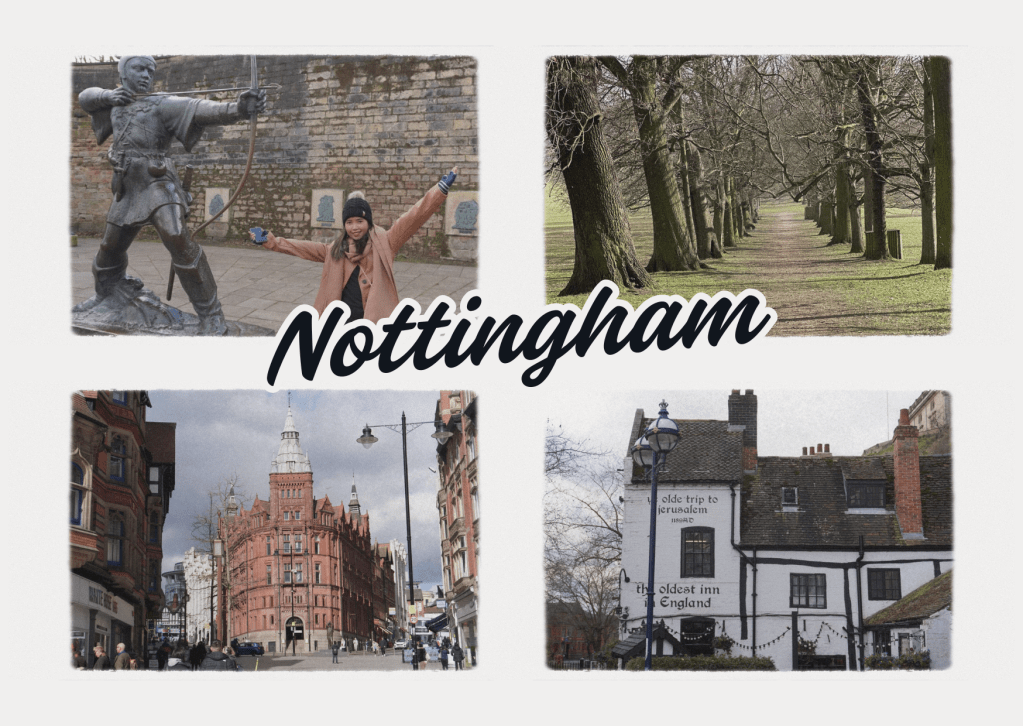
I suppose Nottingham is almost impossible to visit without thinking about Robin Hood. The outlaw is so deeply attached to the city’s identity that even if you arrive with no intention of chasing legends, he eventually finds you anyway. There is something wonderfully theatrical about exploring a city associated with a man whose résumé essentially reads: excellent archer, questionable relationship with authority, unusually generous redistribution policy. Whether one approaches him as folklore, cultural memory or simply one of England’s most persistent stories, Robin Hood gives Nottingham an extra layer of mischief, and I was more than willing to participate.
Nottingham Station: The Beginning in Brick
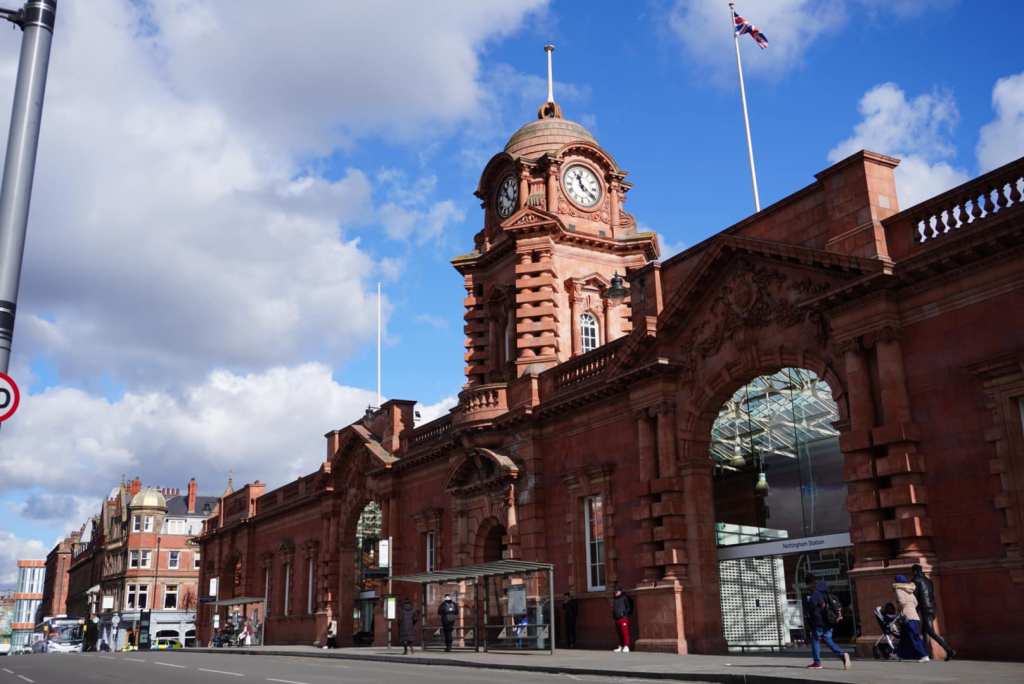
Our adventure began at Nottingham Station, which immediately gave the arrival more character than a generic platform and a hurried exit ever could. The current station dates from the early twentieth century, and its red brick, terracotta detailing and clock tower give it the kind of handsome railway architecture that makes arriving by train feel properly ceremonial. It is not merely somewhere you pass through; it looks like a building designed during an era when even catching a train apparently required architectural dignity.
Stepping outside, I immediately noticed how well Nottingham wears its brick. There are cities that introduce themselves through glass towers, others through Georgian terraces or grand stone façades, but Nottingham often seemed to speak in shades of red, rust and brown. The colour suited the March weather beautifully, especially beneath a pale grey sky that looked as though it had not yet decided whether to rain, sulk or surprise us with something more interesting.
Where Arrows and Legends Dwell
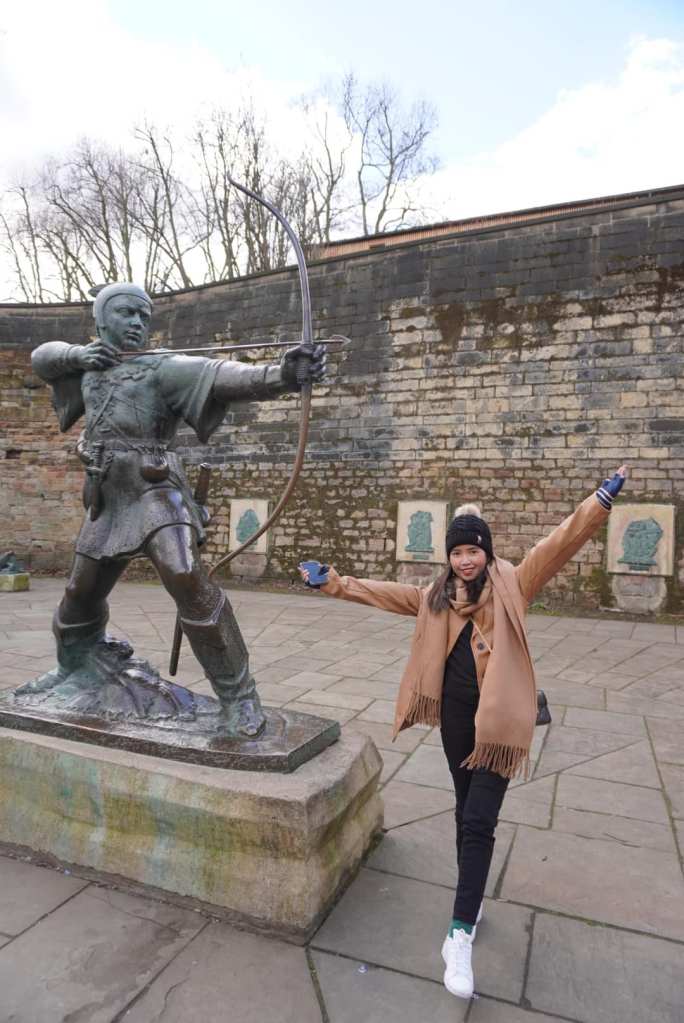
We made our way towards Nottingham Castle, where Robin Hood was waiting in bronze with considerably better posture than either of us after walking through the city. The famous statue stands just below the castle walls, bow in hand and arrow drawn, permanently ready to defend Sherwood Forest or perhaps simply pose for the millions of visitors who have attempted exactly the same stance beside him. Naturally, I joined them. There are moments in travel when dignity should be preserved, and there are moments when you absolutely must pretend to fire an imaginary arrow beside Robin Hood.
The statue has stood there since the early 1950s and has become one of Nottingham’s most recognisable symbols. Behind it rise the sandstone cliffs and walls associated with Nottingham Castle, creating a wonderfully appropriate backdrop for the city’s most famous outlaw. Legend and architecture meet almost too neatly there, and for a few minutes it becomes very easy to forget that Robin Hood belongs to a tangled mixture of medieval stories rather than a neatly documented biography.
Nottingham Castle itself is another reminder that British castles have complicated lives. The medieval fortress associated with kings, sieges and rebellion no longer survives in the form people might imagine when they hear the word castle. Much of the old structure was destroyed after the English Civil War, and a seventeenth-century ducal mansion was later built on the site. The result is fascinating because the place carries several different periods at once: medieval stronghold below the surface, aristocratic residence above it and modern museum and gallery within it.
That layering suits Nottingham. The city repeatedly asks you to look beneath the obvious version of things. Under streets are caves carved into sandstone. Behind a familiar Robin Hood story are centuries of changing folklore. Behind modern shops are buildings shaped by industry, lace and trade. Even the castle is less a single object than a stack of histories occupying the same hill.
Walking around the castle area, I found myself imagining how different the landscape must have looked centuries ago. Nottingham’s position above sandstone cliffs made the site strategically important, and from higher ground the city spreads away beneath you. The stories attached to the castle include royalty, rebellion and conflict, but standing there as an ordinary visitor with a camera, what struck me most was how casually history and modern life coexist. Cars passed below, people went about their day and somewhere nearby I was still recovering from my Robin Hood pose.
A Pint of Time: Ye Olde Trip to Jerusalem
From the castle, we descended towards one of Nottingham’s most famous institutions, although “institution” sounds far too respectable for somewhere called Ye Olde Trip to Jerusalem. The pub sits beneath the castle rock and immediately looks as though it knows several secrets it has no intention of sharing. Its whitewashed exterior leans against the sandstone beneath the castle, and parts of the interior incorporate caves cut directly into the rock.
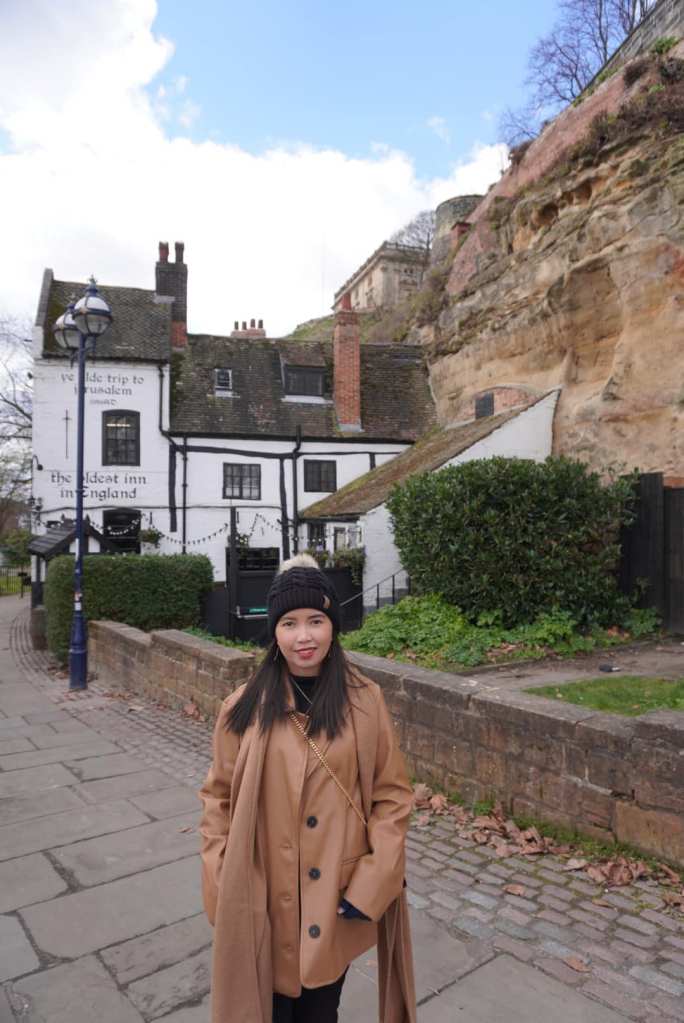
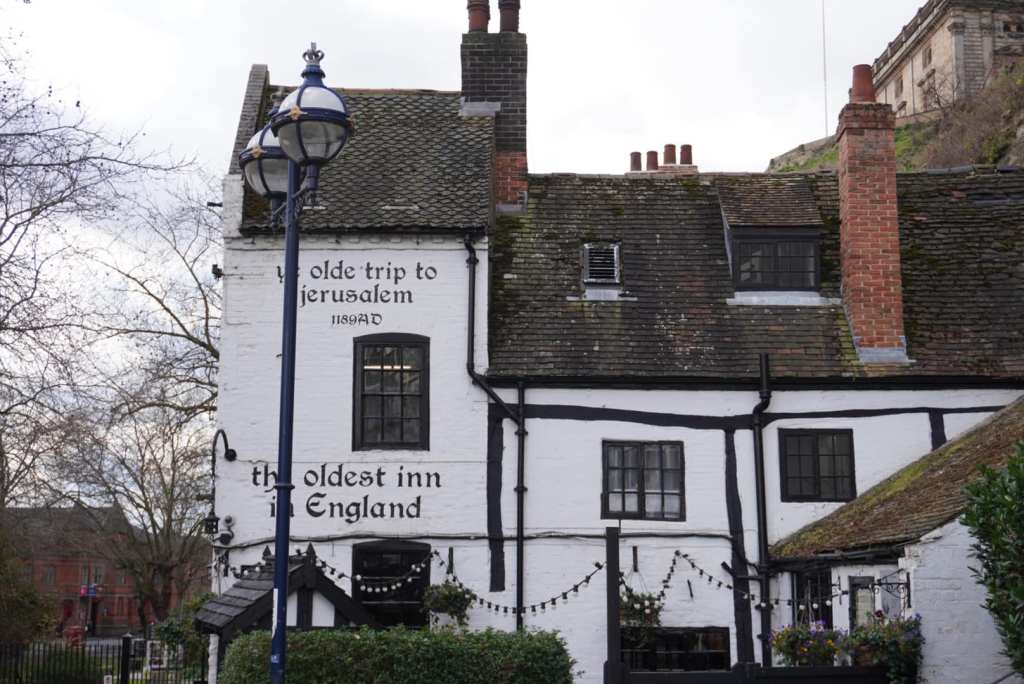
The Trip famously displays the year 1189 and is often described as one of the oldest inns in England, although, like many ancient-pub claims, the precise history is more complicated than the sign suggests. I actually like the ambiguity. A building does not need an uncontested certificate declaring it the oldest thing in the country before it becomes interesting, particularly when you are standing inside rooms that seem to disappear into sandstone.
Inside, low ceilings, old wood, irregular walls and dim corners create exactly the atmosphere its name promises. It feels less like entering an ordinary pub and more like finding somewhere medieval travellers might have stopped before continuing on a dangerous quest, except now the quest probably involves finding the toilets and deciding whose round it is. Tradition links the inn’s name with pilgrims and crusaders travelling towards Jerusalem, and although history and legend overlap liberally around the place, the caves and age of the site make the atmosphere convincing enough.
We did not settle in for a proper pint, but even standing there was memorable. I kept looking at the rock around us and thinking about how strange it is to drink inside part of a cliff. Modern architecture spends enormous amounts of money trying to create interesting interiors; Nottingham apparently looked at a sandstone hill centuries ago and said, That will do.
The Red City & Whispers of Windmills
Emerging again into daylight felt almost like returning from a different century. Nottingham city centre brought us back to movement, shops, streets and the ordinary business of a modern city, but even there history kept interrupting. Victorian and Edwardian façades appeared between newer buildings, and brick warehouses hinted at another important chapter of Nottingham’s story: lace.
The Lace Market was one of the areas I particularly wanted to see because its name alone sounds as though everybody should be wearing gloves and discussing inheritance. In reality, it is a historic district shaped by Nottingham’s nineteenth-century lace trade, with handsome brick warehouses and former factories lining streets that once belonged to merchants, designers and manufacturers. Nottingham became internationally associated with machine-made lace, and much of the district developed around businesses that finished, displayed and sold the material produced across the city.
The buildings give the area a distinct personality. Tall windows once needed to bring light into working spaces now make the old warehouses feel surprisingly elegant. Red brick, decorative stonework and narrow streets create something industrial without being ugly, which made me appreciate how much of Nottingham’s visual character came from work rather than royalty. This was not history constructed for tourists. People earned livelihoods inside these buildings long before anyone considered photographing them for a travel blog.
That is one of the things I enjoy most about British cities. One minute you are standing beside a castle thinking about medieval kings, and fifteen minutes later you are looking at a warehouse thinking about lace machines. History refuses to stay in one category. Politics, architecture, industry, ordinary households and completely ridiculous legends all overlap until the city begins to resemble a family group chat that has been running for several centuries.
Nottingham also has a strange geological secret beneath all that brick. The city sits on soft sandstone, and hundreds of man-made caves exist beneath streets and buildings. They have served different purposes across centuries, from storage and industry to shelter. Once you know they are there, Nottingham begins to feel slightly different, because every ordinary pavement suddenly raises the possibility that another version of the city exists underneath your feet.
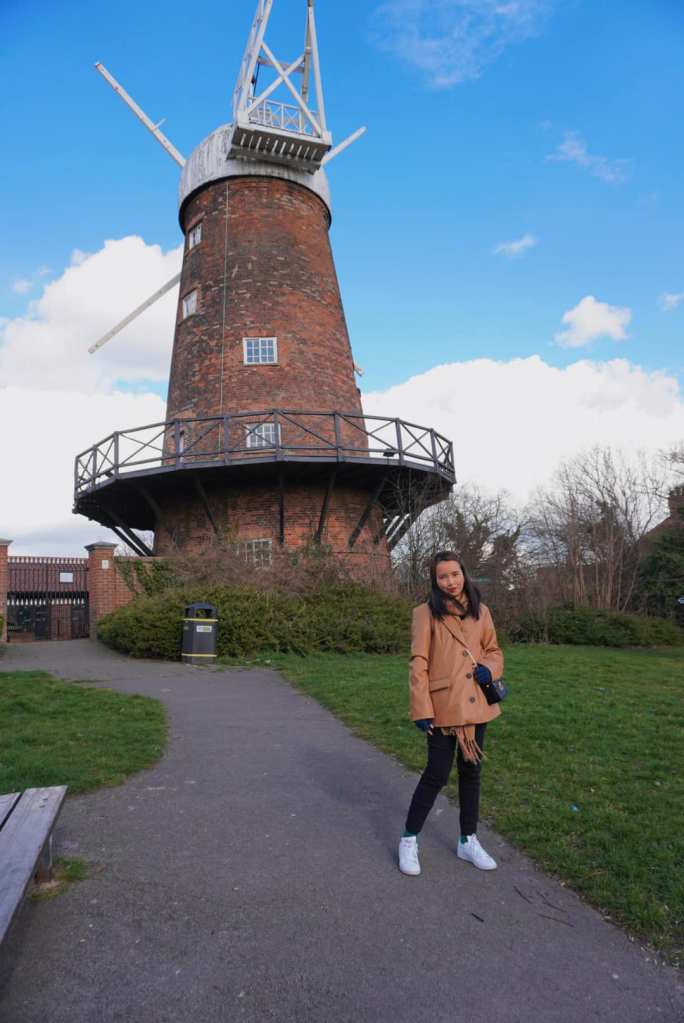
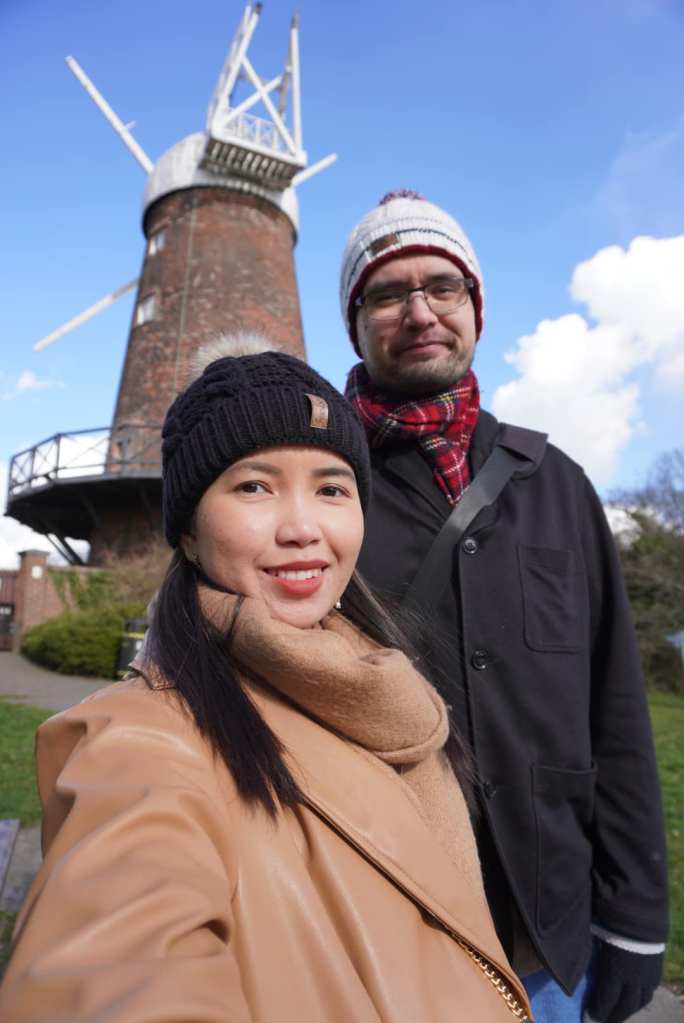
Later, our route took us somewhere completely different again: Green’s Windmill. By this point I had stopped expecting Nottingham to maintain a consistent theme. We had gone from outlaw folklore to castles, ancient pubs and lace warehouses, and now apparently mathematics required a windmill.
Green’s Windmill stands in Sneinton and is connected with George Green, the Nottingham-born mathematical physicist whose work would later become important in mathematics and physics. His father built the original windmill in the early nineteenth century, and Green himself worked there while pursuing mathematics largely outside the conventional academic route of the time. That story made the building much more interesting to me because it complicates the image of where intellectual work comes from. Sometimes important equations apparently begin beside flour.
The restored tower windmill rises above the surrounding area with large sails against the sky, and there is something wonderfully unlikely about finding a scientific heritage centre inside and around it. It was the kind of attraction I probably would not have predicted before the trip, yet those unexpected stops often make a city feel more complete. Nottingham was refusing to be reduced to Robin Hood, although Robin would almost certainly have approved of us wandering around without paying attention to a sensible itinerary.
Of Deer, Bare Trees, and Surprise Snowfall
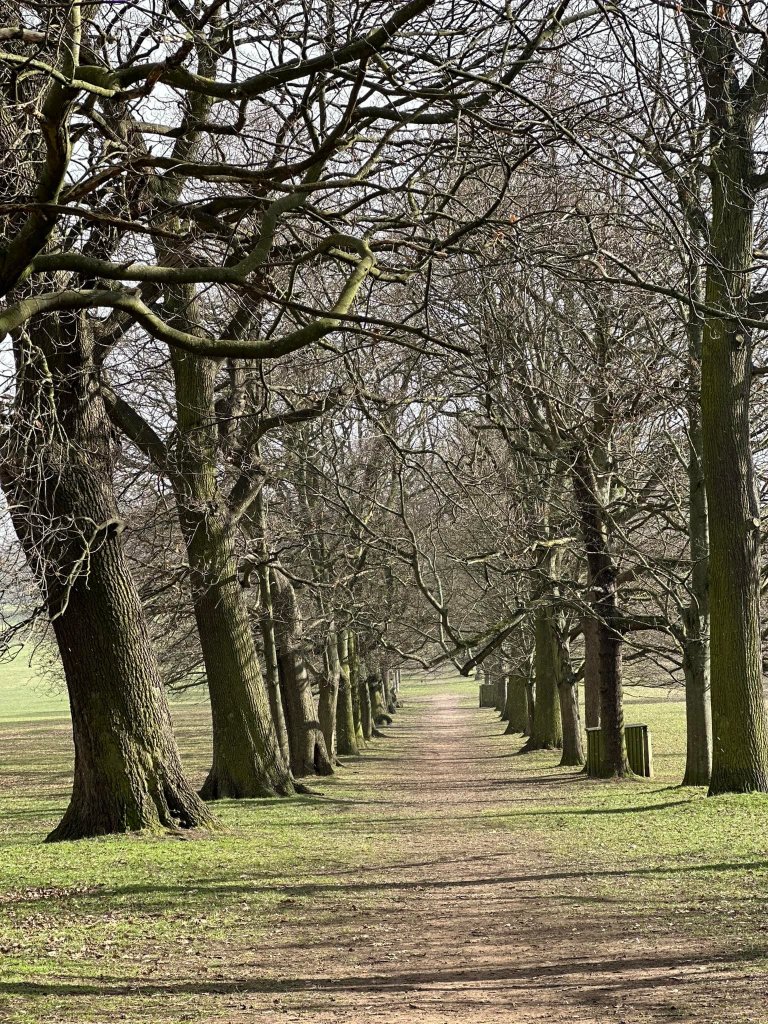
By late afternoon, we made our way to Wollaton Park, and once again the scenery changed completely. After brick, sandstone and city streets, the park opened around us in wide stretches of grass, bare March trees and long sightlines. At its centre stands Wollaton Hall, an Elizabethan mansion built in the sixteenth century, grand enough to look like somebody had accidentally placed a stately home inside a deer park and then decided not to correct the mistake.
Wollaton Hall is striking even from a distance. Pale stone rises above the grounds with towers, decorative details and the kind of symmetrical grandeur that makes you immediately wonder how many rooms a person truly needs before architecture becomes showing off. Film fans may also recognise the building as Wayne Manor from The Dark Knight Rises, which meant that somewhere between Robin Hood and Batman our Nottingham trip had apparently developed a superhero subplot.
The real stars of the park that afternoon, however, were the deer. Wollaton Park is home to herds of red and fallow deer that roam the grounds, and seeing them in the open landscape gave the place an entirely different atmosphere. They were not performing for us, obviously. They were simply existing with the relaxed confidence of animals who know the park belongs to them and that humans are merely visiting with cameras.
The trees were still bare, their branches stretched across the grey sky, and the grass held that muted green of late winter rather than the bright colour of spring. I remember tightening my scarf and watching the deer resting across the landscape, thinking how well the season suited the place. Summer might have made everything prettier in the obvious sense, but March gave Wollaton a kind of restrained beauty: skeletal trees, cold air, open grass and a house that looked dramatic against the clouds.


Then Nottingham delivered its final plot twist.
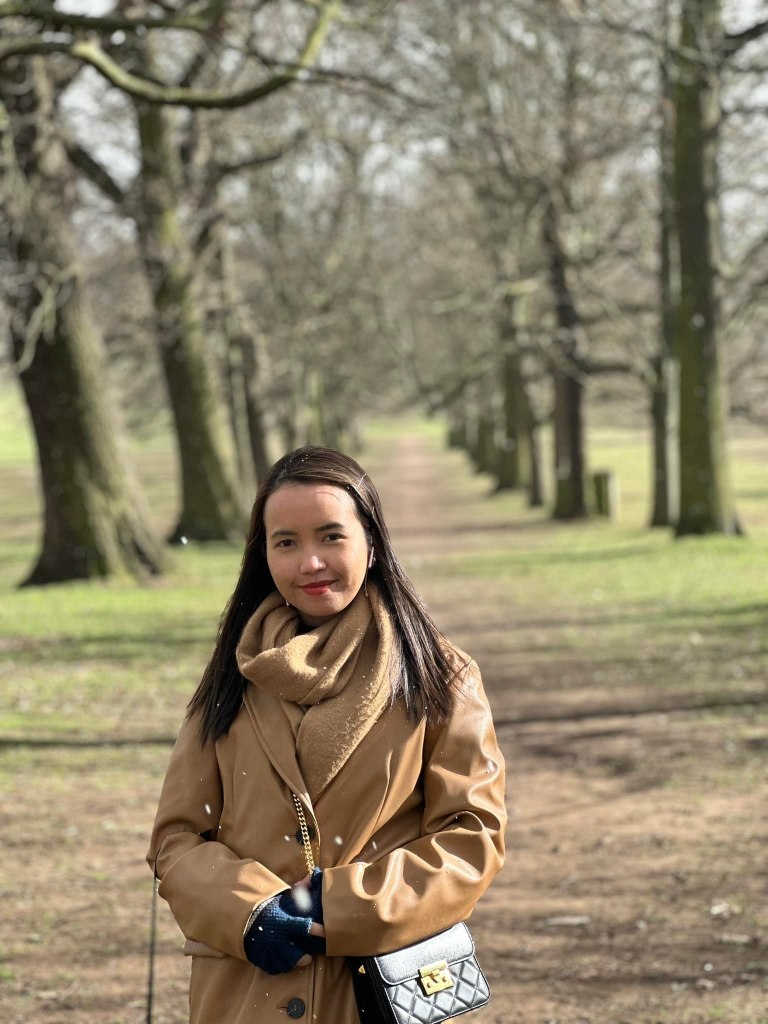
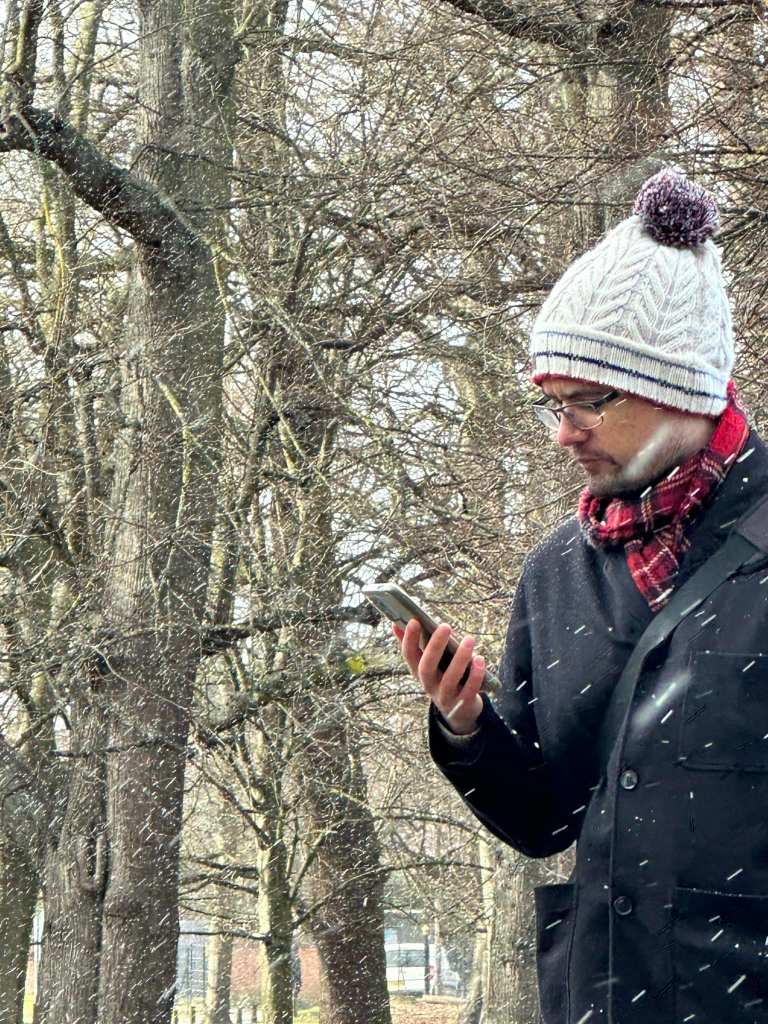
Snow began to fall. At first there were only a few flakes, sparse enough that we were not entirely sure whether we had imagined them. Then more appeared, floating through the cold air and settling briefly against coats and hair before melting. March snow in England is not impossible, of course, but knowing something can happen and actually standing inside it are completely different experiences.
The timing made it feel almost suspiciously deliberate. We had spent the day following a legendary outlaw, walking through centuries of history, standing inside sandstone caves, visiting a windmill and watching deer beneath bare trees. Apparently Nottingham reviewed the itinerary, decided subtlety had already failed and ordered snow for the closing scene.
I loved it.
The flakes caught in my hair and landed against my coat while the park gradually seemed even quieter.. There was no blizzard, nobody disappeared into an enchanted forest and Robin Hood did not emerge from behind a tree carrying hot chocolate. It was simply snow falling over Wollaton Park while deer remained magnificently uninterested in our excitement.
And somehow that was enough.
What I Learned
Travel has taught me that the moments I remember most clearly are rarely the ones I could have planned perfectly. I remember landmarks, certainly, but memory has a strange editing process. It keeps the unexpected joke, the wrong turn, the weather change, the thing somebody said while walking between attractions. The official destination becomes background while one small unscheduled moment moves into the foreground.
That afternoon, the snow became the punctuation mark at the end of Nottingham.
I also liked how appropriate it felt for a city built around stories. Robin Hood is ultimately a story that changed every time people retold it. Nottingham Castle contains several versions of itself layered across centuries. The Lace Market transformed from industrial centre into a district with a different modern life. Green’s Windmill carries a mathematician’s story alongside its machinery. Wollaton Hall has been an Elizabethan house and, for a few minutes of cinema, Batman’s home. Nottingham seemed full of places that had acquired new meanings without completely losing the old ones.
Maybe that is why the city felt more interesting than I had expected. Nottingham is not simply a Robin Hood theme park dressed in green tights, although the outlaw certainly receives excellent branding. Its character comes from contradiction. Medieval legend sits beside industrial heritage. A castle stands above caves. Mathematics lives inside a windmill. An aristocratic mansion shares its grounds with deer, and a March afternoon can suddenly decide it would rather be winter.
Looking back at the photographs, I can see how much ground we covered, but I mostly remember the personality of the day. I remember Nottingham Station announcing the city in red brick. I remember pretending I possessed archery skills beside Robin Hood. I remember the strangely comforting darkness inside Ye Olde Trip to Jerusalem, the old warehouses of the Lace Market and the unlikely combination of mathematics and milling at Green’s Windmill.
There is a temptation when travelling to treat a destination like something to complete. We make lists, collect photographs and quietly congratulate ourselves when enough landmarks have been checked off. I do this too because apparently I am incapable of visiting anywhere without turning my camera roll into evidence for a minor documentary.
The city also made me appreciate how much I still enjoy learning while travelling. I like arriving somewhere and finding out why a building looks the way it does, what happened on a particular hill or why an ordinary neighbourhood carries an unusual name. Perhaps that is the slightly nerdy part of my personality refusing to take annual leave. Give me a historical plaque and suddenly everybody travelling with me has unknowingly enrolled in an informal lecture.
Luckily, Nottingham rewards curiosity.
You can come for Robin Hood and leave thinking about caves, lace, mathematics, industrial history, architecture and deer. And Batman. We must not forget Batman.
By the time we finally left, my nose was cold, my feet had accumulated the usual consequences of my inability to travel at a reasonable pace and my camera contained approximately enough photographs to suggest we had been in Nottingham for a fortnight rather than a day. Yet I felt satisfied in that particular way a good day trip produces, when tiredness feels less like exhaustion and more like evidence that you actually went somewhere.
Nottingham had given us history without feeling like a history lesson.
It had given us folklore without requiring us to believe every legend literally. It had given us architecture, engineering, nature and enough odd combinations to keep the day unpredictable. Most importantly, it had given us a story.
Perhaps that is why Robin Hood makes such an appropriate figure for the city after all. His legend survived because stories like movement. They travel between generations, change slightly in each telling and collect new meanings as they go. A city works similarly. Every visitor arrives, notices different things and leaves carrying a different Nottingham home.
Mine contains a bronze outlaw, a castle that is more complicated than it looks, a pub disappearing into a cliff, warehouses built on lace, a mathematician’s windmill, Batman’s house, extremely photogenic deer and snow that arrived just before the credits.
Not bad for one March day.
If I ever return, I am sure Nottingham will show me another version of itself. Perhaps next time Sherwood Forest deserves its own chapter, if only so I can continue pretending my complete lack of archery training is merely a temporary setback. Until then, I will keep this version exactly as it happened: cold, curious, slightly ridiculous and unexpectedly magical.
We went looking for Nottingham. Somewhere along the way, the outlaw stole the itinerary. And I am rather glad he did.
With love,
Anj ♥




















Leave a Reply