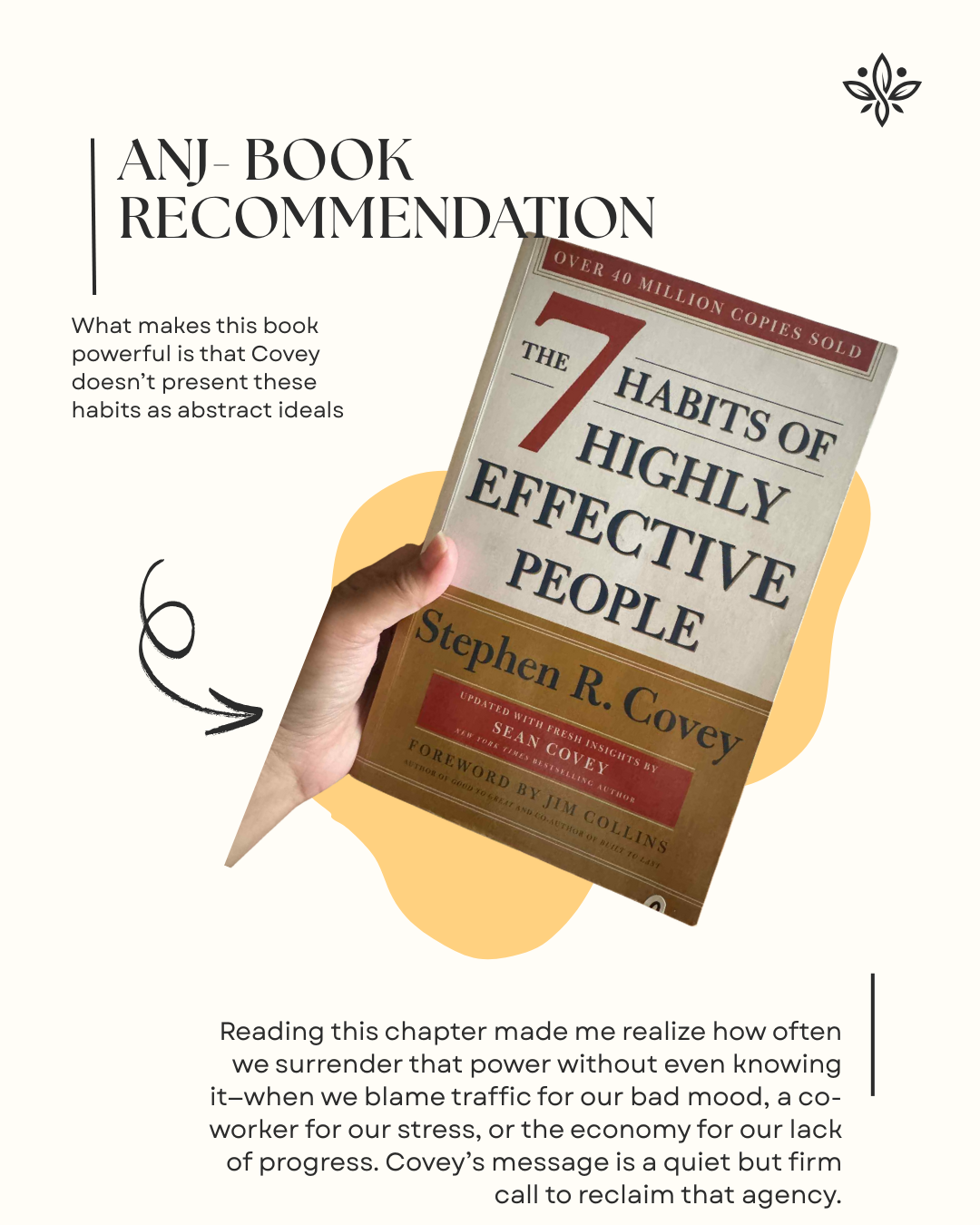
By Stephen R. Covey
Rating: ★★★★☆ (4.5/5)
Category: Book Reviews | Personal Development | Life Lessons
“The key is not to prioritize what’s on your schedule, but to schedule your priorities.”
— Stephen R. Covey
There is a peculiar satisfaction in writing a to-do list. You sit down with a pen, arrange your responsibilities into tidy little lines, and briefly experience the comforting illusion that your life is under control. The laundry has its place. The emails have their place. Even your existential concerns can be postponed until Thursday, provided you have remembered to leave sufficient space in the diary. By the time the list is complete, you feel astonishingly productive, despite having accomplished absolutely nothing beyond documenting the evidence of your own impending exhaustion.
I have always found this contradiction amusing. We spend so much time trying to organise our lives that we sometimes forget to examine the lives we are organising. We measure our days in completed tasks, congratulate ourselves for being busy, and occasionally confuse an overflowing calendar with a meaningful existence. Adulthood, it seems, comes with an impressive amount of administration and very little instruction on what any of it is supposed to achieve.
This was the thought that accompanied me through Stephen R. Covey’s The 7 Habits of Highly Effective People, a book whose title sounds suspiciously like an invitation to discover everything I have been doing wrong.
Seven habits seemed manageable enough. I was already practising several habits quite successfully, although I suspected overthinking, procrastinating on household chores, and checking the weather before deciding whether to leave the house were unlikely to appear among Covey’s recommendations.
What I found instead was a book less interested in helping me squeeze another three tasks into my afternoon than in asking whether those tasks deserved my attention in the first place. An important distinction, as it turns out, and one that makes productivity considerably more philosophical than I had anticipated.


What the Book Is About
First published in 1989, The 7 Habits of Highly Effective People is one of the most influential books in personal development and leadership literature. Covey proposes a principle-centred approach to personal and professional effectiveness, arguing that genuine success depends upon character, integrity, responsibility, and the ability to build meaningful relationships.
Unlike self-help books that promise extraordinary results through a handful of convenient shortcuts, Covey asks readers to examine the foundations of their behaviour. His central argument is that lasting improvement begins with our values and perceptions before it becomes visible in our actions. In other words, buying a beautiful planner will not automatically transform you into an organised person. An unfortunate revelation for those of us who remain convinced that sufficiently attractive stationery can solve almost anything.
The seven habits follow a deliberate progression. The first three concern personal responsibility and self-management, which Covey calls Private Victory. The next three address relationships, communication, and cooperation, collectively described as Public Victory. The seventh focuses on renewal and maintaining the physical, mental, social, and spiritual resources necessary for sustained effectiveness.
What makes this structure compelling is its recognition that personal success cannot be separated entirely from the way we treat other people. Covey does not define effectiveness simply as achievement, wealth, or professional advancement. His philosophy also considers trust, relationships, purpose, and the long-term consequences of our decisions. This broader definition gives the book considerably more substance than its rather corporate-sounding title initially suggests.
The Habits That Made Me Think Twice
1. Be Proactive: The World Does Not Require My Opinion on Everything
The first habit concerns responsibility, particularly the distinction between what we can influence and what lies beyond our control. Covey introduces the concepts of the Circle of Concern and the Circle of Influence, encouraging readers to direct their energy towards situations where their actions can genuinely make a difference.
I found this particularly relevant because human beings have a remarkable capacity to become emotionally invested in matters over which they possess absolutely no authority. We worry about the future, revisit conversations that ended three days ago, speculate about other people’s intentions, and sometimes construct entire imaginary arguments in which we deliver exceptionally articulate responses. Naturally, our imaginary opponents are left speechless. Reality is rarely so cooperative.
What I appreciate about this habit is its invitation to distinguish concern from useful action. It does not mean becoming indifferent to difficulties or pretending that every situation can be resolved through positive thinking. External circumstances, including illness, social inequalities, and institutional constraints, can significantly affect what people are able to do. But within those limitations, recognising our available choices can prevent us from wasting energy on endless frustration.
Working in nursing has made this distinction particularly meaningful. Healthcare involves uncertainty, competing demands, and circumstances that cannot always be controlled. Professional responsibility requires us to recognise what is within our competence and influence, respond appropriately, and work collaboratively when a situation demands more than any one individual can provide.
The lesson, for me, was about using attention more deliberately. Not every inconvenience deserves an emotional investment, and not every problem becomes easier because I have spent the entire evening thinking about it.
2. Begin with the End in Mind: What Exactly Am I Working Towards?
This habit invites readers to define success according to their deepest values rather than simply following society’s conventional measures of achievement.
I found myself considering how often life becomes a sequence of milestones. Finish studying. Establish a career. Become financially secure. Achieve the next qualification. Plan the next chapter. There is usually another destination waiting beyond the one we have just reached, accompanied by the unsettling suggestion that we should already be preparing for it.
Ambition has its place, of course. I value education, personal growth, and the satisfaction of working towards something meaningful. But I also recognise how easily achievement can become an endless pursuit in which we spend more time preparing to live than actually living.
Covey’s argument encouraged me to think more carefully about the difference between having goals and having direction. A goal tells us what we want to accomplish. A sense of purpose helps explain why we believe it matters.
For someone who enjoys writing, this distinction is especially interesting. I could measure my blog through statistics, readership, and the number of articles published. Those figures may be useful, but they cannot completely explain why I write. Much of my enjoyment comes from observing people, examining ideas, preserving experiences, and attempting to make sense of the curious behaviour of human beings, myself included.
Sometimes the value of something lies in the experience of doing it rather than in the applause it receives afterwards.
3. Put First Things First: The Tyranny of the Urgent
Of all Covey’s principles, this may be one of the most immediately useful. He distinguishes between activities that are urgent and those that are important, arguing that effectiveness requires us to give adequate attention to meaningful priorities before they become emergencies.
The idea sounds almost embarrassingly obvious until we examine how much of everyday life is governed by whichever task makes the greatest demand upon our attention.
An email arrives, and we respond. A notification appears, and we investigate. Someone asks for something, and we rearrange our schedule. Meanwhile, activities that sustain us over the longer term—learning, meaningful conversations, creative work, and proper rest—quietly wait for an opportunity that never seems to arrive.
The book made me consider how easily I can devote an entire day to completing responsibilities while postponing something I genuinely wanted to do. It is a curious form of efficiency, completing everything except the activities that made the day worth looking forward to.
That said, I think Covey’s approach requires flexibility. A hospital shift, for instance, cannot be organised entirely according to a personal productivity matrix. Clinical urgency matters, and priorities can change rapidly. But outside those immediate demands, his framework offers a practical way of examining how we distribute our limited time and energy.
Perhaps the real challenge is learning that prioritisation is not simply about deciding what deserves attention. It also involves accepting that some things will have to wait.
And for people who enjoy ticking every box on a list, that can be a surprisingly difficult lesson.
4. Seek First to Understand, Then to Be Understood: The Lost Art of Listening
If I were choosing one habit that deserves particular attention in our increasingly opinionated world, this would be it.
Covey argues that effective communication requires genuine understanding before attempting to persuade, advise, or explain. He distinguishes empathetic listening from the common habit of listening primarily to prepare our own response.
I suspect most of us have encountered conversations in which the other person appears to be listening but is actually waiting for a suitable opportunity to resume speaking. Occasionally, we may even have been that person ourselves. A deeply inconvenient possibility, particularly if we have always considered ourselves excellent conversationalists.
What makes this habit interesting is that it addresses something fundamental about human behaviour. We interpret other people’s experiences through our own assumptions, preferences, and histories. We may hear their words accurately while misunderstanding what those words mean to them.
In nursing, listening has implications beyond courtesy. Understanding a patient’s concerns, expectations, and perspective contributes to person-centred care and effective communication. It also requires professional judgment; empathy must accompany accurate assessment and appropriate clinical action.
Outside work, the same principle applies to friendships, family, and everyday relationships. People do not always need immediate advice. Sometimes they want their experience to be understood before solutions are considered.
I particularly appreciate that Covey treats listening as an active skill rather than a passive courtesy. It requires attention, curiosity, and a willingness to discover that our initial interpretation might be wrong.
A rather humbling requirement for those of us who enjoy being right.
The Other Habits Worth Remembering
Although the four principles above particularly interested me, the remaining habits complete Covey’s broader philosophy.
Think Win-Win challenges the assumption that success must come at another person’s expense. Covey encourages cooperation based on mutual respect and shared benefit. I appreciate the intention, although real situations do not always permit outcomes that satisfy everyone. Some disagreements involve incompatible interests, difficult compromises, or decisions that must be made despite opposition. Nevertheless, approaching people as collaborators rather than automatic competitors is a valuable starting point.
Synergize develops this idea further by exploring how different perspectives can produce better outcomes through cooperation. I found this relevant to multidisciplinary healthcare, where different professional backgrounds contribute distinct forms of knowledge and expertise. The principle is persuasive, although collaboration requires more than simply assembling people with different opinions. Without effective communication and mutual respect, diversity of perspective can become a remarkably efficient way of prolonging a meeting.
Finally, Sharpen the Saw concerns continuous renewal. Covey encourages readers to maintain their physical, mental, social-emotional, and spiritual well-being rather than allowing constant demands to deplete those resources. This chapter offers an important counterbalance to the rest of the book. Effectiveness, after all, becomes rather difficult when we treat ourselves as machines capable of operating indefinitely without maintenance.
I found this particularly refreshing in a genre frequently associated with relentless ambition. There is wisdom in recognising that rest, reflection, relationships, and personal interests are essential parts of a meaningful life, rather than rewards to be enjoyed only after every responsibility has been completed.
Unfortunately, life has an irritating habit of producing new responsibilities faster than we can finish the old ones. Waiting until absolutely everything is done before allowing ourselves to rest could therefore become a lifelong administrative error.
What I Loved Most About the Book
What I appreciate most about Covey’s writing is his insistence that character matters more than appearance. In a culture where success is often represented through accomplishments, status, and carefully curated public identities, his emphasis on personal integrity offers a useful alternative.
The book invites readers to examine whether their decisions reflect the values they claim to hold. That question reaches beyond professional development and into the ordinary details of everyday life. How do we respond when frustrated? Are we fair when nobody is watching? Do we listen when someone disagrees with us? Are we giving our attention to things that genuinely matter?
I also like that the habits are connected rather than presented as seven unrelated tricks. Personal responsibility influences prioritisation. Prioritisation supports purposeful action. Understanding others contributes to cooperation. Renewal sustains the capacity to continue practising everything else.
The book’s strongest quality is this coherent framework. Covey is not simply offering advice about organising a diary or managing workplace relationships. He is proposing a philosophy in which effectiveness involves the relationship between personal values, daily behaviour, and human connections.
A meaningful life cannot be measured entirely by how much we accomplish; we also have to consider what our accomplishments are costing us and whom they are meant to serve.
That is the idea I found most valuable, particularly as someone balancing professional responsibilities with personal interests, relationships, and creative pursuits.
Where the Book Falls Short
Despite its considerable strengths, The 7 Habits of Highly Effective People is not necessarily an effortless read.
Covey’s prose can be repetitive, and some explanations take longer than necessary to establish a principle that has already become clear. His use of business terminology, conceptual frameworks, and extended examples occasionally makes the book feel closer to a leadership seminar than a reflective conversation.
The examples are also rooted partly in the professional and social environment in which the book was written. Although the principles remain relevant, certain scenarios may feel less immediately relatable to readers whose experiences differ from the corporate and managerial settings often discussed.
I also think the book places considerable emphasis on individual responsibility. While personal agency is important, it exists alongside circumstances that people cannot simply overcome through improved attitudes or stronger habits. Financial insecurity, difficult working conditions, health problems, and unequal access to opportunities are not failures of personal effectiveness.
Furthermore, Covey presents his seven habits as a cohesive philosophy, but readers should distinguish between a useful conceptual framework and a scientifically validated formula capable of producing predictable results for everyone.
These reservations do not invalidate the book’s insights. They simply remind me to approach personal development literature with curiosity rather than unquestioning agreement.
Good advice becomes more useful when we understand both its possibilities and its limits.
My Personal Reflection: Effectiveness Is Not the Same as Having Everything Together
Reading this book encouraged me to reconsider what I mean when I describe somebody as successful.
We often admire people who appear exceptionally disciplined, financially accomplished, professionally respected, or consistently productive. There is nothing wrong with appreciating these qualities, but they reveal only part of a person’s life.
I have become increasingly interested in the less visible measures of success: the quality of our relationships, the ability to maintain perspective during difficult circumstances, the willingness to learn, and the freedom to pursue things simply because they bring us satisfaction.
I want to remain ambitious without allowing ambition to consume everything else. I want to take my responsibilities seriously without treating every unfinished task as evidence of personal inadequacy. I want to keep learning, writing, travelling, enjoying ordinary experiences, and making time for the people who matter to me.
Covey’s book does not provide an effortless way to achieve that balance. In fact, its philosophy requires considerable reflection and practice. But it offers a vocabulary for examining the choices through which our everyday lives gradually take shape.
Perhaps that is why I appreciate books about personal development most when they encourage reflection rather than demand reinvention. I am not particularly interested in becoming a completely different person every time I finish a book. I would rather become more thoughtful about the person I already am and more deliberate about the person I hope to become.
There is something rather exhausting about the modern expectation that we should constantly be upgrading ourselves. Human beings are not mobile applications, and I would prefer not to receive a notification announcing that my personality requires another compulsory update.
Improvement matters, certainly. But so does contentment.
And I think the best personal development books should leave room for both.
My Final Verdict: Is It Worth Reading?
Rating: ★★★★☆ (4.5/5)
I would recommend The 7 Habits of Highly Effective People to readers who enjoy examining human behaviour, personal values, communication, leadership, and the relationship between ambition and a meaningful life.
Its greatest strength is the way it connects individual responsibility with interpersonal effectiveness. Rather than treating success as a purely personal achievement, Covey acknowledges that the quality of our relationships and the principles guiding our actions matter just as much as the goals we accomplish.
I would particularly recommend it to students, healthcare professionals, people in leadership positions, and anyone trying to establish a more deliberate approach to their priorities. Its ideas are broad enough to be applied across different professions and stages of life, although readers will need to interpret them according to their own circumstances.
My principal criticism concerns the occasionally lengthy explanations and dated examples. Readers seeking a concise, contemporary productivity guide may find its style demanding. Those willing to engage with its philosophy, however, will discover more substance than the title initially suggests.
For me, the book earns its rating through the durability of its central ideas, the coherence of its framework, and its ability to encourage meaningful self-examination.
It is not a magical instruction manual for becoming successful. Fortunately, I have yet to encounter one, although the publishing industry remains admirably committed to suggesting otherwise.
It is, however, a worthwhile reminder that the habits shaping our lives deserve as much attention as the ambitions occupying our thoughts.
Would I Recommend It?
Yes, particularly if you are interested in personal growth that extends beyond productivity. It is worth reading if you want to improve your decision-making, reconsider your priorities, communicate more thoughtfully, or explore what meaningful success looks like beyond professional accomplishments.
Best read when: You have the time and patience to reflect on its ideas rather than rush through all seven habits in pursuit of immediate transformation. I would recommend keeping a notebook nearby, although I accept no responsibility if purchasing the notebook becomes an elaborate form of procrastination.
The thought I would take away: Being effective is not about filling every hour with something useful. It is about developing the judgment to recognise which things are worth giving our hours to.
The Last Word
I began this review with a to-do list, that familiar little collection of obligations masquerading as a plan for a successful life. And after reading Covey, I am forced to admit that I still rather enjoy writing them. There is a certain reassurance in seeing responsibilities arranged neatly on paper, preferably accompanied by a decent pen and a cup of coffee.
But I have become more interested in what happens before the list is written. Why do particular tasks matter? Whose expectations am I trying to meet? What am I neglecting while attending to everything else? And, perhaps most importantly, will completing these responsibilities bring me any closer to the sort of life I actually want?
I doubt that reading one book will suddenly make me immune to distraction, procrastination, or the occasional questionable decision. I remain an ordinary human being, with all the accompanying inconsistencies and a remarkable capacity to become busy doing something entirely unrelated to my original intentions.
Nevertheless, Covey has given me a useful reason to reconsider the relationship between activity and purpose.
Tomorrow, I will probably make another to-do list. I will arrange the tasks, establish the priorities, and experience that familiar little satisfaction of having everything organised before the day has properly begun.
This time, however, I might leave some space between the lines.
Not for another task, but for the life that is supposed to be happening around them.
Yours in unfinished lists and continuing education,
Anj



Leave a Reply