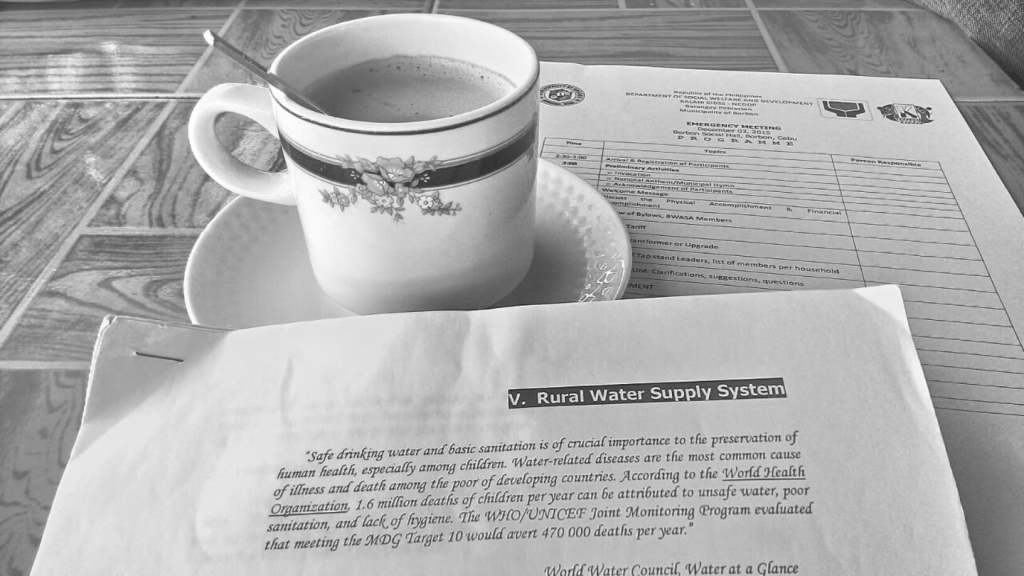
The queue had developed a personality of its own. It began at a government office window, turned awkwardly beside a row of plastic chairs and continued towards a doorway where an electric fan was doing its best to circulate what appeared to be the same exhausted pocket of warm air. People held brown envelopes, folded photocopies and forms that looked increasingly less trustworthy the longer they were examined.
One man studied his paperwork as though it contained instructions for operating a spacecraft. A woman rearranged her documents for what looked like the third time, while an elderly gentleman stared at the service window with such determination that I almost believed he might force the queue to move through concentration alone. I understood his optimism, but I also understood that bureaucracy was unlikely to be intimidated.
In the Philippines, queuing can become less an administrative activity than an opportunity to reconsider the meaning of time. You arrive believing the transaction should be simple, bring the required documents, follow the instructions and wait patiently. Then, just as the front of the line begins to look achievable, somebody informs you that you need another photocopy, another signature or a document whose existence nobody had considered important until that exact moment.
The photocopy shop across the road has naturally anticipated this possibility and is therefore the most financially prepared participant in the entire system. I have occasionally thought that the Filipino photocopier deserves a place in institutional history. It has witnessed more hope, confusion, resignation and last-minute sprinting across roads than many official offices ever will.
But the queue was not what stayed with me that afternoon. Somewhere nearby, somebody said a sentence I had heard many times before: “Basin naa kay kaila diha.” Perhaps you know somebody there. Five ordinary words, yet they contained an entire philosophy of how many Filipinos learn to navigate complicated systems.
When something becomes difficult, someone will often suggest finding a person who knows another person who might know somebody useful. Need help understanding an application? Ask a friend who works there. Looking for a job? Does anyone know somebody inside the company? Confused about a requirement? Perhaps your cousin’s former classmate has a neighbour whose sister once worked in that office.
Sometimes the connection is genuinely useful. Sometimes it leads nowhere, and occasionally everyone spends thirty minutes tracing relationships only to discover that the supposed contact retired three years ago and now raises chickens somewhere outside the city. Still, the instinct remains: find somebody who knows somebody.
I have become increasingly interested in this habit because my work as a Community Facilitator has made questions about access, participation and opportunity more difficult for me to ignore. It would be easy to dismiss our reliance on kaila as simple favouritism, but I think the reality deserves more care. Human relationships are valuable resources, and people naturally help one another understand systems that may be confusing or unfamiliar.
The important distinction is what kind of help the relationship provides. A friend who explains an application process is giving information, while a friend who makes sure your incomplete application is accepted when everyone else must follow the rules is giving privilege. Those two things may both be described casually as “helping,” but ethically they are very different.
One expands somebody’s ability to participate. The other changes the rules depending on who the person knows.
That distinction interests me because Filipinos often admire people who know how to get things done. We use the word madiskarte with approval for someone practical, resourceful and capable of finding solutions when circumstances become difficult. There is much to admire in that quality because resourcefulness helps people survive complicated situations and make the most of limited options.
But perhaps diskarte deserves another question when the clever solution is available only because another person has influence. Finding a cheaper way to complete a task is resourceful. Moving ahead of people who have followed the same rules because you know the right person is something else.
Sometimes the need for connections also exposes weaknesses in the system itself. If requirements are unclear, public information is difficult to obtain and procedures depend heavily on knowing whom to ask, then people will naturally turn to personal networks. That behaviour is not always evidence of dishonesty. Sometimes it is simply the most practical way to understand an unnecessarily confusing process.
A student may ask an older graduate how to apply to university. A job seeker may ask someone already working in the field what an interview is likely to involve. A family may consult a relative who recently completed the same government process. These relationships can reduce uncertainty and give people information they could reasonably have accessed anyway.
Perhaps that is the constructive side of connection. It shares knowledge without changing the standard.
Employment makes the ethical difference clearer. Imagine two people applying for the same position, both qualified and both hoping to be assessed fairly. One happens to know somebody within the organisation who explains the work, tells them about the vacancy or offers sensible advice about preparing for the interview.
There is nothing inherently wrong with that. People share useful information with friends, relatives and former classmates all the time. The problem begins when the relationship affects the decision itself rather than merely helping the person understand how to compete fairly.
If one candidate receives favourable consideration because of who they know, another equally qualified person may lose an opportunity for reasons unrelated to ability. At that point, the issue is no longer networking. It becomes justice.
This is also why favouritism damages more than the individual decision involved. Even when a successful candidate genuinely earned the position, a culture of preferential treatment can make other applicants suspicious that qualifications never mattered. People begin wondering whether the vacancy was truly open or whether the result had already been decided before anyone sent a résumé.
Fair systems need not only to be fair. They need to be credible enough that people can reasonably believe the process was fair.
A qualified applicant should not need an influential cousin. A person requesting an ordinary public service should not require friendship with the employee behind the counter. A family asking for information should not receive a worse explanation simply because nobody recognises their surname.
Fairness becomes meaningful when it extends beyond the people we already know.
That can be uncomfortable in Filipino communities because relationships are rarely simple. A person seeking help may be your neighbour, your former classmate, your relative’s friend or somebody you see at church. The relationship does not disappear when one person steps behind a desk and the other arrives carrying paperwork.
“Kaila bitaw ta,” someone might say. We know each other.
The sentence can be affectionate, but it can also contain pressure. Familiarity quietly becomes an argument for special consideration.
Perhaps integrity becomes most difficult precisely when helping someone we know would be emotionally easy. A public employee may want to assist a relative. A manager may feel more comfortable hiring someone familiar. A community leader may naturally trust the same people who have supported previous activities.
Those impulses are understandable. They become unfair when familiarity replaces relevant criteria.
The same tension appears with utang na loob. Gratitude and reciprocity are important parts of Filipino relationships, and there is something deeply human about wanting to remember kindness. Problems arise only when gratitude becomes an indefinite debt that is later collected through requests for preferential treatment.
Someone once helped us, so now we feel unable to refuse them. A relative supported an activity, so perhaps they expect a favour in return. What began as generosity gradually develops terms and conditions nobody discussed at the time.
We can appreciate kindness without surrendering our judgement. Loyalty does not require us to become unfair to everyone else.
Sometimes the smallest exceptions reveal the problem most clearly. One person skips the queue because they know somebody inside, and everyone else waits longer. One applicant receives an advantage through a connection, and another loses a genuine opportunity. One decision is quietly adjusted because the person requesting it is familiar.
Each exception can look insignificant to the person receiving the benefit. Repeated often enough, however, they create a system where knowing someone becomes more useful than following the rules.
That is especially unfair to people with fewer social connections. Inequality is usually discussed in terms of money, education, property and employment, but relationships themselves can provide access. Knowing people can mean hearing about an opportunity earlier, receiving advice, understanding an unfamiliar institution or discovering whom to approach when something goes wrong.
Sociologists often describe resources embedded in relationships and networks as social capital. The concept is useful because it reminds us that connections can provide practical advantages that never appear on a payslip or certificate.
Imagine two young people preparing to enter employment. One comes from a family where relatives work across several professions, so they can ask about interviews, workplace expectations, qualifications and career progression. Someone may read their application or explain mistakes to avoid.
The second person may be equally capable but know nobody who can provide that guidance. They must discover the same information alone.
Both may eventually succeed. But one begins with access to accumulated experience that the other does not possess.
That is why mentorship can be such a positive form of connection. A mentor can explain, encourage, challenge and introduce possibilities without guaranteeing anybody an unfair outcome. Instead of closing opportunity around a familiar group, good mentorship widens access to knowledge.
Perhaps the goal should never be to remove relationships from professional or community life. That would be impossible and undesirable because people learn through one another. Trust, collaboration and support depend on human connection.
The better question is whether relationships are being used to share opportunities or reserve them.
This becomes especially important in community work. Communities are not collections of perfectly equal individuals standing independently beside one another. They contain histories, family relationships, friendships, conflicts, respected personalities and informal hierarchies that existed long before any meeting began.
One resident may speak confidently because they have attended many discussions before. Another may know the organisers personally. Somebody else may sit quietly because formal meetings feel unfamiliar, because they do not want to contradict an influential neighbour or simply because no one has ever made them believe their opinion will matter.
Technically, all three may have been invited.
That does not automatically mean all three possess the same ability to influence what happens.
My work as a Community Facilitator has made me increasingly interested in questions that look simple until real people enter the room. Who received the information? Who feels comfortable attending? Who understands the process? Whose opinions are heard? Which voices become interpreted as representative simply because they are the voices everyone already recognises?
A meeting can be open to everyone and still reproduce the same small circle of influence.
The person who speaks most confidently may have valuable knowledge, but confidence is not the same as representing everyone. A quieter resident may know something important about a road, water source or household difficulty that more visible community figures have overlooked.
Someone with less formal education may understand local conditions in extraordinary detail. A younger resident may notice a problem older leaders do not experience. If participation depends mainly on already knowing the right people, then the same voices gain more experience, and that experience becomes the reason they are invited again.
The pattern eventually begins justifying itself.
“These are the people we always ask.” “They know how things work.” Perhaps they do, but if nobody else is ever given a chance to participate, familiarity slowly turns into exclusivity without anyone consciously deciding to exclude anybody.
That may be one of the quieter ways privilege reproduces itself. People who already possess access accumulate more access.
The same pattern exists outside formal institutions. Social groups develop inner circles, some people are consulted before decisions while others hear about them afterwards, and certain names appear repeatedly whenever opportunities arise. Often there is no deliberate cruelty involved because people naturally gravitate towards those they trust.
But something can be unintentional and still produce exclusion.
Fairness sometimes requires deliberately looking beyond the familiar.
There is also an emotional cost to living in a culture where people begin believing connections are essential. A young person may become discouraged from applying because they assume qualifications alone will never be enough. Someone rejected for a position may immediately suspect that another applicant had a stronger connection.
Others may begin treating relationships strategically. Who should I know? Who might be useful later? Which friendship could open a door?
I find that a bleak way to understand human relationships.
Friendship deserves more than being treated as an investment portfolio.
Of course friends help one another. A former classmate may share a vacancy, a relative may explain a process and someone we know may recommend us honestly because they understand our abilities. Those things can be generous and appropriate.
The problem is not receiving help. It is beginning to value people mainly according to what access they can provide.
There is something uncomfortable about collecting influential acquaintances as though they are tools waiting for future use. A conversation becomes networking, friendship becomes access and a person’s position becomes more interesting than the person themselves.
Those in positions of influence may experience the opposite problem. They can begin wondering whether someone values them personally or simply values what they can make possible.
Perhaps transparent systems protect relationships too. When procedures are clear, decisions can rely less on private favours and people are less pressured to turn friendships into shortcuts.
If an opportunity exists, information should be shared as widely as reasonably possible. If an application has requirements, they should be stated clearly. If someone asks for help understanding a process, guidance can be offered without promising an outcome that should depend on fair assessment.
Institutions also have a responsibility here. The more confusing a process becomes, the more valuable insider knowledge becomes. Clear public information, consistent requirements and transparent selection criteria reduce the advantage of already knowing someone inside.
People should be able to understand how to apply for something without requiring a private introduction.
That principle extends to everyday courtesy. Imagine two people approaching an office. One knows an employee personally, so they immediately know whom to speak to and receive a friendly explanation. The other person knows nobody, is unfamiliar with the process and feels hesitant about asking questions.
Nobody may have intended to create unfairness.
The experience is still unequal.
Professionalism means ensuring that strangers receive the same seriousness as familiar people. We should not need to recognise someone’s face before deciding their question deserves an answer.
Perhaps that is why the humble queue remains such a useful model of fairness. A queue is an agreement between strangers: people arrive, wait and receive service according to an established order, with reasonable exceptions where priority is genuinely justified.
It is not a perfect model for every form of justice, but it contains an important idea. The person at the back matters even if nobody behind the counter knows them, and the person at the front should not lose their turn merely because somebody more influential has appeared.
Queue-jumping irritates people for more than the additional minutes it creates. It communicates that one person’s relationship is worth more than another person’s time.
Perhaps fairness often feels similarly ordinary. Clear rules, consistent explanations and decisions that can be justified without referring to surnames, friendships or family trees do not produce dramatic stories.
That may be exactly the point.
Eventually, the government-office queue moves. The fan continues rotating with admirable commitment and almost no measurable achievement, the elderly gentleman finally reaches the window, somebody behind me searches for a pen and everyone begins sensing that paperwork may eventually surrender.
Then I hear it again. “Wala kay kaila diha?” Don’t you know somebody there?
I smile because the instinct is perfectly understandable. Perhaps the person simply wants help understanding the process. Perhaps they are tired of waiting. Perhaps experience has taught them that a familiar person can make difficult systems easier to navigate.
Sometimes that is true.
But I find myself wishing for something better than everybody eventually discovering a useful acquaintance.
I would rather have systems in which people do not need one.
A legitimate application should not require an influential relative. A clear explanation should not depend on friendship with an employee. An opportunity should not become more available because someone recognises the names stored in your telephone.
The line moves and I step forward with my documents, hoping I have successfully survived every known photocopy requirement. There is always the possibility that an undiscovered document is waiting somewhere in my immediate future, but ideally that problem should be solvable without consulting my entire family tree.
Eventually, I reach the window. The employee checks the papers, and for a moment I prepare myself for another complication. Instead, the process simply continues.
No private introduction is required. Nobody asks whose cousin I am. No friend of a friend appears from behind a door.
Just a procedure being applied.
It feels almost disappointingly uneventful.
Perhaps fairness is supposed to feel that way.
Outside, the afternoon heat remains committed to its own agenda, and the photocopy shop waits faithfully for the next person who discovers that one more duplicate is required. As I walk past, I think about how beautiful connections can be when they mean having people who advise us, encourage us and help us understand unfamiliar things.
Knowing somebody should make life richer.
It should not be the entrance fee to opportunity.
Because everybody knows somebody sounds comforting only until we ask about the person who knows nobody. The newcomer, the young applicant without influential relatives, the family unfamiliar with the institution and the stranger whose surname means absolutely nothing to the person behind the desk still deserve the same basic chance.
Perhaps the character of a community is revealed not only in how generously it helps its own people, but in how fairly it treats the person who arrives without any connection at all. A fair society is not one where everybody eventually becomes clever enough to locate an influential acquaintance. It is one where the person who knows nobody can approach the same window, present the same documents and reasonably expect that their time, dignity and opportunity will still matter.
Especially without a kaila.
Still making room beyond the familiar circle,
Anj
































Leave a Reply