If there is one thing nobody adequately warned me about before my first trip to Hong Kong, it was how much of the city I would eventually meet through the soles of my shoes. By our second morning, they had already become unofficial witnesses to the trip. They had crossed pavements, climbed stairs, waited at crossings, shuffled through crowds and carried me through streets that still felt new enough to deserve photographs every few metres. I had packed them thinking mainly about comfort. I had not realised they were about to become part of the narrative. Some stories begin with a castle, a forest or a glass slipper. Ours began with very ordinary shoes and a ferry ticket.
There was no fairy godmother waiting outside the hotel, no pumpkin carriage idling beside the pavement and certainly no enchanted horse offering to transport us between attractions. Hong Kong appeared to have a much more practical philosophy: if you wanted the story, you were going to have to walk for it. A lot. We had Victoria Peak and Ocean Park on the itinerary that day, which sounded wonderfully efficient when written down. Two destinations. One day. Perfectly manageable. What the itinerary failed to mention was the considerable amount of Hong Kong existing between those destinations, most of which apparently expected to be crossed on foot.
Still, I was a first-time visitor and therefore operating on the dangerous amount of energy produced by excitement. Tiredness had not yet been formally consulted. Every street looked interesting. Every building seemed worth staring at. Every sign felt photographable simply because it was somewhere I had never been before. I had not yet learned the experienced-traveller skill of seeing something beautiful and continuing to walk. If it looked even remotely interesting, I stopped. My poor shoes had no vote.
We were staying on the Kowloon side, and Victoria Peak was waiting across Victoria Harbour on Hong Kong Island. Since there was no pedestrian bridge and I had not developed the ability to walk on water, the Star Ferry became the most sensible option. I liked that immediately. There is something much more romantic about saying, “We crossed the harbour by ferry,” than saying, “We took public transport,” even when both statements are technically describing the same event.
📍 From the end of Nathan Road, we made our way to the ferry terminal.
🚢 Boarded at Tsim Sha Tsui Pier and crossed over to Central (Pier 8).

Perhaps ferries naturally lend themselves to stories because they give departure time to register. A train disappears into a tunnel and delivers you elsewhere before you have fully processed leaving. A taxi keeps you sealed inside traffic. A ferry lets you watch one shore loosen its grip while another slowly approaches. For a few minutes, you belong to neither side. You are simply in between.
Maybe every good tale needs a crossing.
Ours happened across Victoria Harbour.

We made our way towards Tsim Sha Tsui Pier from the Nathan Road area, joining the morning movement of Hong Kong. The city already seemed fully awake and considerably more organised than we were. People walked with the confidence of those who knew exactly where they were going. They crossed roads efficiently, disappeared into buildings and moved around us with purpose. We, meanwhile, had the unmistakable rhythm of tourists: walk, look, stop, take a photograph, realise everyone else has continued walking, catch up, then stop again because something else looked interesting.
It was essentially interval training disguised as sightseeing.
Then the buildings opened towards the harbour and Hong Kong suddenly had room to show off.
Victoria Harbour was one of those places that made the city look even larger because the water gave everything enough distance to be seen at once. Towers rose on both sides, ferries moved across the harbour, and the skyline seemed to arrange itself into the sort of view I had previously associated with postcards and travel programmes. From the pavement, skyscrapers had towered individually above us. From the harbour, they became part of something larger.
We boarded the Star Ferry at Tsim Sha Tsui and headed towards Central. The boat itself was simple, practical and ordinary in exactly the way fairy-tale transport is not. No gold trim. No velvet carriage. No white horses with inexplicably perfect hair. Just a ferry that had carried countless people across the harbour before us and would continue doing so long after we went home.
I liked it more because of that.
As the ferry pulled away, Kowloon began shrinking behind us while Hong Kong Island grew clearer ahead. For those few minutes, I had the rare luxury of not needing to do anything except look. We could not hurry the boat. We could not skip ahead. We could not suddenly decide to walk faster. The ferry dictated the pace, which was probably one of the few times on that trip that something besides our itinerary managed to slow us down.
From the middle of Victoria Harbour, Hong Kong changed scale. At street level, you meet a city in fragments: one junction, one row of shops, one building enormous enough to block whatever is standing behind it. On the water, those fragments finally started joining together. Glass, concrete, hills, roads and harbour became one composition.
I remember wondering how ordinary the crossing must have seemed to people who used it every day. Somebody nearby might have been commuting to work, thinking about lunch, answering a message or mentally reviewing whatever awaited them on the other side. Meanwhile, we were looking around as though Hong Kong had personally organised the skyline for our arrival. Travel has a funny way of doing that. It turns somebody else’s commute into one of your favourite memories. A local crosses the harbour and thinks about work. A tourist crosses it once and writes about it years later.
The Hongkong Observation Wheel in Central

When we reached Central, the Hong Kong Observation Wheel immediately interrupted the itinerary. It stood near the harbour looking far too photogenic to be ignored, and I have always been weak in the presence of large structures that appear to have been designed specifically for photographs.
There are travellers capable of seeing a landmark, appreciating it internally and continuing towards their original destination. I admire them. I am not one of them.
We stopped for photographs, naturally. One picture became several. Someone blinked. Another angle looked better. The lighting changed slightly and apparently justified another attempt. “One more” became increasingly fictional. My shoes waited. They would do a great deal of that during this trip.
🚋 Riding the Iconic Peak Tram
Eventually we remembered that Victoria Peak was still the actual plan, so we continued towards the Peak Tram. I had been especially excited about the tram because there was something slightly old-fashioned and storybook about the idea of being carried steeply uphill towards one of the most famous city views in the world. If modern fairy tales had abandoned magic for engineering, I imagine they might have invented something similar.
Unfortunately, I managed to delete my photograph of the Peak Tram.
This was tragic at the time. I stared at the device with the sort of disbelief usually reserved for major betrayals. Surely it was still somewhere. Perhaps I had pressed the wrong thing. Maybe sufficient panic would reverse the deletion. I checked again as though the photograph might feel guilty and return voluntarily.
It did not.
Somewhere in the digital afterlife, my Peak Tram photograph now lives among millions of other images accidentally deleted by tourists who were very sure they knew which button they were pressing.
The photograph disappeared, but the ride remained.
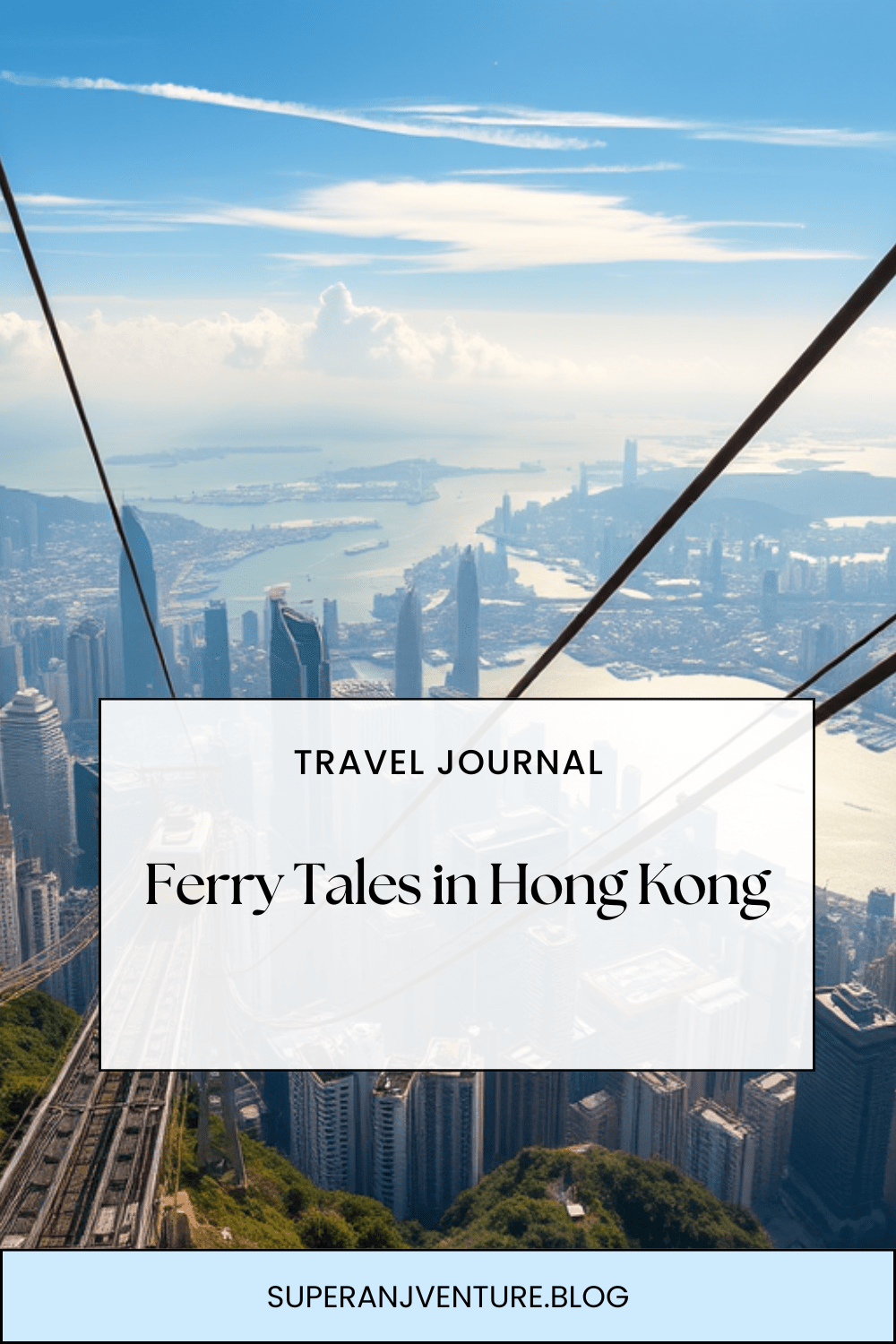
The tram climbed steeply towards Victoria Peak, and the city began tilting strangely through the windows. Buildings appeared to lean at impossible angles while we continued upwards, creating the peculiar sensation that gravity had changed its mind halfway through the journey. Every glimpse outside revealed another layer of Hong Kong.
Then another.
And another.
The city seemed incapable of finishing.

That was when I began to understand just how vertically Hong Kong lived. At ground level, a skyscraper feels like a single enormous object. From above, hundreds of them gather together until the city looks almost engineered around the idea that horizontal space should never be wasted. Buildings stood beside buildings, in front of buildings, behind buildings. Somewhere there must have been a modest little structure minding its own business, but from the tram it looked as though the entire city had collectively decided that anything below a certain number of floors lacked ambition.
Then we reached Victoria Peak.

🏙️ Victoria Peak: Where the Sky Kisses the City
If the ferry had been the beginning of our little tale, the Peak felt like arriving at the place where the castle would normally appear. Except the kingdom was below us.
Hong Kong unfolded beneath the Peak in layers: the harbour, the dense towers, the roads weaving between them, Kowloon beyond the water, hills rising behind the city. For most of the morning I had been looking upward, craning my neck at buildings. Suddenly the whole city was beneath us, and for a little while even I forgot to take a photograph.
That is saying something. Some views deserve a few seconds before the camera interferes. The scale was what struck me most. I had already known Hong Kong was enormous, but information behaves differently when you can see it. From the Peak, all those separate streets we had been walking through became part of one vast city squeezed between mountains and harbour. It looked almost unreal. Then, naturally, I remembered I owned a camera. There are limits to reflection.
We took photographs from one angle, then another. One with me. One without me. One where I was looking at the camera. One where I was apparently meant to stare into the distance as though contemplating the meaning of civilisation rather than thinking, “Is my hair all right?”

📍 Did you know? Victoria Peak is the highest point on Hong Kong Island, and the most popular tourist attraction for first-time visitors. It’s a must.

Fairy tales never include enough retakes. Cinderella arrives at the palace looking immaculate on the first attempt, nobody blinks at the wrong moment, and apparently not one royal photographer ever has to say, “One more, your eyes were closed.” Real travel is less cooperative. At Victoria Peak, one photograph became another because somebody moved, the wind rearranged my hair, or the skyline somehow looked even better three steps to the left. I think fairy tales would improve considerably if they included these practical details. Imagine Cinderella finally reaching the ballroom only to stop halfway up the staircase because the first photograph made her dress look strange.

The air at the Peak felt different too. Far below us, Hong Kong was moving at extraordinary speed, yet from that height everything appeared almost still. Traffic became thin lines weaving between buildings, towers became shapes, and millions of individual lives disappeared into windows too small to distinguish. Somewhere down there, somebody was late for work, somebody was having lunch, somebody had just received wonderful news, somebody was arguing with someone they loved, somebody was buying groceries, and somebody was probably doing absolutely nothing worth remembering. From where we stood, all those private lives had become part of one magnificent skyline. Perhaps that is one of the strange privileges of viewpoints: they allow us to admire cities precisely because we are too far away to see all the complicated human lives happening inside them.
Then, because apparently breathtaking views are even better when accompanied by sugar, we found dessert. I wish I could tell you what it was called, but my memory has preserved everything except the information that would actually allow me to buy it again. I remember that it looked something like soft-serve yoghurt, that it tasted wonderful, and that after all the walking and climbing I considered it one of civilisation’s finer achievements. This is often how my memory behaves around food: it keeps the pleasure and deletes the practical details. Very efficient. If I ever encounter that dessert again, I am fairly certain my taste buds will recognise it several seconds before my brain does.

Somewhere around this part of the day, I also decided that #AtThePeakOfGladness was an entirely appropriate hashtag. Years later, I still cannot bring myself to dislike it because there was something wonderfully sincere about how pleased I was. I had travelled from the Philippines to Hong Kong, crossed Victoria Harbour on the Star Ferry, ridden the Peak Tram, stood above one of the most recognisable skylines in the world and ended up eating a mysterious frozen dessert whose name I would eventually lose to history. If that did not qualify as peak gladness, then the phrase had no useful purpose.
What surprises me now is how little memory respects the hierarchy of an itinerary. Victoria Peak was supposed to be the highlight. It was the famous attraction, the postcard view and the destination around which we had planned the morning. Yet when I think back to that day, the smaller pieces return just as clearly. I remember the walking, the harbour appearing at the end of the streets, the ferry pulling away from Tsim Sha Tsui, the brief feeling of being suspended between two shores, the Observation Wheel distracting us from the schedule, the Peak Tram photograph I accidentally deleted, the strange angle of the buildings during the climb and, of course, the nameless dessert. The Peak was magnificent, but everything that led us there refused to remain background scenery.
Perhaps that is why Ferry Tales makes more sense to me now than it did when the trip actually happened. At the time, the Star Ferry was simply transport. We needed to get from Kowloon to Central, and the ferry carried us there. That was the practical explanation. Memory, however, has since promoted it. The crossing became the first page of the morning: Kowloon behind us, Central ahead and Victoria Peak waiting somewhere higher still. For several minutes none of those destinations mattered because we were simply moving across the harbour slowly enough to notice the space between them.
Fairy tales often require their characters to cross something before the story can change—a forest, a bridge, a river, a doorway. The world on one side is rarely quite the same as the world on the other. Our ferry crossing was considerably less dramatic and involved no spells whatsoever, but perhaps it did something similar. We boarded while still looking upwards at Hong Kong, surrounded by skyscrapers that made us feel small. A few hours later we would stand on Victoria Peak looking down at the same city. The ferry quietly connected those two perspectives without us realising it.
My shoes connected almost everything else. They had carried me from the hotel through the streets of Kowloon and towards Tsim Sha Tsui Pier. They stood on the ferry while Hong Kong shifted around us, crossed Central, waited patiently while I photographed the Observation Wheel, carried me towards the Peak Tram and eventually reached Victoria Peak, where for once they were allowed to stop while I stared down at the distance we had covered. By then, they had every reasonable right to assume the day was finished. Unfortunately for them, Ocean Park was still waiting. I remain grateful that shoes cannot read itineraries because mine might have resigned before lunch.
Years later, though, I remember the aching feet far less clearly than I remember everything they carried me through. Travel has a clever way of editing discomfort after enough time passes. Sore legs fade into the background, long walks become adventures, an accidentally deleted photograph becomes funny, and a dessert whose name you forgot becomes almost legendary precisely because you can no longer identify it. Even the things that annoyed you in the moment eventually acquire the softened edges of nostalgia.
Perhaps that is where fairy tales and ferry tales finally separate. Fairy tales become magical because something impossible happens: a pumpkin becomes a carriage, a frog becomes a prince, or a spell rearranges the ordinary rules of the world. Ferry tales require no such assistance. The boat remains a boat, the harbour remains water, and the shoes remain ordinary shoes that begin to hurt after far too much walking. Nothing needs to transform while you are there because time will perform that trick later. Years pass, and an ordinary ferry ride becomes one of the parts you remember most. A short crossing becomes a chapter, and a pair of comfortable shoes becomes an accidental witness to a city you were seeing for the first time.
Maybe that is the kind of travel story I appreciate more now. Not only the grand destinations we deliberately put on an itinerary, but the small things that accidentally become permanent. In 2015, I thought the story of that morning was about reaching Victoria Peak. Looking back, I think it had already begun much earlier, somewhere between the pavement beneath my shoes and the moment the Star Ferry pulled away from Kowloon. The Peak gave me the magnificent ending I expected, but the ferry gave me a beginning I did not recognise as important at the time, and my poor shoes carried the entire plot.
By the time we headed towards Ocean Park, the soles that had begun the morning with such optimism had already travelled through Kowloon, crossed Victoria Harbour, wandered around Central and climbed towards one of Hong Kong’s most extraordinary views. They still had several hours of adventure ahead of them, although I suspect they would have preferred the traditional fairy-tale arrangement in which somebody simply says “happily ever after,” closes the book and allows everyone to go home. Unfortunately for my shoes, ours was never really a fairy tale. It was a ferry tale, and the walking was nowhere near finished.
🌊 Next Stop: Ocean Park Adventure!
Stay tuned for Day 2 Part 2, where we dive into the thrills and excitement of Ocean Park. 🎢🐧🐠
Until next post,
Anj














Leave a Reply