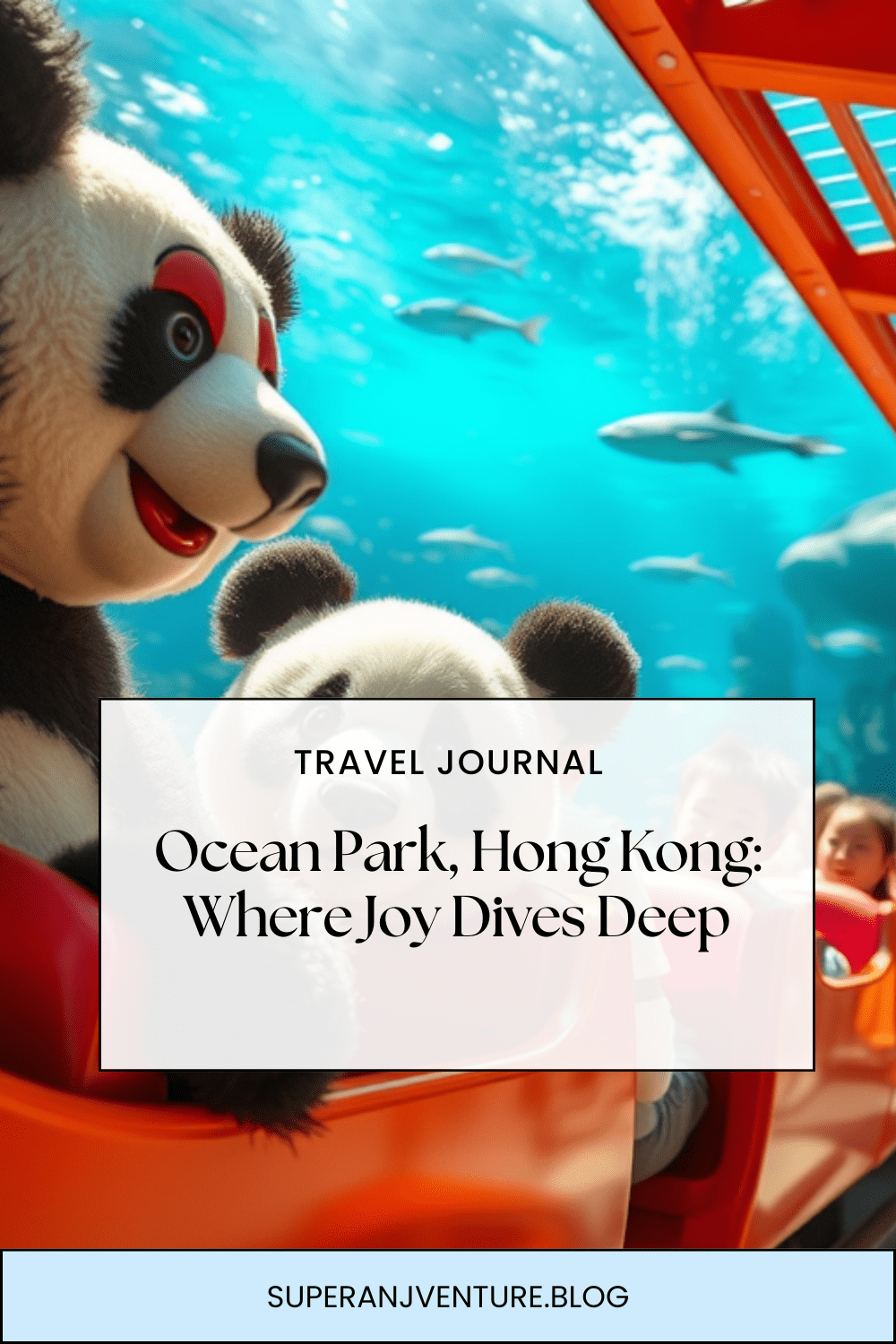
When I was little, I occasionally entertained the idea that living under the sea would be an excellent life choice. I had not considered oxygen, pressure, employment prospects or the general inconvenience of not possessing gills. Childhood dreams are wonderfully free from administrative detail. The important part was that somewhere beneath the surface existed another world—colourful fish, strange creatures, penguins I had only seen on television, and the possibility that life might be significantly more interesting if everyone simply accepted that I belonged underwater. Years later, on our second day in Hong Kong, I walked into Ocean Park and realised that perhaps the closest I was ever going to get to that childhood plan was buying a ticket.
We had already spent the morning crossing Victoria Harbour, riding the Peak Tram and standing above Hong Kong at Victoria Peak, so by the time we reached Ocean Park my feet had every reason to request legal representation. Apparently, however, excitement is capable of temporarily overruling the lower limbs. Ocean Park was enormous, busy and full of the sort of possibilities that make you forget exhaustion until the moment you finally sit down. It was part aquarium, part amusement park, part animal encounter and part elaborate test of whether I possessed the courage I had always assumed I did.

The first thing that impressed me was how difficult it was to decide where to look. There was always something happening ahead, above or somewhere just beyond the path. Maps became less of a guide and more of a suggestion because every route seemed capable of producing another attraction. We would start walking towards one place, become distracted by something else and eventually arrive somewhere we had not originally intended to visit. This is often how I travel. The itinerary exists mainly so that reality has something to ignore.
🐼 Giant Panda Adventure


One of our early stops was the Giant Panda Adventure, and pandas immediately confirmed something I had long suspected: some creatures have discovered how to build an entire public reputation around eating and sleeping. I watched one calmly munching bamboo with the confidence of someone who knew thousands of people had paid to observe this activity and saw no reason whatsoever to increase the entertainment value. There was no performance. No urgency. No existential concern about productivity. Just bamboo, rest and the occasional movement when absolutely necessary.
I respected this deeply.
Naturally, I took far too many photographs. The panda changed position slightly and apparently this justified another picture. Then it looked in another direction. Another picture. At some point my camera roll must have contained enough panda photographs to document an entire afternoon from the animal’s perspective. I suppose this is what travel does to otherwise rational people. You see an animal chew one leaf and suddenly feel responsible for preserving the moment for future generations.

From pandas, the day moved towards creatures with considerably more dramatic career ambitions. At the Amazing Bird Theatre, birds of prey swept through the air with the sort of precision that makes human beings look unnecessarily clumsy. There were eagles, falcons, vultures, caracaras and other birds whose wings seemed to understand aerodynamics far better than I ever understood physics. Watching them fly so closely overhead was both beautiful and slightly humbling. Humans spend extraordinary amounts of money designing machines so we can do what a bird manages before breakfast.
The birds also carried themselves with an impressive amount of confidence. Perhaps this is inevitable when you possess talons. A panda can afford to appear relaxed because everyone already thinks it is adorable. A bird of prey looks as though it has read the room and decided nobody present is a serious threat.
.
Then came the part of Ocean Park where childhood wonder met adult decision-making.
The rides.
I had always liked the idea of being adventurous. The phrase adrenaline junkie sounds excellent when you are nowhere near machinery designed specifically to rearrange your internal organs. Standing underneath actual thrill rides changes the conversation.
Still, I began with the Mine Train.

It was my first proper mine-train roller coaster, and whatever confidence I had carried into the queue began renegotiating its contract once the ride started moving. Then came the drops, the turns, the screaming and that strange moment on a roller coaster when fear becomes funny because there is absolutely nothing left to do except continue.
I screamed.

I laughed.
I probably screamed while laughing.
There is no elegant way to ride a roller coaster. Whatever composure you possess on the ground is removed during the first significant descent. The Mine Train gave me just enough courage to feel accomplished without convincing me that I was suddenly prepared for everything else in the park. This distinction became important later.
Then I met penguins. Real penguins.
There are childhood experiences we imagine so many times that meeting the real version feels strangely unreal. Penguins had belonged to documentaries, cartoons, books and distant frozen places. Suddenly they were in front of me, waddling around with the peculiar dignity of creatures that appear to be permanently dressed for a formal dinner but have never learned how to walk elegantly towards it.
I loved them immediately.

Watching penguins in the Polar Adventure felt like unlocking a small part of childhood I had forgotten was still waiting. Their waddling was even funnier in person. They looked extremely serious about whatever they were doing, which made the walk more entertaining. Somewhere inside me, the little girl who once considered an underwater life entirely reasonable was delighted.

Ocean Park kept offering these strange firsts one after another. Then we rode the Ocean Park Tower and gradually rose above the park. I had already seen Hong Kong from Victoria Peak earlier that day, but this view felt different. Instead of the dense city stretching beneath us, there was the South China Sea, the park, mountains and water meeting at the edges. My stomach performed a small nervous movement as we climbed, but it was the pleasant kind of fear—the kind where your brain remains aware that you are safe while another part of your body asks why the ground has become so unnecessarily distant.

📸 View from the top? Breathtaking.

This is another trick of height. Everything terrifying becomes charming when you are far enough away from it. Roller coasters become little coloured tracks. People become dots. Somewhere below, somebody is screaming with genuine conviction, and from the tower the entire scene looks lovely.
Then there were the escalators.
Of all the spectacular things available at Ocean Park—pandas, penguins, roller coasters, panoramic sea views—it may say something about me that I was genuinely impressed by an escalator. But this was not an ordinary escalator. It just kept going.
Coming from the Philippines, I was accustomed to escalators that understood their modest responsibilities: take you from one floor to another and then stop. Ocean Park apparently looked at this concept and decided it lacked ambition. Their escalator system seemed determined to transport you into another postcode.
I remember riding it and wondering how much longer it intended to continue. Every time I thought we must surely be reaching the end, there was more escalator. It became less a method of transportation and more a philosophical experience. At least my feet were grateful. They had already endured enough walking to consider moving stairs an act of divine mercy.

Then came the cable car. If the escalator had been practical luxury, the cable car was pure scenery. We floated above the landscape with mountains on one side and ocean stretching out below, suspended in that strange space where your eyes are delighted while your stomach remains aware that you are sitting inside a relatively small box hanging from a cable.
I tried not to think about the engineering too deeply. Some experiences improve when you do not investigate how they work.

The views were magnificent. Ocean, hills and the park unfolded beneath us, and for several minutes everything looked so peaceful that I almost forgot Ocean Park also contained machines specifically engineered to frighten people for entertainment. Then I saw them again: The Flash, Thrill Mountain, The Whirly Bird, The Rapids, The Abyss, Raging River, Rev Booster and, with a name showing absolutely no interest in reassuring anyone, the Hair Raiser. I had arrived at Ocean Park believing there was an adrenaline junkie somewhere inside me. Apparently she had taken annual leave.
Looking at some of those rides was enough. The Flash, in particular, looked like something designed by a person who had stared at an ordinary playground swing and thought, This could use considerably more danger. I watched other people ride, listened to them scream and took photographs from the safety of the ground. I considered this an entirely reasonable division of labour. They could supply the courage; I would provide documentation. Somebody had to preserve photographic evidence of their bravery, and there was no compelling reason that person also needed to be rotating through the air at an alarming speed.
There is a particular peace in accepting that not every attraction requires personal participation. A younger version of me might have interpreted refusing a ride as cowardice, but adulthood had apparently introduced me to another useful concept: self-preservation. Courage is admirable, certainly, but so is recognising when you would rather remain upright with your organs in approximately the positions nature assigned them. I told myself there would always be next time, which is one of travel’s most convenient phrases. Next time allows you to postpone almost anything while preserving the dignity of someone who absolutely intends to become fearless at some unspecified point in the future. Perhaps one day I will ride the Hair Raiser. Perhaps I will even enjoy it. For legal clarity, none of this should be interpreted as a binding commitment.


By then, Ocean Park had already given me enough firsts for one day. I had ridden my first real Mine Train, seen penguins in person, discovered an escalator so long that it deserved its own postcode, gone up the Ocean Park Tower, floated above the landscape in the cable car, watched birds of prey soar overhead and spent an unreasonable amount of time photographing a panda whose principal achievements that afternoon involved eating bamboo and looking adorable. The panda may actually have understood life better than the rest of us.
It is funny what survives most clearly after a trip. You assume the grand attractions will dominate—the roller coaster, the famous viewpoint, the spectacular ride—but memory seems to keep its own filing system. I remember the penguins waddling with tremendous seriousness. I remember being absurdly impressed by an escalator. I remember looking up at terrifying rides and discovering that photography had suddenly become my preferred extreme sport. I remember the cable car drifting above the landscape and the strange combination of delight and nervousness that appears when the ground becomes scenery.
Perhaps that was why Ocean Park felt so joyful to me. It did not offer only one kind of excitement. There was the loud excitement of roller coasters and screaming, the childhood thrill of finally seeing an animal you had known only from television, the slower pleasure of looking across the ocean from above, and even the wonderfully ridiculous delight of discovering that an escalator could somehow become one of the things you remembered from an international holiday. Joy, I realised, is not particularly concerned with sophistication. It can be a panda chewing bamboo, a penguin walking badly, the relief of surviving a Mine Train, or the satisfaction of standing safely on solid ground while taking photographs of people who are either much braver than you or simply less attached to the current arrangement of their internal organs.
By the end of the day, my body knew perfectly well that we had been travelling. My feet had already spent the morning crossing Hong Kong before Ocean Park requested several more hours of loyal service, my camera contained enough photographs to suggest I was being paid per image, and my adrenaline had been activated selectively according to whether a ride looked likely to make me reconsider every decision that had brought me to Hong Kong. Yet underneath the tiredness, I remember feeling genuinely full of happiness.
“My heart was full” can sound sentimental when written casually, but every now and then a day earns the phrase.
I remember leaving with one particular thought: I wanted to come back someday with my family. Perhaps that was the clearest sign of how much I had loved the place. When somewhere makes you happy, one of the first things you often do is begin placing the people you love inside the memory before the memory has even finished forming. I could imagine Mama enjoying certain parts, somebody laughing at the penguins, someone forcing another person onto a ride they had repeatedly refused, arguments about where to eat, somebody becoming tired, and at least one family member taking far too many photographs. In other words, it would probably be chaotic, exhausting and completely perfect.
Years later, when I think about Ocean Park, I also think about the little girl who once imagined living beneath the sea. She had pictured something magical because children are wonderfully skilled at wanting impossible things without consulting physics, biology or basic survival requirements. She could never have known that years later she would travel to Hong Kong, see real penguins, watch marine life, float over mountains and water in a cable car, climb towers, ride a roller coaster she had voluntarily queued for and then decline several others with great personal conviction.
I think she would have been impressed by most of it, although I suspect she would also have questioned why adult me refused the scariest rides. I would have explained that growing older teaches you many unexpected things, and apparently one of mine was risk assessment. Childhood me wanted adventure without considering consequences; adult me wanted adventure with conveniently located exits, sensible safety restraints and the option to remain on the ground if a ride looked as though it had been designed during somebody’s particularly aggressive engineering phase.
I never did learn to live under the sea. No mermaid transformation occurred, no gills appeared and adulthood unfortunately delivered a career involving considerably more documentation than underwater kingdoms generally advertise. Yet for one afternoon in Hong Kong, I came close enough to the wonder I had imagined as a child. I saw creatures that had once existed only in books and on screens, looked across the ocean from high above it, screamed on one ride, avoided several others with dignity and discovered that even an escalator can become an adventure if it refuses to end.
Perhaps childhood dreams do not always return to us in the exact form we requested. Sometimes you do not get to live beneath the ocean; sometimes you simply get a day beside it, above it and close enough to remember why you once wanted to. And after one look at the Hair Raiser, I was perfectly content to remain a land-based mammal.
Our second day in Hong Kong had already carried us across Victoria Harbour, up Victoria Peak and through Ocean Park, yet somehow the trip still had another childhood dream waiting for me. Next came Disneyland, where the castles would be real enough to photograph, the fairy tales would have proper merchandise, and childhood would once again turn up without asking whether adult me was ready for it.
📍 Up Next: Day 3 Part 1 – Disneyland Adventure
Stay tuned for magic, Mickey, and childhood dreams coming true. ✨
—Anj ❤









Leave a Reply