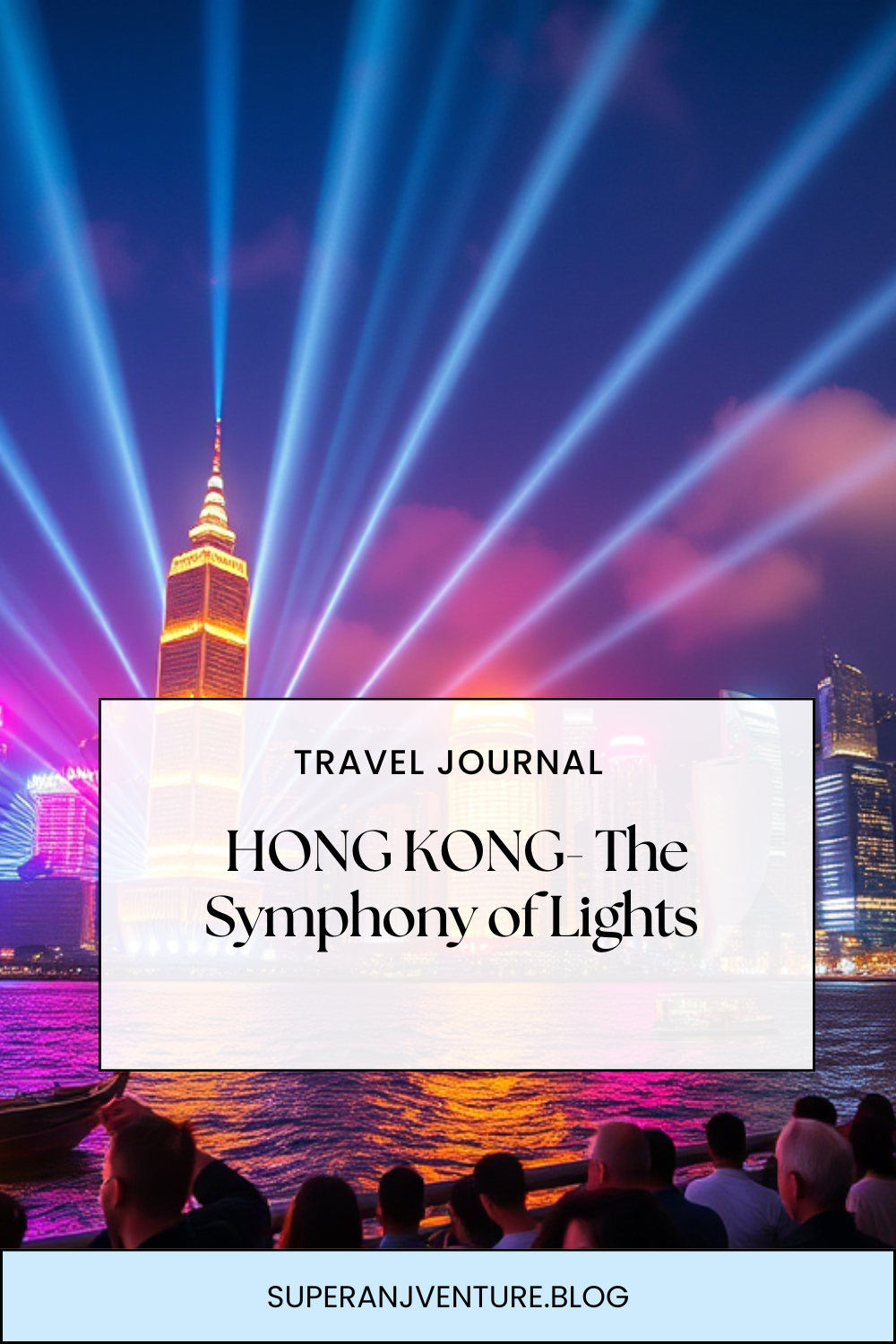
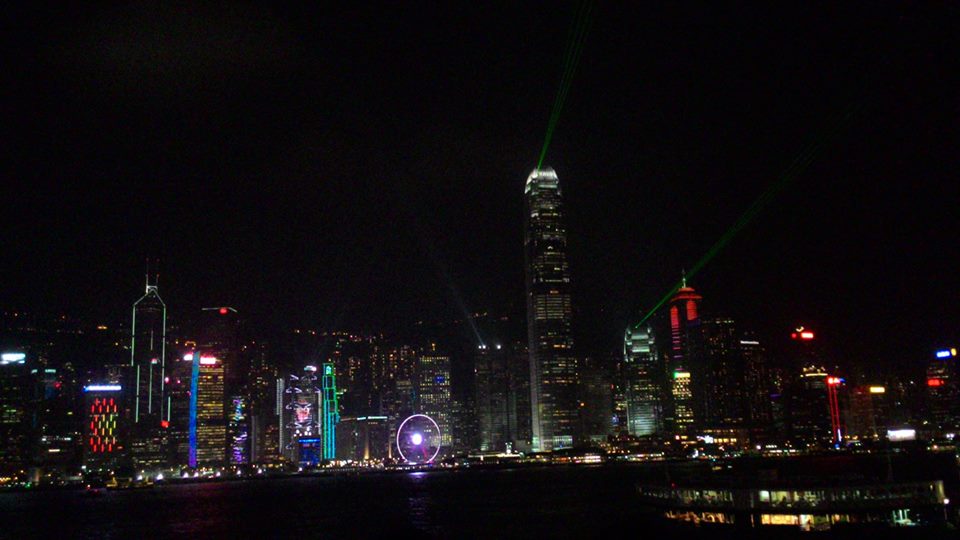
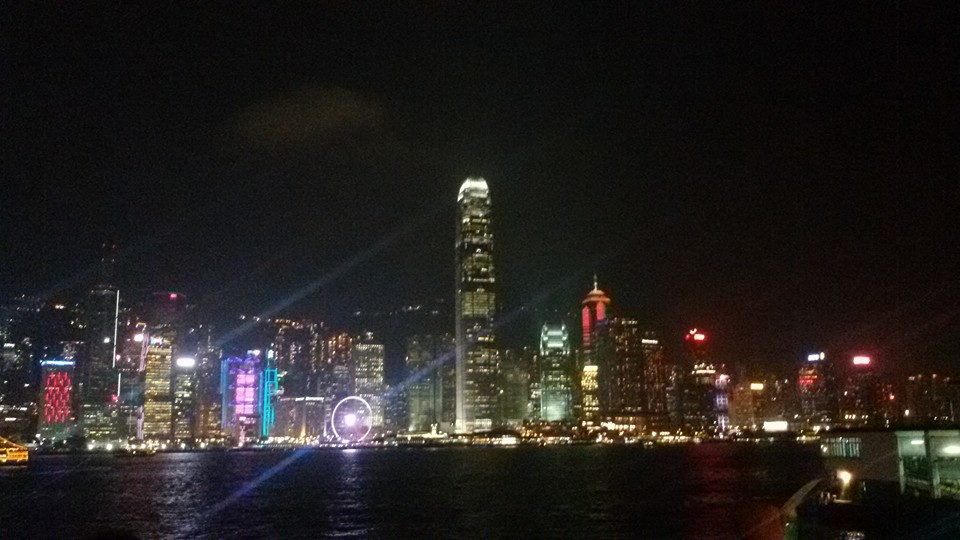
After spending the day wrapped in the fairytale world of Disneyland, we made our way back towards the city for one final experience before calling it a night: Hong Kong’s famous Symphony of Lights. By then, the colours, music and excitement of Disneyland had already filled the day with more than enough wonder, but Hong Kong clearly had no intention of letting us end the evening quietly. It was around 7:30 when we arrived near Victoria Harbour, just enough time to find a good place, settle ourselves and watch the skyline gradually transform as evening took over.
There was something completely different about Hong Kong at night. During the day, the city felt fast, dense and almost overwhelmingly vertical, with buildings competing for space and people constantly moving somewhere. At night, those same towers seemed to acquire another personality. Windows illuminated floor by floor, signs glowed against the darkness and the harbour reflected broken streaks of colour until the skyline looked less like a collection of buildings and more like an enormous stage waiting for something to begin.
The Symphony of Lights had already earned a reputation as one of Hong Kong’s signature evening attractions, and as first-time visitors, we were eager to see whether it really lived up to the hype. The idea itself already sounded impressive: buildings around Victoria Harbour joining together through lights, lasers, illuminated façades and music, creating a show not inside a theatre but across an entire cityscape. It had even been recognised by Guinness World Records as the world’s largest permanent light and sound show, which naturally made it feel even more exciting. The performance was scheduled to begin at eight, but perhaps half the experience was simply standing there beforehand, watching the city prepare itself.
People began finding their places along the harbour. Phones appeared in hands, cameras were raised and conversations softened whenever someone thought the show might be about to begin. Across the water, Hong Kong continued glowing normally, almost pretending it had no idea hundreds of people were waiting for it to perform. I remember looking at the buildings and wondering which ones would light up first, which made the anticipation feel strangely theatrical. Everyone knew something was about to happen, but nobody quite knew where to look when the first moment arrived.
Then eight o’clock came, and the skyline changed.
Buildings on both sides of Victoria Harbour became part of the performance as lights moved across their façades, beams reached into the night sky and colours shifted in time with the music. What had already been an impressive skyline suddenly seemed animated. Towers that had stood quietly during the day now blinked, glowed and appeared to communicate across the harbour through light. The architecture itself became part of the choreography, and for a few minutes the city looked almost unreal.
I remember trying to look everywhere at once, which was impossible. Every time I focused on one side of the harbour, something else seemed to happen somewhere else. Eventually, I stopped trying to follow each individual building and simply took in the scene as a whole. That was when the spectacle made more sense. Hong Kong does scale remarkably well. From Victoria Peak, we had seen the city spread beneath us like an impossible forest of skyscrapers, but from the harbour at night, those same buildings felt closer, more alive and almost theatrical, rising out of the darkness with their reflections trembling across the water.
What I loved most was the contrast with everything that had come before it that day. Disneyland had been deliberately magical, a place built around fantasy, stories and the pleasure of briefly believing in another world. Hours later, we were standing in front of something entirely real, yet Hong Kong somehow managed to look just as fantastical. There were no castles or animated characters now, only glass, steel, water, music and light, but the sense of wonder remained. It made me think that perhaps cities have their own versions of magic, and Hong Kong’s seemed to be built from energy.
The narration and music accompanying the lights gave the performance a sense of story as well, touching on themes of unity, innovation and the momentum of the city. Standing there as a visitor, I found myself thinking about how much of Hong Kong’s character we had already experienced in only a few days. The city felt unapologetically busy. Ferries crossed its harbour, trains carried crowds beneath its streets, trams climbed steep hills and skyscrapers seemed to occupy every available piece of vertical space. Yet somehow all those moving parts worked together to create a place with a very distinct identity.
Perhaps that was what I was responding to while watching the show. A city is much more than its landmarks. It is millions of private lives unfolding at the same time, held together by roads, buildings, routines and shared spaces. Looking across the water, it was impossible to know anything about the individual people inside those illuminated towers. Someone might have been finishing work. Someone might have been eating dinner with family. Someone might have been having an entirely ordinary evening while we stood outside marvelling at the building they probably saw every day.
Travel has a way of changing perspective like that. The things that seem extraordinary to a visitor are often simply somebody else’s background scenery. I wondered whether people who lived in Hong Kong still stopped to notice the skyline in the same way. Perhaps some did, while others had understandably grown accustomed to it. I know there are places in my own life that I barely notice because familiarity has softened their edges. We assume the view will still be there tomorrow, and usually it is, until one day distance makes us realise what we stopped looking at.
That may be one of the quiet privileges of travelling somewhere unfamiliar. You arrive before you have learned what to ignore. The ferry is exciting because you have never taken it before, the tram is memorable because you do not ride it every week, and the skyline becomes worthy of several photographs because you have not yet seen it enough times to look past it. Even the reflections on the water feel special because nothing has become ordinary to you yet.
Perhaps that is why I like keeping these travel memories. Photographs preserve what a place looked like, but writing helps preserve how unfamiliar it once felt. Years later, I may look at a picture of Victoria Harbour and recognise it immediately, but I want to remember that there was once a night when the whole view was new to me. I want to remember how it felt to stand there and think, I am actually here.
The breeze coming from the harbour is one of the details that has stayed with me. After a long day walking through Disneyland, my body was tired in that satisfying way travel often produces, when your feet have reached their limit but your mind still refuses to end the day. Standing near the water while the wind moved past us felt almost like the city giving us permission to pause. We had already done so much, and yet I was still trying to absorb everything around me.
I remember feeling full, although not in the food sense for once. It was that peculiar fullness that comes after a day containing more experiences than your brain has properly processed. We had begun the day inside Disneyland, surrounded by childhood imagination and deliberately constructed wonder, and now we were ending it beside Victoria Harbour, watching real skyscrapers take part in their own kind of performance. Sometimes a travel day simply fits together in a way you could never have planned better.
The show itself lasted only a short while, which felt surprising once it ended. There are experiences that occupy only a handful of minutes but take up far more space in memory. Perhaps that is because attention behaves differently when we know something is temporary. We watch more closely. We try to memorise what is happening even while filming it. We become aware of the ending before it arrives, which somehow makes the moment more vivid.
When the lights returned to their ordinary nighttime glow, the skyline was still beautiful, but the atmosphere had changed. People lowered their phones, conversations resumed and some began walking away almost immediately, already thinking about trains, dinner or whatever came next. Something spectacular had ended, and within minutes everyone had returned to ordinary life. I found that strangely beautiful too. Maybe part of what makes experiences precious is precisely that they finish.
If I could give one piece of advice to anyone watching the Symphony of Lights for the first time, it would simply be to arrive early enough to enjoy the atmosphere before it begins. Find a place where you can see the skyline properly and spend a few minutes watching the city settle into night. The anticipation is part of the experience too. Take photographs if you want them, but also lower the phone for a while and simply look, because some views deserve to exist somewhere other than the camera roll.
I have learned this slowly through travelling because I am completely guilty of wanting to photograph almost everything. There is always another angle, another selfie or another picture that might look better than the previous one. Yet some of my strongest travel memories have no perfect photograph attached to them. They survived because I was paying attention rather than documenting. That night in Hong Kong sits somewhere between both. I remember the lights, but I also remember the air, the tiredness in my legs, the sound of the harbour and that quiet feeling of being very far from ordinary life.
Places begin as names to us. Hong Kong was once simply somewhere on a map, then somewhere I had seen in films, photographs and other people’s holidays. Suddenly, I was standing there myself, looking across Victoria Harbour while the skyline illuminated the night. Travel turns geography into memory, and after that evening, Hong Kong would never again be only a place I recognised from pictures.
It became the Star Ferry, Victoria Peak, tired feet, Disneyland, the harbour at night and the Symphony of Lights. It became the sound of trains, the sight of buildings climbing impossibly high and the feeling of constantly looking upwards because the city seemed determined to use every available inch of sky. It gained temperature, movement, humour, little frustrations and private memories. The city had begun becoming part of our own story rather than something we only observed from a distance.
That is probably why I still enjoy looking back at old travel photographs so much. Memory has a tendency to remove the tiredness first. It softens the queues, the aching feet and all the practical inconveniences we probably complained about at the time. What remains are flashes of wonder: standing somewhere high above a city, laughing during an unexpected moment, discovering a favourite meal or watching lights travel across a skyline.
That evening was one of those flashes.
Hong Kong had already given us an entire day of fantasy, but somehow it found room for one final performance. The castle lights of Disneyland had been replaced by skyscrapers, the harbour had become the stage and the soundtrack belonged to the city now. By the time we eventually walked away, I was exhausted, but it was the satisfying exhaustion of knowing we had filled almost every available hour with something worth remembering.
There was still another adventure waiting for us the following day. Macau was next, which meant another place, another journey and another chapter of this trip that I could not yet imagine. But for that night, Hong Kong had already done enough. We had spent the day chasing childhood magic and ended it watching an entire skyline glow, and somewhere between those two experiences I was reminded why travelling excites me so much.
A single day can contain worlds that feel completely unrelated, yet by nightfall they belong to the same memory. Hong Kong taught me that magic does not always need a fairytale castle. Sometimes it is created by a harbour, a skyline, a little music and enough light to make an entire city look as though it has come alive.
Standing there beneath the night sky, tired feet temporarily forgotten and the wind moving across Victoria Harbour, I was simply grateful that we had stayed long enough to watch. It was one more reminder that some of the best travel memories are not always the ones we carefully plan in advance. Sometimes they are simply the moments when we stop, look around and realise how fortunate we are to be exactly where we are.
Macau was waiting for us tomorrow, but that was another Anjventure entirely.
With love, Anj ♥
















Leave a Reply