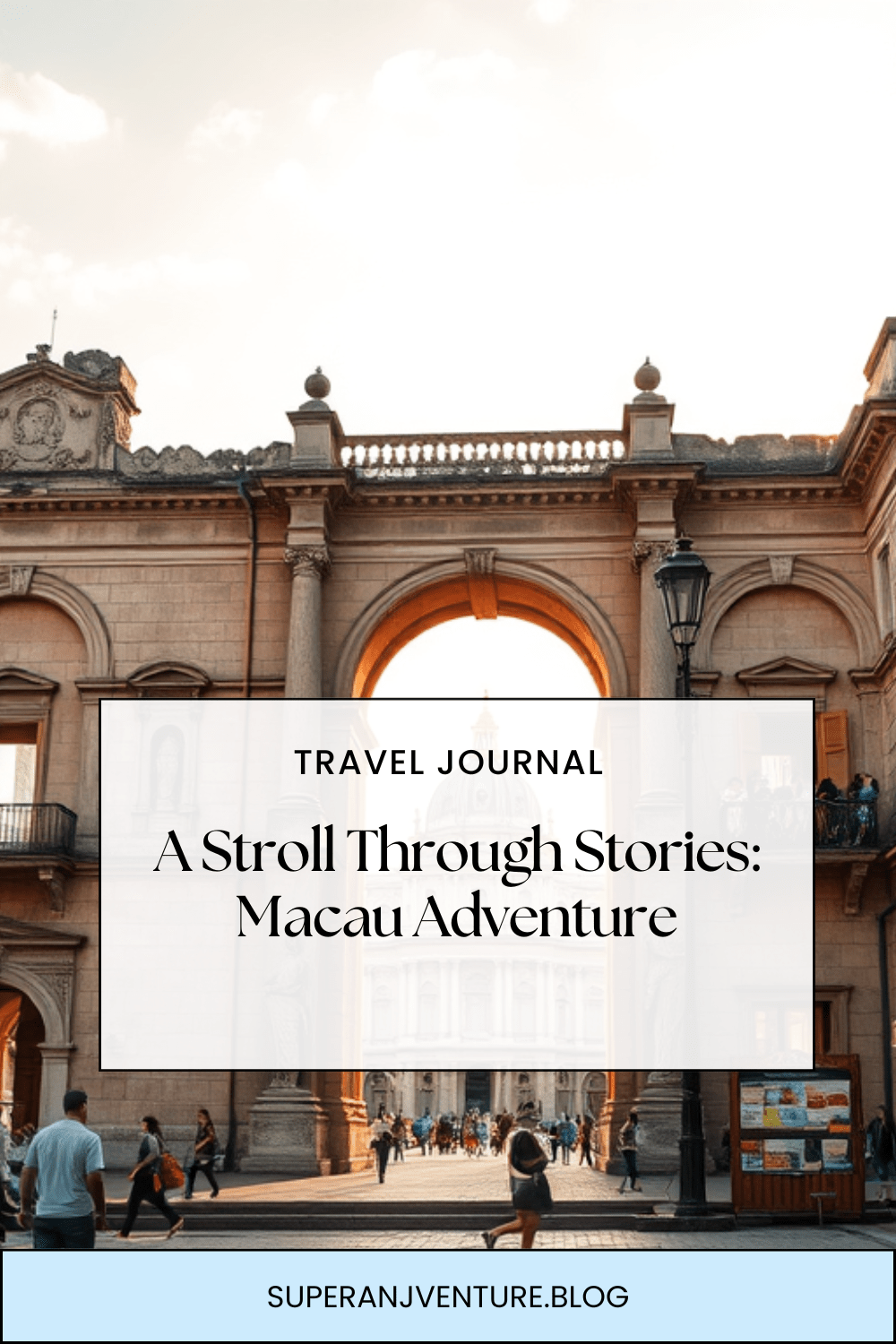
Macau entered my life years before I ever thought of putting it on an itinerary. I first saw it through a television screen while watching Boys Over Flowers, one of those dramas that had me far more emotionally invested than was probably sensible. By then, I already knew that being attached to Geum Jan-di and Gu Jun-pyo meant accepting a relationship in which nobody was apparently allowed to solve a problem with one straightforward conversation. There had to be misunderstandings, impossible families, dramatic departures, expensive coats, emotional staring and, eventually, an international flight. Then Jun-pyo went to Macau, and Jan-di followed him there looking for the boy who had suddenly placed an entire city between them. I watched her wandering through this strange, extravagant place searching for him, with Ji-hoo and the others becoming part of that painful Macau chapter, and somewhere between the heartbreak and the soundtrack, the city lodged itself quietly in my memory.
I did not know much about Macau then. I certainly was not studying the architecture while Jan-di was having an emotional crisis. My priorities were different. I wanted Jun-pyo to stop behaving like Jun-pyo for approximately five minutes and explain himself. Still, certain images remained: the lavish interiors, the canals, the European-looking streets and that peculiar feeling that Macau belonged partly to Asia and partly to somewhere else altogether. It was one of those places I knew first through fiction, where geography becomes attached to characters before it becomes attached to a map.
Years later, in 2015, I found myself boarding a ferry from Hong Kong and travelling towards the same city.
There is a peculiar feeling in arriving somewhere you have already visited through a story. The real place has no background music. Nobody has arranged the weather for emotional effect. Lee Min-ho is regrettably not waiting at the ferry terminal in an expensive suit. You are carrying your own bag, checking where to go next and discovering that television has conveniently omitted how much walking is involved. Yet as Macau appeared from the water, a small part of my younger self recognised the name before the traveller in me understood the place. Macau. The city where Jan-di had gone looking for Jun-pyo. Except this time nobody was searching for a chaebol heir. I was simply arriving with a camera, tired feet and considerably fewer romantic complications.
What made the day even stranger was discovering that some of the places on our own itinerary were not merely vaguely reminiscent of Boys Over Flowers. They were actual locations used during its Macau episodes. The Venetian Macao, which had seemed almost unreal when I watched it on television, would later appear in my own photographs. The Ruins of St. Paul’s, Fortaleza do Monte and parts of the Senado Square area also featured during the Macau storyline. Years earlier I had watched Jan-di, Ji-hoo, Jun-pyo and the others move through these places as fictional characters; now I was wandering through them myself, although my personal drama consisted mainly of crowds, aching feet and trying to take photographs before somebody walked into the frame. It was an improvement.

Senado Square was one of those places where recognition and discovery began overlapping. Its black-and-white wave-patterned pavement seemed almost determined to move beneath my feet, while pastel façades, Portuguese architectural details, Chinese signs, shops and crowds occupied the same view without appearing to argue about which culture belonged there most. The Senado Square area was also among the locations associated with the drama’s Macau sequences, which gave me the slightly absurd pleasure of looking around and thinking, Jan-di has been around here. Not the actual Jan-di, obviously. I had not completely lost contact with reality. But travel occasionally allows us these harmless little collisions between fiction and geography, and I was quite happy to enjoy mine.
The square itself felt much less like a television set and much more alive than anything a drama could capture. People crossed in every direction, tourists arranged themselves for photographs, locals went about their day and strangers repeatedly wandered into one another’s carefully composed backgrounds. This is one thing television rarely tells you about famous places: apparently everybody else has also decided to visit on the exact day you arrive. Senado Square may have been picturesque, historic and wonderfully European-looking in parts, but getting a clean photograph occasionally required the tactical patience of wildlife photography.
📸 Tip: Come early in the morning or later in the evening for fewer crowds and golden light for your photos.

Designated as part of the UNESCO World Heritage Site in 2005, Senado Square is the perfect blend of old-world charm and everyday local life. Tourists snap photos while locals casually stroll or shop for goodies. If you’re a fan of history, architecture, or just pretty places—this one’s a must.

📝 Fun fact: Locals affectionately call this site “Sam Ba Sing Tzik” (三巴聖跡), and it’s one of Macau’s top tourist attractions.
From there we made our way towards the Ruins of St. Paul’s, another place I had unknowingly stored in my memory through Boys Over Flowers before ever understanding its history. The ruins appeared in the drama’s Macau scenes too, but standing in front of them was different from recognising them on a screen. Television had made them scenery. Being there made me look properly.
The façade rose above the steps with the strange authority of something that had survived after almost everything it belonged to had disappeared. The church behind it was destroyed by fire in 1835, leaving the great stone front standing almost alone. Windows opened onto sky. Carvings remained where walls and rooms no longer did. It felt less like looking at an abandoned building and more like seeing the last page of a story whose earlier chapters had been taken away.
Naturally, all this historical contemplation occurred while surrounded by selfie sticks.
There were families, couples, tour groups and travellers attempting to photograph the ruins without accidentally documenting fifty strangers along with them. Somewhere in the crowd I remembered again that this had also been one of the Macau locations used in the series. Years earlier, the place belonged to Jan-di and Ji-hoo wandering through a fictional story. Now it belonged to several hundred tourists and me trying to find an angle where somebody’s head was not emerging from my shoulder. Somehow, I preferred this version. It was messy, noisy and real.
Near the ruins was Fortaleza do Monte, with the Macau Museum sitting within the historic fort complex. This area, too, appears among the locations used during the Macau episodes of Boys Over Flowers. By this stage of the day I was beginning to suspect I had accidentally designed a small K-drama pilgrimage without formally admitting it to myself. What had started years earlier as watching Jan-di travel to Macau looking for Jun-pyo had somehow become photographs of my own scattered across the same city.

Then came The Venetian Macao, and this was where my teenage television memory collided most spectacularly with reality.
If there was one Macau location I associated strongly with Boys Over Flowers, it was The Venetian. Much of the Macau storyline was filmed there, including scenes around its canals and grand interior spaces. I remembered Jan-di arriving in a world that looked almost absurdly luxurious, the whole place reinforcing just how far Jun-pyo’s world seemed from hers. Seeing those spaces myself years later produced that wonderful travel sensation of recognition: I had never physically been there before, yet my brain kept insisting that I knew it.
The Venetian did not disappoint in the extravagance department. Everything appeared to have been designed by somebody who considered understatement a personal insult. There were vast corridors, painted ceilings, ornate façades, shops, canals, gondolas and the famous artificial blue sky stretched overhead, permanently enjoying better weather than most actual countries. It was Macau pretending to be Venice while also being completely unapologetically Macau, and the whole thing was so elaborate that eventually questioning it became pointless. You simply surrendered.
I also got lost.
This felt appropriate.
The Venetian is the kind of building where you can walk confidently in one direction for ten minutes before gradually realising that confidence and accuracy are unrelated qualities. Every corridor appeared to reproduce when I was not looking. Another bridge appeared. Another row of shops. Another turn. I began to understand why dramatic television characters could spend so much time searching for one another there. I struggled to find an exit.

🎭 Whether you’re here to shop, splurge, or just soak in the extravagance—it’s a destination in itself.
And then there was the casino, where my own Macau storyline finally developed its major conflict. Security kept asking for my ID. The first time, I handed it over. Then somebody asked again. Eventually I began approaching certain areas already expecting the interrogation, producing identification with the weary efficiency of someone passing through immigration. Of all the things I imagined doing at a Boys Over Flowers filming location, repeatedly proving that I was legally old enough to stand there had not featured prominently.
Still, I could hardly complain. Jan-di came to Macau and had her heart broken by Jun-pyo. I came to Macau and was repeatedly told I looked underage. Of the two storylines, I know which one I would choose.
After all that extravagance, our final stop brought us back towards the older Macau at Fortaleza do Monte and the Macau Museum. By this point, my feet had begun filing formal complaints, but museums have always had an unfair advantage over tiredness. Put enough old photographs in front of me and apparently my legs are willing to renegotiate.

🏯 Macau Museum: Where the Past is Never Forgotten
The Macau Museum sits within the Fortaleza do Monte complex, high above parts of the historic city. The fort itself carries centuries of history, and walking into the museum felt like stepping behind the visible Macau we had been photographing all day and asking how all those layers had ended up together in the first place. The city outside had already shown us Portuguese façades beside Chinese life, Christian ruins beside casinos and historic streets beside luxury resorts. Inside the museum, those contrasts began acquiring explanations.


There were objects, displays and dioramas showing aspects of Macau’s everyday life and the long meeting of Chinese and Portuguese cultures. I found the dioramas particularly fascinating because miniature worlds have a strange ability to make history feel intimate. Instead of simply reading that people once lived differently, you see rooms, streets, clothing, tools and routines arranged in front of you. History stops behaving like a collection of dates and begins to resemble what it really was for most people: ordinary lives unfolding one day at a time.
But it was the old photographs that held me longest. There is something about old photographs that unsettles time. You look at streets that still exist but no longer look quite the same, buildings before renovations, and people standing in places where thousands of tourists now pose for photographs. The difference is that those people did not know they were standing inside what we would eventually call history. To them, it was simply home. I found myself wondering where they went after the photograph was taken, who was waiting for them when they returned home, what they worried about that morning, whether the person standing beside them remained in their life, whether they complained about work, and whether they too occasionally looked around Macau and thought their city was changing far too quickly.

Most people living through history probably do not realise that history is what they are doing. They cook dinner, go to work, buy what they need, raise children, fall in love, worry about money, become irritated with neighbours and laugh at things no historian will ever bother to record. Their lives probably feel no more historically important to them than ours do to us now. Then enough years pass, the clothes become recognisably old-fashioned, the buildings change, the streets acquire another generation of footsteps, and somebody places a photograph of their perfectly ordinary Tuesday behind museum glass.
That was where Macau shifted again for me. The city was no longer merely the extravagant place I first remembered from Boys Over Flowers, nor was it simply casinos, Portuguese architecture and famous ruins waiting to be photographed. It began to feel like a living archive. Its layers had accumulated rather than politely replacing one another. Chinese and Portuguese influences had met, mixed and remained visible in architecture, food, religion, language and daily life. The modern skyline had not erased the older streets, just as the ruins of a centuries-old church had not prevented somebody from building an enormous resort with an artificial Venetian sky only a short distance away. Macau seemed remarkably comfortable with the fact that identity does not have to be tidy.
Perhaps that is why the trip survives so vividly in my memory. I remember Macau less as a sequence of tourist attractions and more as a collection of contradictions that somehow belonged together: the black-and-white waves of Senado Square beneath my feet, the stone façade of St. Paul’s opening onto empty sky, those old photographs inside the museum, an artificial Venetian sky where clouds had apparently been placed under management, and security guards repeatedly asking me to confirm my date of birth. History, fantasy and mild personal inconvenience had somehow occupied the same day.
I had first discovered Macau as the setting of somebody else’s story. Jan-di travelled there looking for Jun-pyo, and a younger version of me watched from home without imagining that the city surrounding those characters would one day appear in my own photographs. Years later, I stood in Senado Square, wandered around the St. Paul’s area, explored Fortaleza do Monte, got hopelessly lost inside The Venetian and eventually found myself inside the Macau Museum looking at photographs belonging to people who had walked those streets long before Jan-di, Jun-pyo, K-dramas or my own travel plans existed. Television had given Macau a plot; travelling there gave it texture.
That, I think, is one of the great differences between seeing somewhere on a screen and eventually standing there yourself. Fiction chooses what belongs inside the frame. Travel is far less cooperative. It gives you the crowds, the wrong turns, tired feet, unpredictable weather, the stranger who walks directly into the photograph you have spent five minutes composing, and the security guard requesting your identification for what feels like the third time. None of these things would make the promotional brochure, yet years later they are often the details that remain.
When I look at those photographs now, Macau feels almost like a conversation between stories. One belonged to Jan-di and Jun-pyo, fictional, dramatic and once enormously important to a younger version of me. Another belonged to the unknown people in those museum photographs whose names and private worries I would never know. Then there was mine, considerably less dramatic but at least entirely real, written through ferry rides, crowded squares, museum corridors, aching feet, wrong turns and a face that apparently caused repeated suspicion about whether I was legally old enough to be anywhere near a casino.
Perhaps that is also why I no longer think of travel simply as collecting destinations. We arrive carrying stories we have already heard about a place, and then the place quietly corrects, enlarges and complicates them. Macau had been introduced to me through Boys Over Flowers, but by the time I left, it belonged to far more than that television memory. It had become Portuguese stone and Chinese heritage, old photographs and gilded ceilings, church ruins and casino lights, history preserved inside an old fort and ordinary people continuing their lives between all of it.

Macau is often described as a city of contrasts, although even “contrast” now feels slightly too tidy for what I remember. It seemed more like several stories being told at once. Centuries-old walls stood beside buildings designed to look eternally new. A ruined church attracted crowds carrying the latest phones. A museum preserved the details of ordinary lives while, only a short distance away, casinos and luxury hotels manufactured fantasy on an enormous scale. The past remained visible everywhere, yet nobody seemed particularly interested in allowing it to prevent the future from moving in next door.
I had begun the day walking through places I partly recognised from television, following the traces of a fictional story I had loved years earlier. I ended it inside a museum looking at photographs of real people who could never have imagined a Korean drama, a smartphone or some Filipina traveller decades later staring curiously into their world. Somehow, that felt like an appropriate way for Macau to end. I had first discovered the city through somebody else’s story, only to travel there years later and realise that it had been full of stories long before Jan-di ever went searching for Jun-pyo—and would continue collecting them long after I boarded the ferry home.
Our Macau adventure therefore ended with history, tired feet and a camera carrying far too many photographs, but there was still one chapter left before flying home. Day Five would be considerably less concerned with ruins, colonial heritage and fictional chaebol heirs because it had another subject entirely: food. Stay curious, Anjventuristas. Some destinations give you scenery, some give you history, and some somehow give you both while repeatedly requesting proof of your age. Macau managed all three, and years later, I still think that is a rather excellent story to have carried home.
Next stop: Day 5—A Culinary Adventure Before Flying Back!
Stay curious, Anjventuristas,
Anj ❤













Leave a Reply